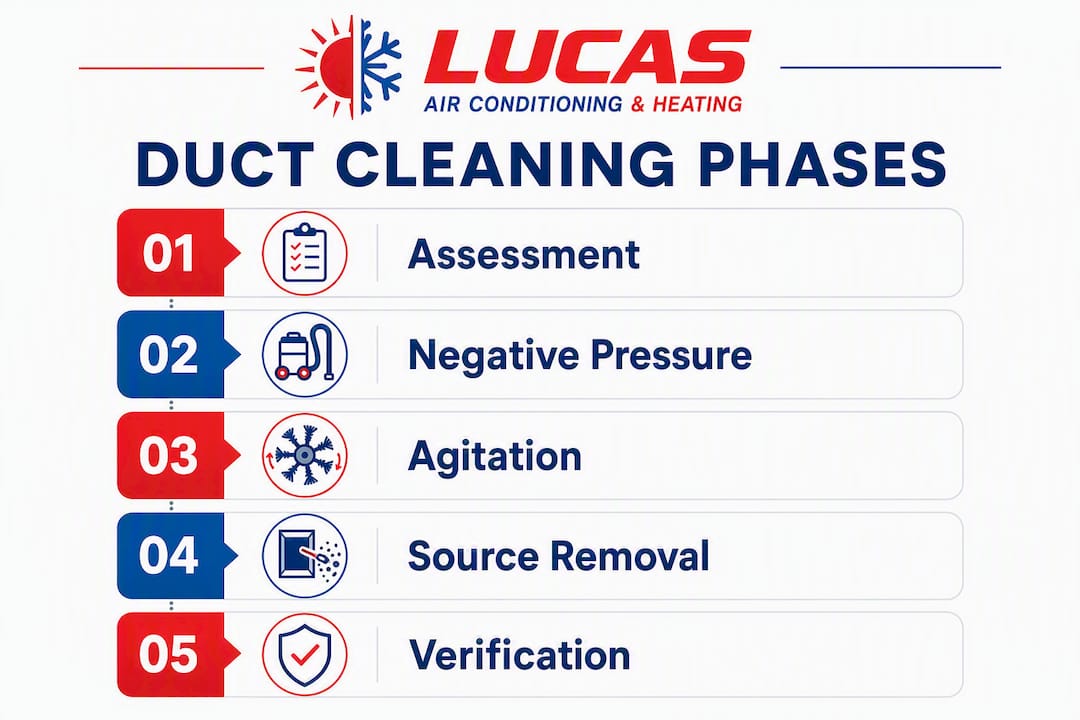
The recommended duct cleaning workflow for complexes follows five NADCA-aligned phases: systems assessment, negative pressure containment, zonal agitation and source removal, biological control when required, and documented verification. Every phase has a defined entry gate and exit deliverable. Before any crew mobilizes, you should have confirmed NADCA ACR compliance in the contract, established a continuous manometer log requirement, and locked in before/after camera footage and a signed certificate of completion as non-negotiable handover items. Neglected ductwork can reduce HVAC efficiency significantly, which means a properly scoped project pays for itself in energy recovery alone; understanding HVAC maintenance fundamentals can help optimize system performance. Lucas Air Conditioning & Heating applies this exact framework on complex jobs across Central Florida.
Table of Contents
- What does a duct cleaning project actually cover?
- What should a pre-job inspection deliver?
- How does the NADCA ACR five-phase workflow map to your checklist?
- What does the day-of operational sequence look like?
- What equipment specs should you require from contractors?
- How long does a complex duct cleaning project take?
- How do you protect occupants and prevent cross-contamination?
- What does a complete handover package look like?
- How often should you schedule duct cleaning in a complex?
- Key Takeaways
- What most specs miss about complex duct cleaning
- Lucasair handles complex duct cleaning from scope to certificate
- Useful sources
What does a duct cleaning project actually cover?
Scope confusion is the single most common reason a complex cleaning project underdelivers. A complete commercial duct cleaning process covers main supply and return trunks, all branch runs, air handling units (AHUs), evaporator coils, condensate drain pans, VAV box interiors, registers, grilles, diffusers, and every access panel opened during the job. Coils, drain pans, blowers, and AHU internals belong in the scope because leaving them dirty will re-contaminate cleaned ductwork within weeks.
Scope checklist for reviewing a contractor’s proposal:
- Main supply and return trunk ducts (all zones)
- Branch runs to each unit or zone
- AHU cabinets, coils, and blower assemblies
- Condensate drain pans and drain lines
- VAV boxes and terminal unit interiors
- All registers, grilles, and diffusers (removed, cleaned, reinstalled)
- Access panels opened and resealed
- Fire dampers verified and restored to marked positions
Common triggers that require immediate inspection or cleaning:
- Visible dust discharge at diffusers or registers
- Musty or chemical odors in occupied spaces
- Occupant complaints about air quality or respiratory irritation
- Post-construction particulate contamination
- Water intrusion, flooding, or confirmed mold
- Measured airflow loss or rising energy consumption
- Pest infestation byproducts in ductwork
The NADCA ACR standard lists these conditions explicitly as triggers for cleaning. If any one of them applies to your building, an inspection is warranted before the next scheduled date.
What should a pre-job inspection deliver?
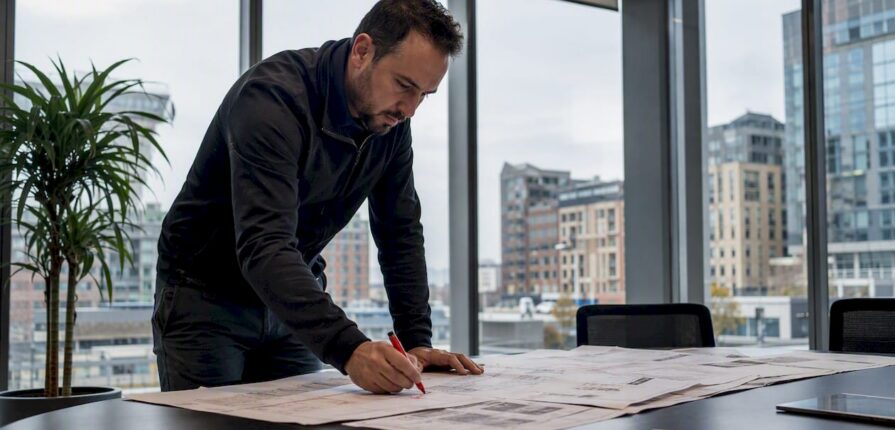
A defensible pre-job inspection is the foundation of the entire project. The inspector, ideally a Certified Ventilation Inspector (CVI) or a technician credentialed under NADCA’s program, should produce four documents before work begins: updated system drawings with zone boundaries marked, a complete access point map, a contamination survey with representative photos, and a written scope of work. A proper NADCA-aligned inspection also includes borescope or visual inspection of duct interiors, microbial sampling when conditions warrant it, duct leakage testing, and a documented report with recommended scope.
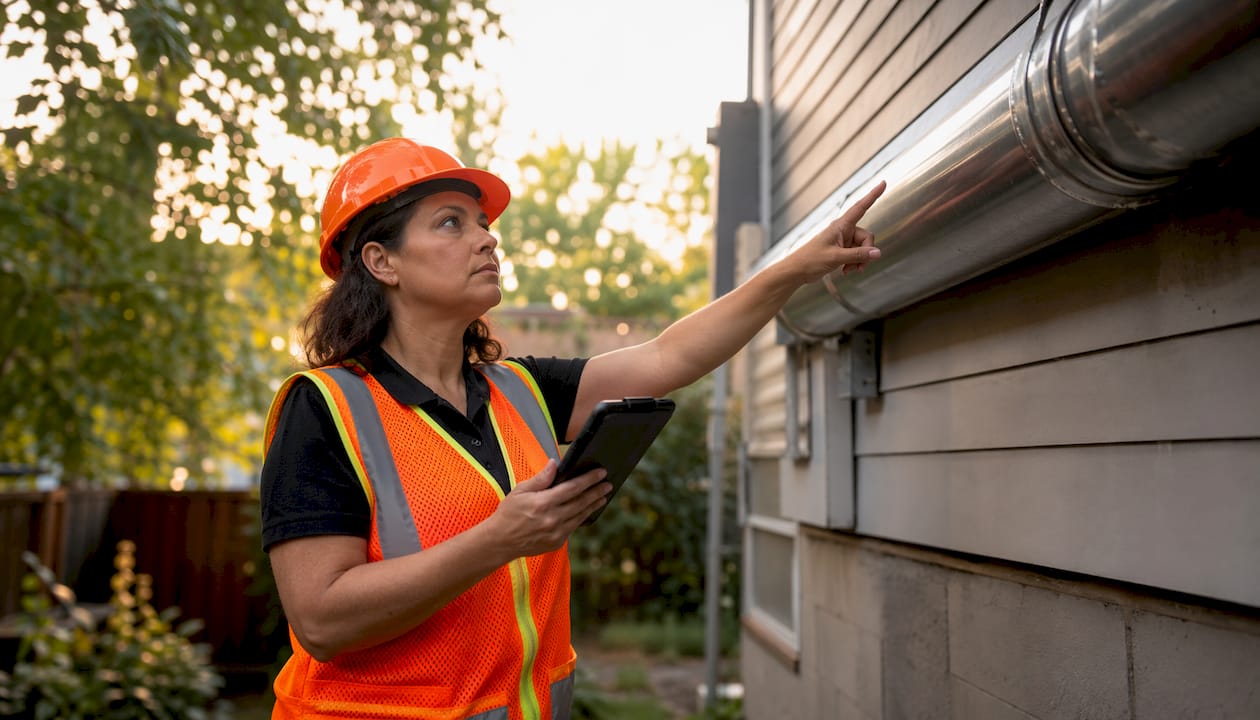
Photo and video documentation at this stage must use fixed vantage points so post-cleaning images are directly comparable. Timestamp every image. Capture representative samples from trunks, branches, and AHU interiors. These pre-work images become the baseline for your certificate of completion.
How does the NADCA ACR five-phase workflow map to your checklist?
The five-phase technical workflow is the backbone of every standards-aligned complex cleaning project. Here is how each phase maps to a manager’s acceptance gate.
| Phase | Description | Acceptance Gate |
|---|---|---|
| 1. Systems assessment and blueprint review | Review drawings, identify zones, map access points, confirm contamination survey | Signed written work plan per NADCA ACR Section 2 |
| 2. Negative pressure containment | Connect high-volume HEPA vacuum collectors; establish and verify negative pressure differential | Manometer baseline reading logged before agitation begins |
| 3. Zonal agitation and source removal | Mechanical agitation (brushes, air whips) zone by zone; HEPA vacuum extraction running continuously | Post-zone camera footage confirming debris removal; manometer logs every 30 minutes |
| 4. Biological control (when required) | EPA-registered antimicrobial applied to surfaces meeting Condition 2 or 3 mold criteria | Application records, product data sheets, and dwell time logs |
| 5. Documented verification and final inspection | Before/after camera footage, NADCA vacuum test or surface comparison test, signed certificate of completion | Pass/fail test results attached to completion report |
Pro Tip: Require the contractor to log manometer readings at 30-minute intervals with zone IDs and timestamps. A continuous documentation thread is the only defensible proof that containment held throughout the job.
Source removal methods combine mechanical agitation with simultaneous HEPA vacuum extraction. Surface dusting alone does not meet NADCA ACR requirements and will not pass a post-work vacuum test. Make sure your contract language specifies source removal explicitly.
Sample contract clause language:
“Contractor shall perform all duct cleaning using source-removal mechanical methods as defined in NADCA ACR. Surface dusting or air-wash-only methods are not acceptable. Contractor shall maintain NADCA ACR compliance throughout all phases and provide written documentation of compliance upon project completion.”
“Contractor shall maintain a continuous manometer log throughout all agitation phases, recorded at minimum every 30 minutes with zone ID and timestamp. Before and after borescope camera footage from fixed vantage points shall be provided for each zone cleaned.”
What does the day-of operational sequence look like?
Turn the five phases into a chronological on-site checklist your crew supervisor can follow and you can verify.
Numbered task sequence:
- Mobilize equipment and stage collection units at designated exterior or mechanical room locations.
- Seal all supply and return registers in the active zone with temporary covers.
- Confirm HVAC mode: system must be in the correct operating state per the work plan (typically fan-off or isolation mode for the active zone).
- Connect HEPA vacuum collectors to the main trunk access point; establish negative pressure and log the baseline manometer reading.
- Verify negative pressure differential is achieved before any agitation tool enters the duct.
- Begin agitation at the zone farthest from the collection point, working toward it systematically.
- Run continuous vacuum extraction throughout agitation; never pause the vacuum while agitation tools are active.
- Log manometer readings every 30 minutes; note any pressure drop that may indicate a containment breach.
- Complete zone, capture post-agitation camera footage from fixed vantage points, and verify cleanliness before moving to the next zone.
- Apply biological control treatment if required; document product, dilution, and dwell time.
- Reinstall all registers, grilles, and access panels; verify fire dampers are restored to marked positions.
- Demobilize equipment, conduct final walkthrough, and collect all documentation for handover.
On-site checks that must be logged:
- Manometer readings (timestamp, zone ID, reading in inches of water column)
- Filter loading checks on vacuum collectors (replace before saturation)
- Access panel integrity before and after sealing
- Fire damper position verification at restart
- Any unexpected conditions encountered (water staining, pest evidence, damaged liner)
Tenant notification template (adapt as needed):
“Scheduled HVAC duct cleaning will take place in [Zone/Floor/Unit range] on [Date] between [Start Time] and [End Time]. During this period, HVAC service to affected units will be temporarily interrupted. Registers will be sealed and should not be disturbed. Please contact [Facility Manager Name] at [Contact] with questions.”
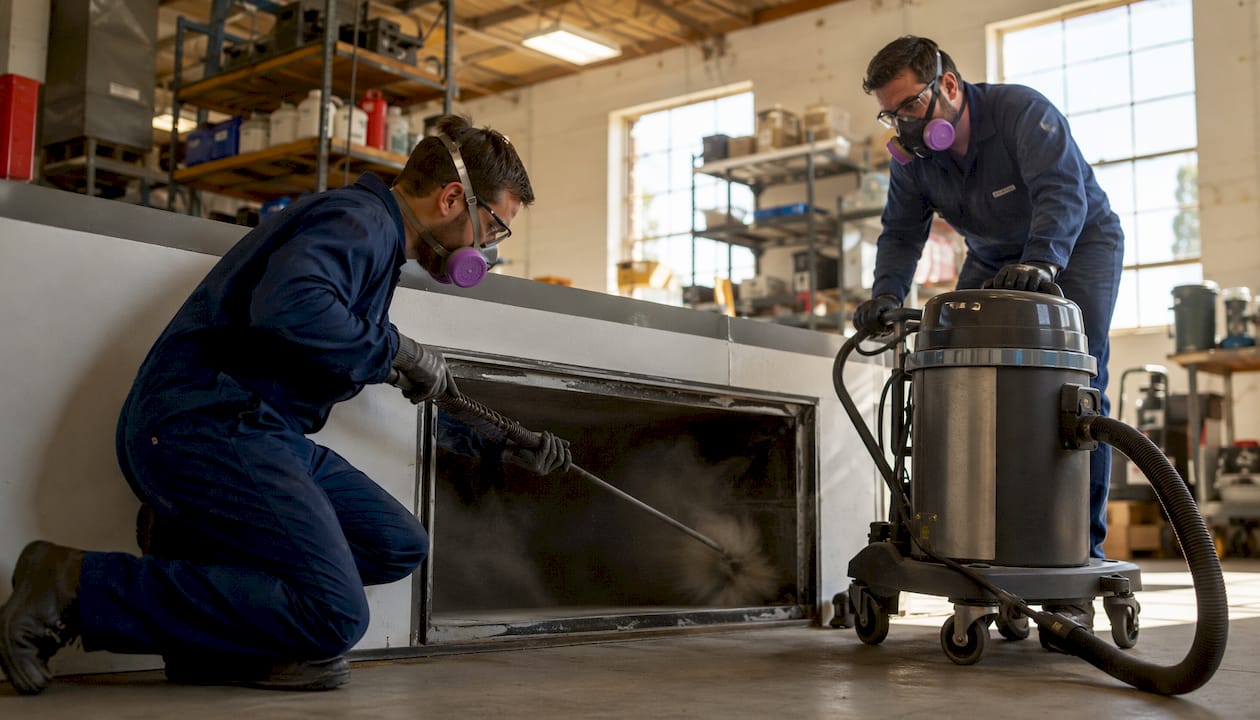
For large complexes, a phased floor-by-floor approach during off-hours (typically 7 PM to 6 AM) minimizes tenant disruption and allows the crew to work without occupant interference.
What equipment specs should you require from contractors?
Under-equipped bids are a real problem on complex jobs. A contractor running a single portable vacuum on a 200-unit building is not performing a NADCA-compliant cleaning. Use this minimum-spec table in your procurement language.
| Equipment | Minimum Specification |
|---|---|
| HEPA vacuum collectors | True HEPA filtration; sized to building CFM requirement |
| Negative-air machines | Capacity matched to zone volume; continuous operation during agitation |
| Agitation tools | Rotating brushes and air whips sized to duct dimensions |
| Compressed air supply | Sufficient PSI for pneumatic agitation tools per manufacturer specs |
| Vacuum hoses and connections | Sealed connections throughout; no open-ended hoses during extraction |
| Access panels | Pre-fabricated or field-cut to NADCA ACR minimum dimensions |
| Camera/borescope | Color video capable; footage timestamped and exportable |
| Manometer | Calibrated; precise water column measurement |
Technician PPE requirements:
- N95 or higher respirator during agitation and biological remediation phases
- Safety glasses or goggles
- Disposable coveralls when working in contaminated areas
- Gloves rated for chemical contact during antimicrobial application
How long does a complex duct cleaning project take?
Timeline varies significantly by system size, access complexity, and whether biological remediation is required. A rough framework:
- Single AHU serving one floor zone: 4–8 hours for a well-equipped two-person crew
- Multi-zone commercial building (4–10 AHUs): 2–5 days depending on access panel fabrication needs and zone complexity
- Large residential complex (50+ units, multiple AHUs): 1–3 weeks using a phased zone approach
Common cost drivers to watch in bids:
- Access panel fabrication (number of panels cut and resealed)
- Number of zones and AHUs in scope
- Biological remediation requirements (adds material cost and dwell time)
- Post-work duct leakage testing (adds time and equipment)
- Documentation and reporting packages (manometer logs, video, certificates)
- Off-hours or weekend scheduling premiums
For large portfolios, bundling duct cleaning with preventative HVAC maintenance reduces mobilization costs and allows condition-based scheduling rather than fixed calendar dates. A rotational zone approach, cleaning one building or wing per cycle, spreads cost across fiscal years while keeping the portfolio in compliance.
How do you protect occupants and prevent cross-contamination?
Negative pressure containment is not optional. The vacuum system must achieve directional transport of dislodged debris from the occupied space toward the collection unit, never the reverse. If a containment breach occurs (indicated by a manometer pressure drop), agitation must stop immediately until the breach is identified and sealed.
Safety checkpoints managers must verify:
- HVAC shutdown sequence confirmed before access panels are opened
- Smoke detectors and fire dampers in the work zone verified and protected from dust intrusion
- Water capture controls in place before wet coil cleaning begins
- PPE worn by all technicians during agitation and biological remediation
- Occupied spaces adjacent to the work zone confirmed under positive pressure or isolated
When biological remediation is required, occupant relocation from the immediate work area is standard practice. Temporary ventilation changes may be needed to maintain acceptable air quality in adjacent occupied spaces during treatment and dwell time. Document every decision and its rationale.
What does a complete handover package look like?
The final report is your audit-ready proof of compliance. Require these deliverables in writing before you sign off on the job.
Required handover deliverables:
- Before/after borescope camera footage for every zone, from fixed vantage points
- Continuous manometer log (timestamps, zone IDs, readings throughout agitation)
- Vacuum/recovery bag chain of custody if hazardous material was present
- Post-service particle counts or NADCA vacuum test results
- Signed certificate of completion on contractor letterhead
- List of all access panels opened, their locations, and resealing method
- Any remediation steps taken and recommended follow-up actions
| Deliverable | Pass Criteria | Fail Response |
|---|---|---|
| Post-cleaning camera footage | No visible debris accumulation in duct interior | Re-clean affected zone; repeat camera verification |
| NADCA vacuum test | Meets NADCA ACR cleanliness threshold | Additional mechanical cleaning; retest |
| Manometer log | Continuous readings; no unexplained pressure drops | Investigate containment breach; document resolution |
| Certificate of completion | Signed by NADCA-credentialed contractor | Withhold final payment until provided |
| Fire damper verification | All dampers restored to pre-work marked positions | Contractor corrects before demobilization |
If a zone fails the post-work camera or vacuum test, the contractor re-cleans at no additional cost. Build this into the contract before work begins.
How often should you schedule duct cleaning in a complex?
Calendar-based cleaning schedules waste money. Condition-based scheduling tied to annual visual inspections and contamination thresholds in your CMMS is the more defensible approach.
| Building Type | Recommended Cleaning Frequency | Inspection Frequency |
|---|---|---|
| Healthcare and food service | Every 1–2 years | Annually |
| Schools and educational facilities | Every 1–2 years | Annually |
| Office buildings and commercial complexes | Every 3–5 years | Annually |
| Residential multifamily (standard occupancy) | Every 3–5 years | Annually or after trigger events |
| Post-construction or renovation | Immediately after construction dust clears | Before occupancy |
Shorten the cycle when any trigger condition from the NADCA ACR list appears: visible contamination, occupant complaints, measured airflow loss, or post-water-intrusion. A preventative maintenance workflow built around annual inspections catches these triggers before they become full remediation projects.
CMMS fields to capture per duct asset:
- Inspection date and inspector credentials
- Pre-inspection photos (timestamped, fixed vantage points)
- Contamination rating (scale or descriptive)
- Manometer baseline and post-cleaning readings
- Contractor name, NADCA credentials, and insurance certificate
- Certificate of completion (scanned attachment)
- Recommended next inspection date and trigger conditions
Centralizing this data in your CMMS means any auditor, insurer, or building owner can pull a complete asset history in minutes. That is the practical value of condition-based scheduling over a spreadsheet.
Key Takeaways
A NADCA-aligned, five-phase source-removal workflow with continuous manometer logging and before-and-after camera documentation is the only defensible duct cleaning process for multi-unit complexes.
| Point | Details |
|---|---|
| Five-phase workflow | Assessment, negative pressure, zonal agitation/source removal, biological control if needed, and documented verification. |
| Mandatory documentation | Require continuous manometer logs (every 30 minutes), before/after borescope footage, and a signed certificate of completion. |
| Scope includes AHU internals | Coils, drain pans, and blowers must be in scope or cleaned ductwork will re-contaminate quickly. |
| Condition-based scheduling | Annual inspections with CMMS-tracked contamination ratings reduce unnecessary cleanings and support audit readiness. |
| Lucasair for Central Florida complexes | Lucas Air Conditioning & Heating delivers NADCA-aligned complex cleaning with full documentation packages in Central Florida. |
What most specs miss about complex duct cleaning
The gap between a technically compliant cleaning and one that actually protects your building comes down to documentation discipline, not equipment. Most facility managers focus on the cleaning itself and treat the paperwork as an afterthought. That is backwards.
A manometer log with gaps, or before/after photos taken from different angles, is functionally useless in an audit or an insurance claim. The documentation is the product. The cleaning is the prerequisite. When Lucas Air Conditioning & Heating works on a complex job, the continuous documentation thread is built into the scope from day one, not assembled after the fact from whatever photos the crew happened to take.
The other thing most specs miss: coils and drain pans. Contractors who clean ductwork but leave AHU internals dirty are handing you a 90-day re-contamination timeline. Insist on full AHU scope in writing, or the cleaning is a short-term fix.
One practical tip that separates quality bids from cheap ones: ask every contractor to show you a sample manometer log from a recent comparable job. A contractor who cannot produce one has never maintained continuous documentation. That is a disqualifying answer.
Lucasair handles complex duct cleaning from scope to certificate
Property managers and facility directors across Central Florida trust Lucas Air Conditioning & Heating for complex duct cleaning projects that arrive with full documentation, not just a cleaned system. Every project follows the NADCA-aligned five-phase workflow described in this guide, with certified technicians, continuous manometer logging, before/after borescope footage, and a signed certificate of completion included as standard deliverables.
A scoped proposal from Lucasair covers pre-inspection with system drawings review, access panel planning, containment strategy, zone sequencing, and a CMMS-ready reporting package. To request a proposal, have your asset drawings, recent HVAC service reports, and a list of known trigger conditions ready. Request your scoped proposal and get a project plan your building owner can review and approve.
Useful sources
- NADCA ACR Standard — The primary industry standard for assessment, cleaning, and restoration of HVAC systems. Use for contract compliance language, source-removal method requirements, and verification test specifications.
- NADCA Commercial Cleaning Checklist — Minimum requirements checklist for commercial duct cleaning projects; useful for reviewing contractor proposals.
- NADCA Guide Specification (PDF) — Standard contract language for submittals, safety plans, access openings, and verification methods; adapt directly into your SOW.
- NADCA ACR Standard (2021 Edition) — Full technical standard including cleaning triggers, vacuum collection requirements, AHU cleaning protocols, and damper restoration requirements.
- Commercial Air Duct Cleaning Process: Technical Phase Protocols — Phase-by-phase technical breakdown with containment and documentation requirements; supports the five-phase workflow and manometer logging guidance.
- Duct Cleaning and Inspection for Commercial Buildings (iFactory) — Condition-based scheduling guidance and CMMS integration fields; supports inspection frequency and asset history recommendations.
- ASHRAE — Referenced in NADCA ACR as the governing standard for HVAC maintenance programs (ANSI/ASHRAE/ACCA Standard 180); consult for maintenance program integration.
Recommended
- Landlord Duct Cleaning Workflow: A Property Manager’s Guide – Lucas Air Conditioning and Heating
- Step by Step Duct Cleaning: Home Guide for 2026 – Lucas Air Conditioning and Heating
- The Role of Duct Cleaning in Manufacturing Facilities – Lucas Air Conditioning and Heating
- Restaurant duct cleaning: Keep compliant and customers happy – Lucas Air Conditioning and Heating
