

For Central Florida property managers, a compliant commercial kitchen ventilation system means three things: the correct hood type (Type I for any grease-producing equipment), a make-up air unit (MAU) sized to match exhaust volume, and NFPA 96-level cleaning to bare metal with documented proof. A shiny canopy face means nothing if the ductwork above the ceiling and the rooftop fan housing are packed with grease.
Right now, verify these three things:
- Hood type: confirm Type I is installed over every fryer, grill, and char broiler; Type II only where there is heat or steam but no grease
- MAU balance: check that the make-up air unit is operational and sized to replace the volume the exhaust fan removes
- Cleaning certificate: insist on a full-path cleaning report with before/after photos, not just a hood sticker
ASHRAE guidance and NFPA 96 together set the sizing and safety floor. Lucasair serves as the local, veteran-owned HVAC service option for Central Florida property managers who need this work done right and documented.
Table of Contents
- What does a commercial kitchen ventilation system actually include?
- Type I vs. Type II hoods: which one does your kitchen need?
- Why balanced make-up air matters and how to spot problems
- What full-path cleaning actually looks like
- How to stay compliant and audit-ready
- Troubleshooting common ventilation symptoms
- How to choose a qualified ventilation contractor
- Lucasair supports Central Florida property managers with ventilation compliance
- Key Takeaways
- Why full-path maintenance is the only standard worth holding
- Useful sources and standards
What does a commercial kitchen ventilation system actually include?
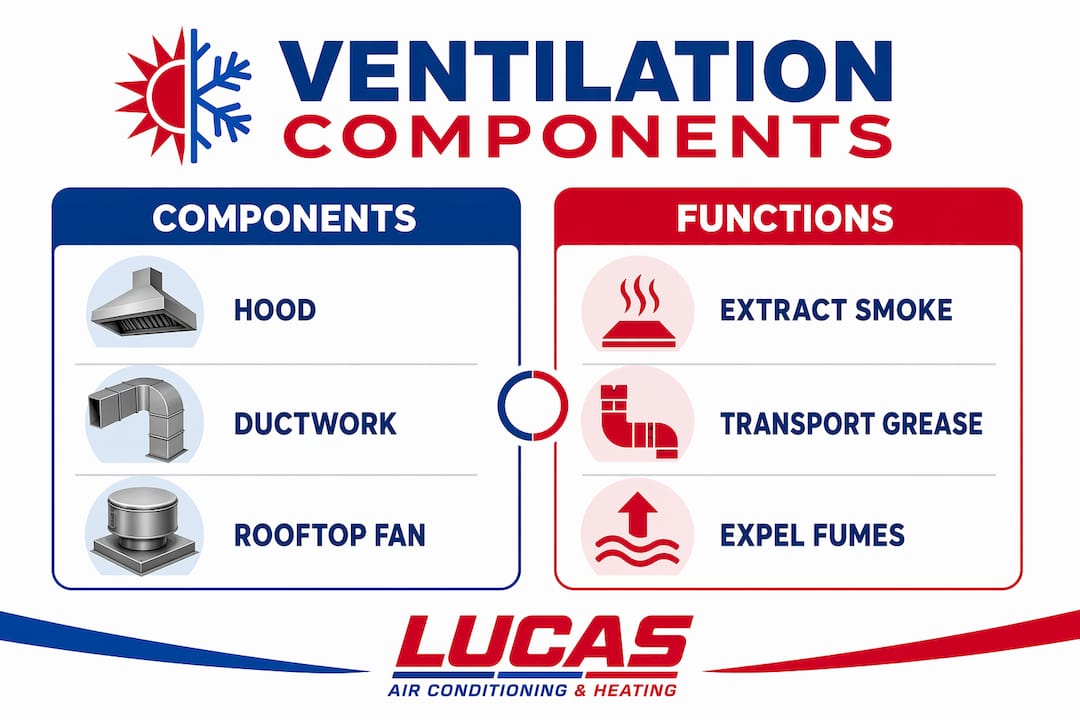
The system is an interdependent assembly. A failure in any one component compromises the whole fire and air-quality path.
- Hood/canopy: captures grease-laden vapor at the source
- Baffle grease filters: intercept grease before it enters the duct
- Hood plenum: the internal chamber that distributes airflow evenly
- Grease trough and drain: channels collected grease to a containment point
- Type I grease duct (continuous weld): the only code-compliant duct for grease-laden exhaust; no seams where grease can pool
- Access/cleanout panels: required by NFPA 96 for full-path cleaning; missing panels are a compliance violation
- Rooftop exhaust fan and housing: the endpoint of the exhaust path and the most commonly neglected grease accumulation point
- Make-up air unit (MAU): replaces exhausted air with tempered outside air to maintain pressure balance
- Fire suppression system: integrated into the hood; must be inspected on its own schedule
- Grease containment (traps/roof cans): catches discharge at the rooftop; grease traps also protect the building’s drain system
The real fire path runs from the hood face through the duct to the rooftop fan housing. Grease accumulates above the ceiling line and inside fan assemblies where cosmetic cleaning never reaches.
| Component | Primary Function | Common Failure Mode |
|---|---|---|
| Baffle grease filters | Intercept grease before duct entry | Clogged filters reduce airflow and capture |
| Type I grease duct | Carry grease-laden exhaust to roof | Grease buildup; missing cleanout panels |
| Rooftop exhaust fan | Pull exhaust through the system | Belt wear, bearing failure, grease-packed housing |
| Make-up air unit | Replace exhausted air volume | Undersized unit creates negative pressure |
| Fire suppression system | Suppress hood-area fires | Expired inspection tag; nozzle blockage |
Type I vs. Type II hoods: which one does your kitchen need?
Hood type is not a preference. It is a code requirement tied directly to what the equipment produces.
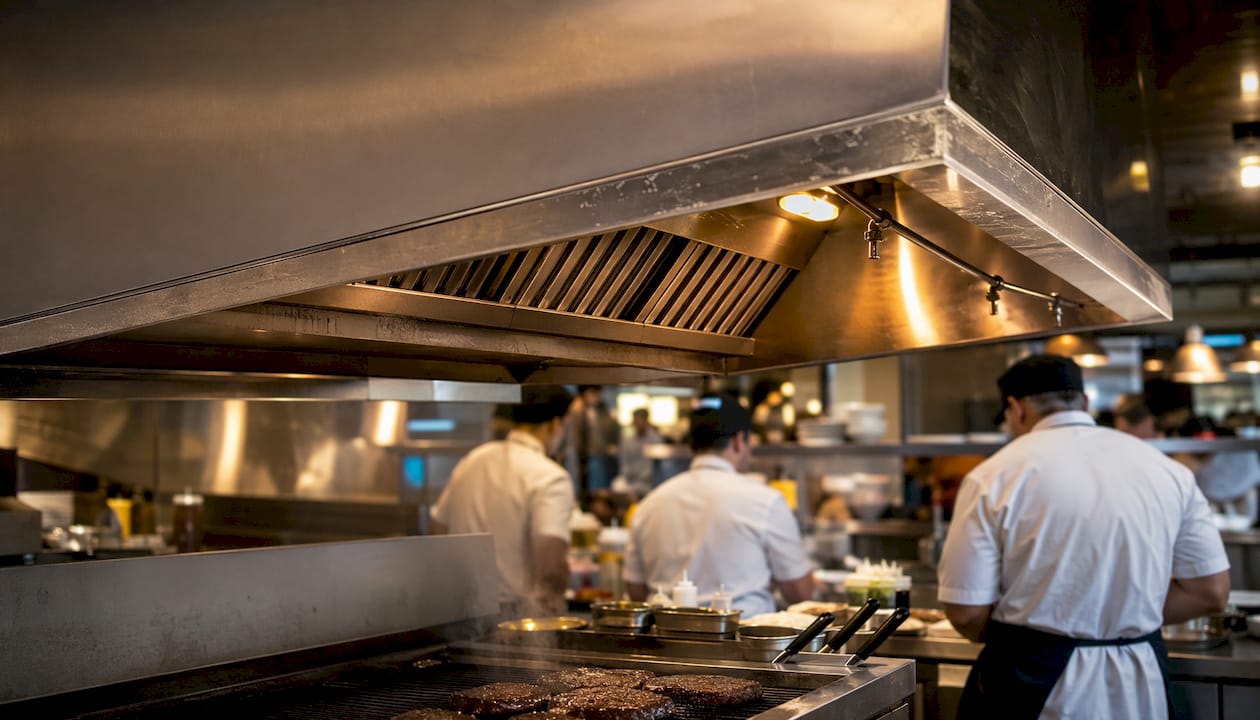
Type I hoods are mandatory over any equipment that generates grease-laden vapors: fryers, griddles, char broilers, woks, and ranges. They require baffle grease filters, a continuous-weld grease duct, and an integrated fire suppression system. Type II hoods cover heat- and steam-only appliances such as steamers, ovens, and dishwashers. They handle moisture and heat but are not rated for grease and carry no fire suppression requirement.
The 6-inch overhang rule: the hood must extend beyond the open sides of the cooking equipment by a minimum distance to ensure effective capture of rising grease plumes. That overhang is what creates the capture zone. A hood that sits flush with the equipment edge will miss rising grease plumes, especially when cross-drafts are present.
Sizing is driven by equipment BTU output and the thermal plume the equipment generates, not by floor area. ASHRAE and the International Mechanical Code (IMC) both tie exhaust rate calculations to equipment type and heat output.
| Feature | Type I | Type II |
|---|---|---|
| Required filtration | Baffle grease filters | Standard mesh or none |
| Fire suppression | Required | Not required |
| Duct type | Continuous-weld grease duct | Standard duct acceptable |
| Typical cleaning frequency | Monthly to quarterly (volume-dependent) | Semi-annual to annual |
| Code trigger | Any grease-producing equipment | Heat/steam-only equipment |
Pro Tip: When a tenant adds a char broiler or switches from a convection oven to a fryer, the existing Type II hood is immediately non-compliant. Re-evaluate hood type and sizing before the equipment goes live, not after the fire marshal visits.
Why balanced make-up air matters and how to spot problems
A kitchen exhaust fan pulls contaminated air out of the space. If nothing replaces that volume, the building goes negative. That is when things get visibly wrong.
Symptoms of an unbalanced system:
- Doors slamming shut or requiring significant force to open
- Smoke or cooking odors migrating into dining rooms or adjacent tenant suites
- Difficulty opening exterior doors near the kitchen
- Reduced hood capture: smoke visibly escaping around the hood edges
The fix is not a bigger exhaust fan. Increasing exhaust without matching make-up air makes the imbalance worse. The MAU must supply tempered outside air in a volume that matches what the exhaust removes.
Quick verification checklist:
- Stand near the kitchen entrance with the exhaust running. A slight inward draft is normal; a strong pull or visible smoke migration is not.
- Open an exterior door near the kitchen. Resistance beyond normal door weight suggests negative pressure.
- Check the MAU unit physically: confirm it is powered, the filter is not blocked, and the damper is open.
- Listen at the exhaust fan: unusual noise (squealing, grinding) signals belt or bearing wear.
When any of these checks fail, call an HVAC technician for a measured airflow balance test. Replacing a fan or MAU without recalibrating the whole system is a common mistake that recreates the problem with new equipment.
What full-path cleaning actually looks like
Insist on cleaning to bare metal across the entire exhaust path: hood interior, ductwork, fan housing, and rooftop components. A hood sticker alone is not compliance.
NFPA 96 requires that cleaning be performed by qualified, certified companies and that contaminated surfaces be cleaned to bare metal. The visible hood face is the easiest part. The real grease load hides in duct runs above the ceiling and inside the rooftop fan housing, where a cosmetic cleaning crew never goes.
NFPA 96 cleaning frequency tiers (from Table 11.4):
- Monthly: solid-fuel cooking (wood, charcoal) and high-volume grease operations
- Quarterly: high-volume standard cooking (busy full-service restaurants)
- Semi-annual: moderate-volume operations
- Annual: low-volume or seasonal operations
These are minimums. If a tenant changes the menu to add high-grease items or increases production volume, the schedule must be updated immediately, not at the next calendar interval.
What to require from every cleaning provider:
- Pre-job inspection with photos of duct access panels and fan housing
- Inventory of all cleanout panels opened (missing panels must be noted)
- Cleaned linear footage of ductwork documented in the service report
- Fan inspection: belt tension, bearing condition, motor amperage under load
- Before/after photos with timestamps and location metadata
- Written note of any inaccessible areas, per ANSI/IKECA C10 guidance
- Post-job white-glove verification: no grease residue on accessible surfaces
Pro Tip: Require digital certificates, not paper stickers. Insurers and AHJs increasingly reject claims backed only by a hood sticker. A digital report with photos and section-by-section records is what holds up in an audit.
In-house staff can handle daily surface wipe-downs, but ductwork and rooftop fan cleaning require certified professionals with specialized access equipment. Pressure washing ducts is not an acceptable method and can create new hazards.
For a detailed restaurant duct cleaning workflow, Lucasair’s property manager guide covers scope language and scheduling in depth.
How to stay compliant and audit-ready
NFPA 96 places the compliance burden on the building owner and operator, not the cleaning company. That means your records are your protection.
Required record elements for every cleaning:
- Date of service and company name with certification number
- Areas cleaned and linear footage or sections documented
- Fan mechanical inspection results (belts, bearings, amperage)
- Before/after photos with timestamps
- Fire suppression inspection certificate (separate schedule)
- Written list of any deficiencies or inaccessible areas
Keep these records for a minimum of the current inspection cycle plus one prior cycle. When an AHJ or insurer asks, you need to produce them within hours, not days.
Periodic audit routine (run this 30 days before any scheduled inspection):
- Pull the last two cleaning certificates and confirm they cover the full path, not just the hood face
- Verify the fire suppression tag is current
- Confirm the MAU is operational and the last service date is logged
- Check that cleanout panels are present and accessible
- Review the cleaning schedule against current cooking volume and menu
Non-imminent hazards identified during an AHJ inspection typically carry a correction window. Severe violations, particularly heavy grease accumulation in ducts, can trigger immediate shutdown. An incomplete record file compounds the risk because it removes your ability to demonstrate prior compliance.
Troubleshooting common ventilation symptoms
Most ventilation problems announce themselves before they become emergencies. The key is knowing which symptoms require a phone call versus which ones require stopping operations.
Symptom → likely cause → immediate action:
- Smoke in the dining area: check MAU operation and hood capture; if smoke is escaping the hood edge, stop cooking and call a certified technician
- Doors slamming or hard to open: negative pressure from MAU failure or blockage; check MAU filter and damper before resuming full service
- Unusual fan noise (squealing, grinding): belt wear or bearing failure; fan mechanical checks should be performed quarterly; schedule repair immediately
- Grease dripping from duct seams or ceiling tiles: duct overload; stop cooking and call for emergency cleaning
- Cooking odors in adjacent tenant spaces: system imbalance or duct leakage; requires a full airflow measurement
Stop operations and call a certified contractor immediately if you observe: visible heavy grease accumulation inside accessible duct sections, a non-functional or expired fire suppression system, the exhaust fan not running under cooking load, or any condition your AHJ would classify as an imminent hazard. Document findings with photos and log the issue before the contractor arrives.
Quick checks any manager can run:
- Inspect baffle filters: if they are visibly saturated, the cleaning schedule is already overdue
- Check the suppression system tag date
- Confirm the fan is audible and running during cooking hours
- Look for grease staining on the rooftop around the fan housing
How to choose a qualified ventilation contractor
The right contractor produces a written scope, carries documented insurance, and delivers a report you can hand to a fire marshal. The wrong one hands you a hood sticker and disappears.
Questions to ask before signing anything:
- What certifications do your technicians hold? (Look for ANSI/IKECA C10 or equivalent NFPA 96-trained staff)
- What does your insurance cover, specifically for kitchen exhaust cleaning?
- Can you provide a sample service report from a recent comparable job?
- How do you handle cleanout panels that are missing or welded shut?
- What is your rooftop safety protocol?
- Do you inspect the fan mechanically, or only clean the housing?
Red flags that disqualify a vendor:
- Scope described only as “we clean the hood”
- No photos included in the service report
- Reliance on a hood sticker as the sole compliance record
- Refusal to open or access cleanout panels
- No written deficiency report when inaccessible areas exist
Contract scope language to include:
- Full-path cleaning to bare metal: hood interior, ductwork, fan housing, rooftop components
- Fan mechanical inspection checklist: belt tension, bearing condition, motor amperage under load
- Required deliverables: timestamped before/after photos, sections cleaned, inaccessible area notes
- Corrective action turnaround: deficiencies addressed within a defined window (typically 30 days for non-imminent hazards)
For landlords managing multi-tenant buildings, add a lease clause that requires tenants to produce a cleaning certificate within a set period, with the right to arrange cleaning at tenant cost after a 5-day notice if they fail to comply. That clause is your enforcement tool when a tenant goes quiet on compliance.
Pro Tip: Before approving any major ventilation change, a new hood, different cooking equipment, or fan replacement, require a whole-system airflow audit and a written balancing report. Replacing a fan without adjusting the MAU is one of the most common causes of recurring imbalance.
For a full property manager’s duct cleaning guide, Lucasair’s resource covers contract language and vendor scope templates in detail.
Lucasair supports Central Florida property managers with ventilation compliance
Central Florida property managers dealing with commercial kitchen ventilation need a local partner who understands both the mechanical side and the documentation trail that protects building owners.
Lucasair, founded in 2018 by Army Veteran Cameron Lucas and based in Eustis, Florida, handles commercial duct and hood cleaning coordination, MAU and exhaust fan balancing, rooftop fan maintenance, and preventative maintenance agreements that include NFPA 96-aligned documentation. On a first call or site visit, you get a scope review, a written quote, and a sample service report so you know exactly what the deliverable looks like before work begins.
If you manage a property with a commercial kitchen tenant, the fastest next step is a compliance audit of a single kitchen: hood type confirmed, MAU balance checked, and cleaning records reviewed. Contact Lucasair to schedule that visit or to ask about commercial installation and balancing services for Central Florida properties.
Key Takeaways
A compliant commercial kitchen ventilation system requires the correct hood type, a balanced make-up air unit, and documented full-path cleaning to bare metal under NFPA 96.
| Point | Details |
|---|---|
| Hood type is non-negotiable | Type I is required over all grease-producing equipment; Type II covers heat/steam only. |
| MAU balance prevents smoke infiltration | The make-up air unit must match exhaust volume; imbalance causes negative pressure and smoke migration. |
| Full-path cleaning, not cosmetic | NFPA 96 requires cleaning to bare metal across hood, ductwork, fan housing, and rooftop components. |
| Digital records protect you | AHJs and insurers increasingly require photo documentation and digital certificates, not just a hood sticker. |
| Lucasair for Central Florida compliance | Lucasair provides MAU balancing, exhaust fan maintenance, and NFPA 96-aligned documentation for property managers. |
Why full-path maintenance is the only standard worth holding
The conventional wisdom in commercial kitchen maintenance is that a clean hood face means a safe kitchen. It does not. The hood face is the part a tenant cleans to pass a casual walk-through. The fire risk lives in the duct run above the ceiling tiles and in the grease-packed fan housing on the roof, places most property managers never see and most cleaning crews never reach unless the scope explicitly requires it.
What actually protects a building owner is a documented, full-path cleaning record that an insurer or fire marshal can audit. That means photos with timestamps, sections cleaned, fan mechanical results, and a written note of anything inaccessible. A hood sticker is a marketing artifact. A complete service report is a legal document.
Lucasair’s approach to commercial kitchen ventilation work in Central Florida is built around that standard: written scope, photo documentation, and mechanical inspection of the fan, not just the visible surfaces. Veteran-owned and locally operated since 2018, the company serves property managers across the region who need compliance they can actually defend.
Useful sources and standards
The following authoritative references underpin this guide. Property managers, AHJs, and insurers all recognize these sources.
-
NFPA 96, Standard for Ventilation Control and Fire Protection of Commercial Cooking Operations: the primary U.S. standard governing hood types, duct construction, cleaning requirements, fire suppression, and documentation. Every commercial kitchen in the U.S. is subject to it. Reference it when reviewing contractor scopes or preparing for AHJ inspections.
-
ASHRAE Fundamentals of Kitchen Ventilation (PDH Online): covers exhaust rate calculations, make-up air strategies, hood geometry, and airflow design principles. Useful when evaluating whether a system was sized correctly or when a tenant requests equipment changes.
-
NFPA 96, 2024 Edition (up.codes): the current code text, fully navigable by chapter. Use this to verify specific requirements during procurement or when an AHJ cites a code section.
-
ANSI/IKECA C10: the industry standard for kitchen exhaust cleaning companies. Contractors certified to this standard have demonstrated training in full-path cleaning methods, access procedures, and documentation. Ask for this certification by name when vetting vendors.
Recommended
- The Role of Ventilation in Kitchens: Safety and Air Quality – Lucas Air Conditioning and Heating
- Commercial Duct Cleaning Guide for Property Managers – Lucas Air Conditioning and Heating
- How to maintain restaurant HVAC for efficiency and compliance – Lucas Air Conditioning and Heating
- Restaurant duct cleaning: Keep compliant and customers happy – Lucas Air Conditioning and Heating
