
TL;DR: Warm air from your AC usually means the outdoor unit has stopped working while the indoor fan keeps running. Check the thermostat mode, the breakers, the drain pan, the filter, any ice and the space around the outdoor unit first. Refrigerant, electrical and compressor problems need a licensed technician.
If your AC is blowing warm air, the cause is usually one of a few things. The thermostat may be set wrong, a breaker may have tripped, a clogged drain line may have shut the system off, the filter may be choked, or the outdoor unit may have stopped running. Refrigerant leaks and failed parts need a technician.
Why is my AC blowing warm air when it ran fine yesterday? In Tavares and the rest of Lake County, the long, humid cooling season is hard on drain lines, filters and outdoor units. This post is a triage list for homeowners. It covers what to check yourself, in what order, and when to stop and call. For a closer look at the parts behind each cause, see our earlier post on six common causes of an AC blowing warm air.
Why is my AC blowing warm air right now?
Most of the time, something has stopped the outdoor unit while the indoor fan keeps running. The indoor air handler only moves air. The outdoor unit, with its compressor and fan, pulls heat out of your home. If the outdoor side shuts down, the blower still pushes air through your vents, but it’s just warm house air.
That’s why a tech starts with simple questions. Is the outdoor unit running? Is the fan on top spinning? Is anything iced over? You can safely answer those questions with the checks below.
7 checks to make before you call a tech
1. Confirm the thermostat is set to Cool
Make sure the mode says Cool, not Heat, Auto or Emergency Heat. The set point should be a few degrees below room temperature. Heat pumps are the most common heating system in Central Florida. If someone switched the thermostat to Heat on a cool morning, it can keep sending warm air all afternoon. Set the fan to Auto. On the On setting, the blower keeps running between cooling cycles and pushes room-temperature air that can feel warm. Replace the batteries if the screen is faint or blank. If the thermostat still seems off, our guide on why a thermostat never reaches the set temperature covers the next steps.
2. Look and listen at the outdoor unit
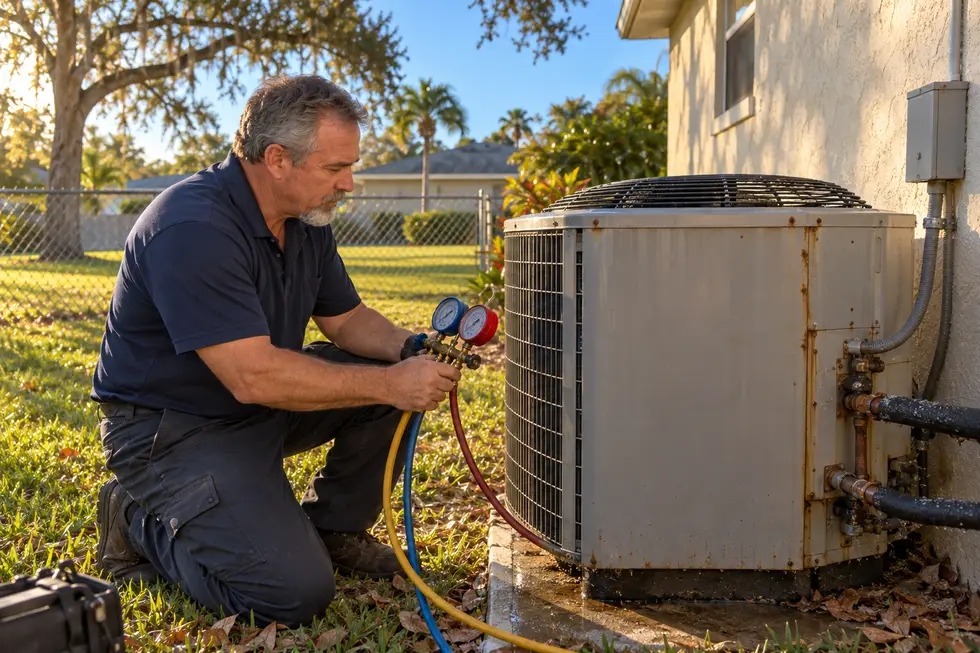
Go outside while the system is calling for cooling. You should hear the compressor running, see the top fan spinning and feel warm air blowing up out of the unit. If the indoor fan runs but the outdoor unit is silent, the outdoor side isn’t getting power or a signal. If it hums but the fan doesn’t spin, turn the system off at the thermostat and call. That pattern often points to a failed capacitor or fan motor, and running the unit that way can overheat the compressor.
3. Check the breakers and the outdoor disconnect
Most split systems have two breakers in the panel, one for the indoor air handler and one for the outdoor unit. If one has tripped, reset it once. Also check the disconnect box on the wall near the outdoor unit. If a breaker trips a second time, leave it off. A repeat trip means an electrical or mechanical fault that needs a technician.
4. Check the drain pan and float switch
Florida humidity means your AC pulls a lot of water out of the air. On many systems, a clogged condensate drain line trips a safety float switch that shuts off cooling. That keeps water from spilling into your ceiling or closet. Look for standing water in the pan under the air handler. If you find water there, the drain line has to be cleared before the system will cool again. ENERGY STAR lists a condensate drain check as part of a standard HVAC maintenance check-up.
5. Change the air filter
A clogged filter starves the indoor coil of airflow. Low airflow can freeze the coil, and a frozen coil can’t cool. ENERGY STAR advises checking your filter every month and changing it at least every three months. During a Florida summer, many homes need a new filter every month.
6. Look for ice on the copper lines or indoor coil
Check the larger copper line where it enters the outdoor unit. If you can see the indoor coil, check it too. Ice or frost on either one means the system has an airflow or refrigerant problem. Turn cooling off and set the fan to On so the ice melts, which can take a few hours. Don’t chip at it. If the ice comes back after you change the filter, call a pro.
7. Clear space around the outdoor unit
The U.S. Department of Energy recommends trimming plants back at least two feet from the condenser so it gets enough airflow. Grass clippings, leaves and storm debris pack into the coil fins and trap heat. If you live on a wooded lot out toward Paisley or Astor, check the unit after every big storm. Shut off power at the disconnect first. Then rinse the coil gently with a garden hose, never a pressure washer. Leave the hurricane straps and pad in place.
Which warm-air problems need a technician?
Anything involving refrigerant, electrical parts or the compressor needs a licensed tech. Under EPA rules, anyone servicing stationary AC equipment must have Section 608 certification. Adding refrigerant without finding the leak only buys time. Use this table to sort out what you’re seeing.
| What you notice | Likely cause | What you can do | When to call |
|---|---|---|---|
| Indoor fan runs, outdoor unit silent | Tripped breaker, float switch or failed contactor | Reset the breaker once; check the drain pan | If the breaker trips again or the pan is dry |
| Outdoor unit hums, fan not spinning | Weak capacitor or failed condenser fan motor | Turn the system off at the thermostat | Right away |
| Ice on the copper line or coil | Dirty filter or low refrigerant | Change the filter and let the ice thaw | If the ice comes back |
| Cool in the morning, warm by afternoon | Dirty coils or a refrigerant leak | Clear around the unit and rinse the coil | If nothing improves within a day |
| Warm air from only some vents | Torn or disconnected duct in the attic | Make sure the vents are open | Soon, since the ductwork needs repair |
Signs you need to call a pro
- A breaker trips again after you reset it.
- The outdoor unit hums, clicks or buzzes, but the fan doesn’t spin.
- Ice comes back within a day of a filter change.
- You hear hissing or bubbling near the copper lines, or see oily spots on them.
- You smell burning or hot plastic. Turn the system off and read our post on what a burning smell from your AC means.
- The drain pan keeps filling after the line has been cleared.
- The air turns warm partway through the afternoon, day after day.
What should you tell the technician when you call?
Clear notes speed up the diagnostic and help the tech bring the right parts. Before you call, write down:
- When the warm air started, and whether it followed a storm, a power outage or a breaker trip.
- Whether the outdoor unit runs, hums or is silent.
- Any ice, water in the drain pan, or strange noises or smells.
- The thermostat mode and setting, plus the date of your last filter change.
- The age of the system if you know it, and whether it’s a heat pump or a cooling-only unit.
Landlords and property managers can ask tenants for the same details. Photos of the outdoor unit and the thermostat screen also help, whether the rental is in Tavares or Zellwood.
Why homeowners call Lucas Air Conditioning and Heating
Lucas Air Conditioning and Heating, LLC is veteran-owned and was founded in early 2018 by Cameron Lucas, who served eight years in the U.S. Army’s 82nd Airborne Division.
Our office is at 15800 Old US Hwy 441 in Tavares.
We hold Florida license CAC1819409.
A diagnostic costs $125 for homes and $135 for commercial properties.
We have a 5.0-star Google rating from more than 1,000 reviews.
We’ve been a Nextdoor Neighborhood Favorite four years running.
At the Colonial Pines apartment complex in Tavares, we replaced 30 split systems and installed 2 ductless units in 10 working days.
Our office is open Monday through Friday, 8:00 AM to 5:30 PM, and a technician is on call after hours for emergencies.
Our Preventative Maintenance Agreement is $129 per year and includes one tune-up, 15% off parts and priority scheduling.
If your AC is still blowing warm air after these checks, call (352) 805-0359 or book a service appointment online.
Frequently Asked Questions
Can I keep running my AC while it’s blowing warm air?
Turn cooling off if the outdoor unit hums without spinning, if you see ice, or if a breaker trips. Running it that way can damage the compressor. Running only the fan to melt ice is fine.
Why does my AC blow warm air after a power outage?
A breaker may have tripped, or the thermostat may have reset to a different mode. Many systems also wait a few minutes before restarting the outdoor unit, so give it a short time before you troubleshoot.
How much does it cost to find out why my AC is blowing warm air?
A diagnostic from Lucas Air Conditioning and Heating is $125 for homes and $135 for commercial properties. The repair cost depends on which part failed and what it takes to fix it.
Can I add refrigerant to my AC myself?
No. EPA rules require Section 608 certification to service stationary AC systems, and only certified technicians can buy most refrigerants. Low refrigerant also means there’s a leak that has to be found and fixed.
Is an AC blowing warm air an emergency in Central Florida?
In the summer heat it can be, especially if older adults, infants or pets are in the home. Lucas Air keeps a technician on call after hours for emergencies.
Recommended Reads
- Why Is My AC Blowing Warm Air? 6 Common Causes Explained
- Why Does My AC Smell Like Burning? Common Causes and When to Worry
- Why Is Your AC Spiking Your Electric Bill? 7 Likely Culprits