
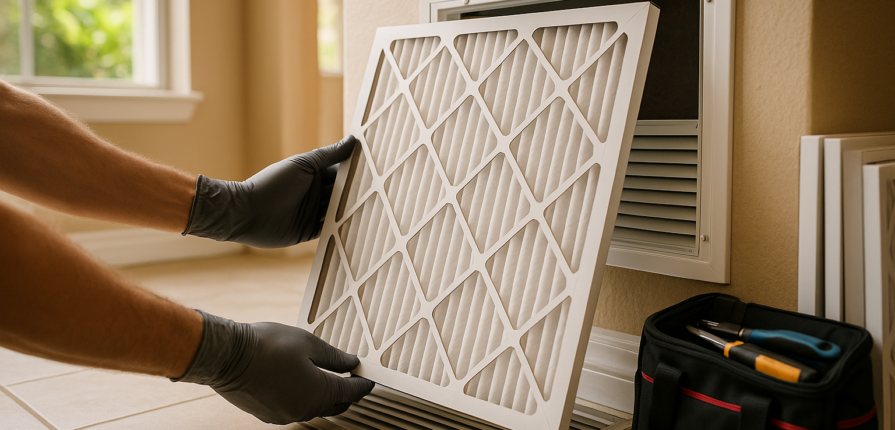
TL;DR: MERV (Minimum Efficiency Reporting Value) measures how well an air filter traps particles, on a scale of 1 to 16 for residential use. Most Central Florida homes do best with MERV 8-13, but the right number depends on your system’s airflow capacity, pets, allergies, and how often you’re willing to change filters in our humid, nearly year-round cooling climate.
If you’ve stood in the filter aisle staring at boxes labeled MERV 8, MERV 11, and MERV 13, wondering which one your system actually needs, you’re not alone. The number matters more than most homeowners realize, especially in Lake County and Orange County, where air conditioners run nearly year-round.
This guide breaks down what MERV ratings mean, how the scale works, and how to pick the right filter for your home in Tavares, Clarcona, Astor, Paisley, Grand Island, Zellwood, and the surrounding communities we serve.
What Is a MERV Rating?
The Minimum Efficiency Reporting Value (MERV) rating is a standardized measurement of how effectively an air filter removes particles from the air, introduced by the American Society of Heating, Refrigerating and Air-Conditioning Engineers (ASHRAE), which helps consumers compare air filter performance on a scale from 1 to 16 for most residential applications.
Each filter is rated based on the size and percentage of particles it can trap, and the higher the MERV rating, the smaller the particles it captures, and the greater the filtration efficiency.
How Filters Earn Their Rating
MERV ratings are assigned through standardized testing protocols developed by ASHRAE, primarily outlined in ASHRAE Standard 52.2. Filters are tested in a controlled lab environment using particles ranging from 0.3 to 10 microns, and their performance is evaluated based on how efficiently they trap different particle sizes to determine their placement on the scale. This standardized testing ensures that filters from different manufacturers can be reliably compared.
The MERV Scale, Explained Simply
Here’s roughly what each range captures, based on EPA and ASHRAE data:
- MERV 1-4: Catches larger particles — dust, lint, pollen, pet dander — the minimum level typically found in basic residential equipment.
- MERV 5-8: Common in most residential and commercial buildings, these filters capture particles down to 3 microns in size, including mold spores, dust mites, and household lint, and balance filtration and airflow for standard HVAC systems.
- MERV 9-12: Adds finer particles down to 1.0 micron, including finer pet dander and dust.
- MERV 13-16: Recommended for environments that demand high air quality, these filters capture particles as small as 0.3 microns, including bacteria, viruses, smoke, and smog.
- MERV 17-20 (HEPA): To earn the HEPA designation, a filter must remove at least 99.97% of particles that are 0.3 microns or larger in diameter — performance equivalent to MERV 17-20 ratings. These are rarely practical for residential ductwork.
What the EPA Actually Recommends
The U.S. Environmental Protection Agency offers direct guidance on this. For upgrading a standard furnace or HVAC filter, the agency advises:
choose a filter with at least a Minimum Efficiency Reporting Value (MERV) 13 rating, or as high a rating as your system fan and filter slot can accommodate, consulting a professional HVAC technician to determine the highest efficiency filter that will work best for your system.
That last part is the catch. The EPA’s own technical research notes that
filters with a MERV between 7 and 13 are likely to be nearly as effective as true HEPA filters at controlling most airborne indoor particles, while being less expensive and allowing quieter HVAC fan operation and higher airflow rates since they have less airflow resistance
than true HEPA media. In other words, you don’t need to chase the highest number on the shelf to get meaningful protection.
Pros and Cons by MERV Range
MERV 8: The Everyday Workhorse
Pros: Lowest airflow resistance, widely available, inexpensive, protects your equipment from dust and debris.
Cons: Limited capture of fine particles like smoke, bacteria, or very fine pollen.
MERV 11: The Upgrade for Pets and Allergies
Pros: Captures finer dust, pet dander, and mold spores without a major airflow penalty in most residential systems.
Cons: Slightly higher resistance than MERV 8; not rated for smoke or bacteria-level particles.
MERV 13: The EPA’s Top Pick, With a Caveat
Pros:
It’s the sweet spot for air quality — the first level that captures a meaningful share of bacteria and virus-carrying particles
, and it’s what the EPA points to for better filtration.
Cons: The tradeoff is airflow. A filter that’s too restrictive for your blower can choke airflow, strain your system, and even contribute to issues like frozen evaporator coils.
Before you upgrade your filter, make sure your specific system can accommodate that rating, because a higher MERV rating often means lower airflow.
Why Florida’s Climate Changes the MERV Equation
In Tavares, Astor, Zellwood, and the rest of our Lake and Orange County service area, your AC isn’t a seasonal appliance — it’s running almost constantly for much of the year. That changes two things about filter selection.
1. Filters Load Up Faster Here
Florida’s hot, humid climate means air conditioners run almost nonstop, leading to more wear and tear and a higher risk of breakdowns, which makes regularly replacing your HVAC filter one of the simplest yet most important maintenance tasks.
Because your AC runs almost year-round, filters may need replacement closer to the 30-day mark during peak summer months.
As a general rule for our area:
filters in the 1-10 MERV range should be changed every 3 months (or every other month during summer when you’re using your AC system heavily), while 11-16 MERV filters should be changed every 1-2 months (or monthly during summer)
.
2. Higher MERV Means More Strain on an Already-Hardworking System
A dirty or overly restrictive filter doesn’t just reduce air quality — it makes your compressor and blower motor work harder, which can shorten the life of major components. If you’re already wondering whether your system is nearing the end of its service life, our guide on how long an AC unit lasts in Florida covers the factors that accelerate wear, including airflow restriction.
When MERV 13 Makes Sense — and When It Doesn’t
MERV 13 is worth considering if:
- Someone in your household has asthma or severe allergies
- You’re near agricultural land, controlled burns, or wildfire smoke drift
- Your system was designed or upgraded with sufficient static pressure capacity
It’s probably not worth it if:
- You have an older system with a standard 1-inch filter slot not designed for high-resistance media
- You’re not prepared to check and change filters more frequently
- A technician hasn’t confirmed your blower can handle the added resistance
This is exactly the kind of decision where a quick professional check pays off. If your system is older or was sized without today’s filtration options in mind, it’s worth asking whether a higher MERV filter is even appropriate, the same way you’d ask what size AC unit your home actually needs before any replacement.
Practical Filter Tips for Lake and Orange County Homes
- Check monthly, even if you don’t change it. Hold it up to light — if you can’t see through it, it’s time.
- Match the MERV to your system, not just your preference. A filter rated too high for your blower can restrict airflow enough to cause coil freezing or efficiency loss.
- Consider a media filter cabinet. Thicker 4-5 inch filters hold more debris and often allow higher MERV ratings without the airflow penalty of a thin 1-inch filter.
- Don’t ignore odd symptoms. Weak airflow, uneven cooling, or a system that runs constantly can be signs of a clogged filter — or something else, like a failing component. If you’ve ruled out the filter, it may be worth reviewing common AC capacitor failure symptoms, another frequent cause of airflow and cooling complaints.
How This Fits Into Regular Maintenance
Filter changes are one piece of a larger maintenance picture. Our Preventative Maintenance Agreement ($129/year) includes one tune-up, 15% off parts, and priority scheduling, which makes it easier to stay ahead of filter and airflow issues before they turn into bigger repairs. A precision tune-up ($125) is also a good time to have a technician confirm your system can safely handle a MERV upgrade if you’re considering one.
The Bottom Line
For most homes across Tavares, Mount Dora, The Villages, and our broader service area, a MERV 8 to 13 filter strikes the right balance between air quality and system performance — exactly the range
HVAC professionals typically recommend for home use
. The right number for your specific house depends on your system’s airflow capacity, your household’s needs, and how diligent you can be about checking filters in our humid, high-runtime climate. When in doubt, a quick conversation with a licensed technician beats guessing — especially since the wrong filter can quietly strain a system that’s otherwise in good shape.
Recommended Reads
- The R-454B Refrigerant Switch: What Florida Homeowners Need to Know
- How to Tell If Your AC Capacitor Is Failing — and What It Costs to Fix
- AC Repair vs. Replacement: How to Make the Right Call in Florida
