
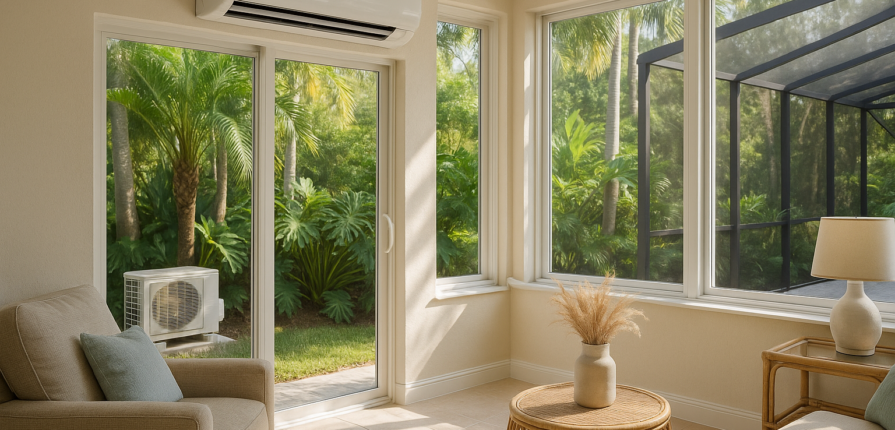
TL;DR: A ductless mini-split is usually the most practical way to add cooling and heating to a garage, sunroom, or addition in Central Florida because it skips extending ductwork, runs on high-efficiency inverter technology, and gives you a dedicated zone you control separately from the rest of the house. It isn’t free of tradeoffs, though — upfront cost, line-set distance limits, and permitting all factor into whether it’s the right call for your space.
If you’ve converted your garage into a workshop, added a Florida room, or built an addition onto your home near Tavares, Zellwood, or Grand Island, you’ve probably run into the same problem: that space is either an oven by 10 a.m. or stuck without any climate control at all. Extending your existing ductwork is often expensive, disruptive, or just not possible. That’s where a ductless mini-split comes in.
This guide explains what a mini-split is, how it works, the real pros and cons for Central Florida conditions, and how to know if it’s the right fit for your garage, sunroom, or addition.
What Is a Ductless Mini-Split, Exactly?
Ductless heat pumps, or mini split heat pumps, are an alternative to radiator or baseboard heating, as well as a replacement for window units for cooling, and no duct work is needed. A small indoor wall or ceiling-mounted unit connects to an outdoor condenser through a thin refrigerant line set run through a 2-3 inch hole in the wall — no bulky ductwork required.
The outside unit extracts heat from the air, even when it’s cold, and in warmer months, the system works in reverse for quiet, efficient air conditioning. That means one system handles both your addition’s summer cooling and winter heating needs — a real advantage during Central Florida’s occasional cold snaps.
Why Garages, Sunrooms, and Additions Are a Natural Fit
These spaces share a common problem: they sit outside the reach of your main HVAC system’s ductwork. Running new supply and return ducts from your existing air handler to a converted garage or a bump-out addition usually means tearing into walls, ceilings, or attic space — and even then, the extra duct run can strain a system that wasn’t sized for the added square footage.
A mini-split sidesteps that entirely. You get a dedicated zone with its own thermostat control, so you’re not cooling (or paying to cool) a garage or sunroom that only gets used a few hours a day.
Common Central Florida Use Cases
- Converted garages used as home offices, gyms, or workshops in Tavares, Mount Dora, and Eustis
- Florida rooms and sunrooms added onto homes in Leesburg, Fruitland Park, and The Villages
- New additions and in-law suites in growing neighborhoods around Apopka and Sorrento
- Detached studios, she-sheds, or pool houses near Grand Island, Zellwood, and Astor
- Rental units or accessory spaces for landlords and property managers managing properties across Lake and Orange counties
How a Mini-Split Installation Actually Works
- Sizing the unit. A technician calculates the room’s heat load based on square footage, insulation, window exposure, and ceiling height — garages and sunrooms often need different BTU capacity than a typical bedroom.
- Placement. The indoor head goes on an interior wall or ceiling; the outdoor condenser sits on a pad or bracket nearby.
- Line set routing. Refrigerant lines run through the wall connecting indoor and outdoor units. Distance matters here — most single-zone systems support roughly 65–100 ft for single-zone ductless mini-splits, so a detached garage far from a logical power/condenser location may need extra planning.
- Electrical and permitting. The unit needs a dedicated electrical circuit, and in Florida, a mechanical and often electrical permit is required.
- Commissioning. The line set is vacuum-tested and charged, then the system is tested for proper operation.
Permits: Don’t Skip This Step
Some homeowners assume a small ductless unit doesn’t need a permit the way a full AC replacement would. It does. Under the Florida Building Code, Building Chapter 1, section 105.2, a permit requirement applies broadly, with narrow exceptions like portable HVAC equipment or replacement of parts that doesn’t alter approval or create a hazard. Mini-split systems installed in garages, new construction additions, and converted spaces specifically fall under the Florida Building Code, Mechanical Chapter 3, and Section 301.15 requirements, and permits typically trigger both rough-in and final inspections.
A licensed, insured contractor pulls these permits as part of the installation — one more reason to avoid a weekend DIY install or an unlicensed handyman for this kind of work.
Pros of a Mini-Split for a Garage, Sunroom, or Addition
- No ductwork required. You avoid the cost and disruption of extending existing ducts into a space that wasn’t originally designed for central air.
- High efficiency. Mini-splits typically carry SEER2 ratings of 18–42, while central AC systems range from 13 to 21 SEER2, with the advantage coming from inverter technology and the elimination of duct losses. Our SEER2 ratings guide breaks down what those numbers mean for your bill.
- Zoned comfort. You control the garage or sunroom temperature independently, so you’re not running the whole-house system harder to cool a space you use occasionally.
- Eliminates duct losses. Mini-splits cool directly from the unit, rather than passing through ductwork, eliminating energy losses from ductwork which can account for more than 30% of a home’s energy use for space conditioning.
- Heating and cooling in one system. Useful for sunrooms and additions that get chilly on rare Central Florida cold mornings.
- Quieter operation than a window unit, with sophisticated compressors and fans that can adjust speeds to save energy and money.
Cons and Limitations to Consider
- Higher upfront cost than a window unit. Mini-splits cost more initially than a box fan or portable AC, though they outperform both in comfort and efficiency long-term. See our ductless mini-split cost guide for Central Florida for real local pricing ranges.
- Line set distance limits. Detached garages or additions far from a practical condenser spot may need creative routing or a larger system — most manufacturers set a minimum line set length around 15–16 ft and a standard maximum of 50–75 ft per zone.
- Indoor unit is visible. Unlike hidden ductwork, the wall or ceiling-mounted head is part of the room’s look — not a dealbreaker for most garages, but worth considering for a finished sunroom.
- Permitting and electrical work required. This isn’t a plug-and-play appliance; it needs a licensed installer, a dedicated circuit, and local permits.
- Not ideal for extremely large, open spaces without proper load calculations — oversizing or undersizing a unit hurts both comfort and efficiency.
Single-Zone vs. Multi-Zone: Which Do You Need?
A single garage or sunroom typically only needs a single-zone system — one indoor head, one outdoor condenser. If you’re conditioning an addition with multiple rooms (say, an in-law suite with a bedroom, bathroom, and living area), a multi-zone system lets one outdoor condenser support several indoor heads, each with independent control.
Many of today’s mini-splits also use two-stage or inverter-driven compressors that ramp output up and down rather than simply cycling on and off, which matters a lot in Florida’s long cooling season. If you’re also comparing options for a whole-home or larger-space upgrade, our two-stage vs. inverter AC guide explains the difference in plain terms.
When a Mini-Split Makes the Most Sense
A ductless mini-split is usually the right call when:
- The space is detached or disconnected from your main ductwork (garage, pool house, detached office)
- You use the room often enough that a window unit or portable AC isn’t cutting it, but not enough to justify extending central ductwork
- You want independent temperature control separate from the rest of the house
- You’re finishing a new addition and want efficient, code-compliant heating and cooling built in from the start
- You’re a landlord or property manager who wants a reliable, low-maintenance comfort solution for a converted space or accessory unit
If your garage or addition is large, already ducted, or part of a bigger renovation where extending central air is feasible, a traditional split system might make more financial sense — this is exactly the kind of call our technicians walk through with you during a free estimate.
Get a Straight Answer for Your Space
Every garage, sunroom, and addition is different — square footage, insulation, sun exposure, and how you actually use the space all affect what size and type of system makes sense. Lucas Air Conditioning and Heating offers free estimates on new installations throughout Tavares, Zellwood, Grand Island, Astor, Paisley, Clarcona, and the rest of Lake and Orange County, with no upselling and straight answers from a veteran-owned, locally run team. Check our current seasonal specials before you book your estimate.
Recommended Reads
- How Much Does a Ductless Mini-Split Cost in Central Florida?
- Landing Page for Seasonal Specials – Online Booking – Lucas Air Conditioning and Heating
- Landing Page for Seasonal Specials – Lucas Air Conditioning and Heating
