
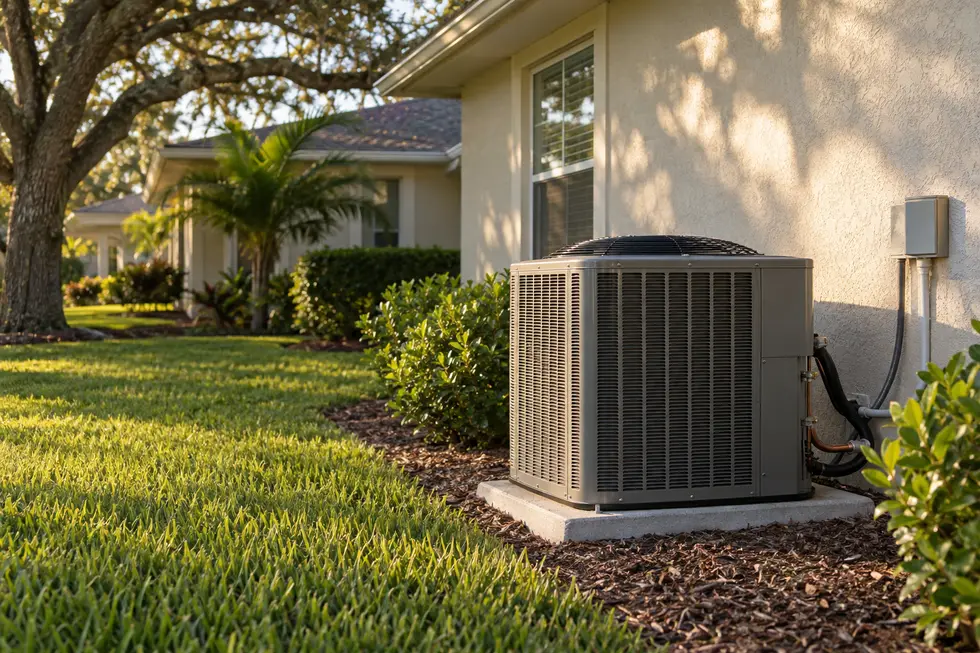
TL;DR: When an AC makes a buzzing noise at the outside unit, the cause is usually an electrical part under strain: a weak capacitor, a worn contactor, a failing fan motor or a compressor that can’t start. A soft hum is normal. A loud buzz while the fan sits still is not, so turn the system off and call a licensed tech before the compressor overheats.
An AC making a buzzing noise at the outside unit usually has an electrical part under strain. The usual suspects are a weak capacitor, a worn contactor, a failing fan motor or a compressor that can’t start. A soft, steady hum is normal. A loud buzz while the fan sits still is not, so turn the system off at the thermostat and call a tech.
In Tavares, outdoor units run for most of the year, so these parts wear out faster than they would up north. Below you’ll learn how to tell one buzz from another, what you can safely check yourself and when it’s time for a technician.
Is Some Buzzing From the Outdoor Unit Normal?
Yes. A low, even hum while the system runs is normal. The compressor and fan motor both make some electrical noise, and the contactor can hum faintly while it’s closed. The contactor is the switch that sends power to the compressor and fan.
Worry when the sound gets louder, harsher or different from what you’re used to. Then check three things: when the buzz starts, whether the fan on top is spinning, and whether the house is still getting cold air. Those clues narrow down the cause quickly.
What Causes an AC Making a Buzzing Noise at the Outside Unit?
Most outdoor buzzing comes from one of five problems. Some are small fixes. A couple can lead to a dead compressor if the unit keeps running.
1. A weak or failed capacitor
The capacitor gives the fan motor and compressor an electrical boost to start. When it weakens, the motor still gets power but can’t turn over, so it just sits there and buzzes. Heat is hard on capacitors, and Central Florida has plenty of it.
2. A worn or blocked contactor
The contactor closes when your thermostat calls for cooling. Over time, its contact points get pitted and can buzz or chatter. In Florida, bugs make this worse. UF/IFAS Extension notes that fire ants nest inside electrical equipment and utility housings, sometimes causing short circuits. Dead ants caught between the contacts can keep the switch from closing all the way.
3. A failing condenser fan motor
If the unit buzzes and the fan on top won’t spin, or spins slowly, the motor or its capacitor may be failing. Without that fan, heat can’t leave the outdoor coil, and the compressor runs hot.
4. A compressor struggling to start
A loud buzz for a few seconds, then a click and silence, often means the compressor tried to start and couldn’t. It may shut off on its internal overload or trip the breaker. Sometimes the cause is a bad capacitor, which is a fairly simple repair. Other times the compressor itself is worn out. If that happens on an older system, you may want to weigh repair against replacement. Our guide on how long an AC unit lasts in Florida can help with that decision.
5. Loose parts or wiring
A rattling buzz that changes with the fan speed is often a loose panel, screw or fan guard. A crackling buzz near the electrical box can mean a loose wire connection, and loose connections can overheat. Treat any crackling sound or burning smell as urgent.
How Can You Tell Which Part Is Buzzing?
Compare what you see and hear to the table below. It won’t replace a technician’s meter reading, but it shows you how urgent the problem is.
| What you notice | Likely cause | How urgent | Keep running it? |
|---|---|---|---|
| Steady low hum, fan spinning, house cooling | Normal operation | Not urgent | Yes |
| Loud buzz, fan not spinning | Fan capacitor or fan motor | Same day | No, turn it off |
| Buzz for a few seconds, then a click, repeating | Compressor not starting | Same day | No, turn it off |
| Buzz or chatter with the thermostat off | Stuck or blocked contactor | Soon | Turn off the AC breaker |
| Rattling buzz that follows the fan | Loose panel, guard or debris | Low | Usually, but have it checked |
What Should You Do Right Now If the Outside Unit Is Buzzing?
Start by turning the system off at the thermostat. If the buzzing continues, switch off the AC breaker in your electrical panel. Then:
- Look, but don’t touch. See whether the fan blades are moving and whether anything is caught in the top grille.
- Pull grass clippings, leaves and vines away from the unit by hand. The U.S. Department of Energy warns that dirty filters and coils can cause early compressor or fan failure.
- Don’t push-start the fan with a stick. It’s a common internet tip, and it puts your hands near moving blades and live wiring.
- Don’t open the electrical cover on the unit. Capacitors can hold a charge even after the power is off. That’s why OSHA’s electrical work rules require capacitors to be discharged before anyone works on the equipment.
- If the breaker trips, reset it once. If it trips again, leave it off and call a technician.
Signs you need to call a pro
- The unit buzzes but the fan won’t spin
- The buzz comes back every few minutes with a click
- The breaker trips more than once
- You hear crackling or smell something burning
- The unit buzzes even with the thermostat off
- Warm air is coming from your vents
If you hear squealing, grinding or banging instead, see our guide to what different AC noises mean.
Why Do Outdoor Units in Lake County Buzz More Often?
The main reason is Central Florida’s long cooling season. With this much heat and humidity, an outdoor unit in Tavares runs for most of the year, and every start wears on the capacitor and contactor. Heat pumps are the most common heating system here, so the same outdoor unit often runs on cool winter mornings too. A heat pump in defrost mode can make a whoosh or a short buzz. That’s normal if it stops after a few minutes.
The yard plays a part too. Many homes around Astor and Paisley sit on wooded lots, so leaves and ant mounds tend to pile up around the pad. Outdoor units here also sit on pads with hurricane straps. If a strap or bracket works loose, it can rattle and buzz against the cabinet.
Why Homeowners Call Lucas Air Conditioning and Heating
- Lucas Air Conditioning and Heating, LLC is based at 15800 Old US Hwy 441 in Tavares.
- U.S. Army veteran Cameron Lucas founded the company in early 2018 after 8 years with the 82nd Airborne Division.
- The company holds Florida license CAC1819409.
- A diagnostic visit is $125 residential and $135 commercial.
- The company has 5.0 stars on Google with more than 1,000 reviews.
- Office hours are Monday through Friday, 8:00 AM to 5:30 PM, and a technician is on call after hours for emergencies.
- The Preventative Maintenance Agreement is $129 a year and includes one tune-up, 15% off parts and priority scheduling.
You can learn more about our HVAC contractor team in Tavares on our homepage.
If your outdoor unit is buzzing, turn it off and call (352) 805-0359, or book a service appointment online.
Frequently Asked Questions
How much does it cost to diagnose a buzzing AC unit in Tavares?
Lucas Air Conditioning and Heating charges $125 for a residential diagnostic and $135 for a commercial one. The repair cost depends on which part failed. A capacitor or contactor usually costs much less to fix than a compressor.
Can I keep using my AC if the outside unit buzzes but the house still cools?
If the buzz is new or louder than usual, have it checked soon, even if the house still feels cool. A weak capacitor or a struggling fan motor can let the compressor overheat, and the compressor is the most expensive part in the outdoor unit.
Should I spray bug killer inside my AC unit for ants?
No. Don’t spray into the electrical compartment. Texas A&M’s fire ant program advises extreme care when using any insecticide around electrical equipment. Treat mounds around the pad according to the product label, and have a technician clean any ant debris out of the contactor.
Why does my AC buzz when I turn it on after being away for months?
If you’re a seasonal resident, ants or debris may have collected in the outdoor unit while you were gone, or a capacitor may have weakened as it sat. If the fan doesn’t spin within a few seconds of startup, shut the system off and have it checked before running it again.
Recommended Reads
- What Different AC Noises Mean — and When to Call a Tech
- How Long Does an AC Unit Last in Florida — and What Shortens Its Life?
- Hurricane Prep for Your AC Unit: A Tavares Homeowner’s Checklist