
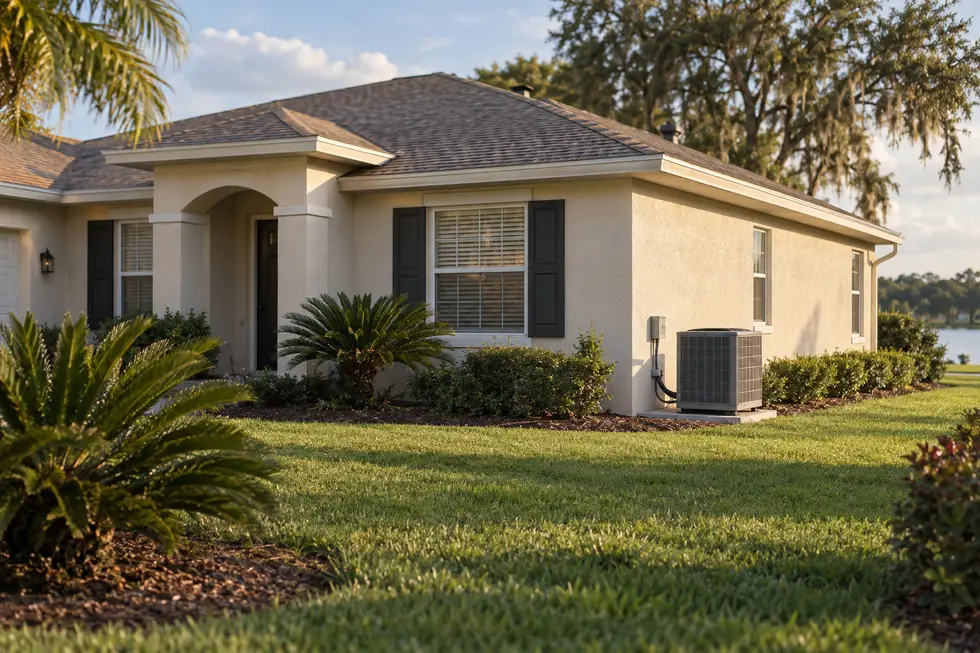
TL;DR: Most Florida AC systems are sized to hold about 75°F indoors on a hot day, but not on the very hottest afternoons of the year. If your system blows cold air, runs nonstop and loses a few degrees late in the day but catches up by night, it may just be at its limit. Warm air, ice on the lines, an outdoor unit that won’t run or a house that never catches up all point to a real problem that needs a licensed technician.
When your AC is not cooling your house in Florida, first figure out if the system is broken or just at its limit. Most central systems are built to hold about 75°F indoors on a typical hot day, not on the hottest afternoon of the year. If the air from the vents is cold and the house catches up by evening, it may be working as designed.
If the air feels warm, the house never catches up or you see ice, something is wrong. This guide explains how cooling capacity works, how to tell the two apart at home and when a Tavares homeowner should call for a diagnostic. If you already know something is off and want a list of causes, see our checklist of 8 reasons an AC isn’t cooling enough.
Why is my AC not cooling my house in Florida heat?
Often it’s because the heat outside is more than the system was sized to handle at that moment. Contractors size home systems with a load calculation called ACCA Manual J. According to the Air Conditioning Contractors of America, the standard indoor cooling target is 75°F at 45%, 50% or 55% relative humidity. That target is measured against a local outdoor design temperature called the 1% value.
The 1% value is a hot day for your area, but it’s not the hottest day. Only a small slice of summer hours run hotter than it. On those afternoons, even a correctly sized system can run all day and still drift a few degrees above the thermostat setting.
Central Florida makes this harder. We get long stretches of heat and humidity, attics that bake in the sun and a cooling season that lasts most of the year. A west-facing living room with big windows can gain heat faster than the vents can remove it between about 3 and 6 PM. That’s a heat load problem, and it doesn’t always mean something needs repair.
How does an AC actually remove heat and humidity?
Your AC doesn’t make cold. It moves heat from inside to outside. A blower pulls warm indoor air across the cold evaporator coil in the air handler. Refrigerant in that coil absorbs the heat. The compressor then pumps it to the outdoor condenser, where a fan blows the heat outside. Moisture in the air condenses on the cold coil and runs out the drain line, which is why Florida systems drip so steadily.
Removing moisture is half the job here. UF/IFAS Extension notes that Floridians rely on AC to lower humidity as well as temperature. It explains that a system with a sensible heat ratio of 0.7 spends 70% of its effort cooling and 30% removing moisture. A house at 76°F and sticky can feel worse than one at 78°F and dry, so sometimes the real problem is humidity, not temperature. Heat pumps, the most common heating system around here, cool exactly the same way in summer.
Is your AC broken, or just maxed out?
Watch how the system behaves over a full day, not just one hot afternoon. These are the patterns that help sort the two.
| What you notice | Likely maxed out (normal) | Likely a problem |
|---|---|---|
| Air at the vents | Feels cold and steady | Lukewarm, barely cool or warm |
| Indoor temperature | Drifts a few degrees above the setting late in the day | Climbs all day, even in the morning |
| Overnight | Catches back up to the setting by evening or overnight | Never reaches the setting, even at night |
| Outdoor unit | Fan spinning, warm air blowing out the top | Fan stopped, humming, buzzing or clicking on and off |
| Copper lines and drain | Larger line cool and sweating, drain dripping | Ice on the lines or coil, or no water draining on a humid day |
What should you check before calling a technician?
A few safe checks take about 10 minutes and sometimes solve the problem.
- Thermostat: Make sure it’s set to Cool, the fan is on Auto and the setting is below the room temperature. Replace the batteries if it uses them. Our guide on why a thermostat never reaches the set temperature goes deeper.
- Filter: Pull it out and hold it up to a light. ENERGY STAR recommends checking filters monthly and warns that a dirty filter can damage equipment.
- Breakers: Check the breakers for both the air handler and the outdoor unit. If one trips again, leave it off and call.
- Outdoor unit: Clear away plants, grass clippings and storm debris. After hurricane season, make sure nothing from storm prep is still stacked against it.
- Vents and returns: Make sure supply vents are open and the return grille isn’t blocked by furniture.
- Sun: Close the blinds on sun-facing windows in the afternoon to cut the heat load.
Stop there. Coils, refrigerant and electrical parts need a licensed technician. ENERGY STAR notes that dirty coils reduce a system’s ability to cool and make it run longer, and coil cleaning belongs in a professional check-up.
Signs you need to call a pro
- The air from the vents is warm or only slightly cool.
- There’s ice on the copper lines or indoor coil. Turn cooling off so it can thaw, and call.
- The outdoor fan isn’t spinning while the thermostat is calling for cooling.
- You hear buzzing or grinding, or you smell burning.
- A breaker trips more than once.
- The house never catches up overnight, even after it cools off outside.
- Water is pooling around the air handler, or the drain line stops dripping.
- The house feels damp and sticky even when the thermostat reads normal.
Refrigerant doesn’t get used up. If a system is low, there’s a leak somewhere, and adding more without finding the leak only buys time.
What if your AC works but still can’t keep up?
If nothing is broken, the problem is usually the size of the system or changes to the house. A technician can measure the temperature drop across the indoor coil, check airflow and look for leaking ductwork in the attic. If everything checks out and the system still can’t hold temperature on normal summer days, it may be too small for the home. Or the home may have changed since it was installed, like a new sunroom, a converted garage or someone now working from home all day.
Bigger isn’t automatically better. UF/IFAS says a system sized close to the actual load controls humidity better than an oversized one. An oversized unit cools fast, shuts off and leaves the air damp. Age plays a part too, since parts wear and capacity can drop over the years. To weigh your options, read our Florida guide to AC repair vs. replacement. Whether your home is in downtown Tavares or out toward Zellwood, the answer depends on that specific house: its windows, attic insulation, ducts and how the sun hits it.
Why homeowners call Lucas Air Conditioning and Heating
- Lucas Air Conditioning and Heating, LLC is a licensed Florida HVAC contractor, license CAC1819409.
- The office is at 15800 Old US Hwy 441 in Tavares.
- Cameron Lucas founded the company in early 2018 after 8 years in the U.S. Army with the 82nd Airborne Division.
- The company has a 5.0-star Google rating with more than 1,000 reviews.
- A residential diagnostic is $125, and a commercial diagnostic is $135.
- At Colonial Pines apartments in Tavares, the team replaced 30 split systems and installed 2 ductless units in 10 working days.
- Office hours are Monday through Friday, 8:00 AM to 5:30 PM, and a technician is on call after hours for emergencies.
If your house is losing the fight with the heat, call (352) 805-0359 or schedule an appointment online.
Frequently Asked Questions
Will setting the thermostat lower help my AC cool the house faster?
No. A central AC cools at the same rate no matter how low you set it. Setting it very low just makes it run longer and use more power, so pick your normal setting and give it time.
Is it normal for my AC to run all day during a Florida summer?
On the hottest afternoons, long run times are normal for a correctly sized system. If it runs all day on mild days and the house still warms up, have it checked.
How much does Lucas Air charge to diagnose an AC that isn’t cooling?
A diagnostic is $125 for homes and $135 for commercial properties. Free estimates are for new system installations only.
Can a tune-up help an AC that’s struggling to keep up?
It can help if dirt on the coils or a clogged filter is part of the problem. A tune-up won’t fix a refrigerant leak or a system that’s too small for the house. Lucas Air’s precision tune-up is $125.
What if my AC quits cooling after office hours in Tavares?
Lucas Air isn’t a 24/7 company, but a technician is on call after hours for emergencies. Call (352) 805-0359.
Recommended Reads
- 8 Reasons Your AC Isn’t Cooling Enough (And What to Do About Each)
- The R-454B Refrigerant Switch: What Florida Homeowners Need to Know
- Why Your Thermostat Never Reaches the Set Temperature (And How to Fix It)