
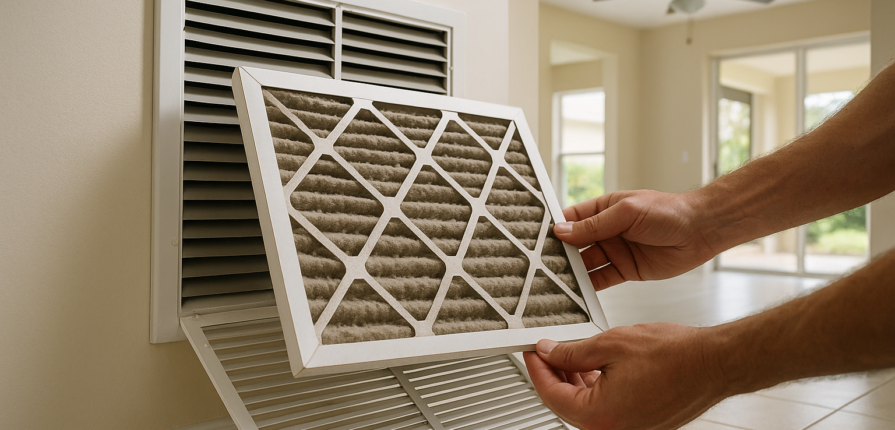
TL;DR: Most Lake and Orange County homes should check their AC filter monthly and replace a standard 1-inch filter every 30-60 days, since Florida’s year-round cooling season and humidity load filters faster than the national average. Pets, allergies, and heavy system use push that down to 20-30 days, while thicker media filters can stretch to 6-12 months.
If you’ve ever pulled an AC filter out expecting a light dusting and found a gray, matted mess instead, you already know Florida plays by different rules. Between the humidity rolling off the Harris Chain of Lakes and an AC that barely gets a day off between March and November, filters in Tavares, Clarcona, Astor, Paisley, Grand Island, and Zellwood work harder than filters almost anywhere else in the country.
Here’s the straightforward answer, plus the local factors that should move you off the national default.
The National Baseline — And Why Florida Changes It
Most manufacturer and government guidance starts with a simple rule.
Check your filter every month, especially during heavy use months, and if the filter looks dirty after a month, change it. At a minimum, change the filter every 3 months.
That’s a reasonable starting point in a climate with distinct heating and cooling seasons. But Lake and Orange County homeowners run their AC nearly year-round, not just a few peak months.
Because Florida is hot and humid nearly year-round, AC systems run longer and harder than in other states, which means filters trap more dust and moisture and should be checked monthly and replaced more often during peak summer.
Industry sources that focus specifically on Florida homes generally land on a tighter window than the national average.
For most Florida homeowners, changing the HVAC filter every 30 to 90 days is a good rule of thumb.
Several Central Florida guides narrow that further, noting
most Florida homes should change HVAC filters every 30-60 days.
How Often, By Household Situation
The right interval depends on what’s actually happening inside your home, not just the calendar. Use these as starting points, then adjust based on what the filter looks like when you check it.
- No pets, low dust, average household: Every 60-90 days during cooler months; tighten to 30-45 days in peak summer.
- One pet:
HVAC systems for pet owners typically need more frequent changes, every 30-45 days, since pet hair and dander clog filters quickly. - Multiple pets or heavy shedding seasons:
With multiple pets, check it monthly — during spring and fall shedding seasons, filters can fill with pet hair in just 4-6 weeks. - Allergy or asthma sufferers:
Change your air filter every 30 to 60 days, since Florida’s high humidity and year-round pollination mean filters work much harder here than in other states. - Vacation homes, seasonal residents, and snowbird properties: If the house sits empty part of the year, the system runs less, so filters can often stretch closer to the 90-day mark — but always check before you leave for the season and right when you return, since humidity and dust can still build up in an unoccupied home.
Filter Thickness Matters Too
Not every filter is built the same, and thickness has a bigger effect on lifespan than most homeowners realize.
A thicker filter has far more surface area to hold dust before it clogs: a 1-inch fiberglass or pleated standard filter needs changing every 1-3 months, a 2-inch pleated filter every 3-6 months, and a 4-to-5-inch deep-pleated media filter every 6-12 months.
If you’re not sure which type is installed in your system, or whether a higher-efficiency filter makes sense for your home, our MERV ratings guide breaks down how filter efficiency and airflow trade off against each other — important in a humid climate where you don’t want to accidentally choke airflow on an older system.
Why This Matters More in a Florida Climate
Skipping filter changes isn’t just an air-quality issue — it’s an efficiency and equipment-life issue, and the stakes are higher here.
Energy Costs Climb Fast
A clogged filter restricts airflow, and the system compensates by running longer and harder.
The U.S. Department of Energy notes that swapping a dirty filter for a clean one can cut an AC’s energy use by roughly 5-15%.
In a county where the compressor runs most of the year, that inefficiency compounds month after month instead of just during a short cooling season.
Humidity Makes Dirty Filters Worse
Florida’s moisture load doesn’t just mean more particles — it changes how those particles behave.
High humidity makes these particles stickier and can lead to mold growth on dirty filters, further restricting airflow.
A moldy filter can also push musty odors and spores right back into the rooms you’re trying to keep clean.
Strain on Components That Are Expensive to Replace
Restricted airflow doesn’t stay contained to the filter slot. It can ice up the evaporator coil, stress the blower motor, and shorten the life of parts like the compressor and capacitor. If you’ve noticed your system short-cycling or struggling to reach the set temperature, a neglected filter is one of the first things worth ruling out — see our guide on why your thermostat never reaches the set temperature for the full list of culprits. A clogged system can also back up condensate, which is a common contributor to the issues covered in our condensate drain line guide.
Signs It’s Time to Change the Filter — Even Off-Schedule
A calendar reminder is a good habit, but your system will usually tell you before the date does.
- The filter looks visibly gray, matted, or coated in pet hair
- Airflow from the vents feels weaker than usual
- Your energy bill creeps up without an obvious reason
- Dust settles on furniture faster than normal
- Musty or stale odors when the AC kicks on
Even if you’re following a set schedule, check your filter regularly for visible dirt and dust buildup, reduced airflow, increased energy bills, more dust accumulation in your home, and worsening allergy symptoms.
A Simple Schedule for Lake and Orange County Homes
- Check monthly, no exceptions. Set a recurring reminder — the first of the month works well.
- Replace on sight if it’s dirty. Don’t wait for a specific day if the filter already looks loaded.
- Default to 30-45 days in peak summer (roughly May through October) when the system runs nearly nonstop.
- Stretch to 60-90 days in cooler months if you have no pets and low indoor dust.
- Shorten the interval for pets, allergies, or recent renovation dust.
If keeping track feels like one more thing on your plate, our Preventative Maintenance Agreement includes a tune-up and 15% off parts, which makes it easy to have a professional set eyes on your filter, coil, and airflow twice a year — on top of whatever changes you’re doing at home in between.
When to Call a Professional
Changing the filter is a DIY task for nearly every household. But if you’ve been swapping filters on schedule and still notice weak airflow, rising bills, or a system that won’t hold temperature, the problem may be upstream of the filter — a failing capacitor, a refrigerant issue, or duct leakage. Our team serves Tavares, Eustis, Leesburg, Mount Dora, The Villages, Lady Lake, Fruitland Park, Umatilla, Sorrento, Howey-in-the-Hills, and Apopka, along with Clarcona, Astor, Paisley, Grand Island, and Zellwood, and we’re happy to take a look. If your system is getting older, it’s also worth knowing that new refrigerant regulations are changing what replacement equipment looks like for Florida homeowners.
As a veteran-owned company founded by an 82nd Airborne veteran, we believe in giving homeowners honest, straightforward answers — not upsells. A clean filter is one of the cheapest ways to protect your investment and keep your home comfortable through another Central Florida summer.
Recommended Reads
- MERV Ratings Explained: How to Choose the Right AC Filter for Your Home
- The R-454B Refrigerant Switch: What Florida Homeowners Need to Know
- How to Tell If Your AC Capacitor Is Failing — and What It Costs to Fix
