
TL;DR:
- Neglected AC maintenance can waste up to 30% of energy in Florida’s humid climate.
- Monthly tasks include replacing filters and flushing drain lines, while semi-annual check-ups are essential.
- Professional tune-ups every six months help prevent costly breakdowns and ensure system efficiency.
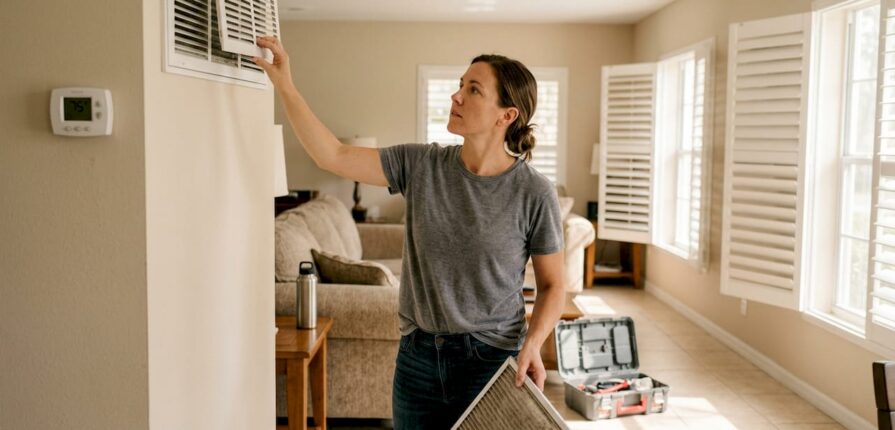
If your energy bill keeps climbing even though you haven’t changed your habits, your air conditioner is probably the culprit. Neglected AC maintenance can waste up to 30% of the energy your system uses, and in Central Florida, where your AC runs almost year-round, that adds up fast. Between the relentless humidity, long cooling seasons, and fine pollen that clogs filters quickly, Florida homes simply can’t follow the once-a-year maintenance advice written for northern climates. This guide gives you a clear, step-by-step plan built specifically for Central Florida homeowners who want to stay comfortable without overpaying.
Table of Contents
- What you need before starting: Tools, safety, and maintenance schedule
- Step-by-step AC maintenance: Monthly and quarterly essentials
- Semi-annual and annual maintenance: What to check and when to call a pro
- Common mistakes and troubleshooting: How to avoid energy waste and breakdowns
- An expert’s take: Why Florida AC maintenance isn’t just ‘set it and forget it’
- Stay cool: Get professional help for total AC peace of mind
- Frequently asked questions
Key Takeaways
| Point | Details |
|---|---|
| Monthly filter changes | Keeping filters clean drastically improves air quality and lowers energy costs year-round. |
| Quarterly coil cleaning | Removing Florida dust from coils prevents up to 21% efficiency loss. |
| Biannual tune-ups | Semi-annual professional service prevents most breakdowns and is superior to annual alone in Florida. |
| Spot and fix mistakes early | Knowing common errors helps you save money and avoid AC emergencies. |
| Know when to call a pro | Professionals should handle electrical, refrigerant, and duct repairs for optimal safety and system life. |
What you need before starting: Tools, safety, and maintenance schedule
Once you know why AC maintenance is so important, here’s what you need to get started. Gathering the right tools before you begin saves time and keeps you from stopping mid-task to hunt down supplies.
Here are the basic supplies every homeowner should have on hand, following basic tools and methods recommended for DIY maintenance:
- Work gloves and safety glasses
- Flashlight or headlamp
- Wet/dry vacuum
- Soft-bristle brush and fin comb
- Replacement air filters (check your unit’s size first)
- White vinegar or diluted bleach for drain line flushing
- Screwdriver set
Always disconnect power to your AC unit at the breaker before touching any internal components. This is not optional. Even a brief contact with live wiring can be fatal.
Safety warning: Never skip the power shutoff step. Turn off both the thermostat and the breaker before opening any access panels or touching electrical components.
Central Florida’s climate means your AC works harder than systems in most other states. Because of that, monthly, quarterly, semi-annual, and annual tasks are all necessary here, not just an annual checkup. Use this maintenance checklist as your ongoing reference.
| Frequency | Task |
|---|---|
| Monthly | Check/replace air filter, inspect drain pan |
| Quarterly | Clean coils, flush condensate drain, clear outdoor unit |
| Semi-annually | Professional tune-up, electrical inspection |
| Annually | Ductwork inspection, refrigerant check, full system evaluation |
Step-by-step AC maintenance: Monthly and quarterly essentials
Now that you have your materials and schedule, let’s dive into the core monthly and quarterly tasks. These are the steps that make the biggest difference in energy costs and system reliability.
Monthly tasks:
- Check your air filter. Hold it up to light. If you can’t see light through it, replace it. A clogged filter forces your system to work harder, raising your bill immediately.
- Inspect the condensate drain pan under your indoor unit. If you see standing water, you likely have a slow clog forming.
- Flush the condensate drain line with a cup of white vinegar. This prevents algae buildup, which is extremely common in Florida’s humidity.
- Walk around the outdoor unit and remove leaves, grass clippings, or shrubs growing within two feet of the unit.
Quarterly tasks:
- Clean the evaporator coil (indoor) and condenser coil (outdoor) using a soft brush. Even a thin layer of dust drops efficiency fast. A dust layer of just 0.042 inches on the evaporator coil can reduce efficiency by 21%.
- Straighten bent fins on the outdoor unit using a fin comb. Bent fins restrict airflow.
- Test your thermostat settings to confirm the system responds correctly to temperature changes.
For a complete breakdown of monthly and quarterly tips, reviewing a detailed resource can help you catch steps that are easy to miss.
Pro Tip: Set a recurring monthly reminder on your phone labeled “AC filter check.” You don’t have to replace it every month, but checking it keeps you from missing a clogged filter for three or four months in a row.
Building seasonal tune-ups into your schedule around these DIY steps gives you a complete protection plan that covers what you can do yourself and what requires professional tools.
Semi-annual and annual maintenance: What to check and when to call a pro
Beyond basic maintenance, there are critical tasks requiring attention every six and twelve months. Some of these you can handle yourself, but several require a licensed technician with specialized equipment.
Tasks every six months:
- Check refrigerant levels (pro only)
- Inspect electrical connections and capacitors (pro only)
- Clean evaporator and condenser coils thoroughly
- Lubricate fan motor bearings if applicable
- Test system controls and safety shutoffs
Tasks every twelve months:
- Full ductwork inspection for leaks or disconnections
- Blower motor and belt inspection
- Full system performance test and efficiency review
Here’s a quick comparison of what you can handle versus what should stay in a professional’s hands:
| Task | Homeowner | Pro required |
|---|---|---|
| Filter replacement | Yes | No |
| Drain line flushing | Yes | No |
| Coil surface cleaning | Yes (light) | Yes (deep) |
| Refrigerant handling | No | Yes |
| Electrical component checks | No | Yes |
| Ductwork sealing | No | Yes |
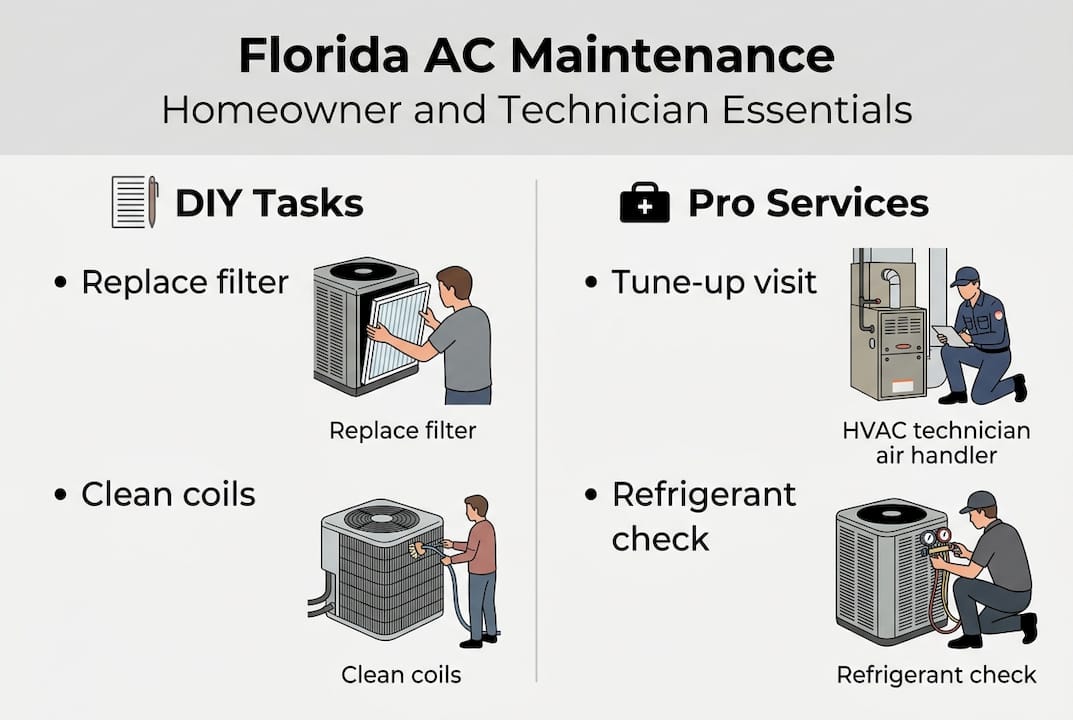
For Florida homes, semi-annual professional tune-ups are optimal, not just one annual visit. The heat and humidity here stress the system far more than a single yearly checkup can address. See professional AC tune-up details to understand what a proper visit should include, and review why tune-ups matter for the long-term cost picture.
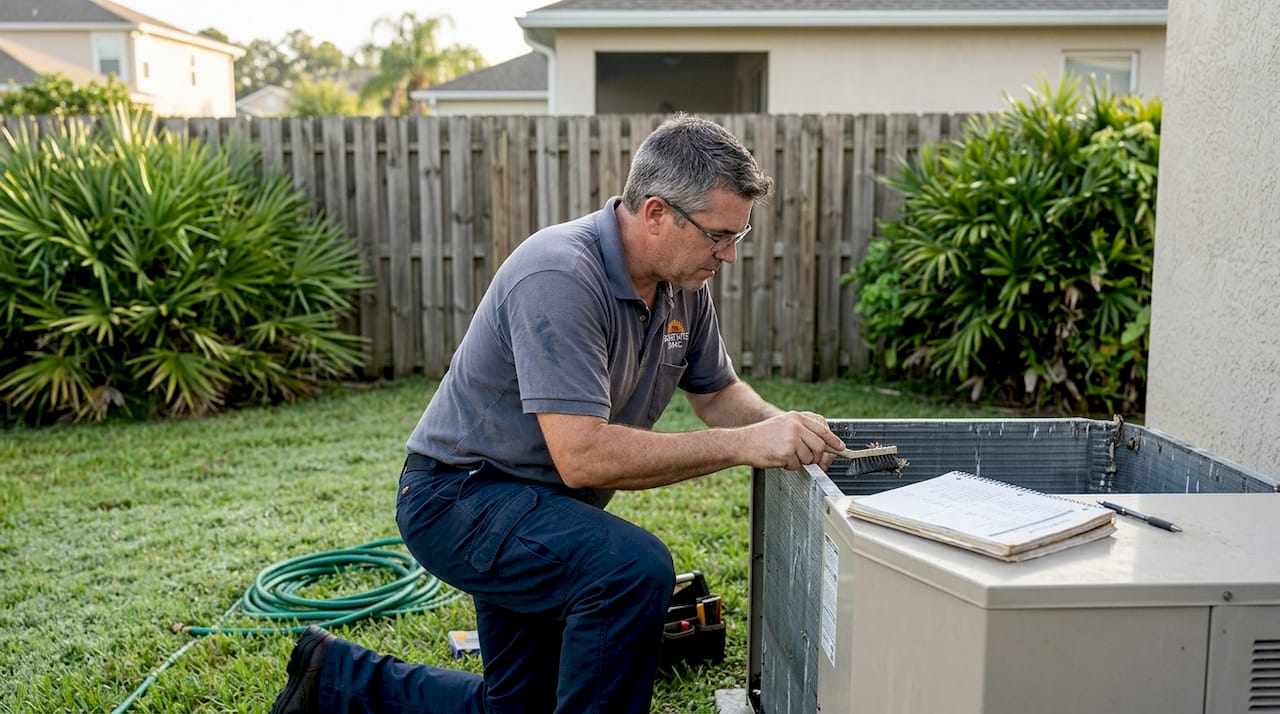
When your technician visits, ask them to work through an ASHRAE 180 checklist. This is a standardized inspection protocol (developed by the American Society of Heating, Refrigerating and Air-Conditioning Engineers) that ensures nothing gets skipped. A quality pro won’t hesitate to walk you through it.
Pro Tip: Ask your technician to show you before and after photos of the coils. A good pro documents this routinely, and seeing the difference will motivate you to stay consistent with your own maintenance steps.
For more detail on what professionals evaluate during a visit, this homeowner tune-up guide breaks it down clearly.
Common mistakes and troubleshooting: How to avoid energy waste and breakdowns
Having covered routine and pro-level care, it’s just as important to know what NOT to do—or how to fix basic issues quickly. Most AC problems don’t appear overnight. They build slowly from habits that seem harmless at the time.
The most common homeowner mistakes:
- Skipping filter changes for two or three months because the system “seems fine”
- Ignoring a slow condensate drain until water damage appears
- Assuming one annual pro visit is enough for a Florida climate
- Planting shrubs or stacking items too close to the outdoor unit
- Setting the thermostat too low to “cool faster” which just runs the system longer
How to spot early warning signs:
- Warm air blowing from vents despite correct thermostat settings — often a refrigerant or coil issue
- Higher bills with no usage change — usually dirty coils or a leaking duct
- Musty odors when the system runs — a sign of mold in the drain pan or coil
- Ice forming on the indoor unit — blocked airflow or low refrigerant
Up to 30% of AC energy can be wasted through poor maintenance and duct leaks alone. That’s a significant portion of your cooling bill going straight out the window.
Cost of neglect: A single skipped season of maintenance can lead to compressor failure, which costs thousands to replace. Prevention is always cheaper than repair.
For simple issues like a tripped breaker or a frozen coil, check the basics first before calling anyone. Review this HVAC troubleshooting guide for a clear first-response process. If the issue persists, your repair workflow reference can help you communicate the problem clearly to a technician.
An expert’s take: Why Florida AC maintenance isn’t just ‘set it and forget it’
National advice about AC maintenance is written for the average climate. Florida is not the average climate. A system running nine to ten months a year in high humidity accumulates dirt, strain, and wear at a rate that simply can’t be addressed with one annual visit.
We’ve seen it repeatedly: homeowners who follow every DIY step correctly but skip the semi-annual professional visit still end up with premature compressor failures or refrigerant loss they didn’t catch in time. Those are expensive lessons.
Biannual professional maintenance is proven optimal for Florida, not annual. That’s not a sales pitch. That’s what the data and real-world service calls confirm year after year.
Smart home technology and IoT sensors that predict failures before they happen are emerging in the industry, and they’re worth watching. But time-based maintenance remains the reliable standard in 2026 for most Florida homeowners. Until predictive systems become affordable and widespread, sticking to a disciplined schedule is your best protection.
The ASHRAE 180 checklist is your accountability tool. If a technician can’t explain what they checked or show you documentation, that’s a red flag. Demand thoroughness from every pro visit. For those who want to go deeper on what proper care looks like, our deeper maintenance standards guide covers what a high-quality program actually includes.
Stay cool: Get professional help for total AC peace of mind
DIY maintenance handles the basics, but some things truly require a trained eye and the right equipment. Central Florida’s heat and humidity don’t give your AC a break, so your maintenance plan shouldn’t either.
At Lucas Air, our local technicians understand exactly what Central Florida systems go through every season. Whether you need a one-time professional AC tune-up or want to set up a maintenance agreement that keeps everything handled automatically, we make it simple. As your trusted local HVAC contractor, we bring veteran-grade reliability to every service call. Reach out today and let us help protect your comfort and your investment all year long.
Frequently asked questions
How often should I change my AC air filter in Central Florida?
Monthly filter changes are necessary in Florida due to the high pollen, dust, and year-round operation. At minimum, check it monthly and replace it whenever airflow looks restricted.
What AC tasks do I need a professional for?
Electrical checks, refrigerant handling, and ductwork sealing always require a licensed technician. Semi-annual and annual tasks involve equipment and safety risks that go beyond safe DIY territory.
What’s the real energy savings from regular AC maintenance?
Consistent maintenance can cut energy use by 15 to 30% and significantly reduce the risk of costly breakdowns. Maintenance saves 15 to 30% energy and extends your system’s useful life by years.
Is it OK to skip professional tune-ups if I do the basic steps myself?
No. DIY steps cover surface-level care, but refrigerant levels, electrical components, and deep coil cleaning need professional tools and expertise. DIY alone is not enough to keep a Florida system running at peak efficiency.
Recommended
- Seasonal HVAC Tune-Ups: Protecting Florida Homes
- 7 Steps to a Complete Home HVAC Maintenance Checklist
- Essential HVAC Preventative Maintenance Guide for Homeowners
- Why Schedule AC Tune-Ups in Eustis – Protect Home Comfort
- 7 Essential Summer Home Maintenance Tips for Massachusetts | Sabatalo Contracting
