
TL;DR:
- A SEER 14 HVAC system meets the federal baseline efficiency standard, with a current equivalent of approximately 13.4 SEER2. Its efficiency advantage over higher-rated systems depends heavily on climate, installation quality, and usage, with regional regulations now requiring at least 14.3 SEER2 in southeastern states like Florida. Proper system sizing, duct sealing, and workmanship are crucial for optimal performance, regardless of the SEER rating.
A SEER 14 HVAC system is defined as an air conditioner or heat pump that meets the federal baseline energy efficiency standard, rated at 14 Seasonal Energy Efficiency Ratio points under the original testing method. Under the newer SEER2 standard adopted in 2023, that same unit carries a rating of approximately 13.4 SEER2. For homeowners, contractors, and property managers in Central Florida and across the Southeast, understanding where SEER 14 fits in the current regulatory and cost environment is the difference between a smart purchase and an expensive mistake.

What is a SEER 14 HVAC system and how does it work?
SEER measures how efficiently an air conditioner cools your home over an entire cooling season. The number represents the ratio of cooling output in BTUs to the electrical energy consumed in watt-hours. A higher SEER number means less electricity used per unit of cooling delivered.
A 14 SEER air conditioner offers a balance of reasonable upfront cost and reliable cooling efficiency, making it a practical choice for moderate climates and homes with standard ductwork. It is not the most efficient system on the market, but it is not the least either. For decades, it served as the federal minimum for most of the country.
The SEER rating is calculated under controlled lab conditions, which is why the Department of Energy introduced SEER2 testing. SEER2 uses more realistic duct resistance levels to reflect actual home performance. Understanding both numbers matters when you are comparing equipment specs or checking regional compliance.
How does SEER 14 compare to higher SEER ratings?
The efficiency gap between SEER 14 and higher-rated systems is real, but the financial payback depends heavily on where you live and how much you run your system.
In hot, humid southern climates like Tampa, upgrading from 14 SEER2 to 16 SEER2 yields annual energy savings of $150 to $240, with a payback period of 2 to 5 years based on approximately 2,800 cooling hours per year. In colder northern climates, that payback period can exceed the useful life of the system itself. The math simply does not favor a high-SEER upgrade in mild climates.
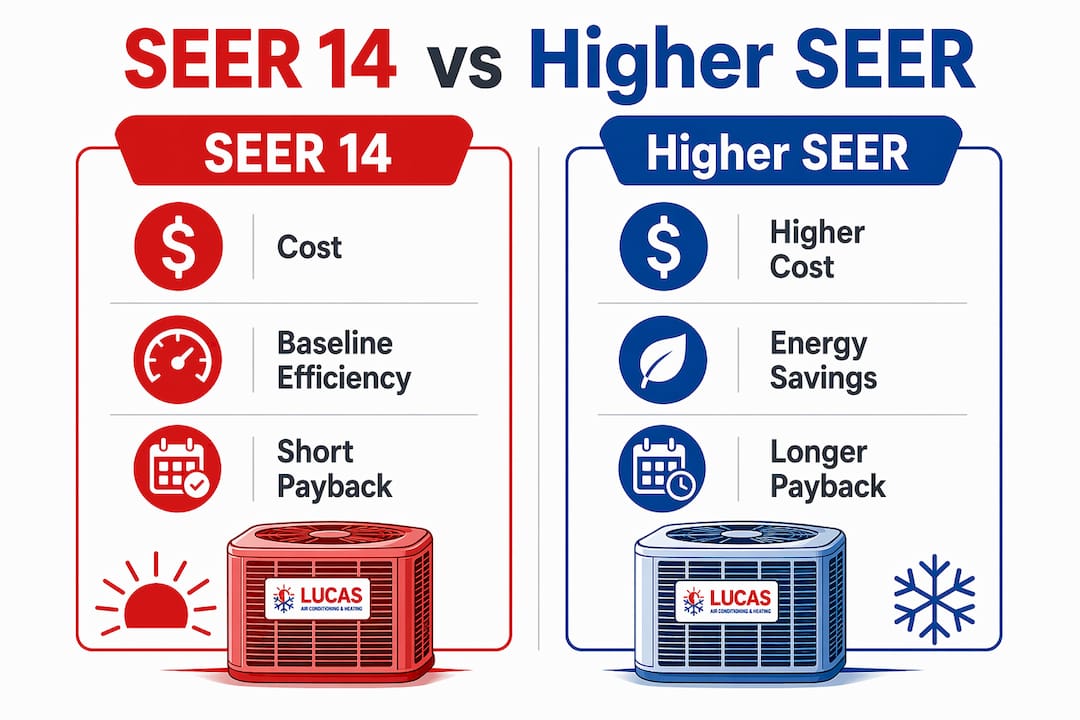
Installed costs tell the other side of the story. A standard 3-ton 14 SEER2 system runs $3,500 to $8,000 installed, with most routine installs landing in the $5,000 to $6,000 range. Moving to a 16 SEER system pushes installed costs toward $9,300 for comparable brands. That $1,900 to $3,300 premium is what you are recovering through energy savings.
| Rating | Installed Cost (3-ton) | Est. Annual Savings vs. SEER 14 | Payback Period (Hot Climate) |
|---|---|---|---|
| SEER 14 / 13.4 SEER2 | $5,000–$6,000 | Baseline | N/A |
| SEER 16 / 15.2 SEER2 | $7,400–$9,300 | $150–$220 per year | 2–4 years |
| SEER 20+ | $10,000–$14,000+ | $300–$500 per year | 5–10 years |
Pro Tip: If you plan to sell your home within three years, a SEER 14 system may deliver better financial value than a premium unit. The resale premium for high-SEER equipment rarely covers the full installation cost difference.
How does seer2 testing change the SEER 14 rating?
The SEER2 standard is not a new efficiency level. It is a new testing method that produces a more accurate number. The SEER2 rating runs about 4.7% lower than the original SEER because it simulates higher external static pressure, which reflects real ductwork resistance in actual homes. A unit rated at 14 SEER under the old method carries a 13.4 SEER2 rating under the new one.
This distinction matters for compliance and for shopping. When a contractor quotes you a “14 SEER” unit, confirm whether they mean the old SEER or the new SEER2 rating. The two numbers describe the same physical equipment performing the same way. Only the measurement standard changed.
Regional minimums shifted when SEER2 took effect in 2023. The table below shows the practical conversion for common ratings.
| Old SEER Rating | Approximate SEER2 Equivalent |
|---|---|
| 14 SEER | 13.4 SEER2 |
| 15 SEER | 14.3 SEER2 |
| 16 SEER | 15.2 SEER2 |
| 18 SEER | 17.1 SEER2 |
Federal regulations require these more realistic testing conditions to confirm that HVAC units perform efficiently under the actual resistance levels present in modern homes. The goal is accuracy, not a penalty for existing equipment.
When should you upgrade from a SEER 14 system?
The upgrade decision is not purely about efficiency ratings. Climate, budget, how long you plan to stay in the property, and comfort priorities all factor in.
Higher SEER units rated 16 and above generally feature two-stage or variable-speed compressors that improve humidity control. In Florida’s climate, that matters more than the efficiency number alone. A single-stage SEER 14 unit blasts cold air at full capacity and shuts off. A two-stage or variable-speed unit runs longer at lower capacity, pulling more moisture out of the air and delivering more consistent comfort.
Industry experts identify 15 to 16 SEER2 as the sweet spot for most homeowners balancing upfront cost and long-term savings, particularly for those staying in the home three to five or more years. That guidance holds especially true in the Southeast, where cooling seasons are long and energy costs are significant.
Consider upgrading from a SEER 14 system when any of the following apply:
- Your current system is 10 or more years old and showing reliability issues
- Your home has persistent humidity problems that basic cooling does not resolve
- You plan to stay in the property for at least three to five years
- Your utility bills have increased significantly without a clear cause
- You are in a hot, humid climate where the payback period on a higher-SEER unit is under five years
- You qualify for federal tax credits or utility rebates that reduce the cost gap
Pro Tip: Check the ENERGY STAR federal tax credit program before purchasing. In 2026, qualifying high-efficiency HVAC systems may be eligible for credits up to $600 under the Inflation Reduction Act provisions, which can meaningfully close the cost gap between SEER 14 and higher-rated units.
For a deeper look at your options, the HVAC upgrade guide for 2026 from Lucasair covers the financial scenarios in detail.
How installation quality affects SEER 14 performance
A SEER 14 system installed correctly will outperform a SEER 20 system installed poorly. That is not an opinion. Installation quality and ductwork integrity often dictate real-world system efficiency more than the rating on the equipment label.
Contractors stress that proper load calculations, duct sealing, and quality installation have a greater impact on HVAC effectiveness than SEER rating alone. Many homeowners overvalue the rating number without accounting for the installation variables that determine what they actually experience in their home.
Here are the four installation factors that most directly affect SEER 14 system performance:
- Manual J load calculation. Proper system sizing is more critical for comfort and efficiency than a higher SEER rating. An oversized system short-cycles, meaning it cools the space quickly but shuts off before removing enough humidity. An undersized system runs constantly and never reaches setpoint. Manual J calculations account for your home’s square footage, insulation, window area, and local climate to determine the correct tonnage.
- Duct sealing and condition. Leaky ducts can waste 20% to 30% of conditioned air before it reaches your living space. A new SEER 14 unit connected to deteriorating ductwork will never deliver its rated efficiency. Duct sealing with mastic or metal tape is one of the highest-return investments in any HVAC installation.
- Refrigerant charge accuracy. An improperly charged system runs inefficiently regardless of its SEER rating. Technicians should verify charge using manufacturer specifications and actual operating conditions, not just a rule-of-thumb estimate.
- Airflow and static pressure verification. After installation, a qualified technician should measure actual airflow and static pressure to confirm the system operates within design parameters. Deviations indicate installation problems that reduce efficiency and shorten equipment life.
For Florida homes specifically, the HVAC load calculation guide from Lucasair explains how local humidity and heat load affect sizing decisions.
What are the 2026 federal rules on SEER 14 HVAC systems?
The regulatory picture for SEER 14 systems changed significantly in 2023 and continues to affect what contractors can legally install in 2026.
Federal minimum efficiency standards now require 13.4 SEER2 in northern states and 14.3 SEER2 in southeastern states, including Florida. That means the old 14 SEER units that were the baseline in the South no longer meet the regional minimum under SEER2 testing. A unit must hit 14.3 SEER2 to be legally installed in Florida and other southeastern states.
Key compliance points for 2026:
- The 14.3 SEER2 minimum applies to split-system air conditioners in southeastern states
- Date-of-installation rules govern compliance, not date of manufacture or purchase
- Equipment manufactured before the 2023 deadline could be sold from existing inventory but must meet regional minimums at the time of installation
- Contractors who install non-compliant equipment face liability and potential licensing consequences
- Homeowners should request documentation confirming their new system’s SEER2 rating meets regional requirements
The practical effect is that true SEER 14 units (13.4 SEER2) are no longer compliant for new installations in Florida. Systems rated at 15 SEER or 14.3 SEER2 are the new baseline in the Southeast. If a contractor quotes you a “14 SEER” system for a Florida installation, ask specifically for the SEER2 rating and confirm it meets the 14.3 minimum.
Key takeaways
A SEER 14 HVAC system remains a cost-effective baseline option in moderate climates, but Florida homeowners need at least 14.3 SEER2 to meet current regional installation requirements.
| Point | Details |
|---|---|
| SEER 14 vs. SEER2 | A 14 SEER unit equals approximately 13.4 SEER2 due to more rigorous testing conditions. |
| Florida minimum standard | Southeastern states require 14.3 SEER2 minimum for new installations as of 2023. |
| Upgrade payback period | Moving from 14 to 16 SEER2 in hot climates saves $150–$220 annually with a 2–4 year payback. |
| Installation beats rating | A correctly sized and installed SEER 14 system outperforms a poorly installed high-SEER unit. |
| Upgrade trigger factors | Age, humidity problems, long-term ownership, and available rebates are the top reasons to upgrade. |
The real value of SEER 14 in 2026
I have seen homeowners spend thousands of dollars chasing SEER numbers while ignoring cracked ducts that were bleeding conditioned air into their attic. That is the most common and most costly mistake in residential HVAC decisions.
SEER 14 systems get dismissed as “entry level,” but that framing misses the point. For a budget-conscious homeowner replacing a failed 10 SEER unit from 2005, a properly installed 14.3 SEER2 system is a meaningful efficiency upgrade. The monthly savings are real. The comfort improvement is real. The idea that you must buy a SEER 20 system to get value is a sales narrative, not an engineering reality.
Where I think the conventional wisdom goes wrong is in treating SEER as a proxy for quality. It is not. SEER measures one dimension of performance under controlled conditions. It says nothing about compressor reliability, refrigerant type, warranty terms, or the contractor’s installation workmanship. A Carrier or Trane unit at 14.3 SEER2 installed by a skilled technician will serve a homeowner better than a premium-rated unit slapped in by someone who skipped the load calculation.
My advice to contractors advising clients: lead with the sizing conversation, not the SEER conversation. Get the Manual J right. Seal the ducts. Then help the client choose a SEER level that fits their budget and timeline. That sequence produces satisfied customers. Reversing it produces callbacks.
— Lucasair
Lucasair handles SEER 14 installations and upgrades in central florida
Lucasair serves homeowners, property managers, and businesses across Central Florida with HVAC installation, maintenance, and system upgrades built around what actually works for your home and budget.

Whether you need a compliant 14.3 SEER2 replacement or want to evaluate whether a higher-efficiency system makes financial sense for your property, the Lucasair team provides honest assessments backed by proper load calculations and quality installation. Cameron Lucas and his team have served the Eustis area since 2018 with a commitment to military and first responder communities. For residents in Lake County and surrounding areas, Lucasair is the trusted HVAC contractor ready to handle your next installation or upgrade with the expertise your home deserves. Schedule your consultation today.
FAQ
What does SEER 14 mean on an HVAC system?
SEER 14 means the unit has a Seasonal Energy Efficiency Ratio of 14 under the original testing standard, equivalent to approximately 13.4 SEER2 under current testing methods. It represents the baseline efficiency level that was federally required for most of the country before 2023.
Is SEER 14 still legal to install in florida in 2026?
A true 14 SEER unit rated at 13.4 SEER2 does not meet Florida’s current minimum of 14.3 SEER2 for new installations. You need a system rated at 15 SEER or 14.3 SEER2 to comply with southeastern regional requirements.
How much can i save by upgrading from SEER 14 to SEER 16?
In a hot climate like Tampa, upgrading to 16 SEER typically saves $150 to $220 per year on cooling costs for a 3-ton system, with a payback period of 2 to 4 years on the higher installation cost.
Does a higher SEER rating mean better cooling?
Higher SEER ratings improve efficiency, not cooling capacity. A SEER 20 system cools the same amount as a SEER 14 system of the same tonnage. It simply uses less electricity to do it, and higher-rated units often include variable-speed compressors that improve humidity control.
What affects SEER 14 system performance the most?
Proper sizing and installation quality affect real-world performance more than the SEER rating itself. Correct Manual J load calculations, sealed ductwork, and accurate refrigerant charge determine what you actually experience in your home day to day.
Recommended
- Upgrading HVAC systems in Central Florida: Your 2026 guide – Lucas Air Conditioning and Heating
- SEER rating explained: Maximize your HVAC efficiency and savings – Lucas Air Conditioning and Heating
- Save on energy costs with HVAC efficiency in 2026 – Lucas Air Conditioning and Heating
- How to Choose HVAC System for Energy-Efficient Comfort – Lucas Air Conditioning and Heating
