
TL;DR:
- Air conditioning cools homes by removing heat and moisture simultaneously, but effective humidity control requires proper system sizing and maintenance. Maintaining indoor humidity between 40% and 55% prevents mold and dryness, while short cycling from oversized units hampers moisture removal. Upgrading to variable-speed systems or adding whole-home dehumidifiers enhances humidity management in humid climates.
Air conditioning and humidity levels are directly linked: your AC unit cools your home by pulling heat and moisture out of the air at the same time. The EPA recommends keeping indoor relative humidity (RH) between 30% and 50%, while ASHRAE Standard 55 allows up to 60% for comfort. If your home feels clammy even when the thermostat reads 72°F, your system is managing temperature but failing at moisture removal. That gap is what this guide addresses.
How does air conditioning remove humidity?
Your AC removes moisture through its evaporator coil. Warm, humid air from your home passes over that cold coil. Water vapor in the air condenses on the coil’s surface, just like a cold glass of water sweats on a summer day. That liquid drains away, and drier air returns to your living space.
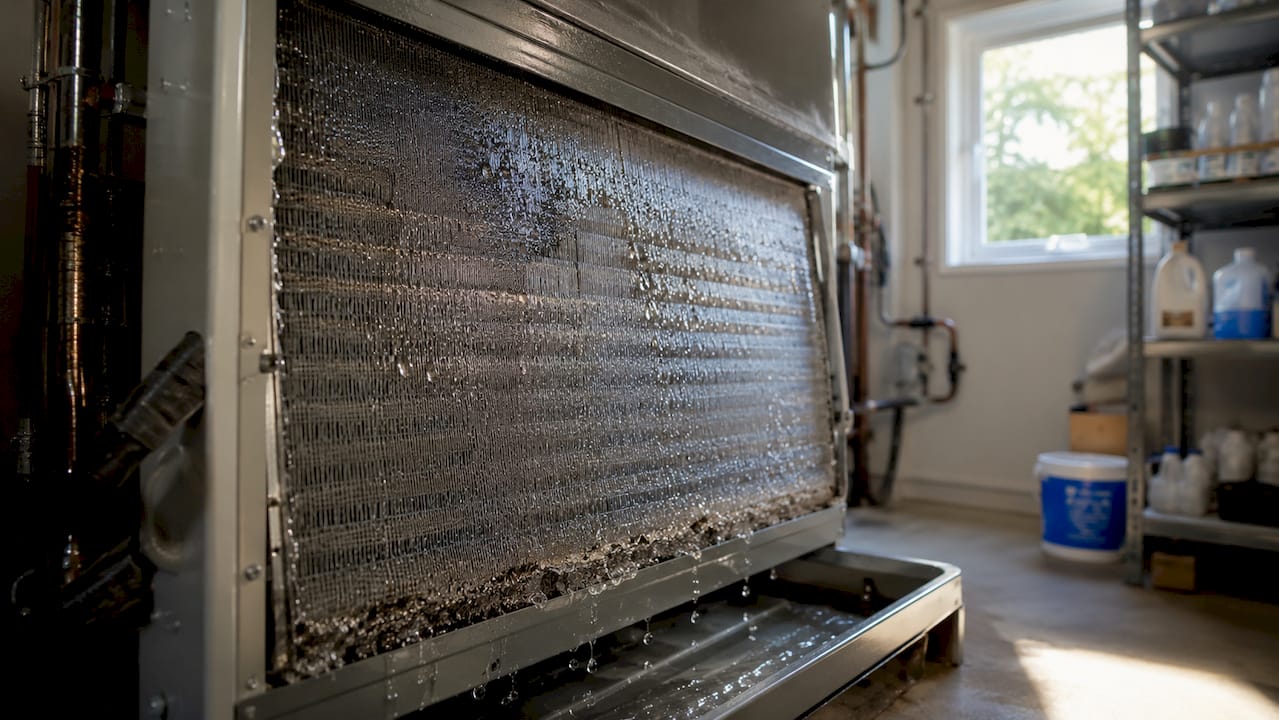
The process works, but it has one critical requirement: time. Effective dehumidification requires your AC to run for at least 15–20 minutes per cycle. Short cycles do not give the coil enough time to condense meaningful amounts of moisture. Your temperature drops, but the humidity stays high.
Four factors determine how well your system removes moisture:
- Cycle length. Longer cycles extract more water. A system that runs for 20 minutes removes significantly more moisture than one that runs for 8 minutes.
- System size. An oversized unit cools the air too fast, shuts off early, and never completes a full dehumidification cycle. This is called short cycling, and it is one of the most common causes of clammy homes.
- Airflow rate. Lower airflow across the coil increases contact time between humid air and the cold surface. Optimized airflow controls during cooling cycles measurably improve moisture removal without replacing equipment.
- Fan setting. When your fan runs continuously on the ON setting, it can evaporate water sitting in the drain pan and push that moisture back into your home. The AUTO setting stops the fan when cooling stops, preventing that problem.
Pro Tip: Switch your thermostat fan from ON to AUTO today. It costs nothing and immediately improves your system’s ability to manage indoor moisture.
What are the ideal indoor humidity levels?
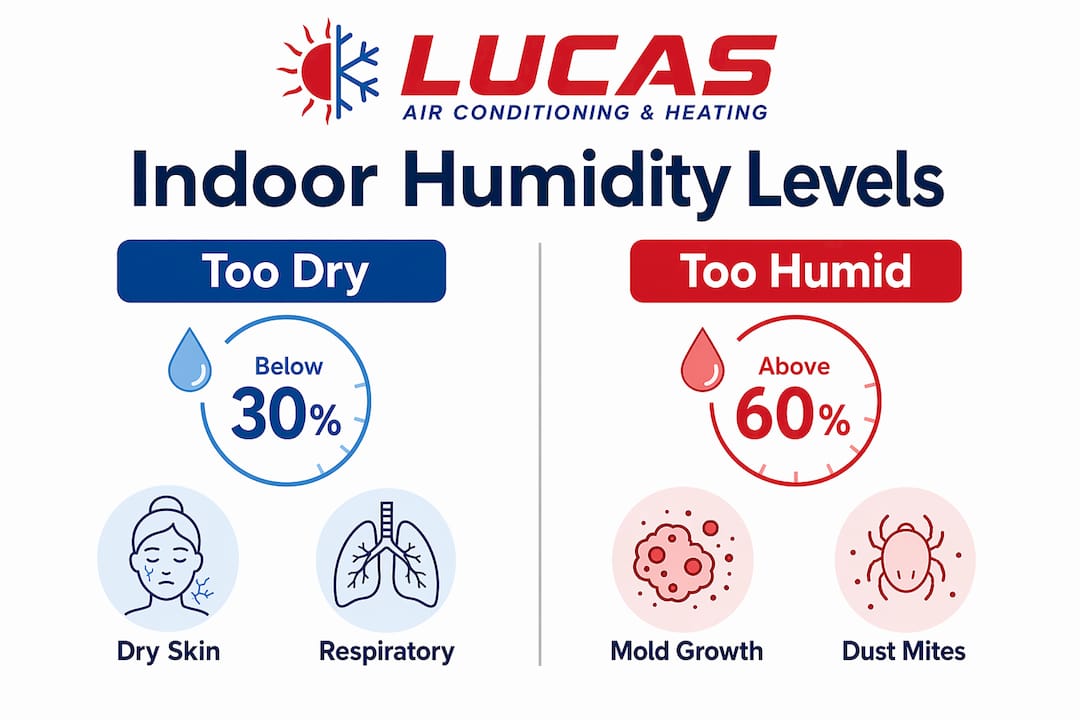
The EPA recommends 30%–50% RH indoors, and ASHRAE Standard 55 sets the upper comfort limit at 60%. For most homeowners in humid climates, the practical sweet spot is 40%–55% RH year-round.
Why does that range matter? Because humidity affects more than comfort. It affects your health, your home’s structure, and your energy bills.
| RH Level | Condition | Key Risk |
|---|---|---|
| Below 30% | Too dry | Dry skin, respiratory irritation, cracking wood |
| 30%–50% | EPA ideal | Balanced comfort and health |
| 50%–60% | ASHRAE upper limit | Acceptable but watch for mold risk |
| Above 60% | Too humid | Mold growth, dust mites, clammy feeling |
The risks at both extremes are real. Humidity above 60% promotes mold colonies and dust mite populations, both of which trigger respiratory problems. Humidity below 30% dries out mucous membranes, irritates sinuses, and causes wood floors and furniture to crack over time.
The 40%–55% range protects against both problems. A simple digital hygrometer from any hardware store tells you exactly where your home sits right now. Most homeowners are surprised by what they find.
Why is my house still humid with the AC running?
This is the most common complaint Lucasair hears from homeowners in Central Florida. The AC is running, the temperature feels fine, but the air still feels heavy and sticky. Several specific causes explain this.
- Short cycling from an oversized unit. The system cools the air in 8–10 minutes and shuts off. The latent load (moisture in the air) never gets addressed because the cycle ends before the coil can do its dehumidification work.
- Continuous fan operation. Running the fan on the ON setting after the cooling cycle ends evaporates water from the drain pan. That moisture re-enters your home, undoing what the coil just removed.
- Dirty filters and coils. A clogged filter restricts airflow. Restricted airflow means less humid air reaches the coil, which means less moisture gets removed. Neglected maintenance directly reduces your system’s dehumidification capacity.
- Internal moisture sources. Cooking, showers, breathing, and even houseplants add moisture to your air constantly. Tighter modern homes trap that moisture inside. Your AC has to work harder to remove it.
- Mild weather conditions. On cooler days, your AC barely runs because the temperature is comfortable. But humidity can still be high. The system never runs long enough to pull moisture out.
Pro Tip: Buy a $15–$20 digital hygrometer and place it in your main living area. Check it over three days. If you consistently read above 55% RH while the AC is running, you have a humidity control problem worth addressing.
When standard AC settings cannot maintain humidity below 60%, a supplemental dehumidifier handles moisture independently. This is especially useful during mild weather when the AC runs infrequently.
How can you optimize your AC for humidity control?
Getting your AC to manage moisture well does not always require new equipment. Start with these steps:
- Set the fan to AUTO. This single change stops moisture from being reintroduced after each cooling cycle. It is the fastest fix available.
- Verify your system is correctly sized. A properly sized HVAC system runs longer cycles and removes more moisture. If your unit was sized only for temperature load and not latent (moisture) load, it will always underperform on humidity.
- Schedule regular maintenance. Clean filters and coils restore airflow and dehumidification capacity. Lucasair’s preventative maintenance agreement keeps your system performing at its best through every humid Florida summer.
- Install a humidistat or smart thermostat. Devices like the Ecobee SmartThermostat and Honeywell Home T9 include humidity sensors and can trigger longer cooling cycles or supplemental dehumidification when RH climbs above your set point.
- Consider a whole-home dehumidifier. Units like the Aprilaire 1850 integrate directly with your HVAC system and remove moisture independently of cooling demand. This solves the mild-weather humidity problem completely.
- Reduce internal moisture sources. Run exhaust fans during cooking and showering. Vent your dryer outside. These steps reduce the moisture load your AC has to manage.
Pro Tip: If you have a newer smart thermostat, check its humidity display right now. Many homeowners discover their indoor RH is sitting at 65%–70% and had no idea.
Modern HVAC controls go beyond temperature to manage humidity directly. Humidity sensor deadbands, which are typically set at a 2%–5% RH range around your target, prevent the system from cycling excessively between modes. That precision keeps your home comfortable without wasting energy.
AC alone vs. supplemental humidity control: which do you need?
Standard single-speed AC units remove some moisture, but they are designed primarily for temperature control. In Central Florida’s climate, that is often not enough on its own.
| Method | Best For | Limitation |
|---|---|---|
| Standard single-speed AC | Mild humidity, well-sized systems | Short cycling reduces moisture removal |
| Variable-speed or multi-stage AC | Humid climates, consistent comfort | Higher upfront cost |
| Standalone dehumidifier | Mild weather, targeted rooms | Requires emptying or drainage setup |
| Whole-home dehumidifier | Persistent high humidity, large homes | Professional installation required |
Variable-speed and multi-stage AC systems run at lower speeds for longer periods. That extended run time dramatically improves moisture removal compared to a single-speed unit that blasts on and off. If you live in a persistently humid climate and your current system short cycles, upgrading to a variable-speed unit is the most effective long-term solution. Lucasair covers the full range of HVAC upgrade options that address both temperature and latent load management.
A standalone dehumidifier like the Frigidaire FFAD7033W1 handles moisture in specific rooms without relying on the AC at all. This works well for basements, sunrooms, or any space where the AC rarely runs. For whole-home coverage, an integrated unit like the Aprilaire 1850 or Santa Fe Advance90 connects to your duct system and operates independently of cooling cycles.
The right choice depends on your home’s size, your current system’s age, and how severe your humidity problem is. A professional load calculation, which accounts for both sensible (temperature) and latent (moisture) loads, gives you the clearest answer.
Key takeaways
Controlling indoor humidity requires more than setting a thermostat: your AC must run long enough, be correctly sized, and be properly maintained to remove moisture effectively.
| Point | Details |
|---|---|
| Target 40%–55% RH | This range prevents mold, dust mites, dry air damage, and discomfort year-round. |
| Fan setting matters | Set your thermostat fan to AUTO to stop moisture from re-entering after cooling cycles. |
| Oversized AC causes clamminess | Short cycling from an oversized unit cools air fast but leaves humidity high. |
| Maintenance restores performance | Clean filters and coils directly improve how much moisture your system removes. |
| Supplemental equipment fills gaps | A whole-home dehumidifier solves humidity problems that AC alone cannot fix. |
The part most homeowners miss about humidity and AC
After years of watching homeowners in Central Florida struggle with sticky, uncomfortable homes, one pattern stands out: almost everyone focuses on temperature and ignores latent load entirely.
Latent load is the moisture your AC has to remove from the air. Sensible load is the heat it has to remove. Most AC systems are sized for sensible load only. That works fine in dry climates. In Florida, it creates a system that hits your temperature target in 10 minutes and shuts off, leaving a home that feels 72°F and 68% RH. That is not comfort. That is a mold factory with good temperature control.
The conventional wisdom that “a bigger AC cools better” is exactly wrong for humid climates. A bigger unit short cycles more aggressively and removes less moisture. The homeowners I see with the worst humidity problems almost always have oversized systems installed by contractors who never ran a proper load calculation.
The fix is not always expensive. Switching the fan to AUTO, scheduling a maintenance visit, and adding a hygrometer costs under $50 total and solves the problem for many homes. For persistent issues, a variable-speed system or whole-home dehumidifier is worth every dollar. The role of your HVAC system in managing moisture is just as important as its role in managing temperature. Treat them as equal priorities and your home will feel genuinely comfortable, not just cool.
— Lucasair
How Lucasair helps you control humidity and stay comfortable
Humidity problems in Central Florida homes are common, and they are fixable. Lucasair provides professional HVAC sizing, installation, and maintenance services designed to manage both temperature and moisture loads in humid climates.

Whether your current system short cycles, your filters need cleaning, or you are ready to upgrade to a variable-speed unit with built-in humidity control, Lucasair’s team has the experience to get it right. As a veteran-owned business serving Eustis and surrounding Central Florida communities, Lucasair brings honest assessments and real solutions. Contact your trusted HVAC contractor to schedule a comfort assessment, or explore Lucasair’s AC maintenance services to keep your system running at peak performance all year.
FAQ
What humidity level should my AC maintain indoors?
Your AC should maintain indoor relative humidity between 40% and 55%. The EPA recommends staying below 50% RH, while ASHRAE Standard 55 sets the upper comfort limit at 60%.
Why does my house feel humid even when the AC is running?
Your AC may be short cycling due to an oversized unit, or your thermostat fan may be set to ON instead of AUTO. Both conditions prevent effective moisture removal even when the temperature feels comfortable.
How does AC remove humidity from the air?
Warm, humid air passes over the cold evaporator coil inside your AC unit. Water vapor condenses on the coil’s surface and drains away, returning drier air to your home. Cycles of at least 15–20 minutes are needed for meaningful moisture removal.
When do i need a dehumidifier in addition to my AC?
You need a supplemental dehumidifier when your indoor RH consistently stays above 60% while the AC is running, especially during mild weather when the AC runs infrequently. A whole-home unit like the Aprilaire 1850 integrates with your HVAC system for continuous moisture control.
Does a variable-speed AC really improve humidity control?
Yes. Variable-speed and multi-stage AC systems run at lower speeds for longer periods, giving the evaporator coil more time to condense moisture. This makes them significantly more effective at managing humidity than standard single-speed units in humid climates.
