
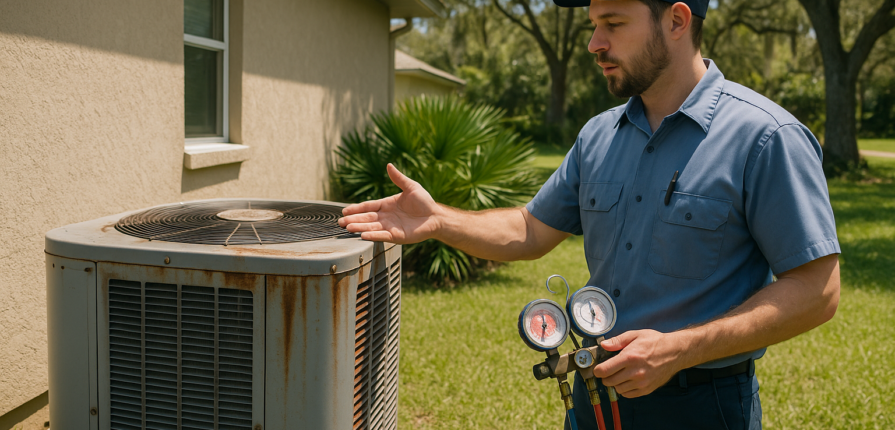
TL;DR: An aging or struggling AC rarely quits without warning — it usually gives you clues first, like rising bills, odd smells, weak airflow, and frequent repairs. This guide covers the 7 signs to watch for and what to do about each one before you’re stuck without cooling on a 95-degree Florida afternoon.
Central Florida doesn’t give air conditioners much of a break. Between the heat, humidity, and long cooling season, your system works harder here than almost anywhere else in the country — and that means wear and tear adds up faster too.
The good news: most AC units don’t die suddenly. They send warning signs for weeks or even months before a full breakdown. Knowing what to look for can help you avoid an emergency call on the hottest day of the year, and can also help you decide whether a repair or a replacement makes more financial sense.
Here are seven signs your AC may be on its way out, and what each one usually means.
1. Your System Is 10-15 Years Old
Age alone doesn’t mean your AC is broken, but it’s the single biggest predictor of trouble ahead. According to ENERGY STAR,
it may be time to call a professional contractor to help you make a change if your heat pump or air conditioner is more than 10 years old, and to consider replacing it with a unit that has earned the ENERGY STAR label
. Other manufacturer and industry sources put the typical lifespan of a well-maintained central air conditioner at
15-20 years with proper maintenance
, though that range assumes consistent upkeep and a mild-to-moderate climate — not Central Florida’s near-constant cooling demand.
If your outdoor unit’s nameplate shows a manufacture date more than a decade old, it’s worth having a technician evaluate its condition rather than waiting for a failure.
2. Your Electric Bill Is Climbing for No Clear Reason
A sudden or steady increase in your cooling costs, without a rate hike or a hotter-than-usual month to explain it, is one of the clearest signs your system is losing efficiency. As components wear out, the compressor and fan motors have to run longer and harder to produce the same amount of cooling.
The ENERGY STAR program notes that
installed correctly, high-efficiency replacement units can save up to 20 percent on heating and cooling costs
compared to older, inefficient equipment. If your bills keep creeping up despite normal usage, don’t assume it’s just the thermostat setting — read our breakdown of why your AC might be spiking your electric bill for the most common culprits.
3. The System Short Cycles or Runs Constantly
An AC that never seems to shut off, or one that clicks on and off in rapid bursts, is showing you it’s struggling. Short cycling puts extra strain on the compressor and can be caused by anything from a dirty filter to a failing capacitor to a unit that was sized wrong from the start.
A capacitor problem specifically is one of the most common (and most fixable) reasons for this symptom. If your system hesitates to start, hums without turning on, or shuts off unexpectedly, see our guide on how to tell if your AC capacitor is failing before assuming the whole unit needs replacing.
4. Some Rooms Are Hot While Others Are Ice Cold
Uneven cooling throughout the house is a red flag that your system can no longer move air the way it should. This can stem from ductwork problems, a failing blower motor, or an aging compressor that’s lost capacity.
Whatever the cause, uneven temperatures usually mean the system is having to run longer to compensate, which drives up wear and energy costs simultaneously. If certain rooms just never feel right, our article on reasons your AC isn’t cooling enough walks through the most likely explanations room by room.
5. You’re Calling for Repairs More Than Once a Year
An occasional repair is normal wear and tear. A pattern of repeated service calls is a different story entirely — it usually means the system has entered a cycle where one fix simply buys time until the next part fails.
A commonly used industry rule of thumb: if a single repair costs close to a third of what a new system would cost, or you’ve needed multiple repairs in the past two years, replacement typically makes more financial sense than continuing to patch an aging unit. Ask your technician for an honest read on the overall health of the system at every tune-up, not just a fix for the immediate complaint — that’s exactly the kind of straight talk we believe in.
6. You Notice Hissing, Ice on the Lines, or Weak Cooling
Hissing or bubbling sounds near the refrigerant lines, ice forming on the copper lines or indoor coil, or air that comes out lukewarm instead of cold are all signs consistent with a refrigerant leak. Refrigerant doesn’t get “used up” during normal operation — if your levels are low, it’s because it’s escaping somewhere, and low refrigerant makes the compressor work harder and can eventually cause it to fail.
This is also where refrigerant type matters. Systems installed before 2010 often use R-22, and the EPA confirms that
new production and import of most HCFCs were phased out as of 2020, with R-22 being the most common HCFC still in use in existing air conditioners and refrigeration equipment
. That means repairs on older R-22 systems increasingly rely on limited reclaimed supply, which can make a leak far more expensive to fix than it would have been a decade ago. If you suspect a leak, our guide on signs your AC has a refrigerant leak explains what happens if it’s ignored.
7. Water Pooling Around the Indoor Unit
Standing water near your air handler, water stains on the ceiling below an attic unit, or a musty smell are usually signs of a clogged condensate drain line, not necessarily a dying compressor. But left unaddressed, that trapped moisture can damage the unit itself, warp flooring, and encourage mold growth.
This is one of the more affordable fixes on this list when caught early. Take a look at our explainer on how a clogged condensate drain line usually causes air handler leaks to see whether a simple clear-out could solve the problem before it spreads.
What to Do If You’re Seeing These Signs
One sign on this list doesn’t necessarily mean your AC needs to be replaced tomorrow. But two or three together, especially combined with the system’s age, are a strong signal that it’s time for a professional evaluation rather than another DIY patch.
At Lucas Air Conditioning and Heating, we’ll always give you an honest assessment of repair versus replacement, no upselling, because that’s how a veteran-owned business should operate. If replacement does make sense, installations start at $7,500 and include the unit, permit, a one-year labor guarantee, and a ten-year parts warranty, with KwikComfort financing available and free estimates on new installations. If it’s just a repair, our $125 precision tune-up or $129/year Preventative Maintenance Agreement can often catch small problems before they become big ones.
Serving Lake and Orange County Homeowners
We proudly serve Tavares, Eustis, Leesburg, Mount Dora, The Villages, Lady Lake, Fruitland Park, Umatilla, Sorrento, Howey-in-the-Hills, and Apopka. Whether you’re a longtime resident, a snowbird returning for the season, or a property manager overseeing multiple units, catching these warning signs early saves money and keeps you comfortable when Florida heat doesn’t let up.
Recommended Reads
- Signs Your AC Has a Refrigerant Leak (And What Happens If You Ignore It)
- How to Tell If Your AC Capacitor Is Failing — and What It Costs to Fix
- 8 Reasons Your AC Isn’t Cooling Enough (And What to Do About Each)
