
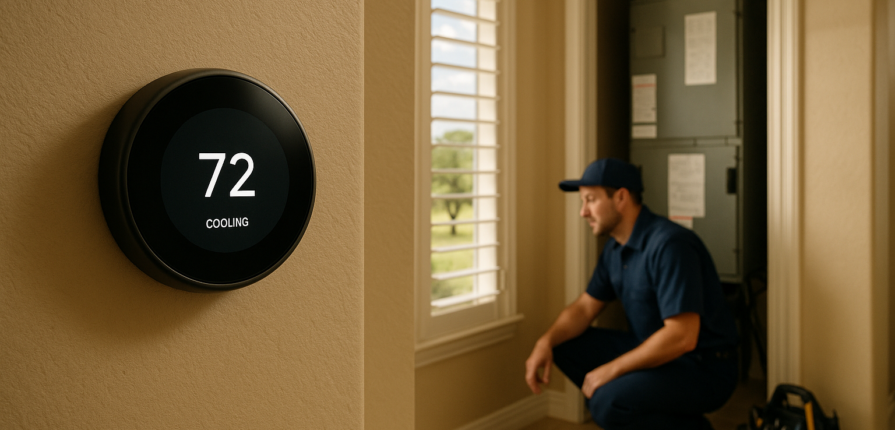
TL;DR: When your thermostat never reaches the set temperature, the problem is rarely the thermostat itself — it’s usually airflow restriction, duct leakage, a miscalibrated sensor, low refrigerant, or a system that’s the wrong size for your home. In Central Florida’s heat, some causes are quick DIY fixes; others need a licensed tech. This guide walks you through all seven, in order of likelihood.
You’ve set the thermostat to 74°F. The system runs and runs. The display still reads 79°F. Sound familiar?
This is one of the most common calls we get at Lucas Air Conditioning and Heating — especially during Lake County summers when outdoor temps push into the mid-90s for weeks at a time. The good news: most causes are diagnosable without a service call if you know what to look for.
First, Understand What the Thermostat Actually Does
Your thermostat is a messenger, not the engine. It reads the air temperature near its sensor, compares that reading to your set point, and tells the HVAC system when to run.
That means two separate things can go wrong: the thermostat can send the wrong signal, or the HVAC system can receive the right signal but fail to deliver enough cooling. Knowing which you’re dealing with saves you time and money.
The 7 Most Common Reasons Your Thermostat Won’t Reach the Set Temperature
1. Dirty or Clogged Air Filter
Start here — always. A clogged filter is the single most common cause of airflow problems in any system. When the system can’t pull enough air through the return, it struggles to condition your home and may freeze up entirely in cooling mode.
DIY fix: Check your filter right now. If it’s gray and matted, replace it. A fresh 1-inch filter costs a few dollars and takes two minutes. In dusty Central Florida homes or those with pets, monthly checks are a must — don’t wait for the 90-day sticker.
2. Thermostat Placement or Calibration Issues
Your thermostat might be doing its job perfectly — it’s just reading the wrong temperature. If it’s mounted on an exterior wall, near a supply register, in direct sunlight, or next to a heat-generating appliance, it gets false readings all day long.
A thermostat exposed to direct sunlight can trigger the AC regardless of what the temperature is in the rest of the house. The fix is simple in theory: relocate it to an interior wall in a central, well-ventilated area away from heat sources and vents.
Calibration drift is a separate but related issue. This is especially common after a power outage, when batteries run low, or in older units. A miscalibrated thermostat will tell the HVAC system the set temperature has been reached — and shut it off — even when your living room is still warm.
DIY check: Tape an inexpensive digital thermometer next to your thermostat for 15 minutes. If the readings differ by more than 1–2°F, calibration or relocation may be needed.
3. Leaky or Blocked Ductwork
This is the hidden villain in many Central Florida homes, especially in older construction. According to ENERGY STAR, leaky ducts and poorly sealed connections can waste 20% or more of the air you pay to heat and cool.
When conditioned air escapes into your attic, wall cavities, or crawlspaces before it reaches your rooms, the system just keeps running — trying to hit a target it can never reach. You’ll often notice uneven temperatures from room to room as the clearest sign.
Blocked vents compound this. If furniture, rugs, or drapes are covering supply registers, your HVAC system can’t distribute air evenly — even if the equipment itself is in perfect shape.
DIY check: Walk every room and confirm all vents are open and unobstructed. Feel for airflow at each register. Then go to your attic or crawlspace and look for disconnected or crushed flex duct sections.
For a deeper inspection, a professional duct cleaning and evaluation — like the service Lucas Air offers — can identify leaks you’d never find on your own.
4. Low Refrigerant (Refrigerant Leak)
Refrigerant is the substance that actually absorbs heat from inside your home and moves it outside. When there’s a leak in the refrigerant line, pressure drops and the evaporator coils can plunge below freezing — paradoxically causing your system to lose cooling capacity just when you need it most.
Signs of low refrigerant include ice on the refrigerant lines, a hissing sound near the indoor unit, warm air from the vents even after a long run cycle, and sky-high electric bills. For a full breakdown of what to watch for, read our guide on signs your AC has a refrigerant leak and what happens if you ignore it.
Important: Refrigerant work is regulated under EPA Section 608. Only a licensed HVAC technician can legally handle refrigerant. A recharge without finding and fixing the leak is a short-term patch — the refrigerant will leak out again.
5. Wrong System Size (Oversized or Undersized)
This one surprises a lot of homeowners. Bigger isn’t always better when it comes to AC systems.
An oversized system blasts your home with cold air, satisfies the thermostat in just a few minutes, and shuts off before completing a full cycle — a condition called short cycling. Because it shuts off so rapidly, it never removes the humidity from the air, leaving your home feeling cold but damp. Worse, those constant startups wear out the compressor faster and drive up your electric bill.
An undersized unit, on the other hand, simply cannot keep up with the heat load. It runs all day without ever reaching the thermostat setting because it is physically too small for your space.
According to Trane, whether too big or too small, an improperly sized system causes early wear and high energy bills — and the only permanent solution is replacing it with a correctly sized unit based on a proper load calculation (called a Manual J).
At Lucas Air, every installation begins with a proper sizing assessment. We don’t guess — we calculate. That’s one reason our installations include a one-year labor guarantee and a ten-year parts warranty you can actually rely on.
6. Extreme Outdoor Heat (Florida’s Design Temperature Reality)
Here’s something most homeowners in Lake County and The Villages don’t know: residential AC systems are not designed to cool your home to any temperature you set regardless of what’s happening outside.
Most residential air conditioners are designed to cool your home about 15 to 20 degrees below the outdoor temperature. That means if it’s 95°F outside, your system can realistically bring your home to around 75–80°F — not 68°F. When outdoor temps push into the upper 90s during a Central Florida heat event, your system may run continuously and still not quite hit your set point. That’s not a malfunction; that’s physics.
What helps: Closing blinds on south- and west-facing windows during peak afternoon hours, using ceiling fans to increase perceived comfort, and bumping your thermostat set point up by 2–3°F on extreme days. If your system genuinely can’t handle normal summer conditions, that’s a sizing or maintenance problem worth having evaluated.
7. Aging Equipment or Failing Components
A blower motor losing efficiency, a failing capacitor, dirty evaporator or condenser coils, or simply a system past its useful life can all prevent your HVAC from delivering enough cooling to reach the set temperature — even if everything else checks out.
Signs your system may be failing rather than just struggling: the problem is getting worse each summer, your electric bills keep climbing, the system is 12–15+ years old, and you’re calling for repairs more than once a season. If you’ve been hearing unusual noises from your unit, our article on what different AC noises mean can help you identify whether a component is on its way out.
Quick DIY Checklist Before You Call
- Replace the air filter if it hasn’t been changed in 30–60 days
- Check batteries in the thermostat — dead or weak batteries cause erratic behavior and false readings
- Verify the thermostat setting — confirm it’s in COOL mode, not HEAT or FAN ONLY; check that no one accidentally activated a vacation or hold schedule
- Unblock all vents — move furniture, drapes, or rugs covering supply and return grilles
- Check the outdoor unit — make sure it’s running, not encased in overgrown shrubs, and that the fins aren’t packed with debris
- Look for ice — ice on the refrigerant line or indoor coil means shut the system off and call a tech
- Compare a thermometer reading to the thermostat display — a big gap points to calibration or sensor issues
When to Stop Troubleshooting and Call a Pro
Call a licensed HVAC technician if:
- You’ve worked through the checklist above and nothing helped
- You see or suspect ice on any part of the system
- The system is making new or unusual sounds (banging, hissing, grinding)
- Your electric bill has spiked without a clear reason — explore the common AC causes of a high electric bill if you’re not sure
- The system is over 10 years old and struggling for the first time
- You smell something off — burning smells especially need immediate attention
How Lucas Air Diagnoses This Problem
When one of our Lake County or Orange County customers calls about a thermostat that won’t reach its set point, we don’t start by recommending a new system. We start with a systematic inspection: filter condition, airflow measurements, refrigerant pressure check, coil inspection, thermostat calibration, and ductwork evaluation.
Our precision tune-up ($125) covers exactly this kind of diagnostic — and our Preventative Maintenance Agreement ($129/year) includes one annual tune-up, priority scheduling, and 15% off parts, so you catch these issues before a 95°F July afternoon makes them obvious.
If you’re a homeowner in Tavares, Eustis, The Villages, Mount Dora, Lady Lake, Apopka, or anywhere across Lake or Orange County, we’re available Monday through Friday, 8:00 AM–5:30 PM — and for genuine emergencies, after hours too.
Free estimates on new installations. No upselling. No guesswork. Just straight answers from a veteran-owned team that treats your home the way we’d treat our own.
Recommended Reads
- 8 Reasons Your AC Isn’t Cooling Enough (And What to Do About Each)
- What Different AC Noises Mean — and When to Call a Tech
- Why Does My AC Smell Like Burning? Common Causes and When to Worry
