
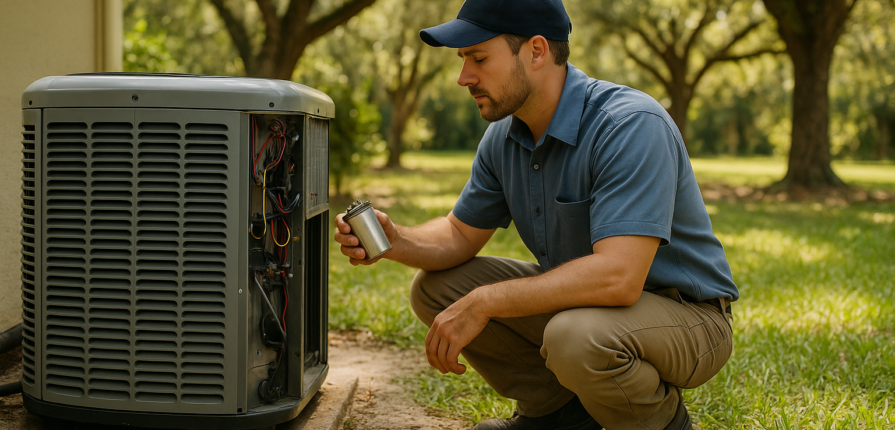
TL;DR: A failing AC capacitor shows up as a humming outdoor unit, hard starts, warm air, short cycling, a non-spinning fan, rising energy bills, or visible damage to the part. Replacement typically costs $150–$450 including labor, and catching it early prevents far costlier compressor or motor damage — especially important in Florida’s punishing heat.
Your air conditioner is running — you can hear it — but the house just won’t cool down. Or maybe it takes forever to kick on, or the outdoor unit hums loudly and then goes quiet. Before you assume the worst, check the simplest culprit: the capacitor.
Capacitor failure is one of the most common AC repairs in Florida, and the good news is that it’s also one of the least expensive to fix — if you catch it early. Here’s everything you need to know.
What Is an AC Capacitor, and What Does It Do?
An AC capacitor is an electrical component that stores and releases energy to help your air conditioner start and run properly. Think of it as a temporary power reserve — similar in concept to a rechargeable battery, but built purely for electrical motors.
Most central air conditioners rely on two types:
- Start capacitor: The start capacitor is responsible for providing the initial surge of energy that your AC unit needs to run, delivering an electrical push that activates motor rotation.
- Run capacitor: A run capacitor maintains a continuous flow of electricity to keep the motor running efficiently. Unlike a start capacitor, which only works during startup, a run capacitor remains engaged throughout the motor’s operation.
Many modern units combine both functions into a single dual run capacitor that serves both the compressor and the condenser fan motor. Without a working capacitor, the compressor and fan motor may not receive enough power to start or continue running.
7 Warning Signs Your AC Capacitor Is Failing
In the early stages of capacitor failure, your air conditioner may still operate, but you’ll likely notice warning signs such as delayed startup, humming noises, weak cooling, or short cycling. Here’s what each of those looks and sounds like.
1. The Outdoor Unit Hums But Nothing Happens
A bad capacitor often sounds like a loud humming or buzzing noise coming from the outdoor unit — the sound of the motor trying to start. Sometimes the outdoor unit hums loudly but the fan doesn’t spin. This is a classic and urgent symptom — don’t let the system keep trying to start without calling a tech.
Related: What Different AC Noises Mean — and When to Call a Tech
2. Hard Starting (Takes a Long Time to Turn On)
Your AC may struggle to turn on — this “hard starting” is a sign of a weak capacitor that is about to fail. Homeowners might find their system only works sometimes or takes several minutes to finally start. This inconsistent behavior is a clear sign of AC capacitor problems.
3. The Fan Blade on the Outdoor Unit Isn’t Spinning
The clearest sign is when the fan on the outdoor unit isn’t spinning, even though the AC is humming and should be running. A non-spinning fan is a very common symptom of a bad capacitor — it could also be a failed fan motor, but the capacitor is the more likely part to fail.
4. Warm Air from the Vents
When your air conditioner is running but failing to blow cold air throughout your home, it could be a faulty AC capacitor. This symptom is insinuated by the air conditioning unit blowing out warm air — when the capacitor is bad, it prevents itself from starting and the air conditioner is no longer able to remove heat and transfer it outside the home.
Warm air has multiple possible causes. If your capacitor checks out, see our guide to 8 Reasons Your AC Isn’t Cooling Enough for a broader checklist.
5. Short Cycling (Turns On, Then Shuts Right Back Off)
The system might turn on and then shut off by itself after just a few minutes — this is a safety feature that activates to stop the unit from overheating. Motors work much harder when the capacitor fails to provide proper electrical support. The compressor and fan motors draw more power than normal to maintain operation. This extra strain generates excessive heat in the motors and surrounding components. Overheated motors wear out faster and may burn out completely if the problem continues.
6. Rising Energy Bills With No Other Explanation
When the capacitor is not functioning correctly, the AC system may draw more power to compensate for its reduced efficiency. This can result in higher energy bills as the AC has to work harder to provide the desired temperature.
If your bills are climbing and you can’t pinpoint why, our post on Why Is Your AC Spiking Your Electric Bill? covers seven likely causes worth reviewing.
7. Visible Damage — Bulging, Leaking, or Burn Marks
A bulging or swollen top on an AC capacitor is one of the most common signs of failure. This bulge indicates that pressure has built up inside the capacitor, typically due to overheating or gas formation. Leaking fluid is another clear sign of failure — the capacitor may have oil or other liquid around its base or running down its sides. Some capacitors also show rust or corrosion on the metal casing.
A burning smell from the outdoor unit can also accompany a failing capacitor. A particularly worrisome sign for a homeowner is a burning smell coming from the condenser unit — this smell usually signifies a faulty AC capacitor. If you notice that smell, head over to our breakdown of Why Does My AC Smell Like Burning? for guidance on when to act immediately.
What Causes AC Capacitors to Fail?
Understanding the “why” helps you protect the next capacitor — and the rest of your system.
- Heat and long run times: Heat and long run-times are major factors. Outdoor units sit in hot conditions, and frequent starting cycles during the cooling season can wear capacitors down faster.
- Florida’s climate: If you live in a place with high heat and humidity — like Florida — your AC capacitor may rust and wear out more quickly. Here in Lake County, systems often run 10–12 months a year, which accelerates that wear significantly.
- Power surges and lightning: Lightning and voltage fluctuations can damage capacitors. Florida leads the nation in lightning strikes, making surge protection a smart investment.
- Oversized or undersized system: If your air conditioner is constantly running — perhaps because it’s too old or isn’t the right size for your home — this can also shorten the lifespan of your capacitor.
- Neglected maintenance: The life of AC capacitors also depends on the regularity of maintenance. A constantly dirty or neglected air conditioner can overheat the capacitor and shorten its lifespan.
How Long Should an AC Capacitor Last?
On average, AC capacitors last 10 years, but their lifespan can range anywhere from five years to 20. In Florida specifically, the math works against you. In Florida, where heat and humidity are constant, capacitors often need replacement every 10 to 15 years.
Some fail internally without any visible signs — some fail visibly (bulging or leaking), while others fail internally and only show up on electrical testing. That’s one reason a professional tune-up catches issues your eyes alone can’t.
Per ENERGY STAR guidance, routine professional inspections help catch failing components early and keep cooling systems running efficiently throughout the season.
Can You Replace a Capacitor Yourself?
Short answer: no, and it’s not worth the risk.
It is very unsafe. Capacitors hold a high-voltage charge even with the power off, and touching them can cause a bad electrical shock. You should not attempt to test an AC capacitor — safely testing it needs specialized tools to discharge the part, and it is a job best left to a trained AC repair technician.
Beyond safety, the spec has to match exactly. Always ensure the replacement capacitor matches the specifications of your original unit (µF rating, voltage, and terminal configuration). An incorrect rating can damage your compressor.
What Does AC Capacitor Replacement Cost?
The good news: this is one of the more affordable AC repairs on the board.
AC capacitor replacement typically costs $150 to $450 in 2026, including the capacitor, labor, and service or diagnostic charges. The labor to diagnose the problem and replace the capacitor makes up most of the repair cost. AC capacitor prices range from $15 to $80 for the part alone.
A failing capacitor is the most common air conditioner repair — and catching it early can prevent far costlier damage to your compressor or fan motor. A compressor replacement, by comparison, can run $1,200–$2,500 or more.
A few cost factors to keep in mind:
- System size: Capacitors for AC units come in several different sizes and voltage ratings. Generally, larger capacitors and those with higher voltages cost significantly more to replace.
- Dual vs. single: A dual run capacitor (serving both compressor and fan motor) typically costs more than a single-motor unit.
- Time of year: The season may also impact labor rates, as the demand for AC repairs increases in the warm summer months.
- Emergency service: Account for diagnostic fees when budgeting, and remember that emergency or weekend service calls add extra charges to your total bill.
What Happens If You Ignore a Failing Capacitor?
Ignoring early warning signs puts the rest of your system at risk. Account for potential additional repairs like damaged compressors or burnt-out motors if your capacitor failure caused system damage. The longer a weak capacitor forces your compressor and fan motors to strain, the more likely you are to face a far bigger repair bill — or a full system replacement.
How Lucas Air Can Help
At Lucas Air Conditioning and Heating, our licensed technicians carry the right meters and replacement parts to diagnose and fix a bad capacitor on the spot — often in a single service call. We serve homeowners throughout Lake County and Orange County, including Tavares, Eustis, Mount Dora, Leesburg, The Villages, Lady Lake, Apopka, and surrounding communities.
Our Precision Tune-Up ($125) includes a full electrical check of your capacitors, contactors, and wiring before a small problem becomes an expensive one. Our Preventative Maintenance Agreement ($129/year) covers one tune-up annually, 15% off parts, and priority scheduling — so if your capacitor does give out, you move to the front of the line.
Emergency service is available outside regular hours (Mon–Fri, 8:00 AM–5:30 PM). Call us or request service online — free estimates on new equipment, no upselling, and the honest, straightforward service you’d expect from a veteran-owned business.
Recommended Reads
- 8 Reasons Your AC Isn’t Cooling Enough (And What to Do About Each)
- What Different AC Noises Mean — and When to Call a Tech
- Why Does My AC Smell Like Burning? Common Causes and When to Worry
