
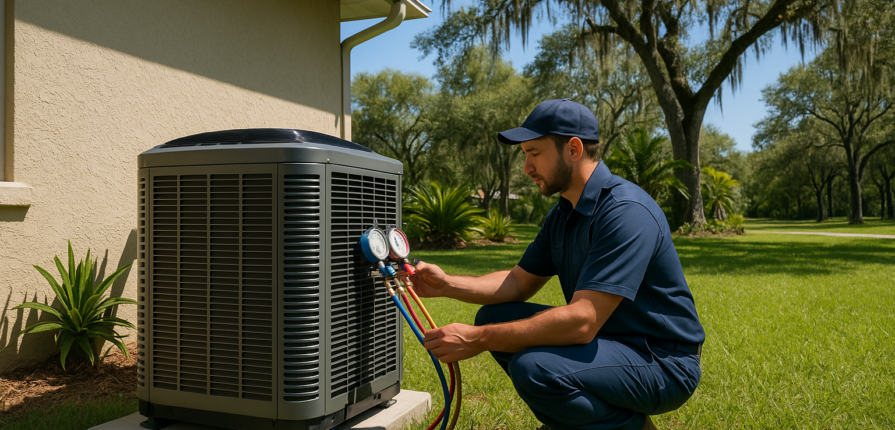
TL;DR: The EPA banned new R-410A equipment manufacturing as of January 1, 2025. Every new residential AC system sold today uses a lower-impact refrigerant — primarily R-454B. Your existing R-410A system is still legal to run and service, but as supply shrinks, repair costs will rise — making this a smart time to understand your options.
If you’ve shopped for a new air conditioner recently, you may have heard technicians mention R-454B and wondered what happened to the R-410A your old system uses. The short answer: federal law changed the refrigerant the industry can put in new equipment, and that change affects every homeowner in Lake County and beyond — whether you’re buying a new system today or planning to squeeze a few more years out of your current one.
Here’s a plain-English breakdown of what R-454B is, why it matters, and exactly what you need to do (and not do) right now.
A Quick History of HVAC Refrigerants
Your AC doesn’t actually “create” cool air — it moves heat out of your home using a chemical called refrigerant. That refrigerant has changed a few times over the decades, always in response to environmental concerns.
- R-22 (“Freon”): The standard for decades, phased out because it depletes the ozone layer.
- R-410A (“Puron”): Replaced R-22 starting in the early 2000s. No ozone risk, but a very high global warming potential.
- R-454B: The new standard for residential systems, with dramatically lower environmental impact.
The earlier transitions — from R-12 to R-22 and from R-22 to R-410A — were focused primarily on reducing ozone depletion. Now, with the change from R-410A to R-454B, the focus has shifted to dramatically reducing global warming potential while maintaining zero ozone depletion.
What Is R-454B, Exactly?
R-454B is a blended refrigerant. It is a mildly flammable HFC-HFO blend containing 68.9% difluoromethane (R-32) and 31.1% tetrafluoropropene (R-1234yf), with a global warming potential (GWP) of 466.
To put that in perspective: R-410A has a GWP of around 2,088, while R-454B’s GWP is approximately 466 — roughly 75% lower. The EPA mandated that manufacturers switch to a refrigerant with a GWP of 700 or less by January 1, 2025. R-454B clears that bar with room to spare.
R-454B offers comparable capacity and improved efficiency compared to R-410A, with excellent performance in normal and high ambient conditions — which matters a great deal here in Central Florida, where summer temps routinely push equipment to its limits.
What Does the Law Actually Say? (The AIM Act Explained)
The HVAC industry is transitioning to new refrigerants required by the American Innovation and Manufacturing (AIM) Act of 2020, which gradually phases down the use of existing classes of refrigerants and establishes new requirements for the refrigerants used in air conditioners and heat pumps.
Here’s the timeline that matters for homeowners:
- January 1, 2025: Manufacturers are no longer permitted to produce or import new residential air conditioning condensing units or heat pumps that utilize R-410A.
- 2026 and beyond: The EPA published a final rule allowing the continued installation of HVAC units manufactured or imported prior to January 1, 2025, that use R-410A refrigerant until existing supplies are depleted. Once that inventory is gone, new installs use R-454B.
- Servicing your existing system: Contractors can still repair and replace existing R-410A equipment. The EPA has not determined a date by which R-410A systems can no longer be serviced.
Bottom line for Lake County homeowners: Your current system is not illegal — you can keep using and repairing your R-410A system. But R-410A recharge costs will rise as supplies decrease.
Is R-454B Safe? The A2L Classification Explained
The most common question we hear at Lucas Air is: “Is the new refrigerant flammable? Should I be worried?” It’s a fair question, and the honest answer is nuanced.
R-12, R-22, and R-410A all fall into the A1 classification of refrigerants, which have no flame propagation. R-454B falls into a new category — A2L — which is “mildly flammable.”
“Mildly flammable” sounds alarming, but the ASHRAE Standard 34 classification tells a more complete story:
- The “L” in A2L signifies a low burning velocity. In practical terms, this means that in the unlikely event of ignition, the refrigerant is likely to burn slowly and self-extinguish.
- A2L refrigerants are so mildly flammable that a significant energy source — like a direct flame — and a high concentration of refrigerant are both required to create a flame.
- The allowable concentration of R-454B is almost 10 times higher than the allowable concentration of propane.
- Modern R-454B systems include built-in safety features. Systems with more than 3.91 lbs of A2L refrigerant charge must include factory-installed leak detection and dissipation systems.
Although R-454B is classified as mildly flammable, it is safe for home use when installed and maintained correctly. The key phrase there is “correctly” — which is why R-454B work should only be handled by trained, licensed technicians.
Can You Just “Switch” Your Existing System to R-454B?
No — and this is one of the most important facts for any homeowner to understand before calling a contractor.
R-454B is not a direct replacement for R-410A or R-22. It is designed for new systems that maximize efficiency and environmental benefits. R-454B requires compressors, metering devices, and system components specifically designed and certified for A2L refrigerants. Attempting a refrigerant swap in an existing R-410A system is both unsafe and a violation of EPA regulations.
If your current system develops a refrigerant leak, a licensed technician can still recharge it with R-410A — for now. But as production quotas tighten, that service will become more expensive over time. R-410A prices have already seen a 40–70% increase from 2022 levels that HVAC contractors and facilities managers are experiencing in 2026.
What It Means for Your Next AC Replacement
If your system is approaching 10–15 years old, this refrigerant transition is worth factoring into your replacement decision. Here’s what changes when you move to an R-454B system:
Higher Upfront Cost
New A2L systems cost roughly 20–30% more upfront, but offer better energy efficiency. That efficiency difference can offset some of the added cost over time — important when your system runs nearly year-round in Florida’s climate. If your electric bill has been climbing, a modern R-454B system’s improved efficiency is worth considering.
Better Long-Term Parts Availability
R-454B systems are what every major manufacturer is building today. Carrier, Lennox, Trane, and others have all transitioned their residential product lines. Parts and refrigerant availability for R-454B will grow — while R-410A supply shrinks each year.
Potential Federal Tax Credits
Federal tax credits are available — up to $2,000 for heat pumps — if you choose to upgrade. Ask your tax professional whether your new installation qualifies under current IRS guidelines.
New Safety Technology Built In
The built-in safety mechanism includes a leak dissipation system with a leak detector. When activated, the leak sensor signals a dissipation board, which energizes a blower to dissipate the refrigerant into the air stream. This technology is standard on new R-454B equipment — it’s not an add-on.
What to Expect from a Technician Working on R-454B Equipment
R-454B doesn’t just require different equipment — it requires different technician training and tools. When you hire an HVAC contractor for a new R-454B system, here’s what a qualified tech brings:
- EPA Section 608 Certification: Contractors and technicians must be EPA-certified to handle refrigerants. This baseline certification is non-negotiable.
- A2L-specific training: While existing EPA 608 certification remains valid for handling R-454B, A2L-specific safety training is strongly recommended and increasingly required by employers and jurisdictions.
- Specialized tools: HVAC technicians working with A2L refrigerants must use A2L-rated service equipment, including A2L-compatible manifold gauges, refrigerant identifiers, recovery machines rated for A2L use, and vacuum pumps with A2L-rated motors.
- Strict handling protocols: Leak detection for A2L refrigerants follows stricter standards under ASHRAE 15-2024 and UL 60335-2-40.
At Lucas Air Conditioning and Heating, our technicians are trained and equipped for A2L refrigerant work. If your system isn’t cooling effectively and refrigerant is suspected, we’ll diagnose the issue honestly — no unnecessary upsells, just the facts about what your system needs.
Should You Repair or Replace Your R-410A System Now?
This is the question most Lake County and Orange County homeowners are wrestling with. Here’s a straightforward framework:
- System under 8–10 years old, no major issues: Keep it. Service R-410A refrigerant is still legal and available. A tune-up and preventive maintenance keep it running efficiently.
- System 10–15 years old with a significant repair needed: Compare the repair cost against a new R-454B installation. A repair that costs more than half the price of a new system rarely makes financial sense.
- System over 15 years old: Replacement is likely the smarter investment — especially with new equipment’s energy efficiency gains and the rising cost of R-410A refrigerant over the coming years.
- System with a refrigerant leak: Get it diagnosed immediately. A leak doesn’t fix itself, and the longer it runs low on refrigerant, the more strain it puts on the compressor — the most expensive component in the system.
Lucas Air offers free estimates on new installations, with systems starting at $7,500, including the unit, permit, a one-year labor guarantee, and a ten-year parts warranty. KwikComfort financing is also available for qualified customers.
The Bottom Line for Florida Homeowners
The R-454B refrigerant switch is real, it’s already in effect for new equipment, and it will gradually reshape the cost of maintaining older R-410A systems. But it’s not a crisis — it’s a transition with a clear, manageable timeline.
Your job as a homeowner is to stay informed, keep your current system well-maintained, and make a thoughtful replacement decision when the time comes. Our job at Lucas Air is to give you honest advice when that moment arrives — the same veteran values of integrity and respect that have driven this company since day one.
Questions about your current system or what an R-454B replacement might look like for your home? Call us at Lucas Air Conditioning and Heating — we serve Tavares, Eustis, Leesburg, Mount Dora, The Villages, Lady Lake, Fruitland Park, Umatilla, Sorrento, Howey-in-the-Hills, Apopka, and the surrounding communities throughout Lake and Orange counties.
Recommended Reads
- Signs Your AC Has a Refrigerant Leak (And What Happens If You Ignore It)
- 8 Reasons Your AC Isn’t Cooling Enough (And What to Do About Each)
- What Different AC Noises Mean — and When to Call a Tech
