
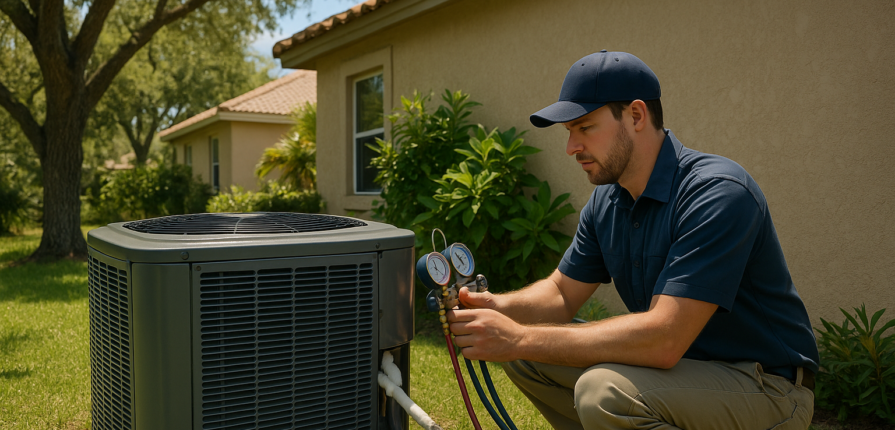
TL;DR: A refrigerant leak is never a ‘top it off and move on’ problem — it signals a real breach in a sealed system that only gets worse. Left alone, it can destroy your compressor, spike your electric bill, and put your family’s health at risk. Knowing the warning signs early is the fastest way to keep a small repair from becoming a very expensive one.
Florida summers are unforgiving. When your AC starts struggling in July heat, the cause could be something as invisible — and as damaging — as a refrigerant leak. Most homeowners never notice one until the system stops cooling entirely. By then, the damage is done.
This guide explains exactly what refrigerant is, how to spot a leak early, what happens if you wait, and what a licensed technician will actually do to fix it.
What Is Refrigerant and Why Does It Matter?
Refrigerant is the chemical that makes cooling possible. According to ENERGY STAR, standard air conditioners use a refrigerant to absorb unwanted heat in your home and transfer it to the air outside — this happens by changing the pressure of the refrigerant fluid; at low pressures, the refrigerant easily absorbs heat from the air and evaporates from a liquid to a gas. At high pressures, the gas refrigerant is higher energy than the outside air, so it passes heat to the surrounding air and condenses back to a liquid.
The key word is sealed. Your system is sealed, which means if refrigerant is low, there is a leak somewhere — and that needs to be fixed. Refrigerant is not a consumable like motor oil; it does not get used up. A low reading always means something is wrong.
ENERGY STAR’s central AC specifications make this point clearly: proper refrigerant charge and proper airflow are critical to achieve rated capacity and efficiency — failure to confirm proper charge and airflow may reduce energy efficiency and shorten equipment life.
7 Warning Signs of an AC Refrigerant Leak
Refrigerant leaks rarely announce themselves with a single obvious symptom. Instead, you typically notice a combination of smaller changes that add up over time. Here is what to watch for:
1. Warm or Lukewarm Air From the Vents
An unmistakable symptom of an AC refrigerant leak is diminished cooling power. When refrigerant levels fall below optimal pressure, the system loses its ability to exchange heat effectively, causing indoor temperatures to climb despite constant fan operation.
2. Ice or Frost on the Evaporator Coil or Refrigerant Lines
Condensation can build up and freeze on the evaporator coils when there is not enough refrigerant to absorb the hot air. Ice on the coils can lead to your system breaking down, and if not fixed, could lead to a more expensive repair.
When the AC shuts off, that ice melts. The melt water can overflow the drain pan, leaving water pooling near the indoor unit — which many homeowners initially mistake for a plumbing problem.
3. Hissing or Bubbling Sounds Near the Unit
A hissing or bubbling noise often accompanies a refrigerant leak as the pressurized gas escapes through cracks or pinholes in copper tubing or at soldered joints. If you hear this near the indoor or outdoor unit, do not ignore it. For a full guide on what different AC sounds mean, see What Different AC Noises Mean — and When to Call a Tech.
4. Rising Humidity Indoors
Air conditioner units contribute to lowering the humidity levels in your home. If your humidity levels increase or fluctuate drastically, you may have an HVAC refrigerant leak. In Central Florida, where outdoor humidity is already high, this symptom is especially noticeable — your home will feel sticky and uncomfortable even with the system running.
5. Your Electric Bill Climbs Without Explanation
When refrigerant leaks out, your AC system struggles to absorb and release heat, which forces the compressor to run longer trying harder to reach your desired temperature. Your AC will work harder when it is low on refrigerant, which will increase your energy costs. If your bill has crept up without any change in your household habits, a refrigerant issue could be why. See also Why Is Your AC Spiking Your Electric Bill? 7 Likely Culprits for a complete breakdown.
6. AC Runs Constantly But Never Reaches the Set Temperature
As the refrigerant level drops, the evaporator coils can get too cold and freeze over while airflow weakens and overall cooling power significantly decreases — your AC will have a tough time keeping your home consistently cool, leading to warm spots, uneven temperatures, and premature wear on components.
7. Oily Residue on or Near the Refrigerant Lines
Check for physical signs such as ice on coils, oily residue on lines, or puddles around the unit. The oil that travels with the refrigerant lubricates the system’s moving parts; when leaks occur, this oil loss causes more friction and can lead to premature breakdown of critical components. An oily smear on a copper line or fitting is often one of the earliest physical clues a technician will look for.
What Causes Refrigerant Leaks?
Leaks happen for several reasons, and age is not always the factor:
- Corrosion: Routine service aids in detecting corrosion, the leading cause of leaks, and maintains the system’s safe and efficient operation. A phenomenon called formicary corrosion — caused by a reaction between copper tubing, moisture, and volatile organic compounds in the air — is especially common in Florida homes near cleaning products or new construction materials.
- Wear at joints and connections: As your unit ages, your coils can wear down and develop little holes and cracks — the joints and connections are most prone to damage over time.
- Faulty installation: Factory defects in coils, valves, or fittings, as well as improper torque applied during installation, can cause leaks even in recently installed systems. If your unit is newer and already showing signs, it may be a warranty issue.
- Physical damage: Lawn equipment striking the outdoor unit, or pest damage to refrigerant lines, can also cause breaches.
What Happens If You Ignore a Refrigerant Leak?
This is the part most homeowners do not fully appreciate. A slow leak does not just mean slightly less cooling — it sets off a chain reaction.
Compressor Failure
Low refrigerant stresses and overworks the compressor. Overheating causes the compressor’s components to wear out more quickly, causing critical damage to important internal parts. When refrigerant levels are low, the compressor can overheat and cycle on and off erratically, leading to increased wear and potential failure.
AC compressor replacement typically costs between $1,200 and $3,500, depending on the HVAC system type, refrigerant requirements, and labor complexity. Although compressors are expensive to replace, they are more cost-effective to replace than to repair — and in cases where the compressor cost is 50% or more of a new AC, homeowners may opt to replace their entire cooling system. In other words, ignoring a modest leak can turn a several-hundred-dollar repair into a full system replacement.
Health Risks
Refrigerant is a chemical substance, and if there is a significant leak, an exhaust smell may occur — turn off the unit and call a professional, as these fumes can be harmful to your health. Seek medical attention if anyone in the home experiences dizziness, shortness of breath, loss of focus or coordination, nausea, difficulty breathing, swelling in the throat or neck, or severe pain in the throat, nose, or sinuses.
If you notice a chemical or sweet smell near your vents alongside other symptoms, treat it as an emergency. Open windows, get people and pets out, and call a licensed tech right away.
Environmental Impact
Many refrigerants are greenhouse gases that contribute to global warming. Some refrigerants are hydrofluorocarbons (HFCs), which are powerful greenhouse gases with global warming potentials hundreds or thousands of times higher than CO₂. Letting refrigerant vent into the atmosphere is not just an equipment problem — it is an environmental one.
Regulatory Exposure (Especially for Commercial Properties)
This matters more than most building owners realize. Under EPA Section 608, as of January 1, 2026, the EPA has reduced the refrigerant leak repair threshold from 50 pounds to 15 pounds for appliances containing regulated refrigerants — this change significantly expands the number of HVAC systems subject to federal leak inspection, reporting, and repair requirements. Commercial building owners, landlords, property managers, and HOA managers with larger systems now have direct compliance obligations they did not have before. Improper repairs risk violating EPA regulations, and only certified professionals can legally handle refrigerants.
What a Technician Will Do
During a maintenance visit, a licensed technician checks refrigerant pressure, inspects coil condition, looks for oily residue at fittings and valves, and can identify developing problems before they become full leaks. When a leak is confirmed, the process goes deeper:
- Leak detection — using electronic detectors, UV dye, or nitrogen pressure testing to pinpoint the source
- Recovery — safely recovering any remaining refrigerant per EPA requirements before opening the system
- Repair — sealing or replacing the leaking component (line, fitting, coil, or valve)
- Pressure verification — confirming the repair holds before recharging
- Recharge — restoring refrigerant to the precise charge specified by the manufacturer
A refrigerant leak repair can take 2–4 hours including leak detection, repair, evacuation, and recharge. More complex repairs involving hard-to-locate leaks or component replacement such as a full evaporator coil can take a full day depending on parts availability.
Repair costs vary based on the severity and location: minor leak repairs including small leaks and basic recharge run $200–$500; moderate repairs with detailed detection and refrigerant refill run $500–$1,000; and severe repairs involving evaporator coil or compressor replacement can run $1,000–$3,000.
Can You Just Top It Off?
No — and any technician who offers to do so without finding and fixing the leak first is doing it wrong. Adding refrigerant without repairing leaks violates EPA regulations and can cause environmental harm — leaks must be located and repaired before recharge. A proper recharge without a proper repair just means the refrigerant leaks out again, and you pay twice.
How to Prevent Refrigerant Leaks
The most reliable way to avoid a refrigerant leak situation in the middle of a hot summer is to have the system professionally inspected every spring before the cooling season begins. Catching the early signs of an AC refrigerant leak during a routine visit costs far less than dealing with a failed compressor or an emergency service call in the middle of August.
At Lucas Air Conditioning and Heating, our Precision Tune-Up ($125) includes a full refrigerant pressure check, coil inspection, and a look at all fittings and connections — exactly the kind of check that catches a small leak before it takes out your compressor. Our Preventative Maintenance Agreement ($129/year) includes one annual tune-up, 15% off parts, and priority scheduling, so if something does go wrong mid-summer, you are first in line.
If your AC is already struggling — not just with cooling but with any of the 8 Reasons Your AC Isn’t Cooling Enough — a refrigerant leak is one of the first things we check. Emergency service is available outside regular hours for situations that cannot wait.
We serve homeowners, retirees, landlords, property managers, and commercial building owners throughout Lake County and Orange County — including Tavares, Eustis, Leesburg, Mount Dora, The Villages, Lady Lake, Apopka, and surrounding communities. Call us or request a free estimate online.
Recommended Reads
- 8 Reasons Your AC Isn’t Cooling Enough (And What to Do About Each)
- What Different AC Noises Mean — and When to Call a Tech
- Why Does My AC Smell Like Burning? Common Causes and When to Worry
