
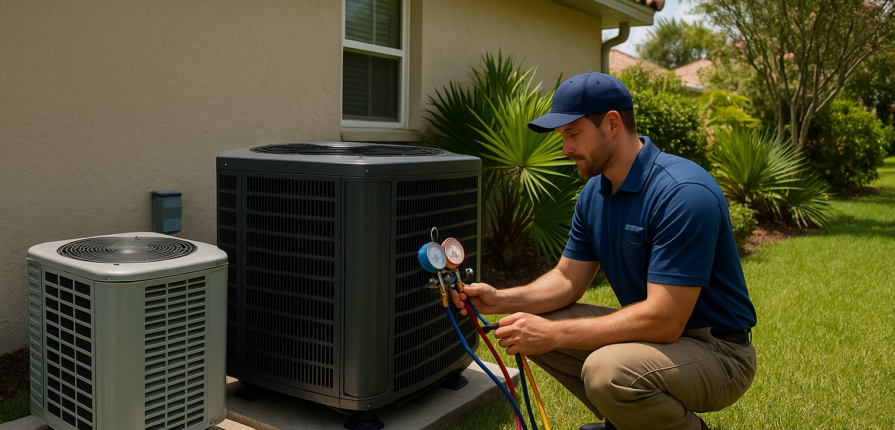
TL;DR: Two-stage AC systems run at a low or high speed, while inverter (variable-speed) systems modulate continuously — and that difference matters a lot in Central Florida’s long, humid cooling season. This guide breaks down how each works, their pros and cons, and which one fits homes in Tavares, Astor, Paisley, Grand Island, Zellwood, and Clarcona.
If you’re replacing an air conditioner in Lake or Orange County, you’ve probably run into three terms on every quote: single-stage, two-stage, and inverter (also called variable-speed). The compressor type your new system uses affects your monthly bill, how humid your home feels in August, how loud the outdoor unit is, and how long the equipment lasts.
This guide breaks down how two-stage and inverter systems actually work, their real pros and cons, and which one makes sense for the climate and housing stock we see across Tavares, Eustis, Mount Dora, The Villages, and the surrounding communities.
How a Standard (Single-Stage) AC Works, for Comparison
Most older Florida homes still have single-stage compressors. These run at full power whenever they’re on, then shut off completely once the thermostat is satisfied. That on/off cycling is simple and inexpensive, but it means big temperature swings, short bursts of humidity removal, and the hardest possible start-up load on the compressor every time it kicks on.
What Is a Two-Stage AC System?
A two-stage compressor has exactly two speeds: a low stage around 65-67% of capacity and a high stage at 100%.
Two stage has a high setting and a low setting, often around 60 to 70 percent.
On mild days, the system runs on low stage for longer stretches instead of blasting full power and shutting off.
That longer, gentler runtime is the whole advantage.
Longer low-stage run times produce smaller temperature swings (1-3°F) and better humidity removal
compared to single-stage equipment. It also runs quieter at low stage —
low-stage operation is 4-6 dB quieter than full blast.
Two-Stage Pros
- Noticeably more efficient than single-stage, typically landing in the
15-17 SEER2
range - Better humidity control and steadier temperatures than a basic on/off system
- Lower equipment cost than a full inverter system
- Proven, widely available technology that most technicians know well
Two-Stage Cons
- Still has only two fixed speeds, so it can’t fine-tune output the way an inverter can
- Two-stage still can’t modulate below its low-stage capacity, so some cycling still occurs on mild days
- Less dramatic energy savings than variable-speed equipment
What Is an Inverter (Variable-Speed) AC System?
An inverter system uses an electronic drive that
varies electrical frequency to the compressor motor, producing continuously variable-speed compressor behavior
instead of just two fixed settings.
Variable-speed inverters modulate continuously from roughly 25 to 100 percent capacity
, constantly adjusting to match the exact cooling load in your home at that moment.
Think of it less like a light switch and more like a dimmer.
These systems make many small variations to compressor and fan speed in order to work more efficiently and keep temperatures and humidity steady
, operating much like adaptive cruise control rather than stop-and-go driving.
Inverter Pros
- Highest efficiency available.
SEER2 ratings of 18-26+ mean the lowest operating costs available in residential cooling. - Superior comfort and humidity removal.
Continuous low-speed operation holds room temperature within about half a degree with excellent humidity control. - Quieter operation.
At low speed, many units produce only 55-60 dB — quieter than a normal conversation. - Less mechanical wear.
Fewer constant starts and stops mean less stress on the compressor, which can extend equipment life.
Inverter Cons
- Higher upfront equipment and installation cost than two-stage or single-stage systems
- More sophisticated electronics mean repairs, when needed, can be more specialized
- The efficiency premium pays off fastest in homes that run AC nearly year-round — which describes most of Central Florida
Why This Decision Matters More in Lake and Orange County
Florida isn’t a market where you can split the difference and assume it won’t matter. The state’s cooling season is long and demanding, which is exactly why
Florida requires a minimum SEER2 of 14.3 for single-phase residential central air systems, higher than the 13.4 SEER2 minimum used in northern states
. Every new installation or replacement in Tavares, Clarcona, Grand Island, and the rest of our service area has to meet that code minimum — but code minimum and “right for your home” aren’t always the same thing.
Humidity is the other half of the equation, and it’s often the more important one here. Florida air carries heavy moisture for most of the year, and
air conditioners have to cycle long enough for moisture to condense on the coils and drain away — with oversized or short-cycling units, that condensation doesn’t fully drain off
. That’s precisely the scenario two-stage and inverter systems are designed to avoid, since both run longer, gentler cycles than a basic single-stage unit. Homes in Astor and Paisley near the St. Johns River and Lake Woodruff corridor, where ambient humidity runs especially high, tend to feel the difference most.
Two-Stage vs. Inverter: Side-by-Side
- Operation: Two-stage = low or high; Inverter = continuously variable
- Typical efficiency: Two-stage reaches roughly 15-19 SEER2; inverter systems reach
18-26+ SEER2 - Humidity control: Two-stage is “better”; inverter is “best,” per
improving comfort, humidity control, and noise as you move up the ladder from single-stage to two-stage to variable-speed - Noise: Two-stage is quieter than single-stage; inverter is quietest of all three
- Upfront cost: Two-stage sits between single-stage and inverter pricing
- Best fit: Two-stage suits budget-conscious homeowners wanting a real step up from single-stage; inverter suits homes run on AC nearly year-round, multi-story homes with uneven cooling, or anyone prioritizing quiet and tight humidity control
When Does Each System Make the Most Sense?
Choose Two-Stage If:
- You want a meaningful efficiency and comfort upgrade without the full inverter price tag
- Your home is a single-story, moderately sized property with decent existing ductwork
- You’re a landlord or property manager balancing upfront cost against tenant comfort
Choose Inverter If:
- You run cooling nearly year-round, which describes most full-time Florida residents
- You’ve struggled with humidity, clamminess, or uneven temperatures room to room
- You want the quietest possible outdoor unit — a common priority in The Villages, Lady Lake, and other close-proximity communities
- You’re planning to stay in the home long enough to recoup the higher install cost through lower bills
Don’t Forget Proper Installation and Sizing
Compressor type only delivers its benefits if the system is sized and installed correctly. An oversized unit of any type — two-stage or inverter — will short-cycle and leave your home cool but sticky, since
an oversized unit will cool the room but only remove some of the humidity, leaving a damp, clammy feeling
. This is one more reason a proper load calculation from a licensed contractor matters more than the brand name on the box.
If your current system is already struggling to keep up regardless of its compressor type, it’s worth ruling out simpler issues first — our guide on 8 reasons your AC isn’t cooling enough walks through common culprits before you assume a full replacement is necessary. And if your outdoor unit has started making new sounds, our breakdown of what different AC noises mean can help you figure out whether it’s a quick fix or a sign the compressor itself is wearing out.
Getting the Right System for Your Home
Every home is different — a single-story home in Zellwood with good ductwork has different needs than a two-story home in Mount Dora or a commercial space in Apopka. As a licensed HVAC contractor in Tavares, FL, we walk through load calculations, humidity concerns, and budget with every homeowner before recommending a system, with no upselling — just the equipment that fits your house and your usage.
All new installations include the unit, permit, a one-year labor guarantee, and a ten-year parts warranty, with KwikComfort financing available and free estimates on new installations. If you’re weighing a two-stage or inverter upgrade, check our current seasonal specials before you book your free estimate.
Recommended Reads
- HVAC Contractor in Tavares, FL
- Landing Page for Seasonal Specials – Online Booking – Lucas Air Conditioning and Heating
- Landing Page for Seasonal Specials – Lucas Air Conditioning and Heating
