
TL;DR:
- Proper home ventilation is essential to ensure indoor air quality, especially in tightly sealed modern homes. Selecting the right system depends on climate, with HRVs suitable for cold, dry areas and ERVs ideal for humid regions like Florida. Regular maintenance, accurate sizing, and monitoring CO2 levels are crucial for effective air exchange and occupant health.
Home ventilation is the controlled process of exchanging indoor air with outdoor air to improve air quality, control humidity, and enhance comfort. The EPA and ASHRAE define adequate ventilation as at least 0.35 air changes per hour or 15 CFM per person, whichever is greater. Without that exchange, pollutants, moisture, and odors accumulate fast. Modern homes are sealed tighter than ever, which makes planned ventilation not a luxury but a necessity. Whether you rely on natural airflow, exhaust fans, or a full Heat Recovery Ventilator (HRV), the right system keeps your family breathing clean air year-round.
What are the main types of home ventilation systems?
Every ventilation system house owners can install falls into one of five categories. Each works differently, and each suits a different situation.
- Natural ventilation uses windows, doors, and passive vents to let air move through the home. It costs nothing to run, but it depends entirely on wind and temperature differences. In Central Florida’s still, humid summers, natural airflow alone rarely delivers enough fresh air.
- Exhaust-only systems pull stale air out through bathroom or kitchen fans, drawing replacement air in through gaps in the building envelope. They are inexpensive but uncontrolled. Negative pressure can pull in radon, moisture, or unconditioned air from crawl spaces.
- Supply-only systems push filtered outdoor air in, creating slight positive pressure that forces stale air out through leaks. They work well in hot, humid climates because positive pressure resists moisture infiltration from outside.
- Balanced ventilation moves equal volumes of air in and out through dedicated ducts. This is the gold standard for controlled air exchange because it does not depressurize or pressurize the home.
- Whole-house fans pull large volumes of air through the living space and exhaust it into the attic. They cool effectively when outdoor temperatures drop below indoor temperatures, but they provide no cooling on their own.
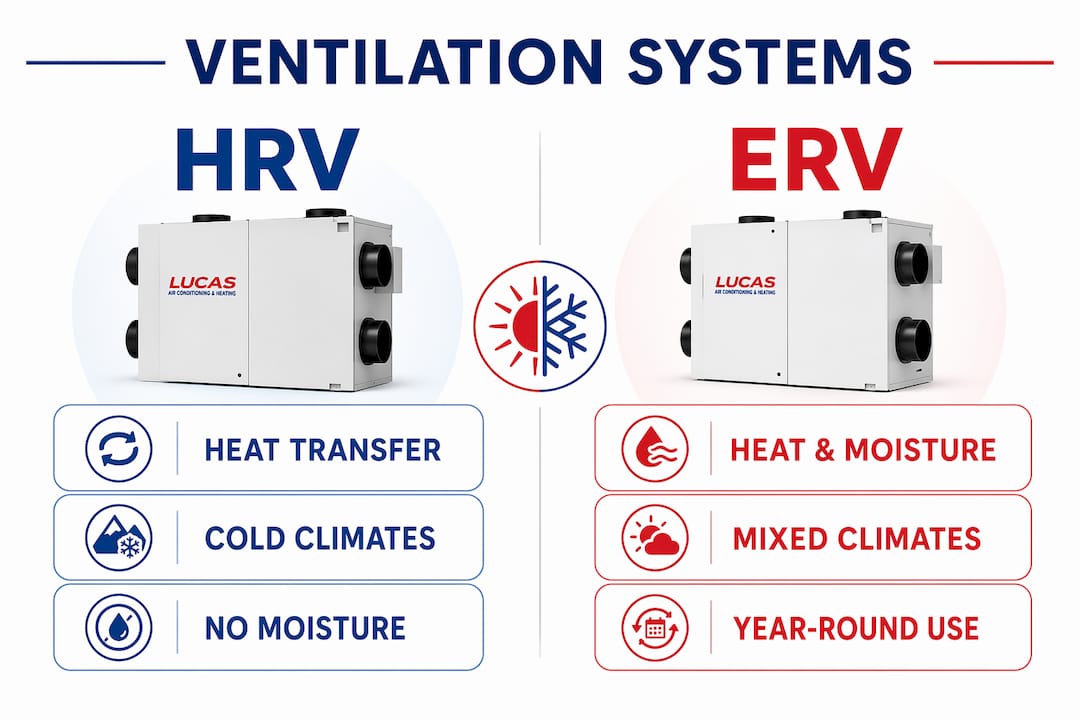
The two most advanced balanced options are HRVs and ERVs. Here is how they compare:
| Feature | HRV (Heat Recovery Ventilator) | ERV (Energy Recovery Ventilator) |
|---|---|---|
| Transfers heat | Yes | Yes |
| Transfers moisture | No | Yes |
| Best climate | Cold, dry | Humid or mixed |
| Humidity control | Keeps indoor air drier | Balances indoor humidity |
| Typical use | Northern states, dry regions | Florida, Gulf Coast, mixed climates |
HRVs are recommended for cold, dry climates because they recover heat without transferring moisture, keeping heating costs low. ERVs transfer both heat and moisture, which makes them the better fit for humid regions like Central Florida where you want to limit how much outdoor humidity enters the home.
Pro Tip: If you live in a mixed climate, an ERV gives you year-round flexibility. It manages humidity in summer and recovers heat in winter, making it the more versatile choice for most Florida homeowners.
How much ventilation does a home need in 2026?
ASHRAE 62.2, the industry standard for residential ventilation, gives you a precise formula. The ASHRAE 62.2 ventilation formula is: 0.03 x floor area (sq ft) + 7.5 x (number of bedrooms + 1) CFM. That number is your minimum continuous ventilation rate.
Here is what that looks like in practice:
- Calculate your floor area. A 2,000 sq ft home multiplied by 0.03 gives you 60 CFM from the floor area component.
- Add the occupancy factor. A three-bedroom home uses 7.5 x (3 + 1) = 30 CFM for occupancy.
- Add the two numbers. That home needs at least 90 CFM of continuous fresh air supply.
- Check against the per-person minimum. The EPA also requires at least 15 CFM per person. A family of four needs 60 CFM minimum from this calculation alone.
- Use the higher number. Always apply whichever result is greater to stay within ASHRAE 62.2 compliance.
Beyond the formula, CO2 levels tell you whether your ventilation is actually working. Indoor CO2 above 1,500 ppm in bedrooms signals inadequate ventilation. The target is below 1,000 ppm. That gap matters because high CO2 causes fatigue, poor sleep, and reduced concentration, problems many homeowners blame on stress or poor sleep habits rather than air quality.
Kitchens and bathrooms have their own local exhaust requirements. ASHRAE recommends at least 25 CFM continuous or 100 CFM intermittent for bathrooms, and 100 CFM continuous or 150 CFM intermittent for kitchens. These numbers exist on top of your whole-home rate, not instead of it.
Tightly sealed homes built after 2010 almost always need mechanical ventilation to meet these rates. Natural leakage through the building envelope no longer provides enough air exchange in modern construction.
How do climate and home design affect your ventilation choice?
Climate is the single biggest factor in choosing between home ventilation options. Getting this wrong costs you money and comfort.

Cold and dry climates (think Minnesota or Colorado) lose significant heat through ventilation. An HRV recovers up to 80% of that heat from outgoing air before it leaves the building. That recovery keeps energy bills manageable while still delivering fresh air.
Humid and mixed climates like Florida present the opposite problem. Bringing in raw outdoor air in July means bringing in moisture. An ERV pre-conditions incoming air by transferring some of the indoor air’s dryness to the incoming humid air. The result is fresh air without a spike in indoor humidity.
Tight, energy-efficient homes amplify every ventilation decision. Modern homes built with tight envelopes require controlled, balanced ventilation to avoid trapped moisture and pollutants. A home that scores well on a blower door test is not self-ventilating. It needs a mechanical system to do what leaky older homes did accidentally.
Whole-house fans work well in climates with cool evenings, such as high-desert regions or mild coastal areas. Whole-house fans are effective only when outdoor temperatures are lower than indoor temperatures. In high-humidity climates, they can pull moist outdoor air inside and raise indoor humidity, which is the opposite of what most Florida homeowners want.
Sizing a whole-house fan also requires attention to attic venting. A whole-house fan needs roughly 1 square foot of attic vent area per 750 CFM of fan capacity. Without adequate attic venting installation, the fan creates back pressure, reduces performance, and can force exhaust gases from water heaters or furnaces back into the living space.
| Climate type | Recommended system | Key benefit |
|---|---|---|
| Cold and dry | HRV | Recovers heat, keeps air dry |
| Humid and mixed | ERV | Balances heat and moisture |
| Mild with cool nights | Whole-house fan | Low-cost cooling ventilation |
| Any tight modern home | Balanced mechanical system | Controls pollutants and moisture |
Pro Tip: Before buying any system, run the ASHRAE 62.2 formula for your home and compare it against your current setup. Most homeowners discover their existing exhaust fans fall well short of the minimum rate.
What practical steps improve home air circulation and quality?
Improving your home’s air circulation does not always require a new system. Several common problems reduce ventilation effectiveness before any equipment failure occurs.
Blocked vents and clogged air filters are the leading causes of reduced airflow in residential HVAC systems. These conditions force your system to work harder, shorten its lifespan, and raise your energy bills. Check every supply and return vent in your home. Furniture, rugs, and storage boxes block more vents than most homeowners realize.
Use a CO2 monitor to verify your ventilation is actually working. Placing a CO2 sensor in your bedroom overnight gives you a direct measurement of ventilation adequacy. If levels climb above 1,000 ppm by morning, your bedroom needs more fresh air. Opening interior doors before bed is a simple fix that reduces CO2 accumulation by allowing air to circulate between rooms.
Whole-home balanced ventilation systems consistently outperform localized exhaust fans for maintaining air quality. Continuous filtered outdoor air supply controls CO2, odors, and volatile organic compounds across the entire living space. A single bathroom fan running intermittently cannot replicate that performance.
HRV and ERV filters need annual replacement to maintain airflow and indoor air quality. Neglecting filter changes in tightly sealed homes reduces system efficiency and creates conditions for moisture buildup and mold growth. Set a calendar reminder every fall before heating season begins.
For whole-house fans, proper attic venting is non-negotiable. Whole-house fans require 2 to 4 times more attic vent area than standard attic ventilation guidelines specify. If your attic is under-vented, the fan underperforms and risks backdrafting combustion appliances. Check your attic vent area before running the fan at full capacity.
Finally, integrate your ventilation strategy with your HVAC system. A well-balanced system delivers fresh air to every room, not just the rooms closest to the air handler. If some rooms always feel stuffy or humid, that is a sign of poor air balancing rather than a ventilation rate problem.
Key takeaways
Effective home ventilation requires a system matched to your climate, sized to ASHRAE 62.2 standards, and maintained annually to protect indoor air quality.
| Point | Details |
|---|---|
| Use the ASHRAE formula | Calculate 0.03 x floor area + 7.5 x (bedrooms + 1) CFM to find your minimum ventilation rate. |
| Match system to climate | Choose an HRV for cold, dry climates and an ERV for humid or mixed climates like Florida. |
| Monitor CO2 levels | Bedroom CO2 above 1,500 ppm confirms inadequate ventilation; target below 1,000 ppm. |
| Maintain filters annually | Replace HRV and ERV filters every year to prevent mold and maintain airflow in tight homes. |
| Choose whole-home over localized | Balanced whole-home systems control pollutants and moisture better than exhaust-only fans. |
The “build tight, ventilate right” lesson most homeowners learn too late
I have seen this pattern more times than I can count. A homeowner upgrades their insulation, seals every gap, and installs new energy-efficient windows. Their utility bills drop. They feel good about the investment. Then six months later they notice condensation on windows, a musty smell in the closets, and everyone in the house seems to have a perpetual headache.
The problem is not the upgrades. The problem is that they built tight without ventilating right. That phrase, “build tight, ventilate right,” is the most important principle in modern residential construction, and most homeowners hear it for the first time after the damage is done.
What I find most frustrating is that the fix is rarely expensive once you understand the problem. In most cases, a properly sized ERV or HRV solves the issue completely. The real cost is the delay, the mold remediation, the HVAC repairs from a system straining against blocked airflow.
Homeowners also consistently misidentify the cause of poor air quality. They blame the HVAC system when the actual culprits are a rug blocking a return vent and a filter that has not been changed in 18 months. I always recommend checking the simple things first. Walk through your home and look at every vent. Pull the filter and hold it up to the light. If you cannot see light through it, your system is working against itself.
The other misconception I hear regularly is that cracking a window counts as ventilation. It does, in the loosest sense. But it is not controlled, it is not filtered, and it does not reach every room. If you want to know what your indoor air quality actually looks like, buy a CO2 monitor and run it overnight. The number you see in the morning will tell you more than any visual inspection ever could.
— Lucasair
Get expert ventilation help from Lucasair

Selecting and sizing a ventilation system to meet ASHRAE 62.2 standards is not guesswork. Lucasair provides professional evaluation, system sizing, and installation for Central Florida homeowners who want real results. Whether you need an ERV, HRV, whole-house fan, or a full residential HVAC installation, the Lucasair team sizes every system to your home’s specific floor area, occupancy, and climate conditions. Maintenance matters just as much as installation. Lucasair’s HVAC repair and maintenance services keep your ventilation system running at peak performance year after year, protecting your investment and your family’s health. Schedule your evaluation today.
FAQ
What is the minimum ventilation rate for a home?
The EPA and ASHRAE 62.2 require at least 0.35 air changes per hour or 15 CFM per person, whichever is greater. Use the formula 0.03 x floor area + 7.5 x (bedrooms + 1) CFM to calculate your home’s specific minimum.
What is the difference between an HRV and an ERV?
An HRV transfers heat only and works best in cold, dry climates. An ERV transfers both heat and moisture, making it the better choice for humid or mixed climates like Florida.
How do I know if my home has enough ventilation?
Place a CO2 monitor in your bedroom overnight. CO2 levels above 1,500 ppm in the morning indicate inadequate ventilation. Levels below 1,000 ppm confirm your system is performing adequately.
How often should I replace ventilation system filters?
HRV and ERV filters need replacement at least once per year. In tightly sealed homes, skipping this maintenance leads to reduced airflow, higher energy use, and conditions that promote mold growth.
Are whole-house fans a good ventilation solution in Florida?
Whole-house fans work only when outdoor temperatures are lower than indoor temperatures. In Florida’s humid summers, they can pull moist outdoor air inside and raise indoor humidity, so they are not the primary ventilation solution for most Florida homes.
Recommended
- Best HVAC Features for New Homes in 2026 – Lucas Air Conditioning and Heating
- Upgrading HVAC systems in Central Florida: Your 2026 guide – Lucas Air Conditioning and Heating
- HVAC trends 2026: Smart solutions, efficiency, comfort – Lucas Air Conditioning and Heating
- Upgrade your HVAC in 2026 for efficiency & cost savings – Lucas Air Conditioning and Heating
