
TL;DR:
- Many Central Florida restaurant owners inaccurately believe that duct cleaning is only necessary annually or semi-annually, risking fire safety and insurance claims. Proper duct cleaning involves two separate systems: kitchen exhaust ducts governed by NFPA 96, which prevent grease fires, and HVAC ducts regulated by NADCA standards that maintain indoor air quality. Regular, documented maintenance tailored to cooking volume and local conditions helps ensure compliance, safety, and operational efficiency.
Most restaurant owners in Central Florida assume duct cleaning means scheduling someone to scrub the kitchen hood once or twice a year. That assumption can cost you your operating license, trigger an insurance claim denial, or worse, lead to a grease fire that shuts your doors permanently. The truth is, duct cleaning for restaurants covers two entirely separate systems, each governed by its own standards and carrying its own risks if ignored. This article walks you through both systems, the Florida-specific regulations you must follow, how often cleaning is required, and what documentation you need to protect your business every single day you’re open.
Table of Contents
- What is duct cleaning for restaurants?
- NFPA 96: Fire regulations and cleaning schedules
- Kitchen exhaust versus HVAC duct cleaning: Process and benefits
- Florida’s unique duct cleaning challenges: Access, humidity, and documentation
- The real-world truth about restaurant duct cleaning
- Partnering for compliance, safety, and comfort
- Frequently asked questions
Key Takeaways
| Point | Details |
|---|---|
| Both systems matter | Fire safety (exhaust) and air quality (HVAC) each require attention to meet compliance and impress customers. |
| NFPA 96 is law | Florida restaurants must follow NFPA 96 schedules for kitchen exhaust cleaning or risk fines and closures. |
| Florida brings unique risks | High humidity accelerates mold, and documentation is crucial for inspections and insurance protection. |
| Pro documentation is critical | Photos and reports safeguard you during health and fire inspections and make insurance claims smoother. |
| Partner with local experts | Working with a Florida-focused cleaning provider ensures code compliance and a comfortable dining experience. |
What is duct cleaning for restaurants?
Duct cleaning is not a single service. It’s two distinct processes that address two very different threats to your operation.
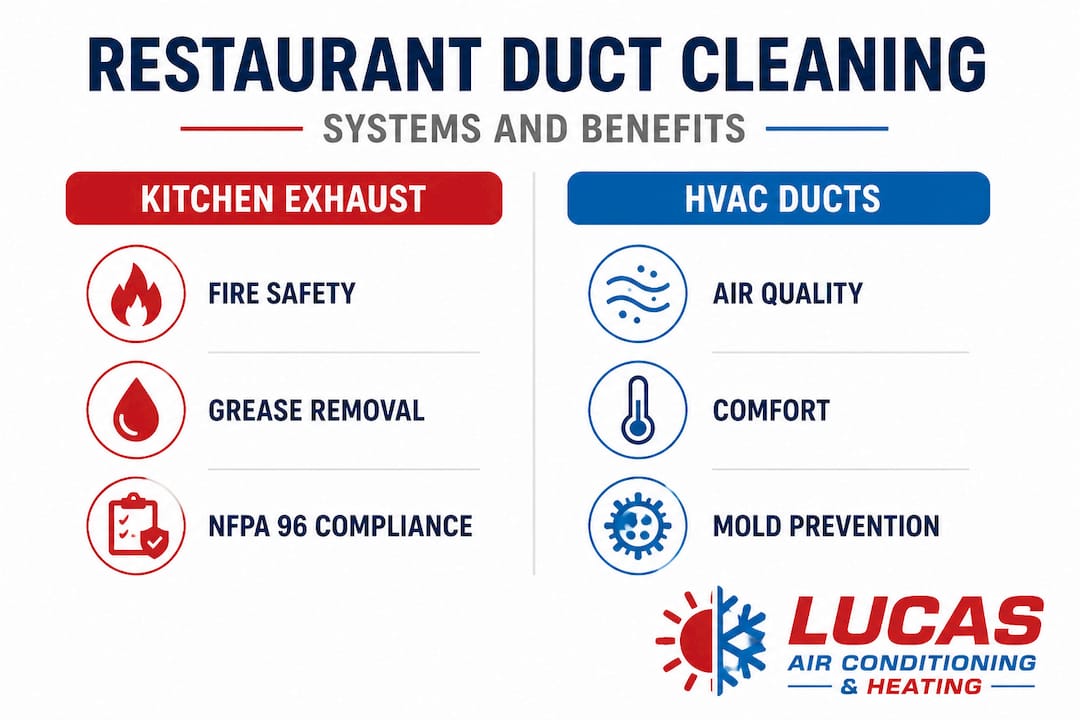
Duct cleaning for restaurants primarily involves cleaning two systems: kitchen exhaust ducts (which carry grease-laden vapors from your cooking line) governed by NFPA 96, and supply/return HVAC ducts governed by NADCA (National Air Duct Cleaners Association) standards. Treating them as the same job or assuming one covers the other is one of the most common and costly mistakes restaurant operators make.
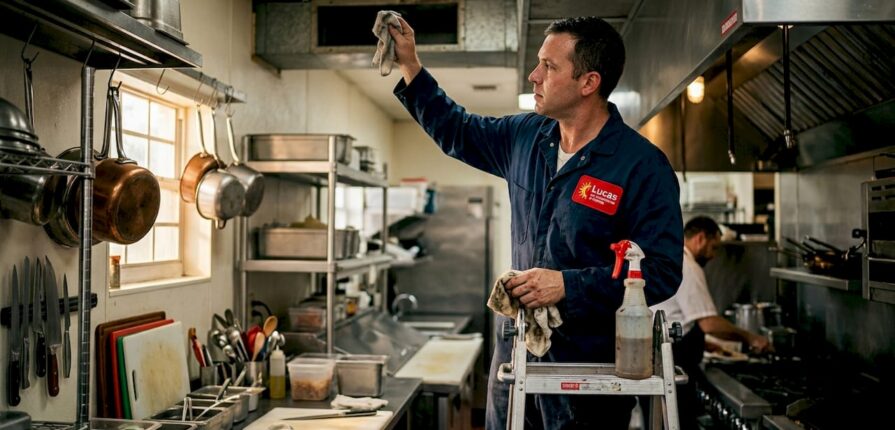
Kitchen exhaust ducts run from your hood above the cooking equipment, through the ceiling, and out through the rooftop exhaust fan. Every time your line cooks sear proteins, fry in oil, or run a flat-top at full blast, grease-laden vapor travels through that system. Over time, grease coats every interior surface. That coating is fuel. It is the primary cause of commercial kitchen fires.
HVAC supply and return ducts are completely separate. They carry conditioned air throughout your dining room, prep areas, and restrooms. These ducts accumulate dust, allergens, mold spores, and, in some cases, grease that has migrated from cooking areas. The governing body here is NADCA, which sets standards for how thoroughly ducts must be cleaned and inspected.
Here is a quick comparison to clarify both systems:
| Feature | Kitchen exhaust system | HVAC supply and return ducts |
|---|---|---|
| Governing standard | NFPA 96 | NADCA |
| Primary risk | Grease fire | Poor indoor air quality |
| Cleaning driver | Legal/fire code compliance | Health, comfort, energy efficiency |
| Inspection authority | Fire marshal, health dept. | Health dept., internal audits |
| Cleaning frequency | Monthly to annually by code | Based on conditions |
| Documentation required | Yes, mandatory | Strongly recommended |
One common misconception is that cleaning the hood face is enough. It is not. NFPA 96 requires cleaning all the way through the ductwork and the rooftop exhaust fan, not just the visible surfaces. Another misconception is that HVAC duct cleaning is optional for restaurants. While there is no Florida code that mandates HVAC duct cleaning on a fixed schedule, the impact on duct cleaning and air quality is directly tied to customer experience and health department impressions.
“Many operators think passing a hood inspection means their duct system is compliant. In reality, compliance means bare metal throughout the entire exhaust path, documented with post-service photos.” — Industry best practice, NFPA 96 compliance framework
Doing both jobs well is what separates restaurants that sail through inspections from those that scramble every time an inspector shows up.
NFPA 96: Fire regulations and cleaning schedules
Florida has adopted NFPA 96 statewide, making it the legal standard for commercial kitchen ventilation and fire safety. This is not optional guidance. This is code.
NFPA 96 requires cleaning of hoods, ducts, and fans to bare metal, with cleaning frequency based on the type of cooking operation: monthly for high-volume or solid-fuel operations, quarterly for standard restaurants, semi-annually for moderate-use kitchens, and annually for low-volume operations. Here is how that breaks down in practice:
| Restaurant type | Cleaning frequency required |
|---|---|
| High-volume (24-hour, fast food, solid fuel) | Monthly |
| Standard full-service restaurant | Quarterly |
| Moderate-use (limited menu, part-time cooking) | Semi-annually |
| Low-volume (seasonal, single-shift, light cooking) | Annually |
Most sit-down restaurants in Central Florida fall into the quarterly category. If you are running a high-traffic kitchen during peak tourist season or operating a wood-fired oven or charcoal grill, you move into monthly territory immediately.
Florida and Central Florida adopt NFPA 96 statewide, with health departments actively inspecting hoods and ventilation systems. While there is no specific mandate requiring HVAC duct cleaning on a fixed schedule, compliance with indoor air quality (IAQ) best practices strongly supports your standing with health inspectors.
Here is what fire and health inspectors specifically look for during a commercial kitchen inspection:
- Evidence of bare metal throughout the hood, plenum, duct interior, and rooftop fan
- A current service report from the cleaning company dated within the required interval
- Access panels installed correctly along duct runs for cleaning access
- No grease drips or pooling visible on hood filters or duct entry points
- Rooftop exhaust fan free of grease accumulation and spinning freely
Pro Tip: Request post-service photos from your duct cleaning contractor after every visit. Inspectors increasingly ask to see photographic evidence, not just a paper report. A contractor who does not provide photos after every job is not giving you the documentation you need.
The consequences of falling out of compliance are serious. Fire marshals can issue fines ranging from several hundred to several thousand dollars per violation. Your commercial property insurance policy almost certainly has a clause requiring documented NFPA 96 compliance. If a grease fire occurs in a non-compliant kitchen, your insurer has grounds to deny the claim entirely. Beyond the legal and financial risks, unscheduled downtime for emergency cleaning or repairs can cost a busy Central Florida restaurant tens of thousands of dollars in lost revenue during a single peak weekend.
Pairing this compliance work with a solid restaurant HVAC maintenance schedule gives you a defensible record that protects your business on every front.
Kitchen exhaust versus HVAC duct cleaning: Process and benefits
Understanding exactly what happens during each type of cleaning helps you evaluate contractors and set expectations for your team. These are not interchangeable services, and the processes are very different.
Kitchen exhaust cleaning process:
Kitchen exhaust cleaning follows a documented methodology: inspect the system first, remove filters, degrease and pressure wash the hood interior, plenum, ductwork, and fans, vacuum debris, perform a post-cleaning inspection, and document everything with photos. A qualified contractor will also check the rooftop fan motor and bearings during the visit.
Here is the step-by-step breakdown:
- Pre-service inspection to identify grease load and access points
- Protect kitchen equipment and surfaces with plastic sheeting
- Remove and soak filters in chemical degreaser
- Apply degreaser inside hood, plenum, and duct surfaces
- Pressure wash from the fan back toward the hood to push grease downward
- Collect and dispose of grease waste properly (environmental compliance)
- Reinstall cleaned filters and inspect fan assembly
- Post-service photo documentation and written report
- Apply grease-resistant coating if applicable
HVAC duct cleaning process:
HVAC duct cleaning is a completely different operation. Exhaust versus HVAC duct cleaning comes down to this: exhaust systems prevent fires through mandatory scheduled cleaning, while HVAC systems improve indoor air quality and energy efficiency based on actual conditions. Both are necessary for full compliance and customer satisfaction in a restaurant setting.
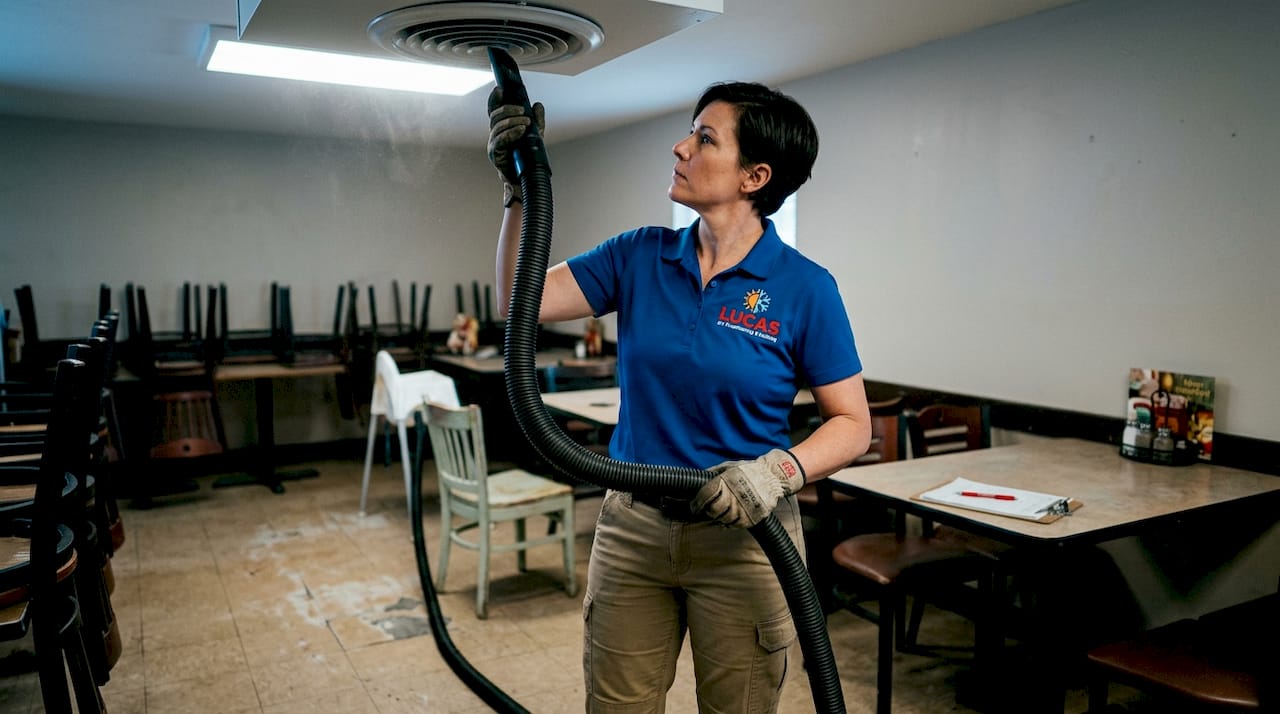
For HVAC ducts, a professional contractor uses a truck-mounted vacuum system to create negative pressure inside the duct network, then mechanically agitates debris from duct walls using compressed air whips and rotary brushes. Every register and diffuser is cleaned and inspected. The system is then sealed and tested for airflow.
Pro Tip: Ask any HVAC duct cleaning contractor whether they use truck-mount or portable vacuum equipment. Truck-mount systems generate significantly more suction and are far more effective in large commercial spaces like restaurant dining rooms and prep areas. Portable units are often insufficient for a full restaurant cleaning.
The business case for HVAC duct cleaning goes beyond compliance. When your dining room HVAC system is pushing clean, conditioned air through unobstructed ducts, your AC equipment runs more efficiently and your customers feel the difference. Humidity control improves. Odors from cooking areas are less likely to drift into the dining room. In Central Florida’s heat and humidity, a well-maintained restaurant HVAC maintenance program directly affects how long customers stay at their tables, which affects your average check size.
Florida’s unique duct cleaning challenges: Access, humidity, and documentation
Central Florida creates conditions that intensify every duct cleaning challenge. This is not just about keeping up with a schedule. It is about understanding what your local climate does to your ductwork when it goes unmanaged.
Here is what makes Florida restaurant ducts uniquely demanding:
- Humidity accelerates mold growth. Florida’s year-round humidity means condensation can form inside HVAC ductwork, creating conditions where mold establishes quickly. High humidity in Florida accelerates mold development in ducts, grease can migrate from exhaust systems into supply air paths, access panels are required every 12 feet along duct runs, and solid-fuel cooking operations require monthly cleaning.
- Grease migration is a hidden problem. In kitchens without proper exhaust pressure balance, grease-laden air can be drawn into supply duct systems. This contaminates areas well beyond the kitchen and creates fire risk where no one is looking.
- Access panels are a code requirement. NFPA 96 mandates access panels every 12 feet along kitchen exhaust duct runs. Many older restaurant buildings in Central Florida lack these, which means contractors either cannot properly clean the duct or have to cut in new panels, adding cost and downtime.
- Documentation is your shield. For Central Florida restaurant owners, the priority is clear: NFPA 96 compliance for inspections and insurance, NADCA best practices for IAQ and customer comfort, and thorough documentation for every visit with health and fire departments.
“In Florida’s climate, ‘clean enough’ does not exist for commercial kitchen ductwork. Mold and grease build faster here than in cooler, drier markets. Your documentation has to be flawless because inspectors know the local conditions too.” — Common guidance from Central Florida fire compliance professionals
What does strong documentation actually look like? It means a written service report on contractor letterhead with the date, technician name, areas cleaned, methods used, and a statement of compliance with NFPA 96. It means before-and-after photographs of every major duct section, the hood plenum, and the rooftop fan. It means a signed copy kept on site and available immediately if an inspector requests it.
Understanding when duct cleaning helps Florida businesses goes hand in hand with recognizing that the humidity factor alone makes Florida a higher-frequency market than national averages suggest.
The real-world truth about restaurant duct cleaning
Here is something that rarely gets said directly: most restaurant operators in Central Florida treat duct cleaning as a reactive task. They schedule it when an inspection is coming, when the hood starts dripping, or when a health department notice arrives. That approach costs more money in the long run and exposes you to unnecessary risk between service dates.
The restaurants that consistently score well with inspectors and rarely deal with fire or IAQ problems share one habit. They treat duct cleaning as an operational investment, not a compliance checkbox. They schedule based on their actual cooking load, not the minimum code requirement. A restaurant doing high-volume weekend brunches and running a full dinner service six nights a week has a different grease loading profile than a small cafe serving light fare five days a week. The code gives you a floor, not a ceiling.
There is also a real financial return to proactive cleaning that most owners never calculate. Documented NFPA 96 compliance can lead to lower commercial property insurance premiums. Clean HVAC ducts reduce the load on your air conditioning units, which in Central Florida’s climate means real savings on energy bills every month. Diners notice when a restaurant smells fresh versus when it smells faintly of old grease or must. That sensory experience affects reviews, and reviews affect reservations.
The uncomfortable truth is that choosing a contractor who documents thoroughly and addresses both the exhaust and HVAC systems every visit is the real differentiator. Not just for compliance, but for the kind of uninterrupted operations that protect your revenue. Look into HVAC upgrades for restaurants alongside your cleaning schedule to keep your entire system performing at the level your customers and inspectors expect.
Partnering for compliance, safety, and comfort
Running a restaurant in Central Florida means managing more compliance requirements than most business owners face, and your duct systems sit at the intersection of fire safety, health codes, and customer experience.
At Lucas Air Conditioning and Heating, we understand what Central Florida restaurants need because we work in this market every day. Founded by Army Veteran Cameron Lucas and serving Eustis, Lake County, and surrounding communities since 2018, we bring a code-first, documentation-driven approach to every commercial duct cleaning job. We handle both kitchen exhaust compliance and HVAC IAQ services, deliver post-service photo reports that satisfy health and fire inspectors, and work around your schedule to minimize downtime. Explore our evidence-based duct cleaning services and see how we help restaurant operators stay compliant, protect their insurance coverage, and create a dining environment their customers want to return to.
Frequently asked questions
How often should restaurant kitchen ducts be cleaned in Florida?
NFPA 96 requires cleaning monthly for high-volume or solid-fuel operations, quarterly for standard restaurants, semi-annually for moderate-use kitchens, and annually for low-volume operations, with most Central Florida restaurants falling into the quarterly category for code compliance.
What is the difference between kitchen exhaust and HVAC duct cleaning in restaurants?
Restaurant duct cleaning covers two systems: kitchen exhaust ducts governed by NFPA 96 focus on grease removal and fire prevention, while HVAC supply and return ducts governed by NADCA standards address indoor air quality and customer comfort.
Do Florida health inspectors require HVAC duct cleaning documentation?
Florida health departments actively inspect hoods and ventilation, and while no specific code mandates HVAC duct cleaning on a fixed schedule, maintaining thorough documentation demonstrates your IAQ commitment and protects your standing if questions arise.
Why is mold a concern in Florida restaurant ducts?
Florida’s high humidity accelerates mold development inside ductwork, and when combined with condensation from active air conditioning systems, conditions for mold growth can establish quickly even in recently cleaned ducts without proper humidity management.
Recommended
- How to maintain restaurant HVAC for efficiency and compliance – Lucas Air Conditioning and Heating
- Restaurant HVAC preventative maintenance workflow that works – Lucas Air Conditioning and Heating
- Top HVAC Upgrades for Restaurants: Boost Efficiency – Lucas Air Conditioning and Heating
- Duct Cleaning & Indoor Air Quality: Evidence & Best Practices – Lucas Air Conditioning and Heating
