

TL;DR:
- Most homeowners assume a larger air conditioner provides better comfort, but oversizing causes short-cycling and humidity issues. Proper HVAC load calculation, especially using Manual J, ensures the system matches the home’s actual heating and cooling needs, which is critical in Florida’s humid climate. Skipping precise sizing leads to higher energy bills, mold growth, system failure, and discomfort, making accurate load assessment essential for long-term efficiency and indoor air quality.
Most homeowners assume the biggest air conditioner wins. It doesn’t. In Central Florida, an oversized system short-cycles, meaning it blasts cold air and shuts off before pulling enough moisture from the air, leaving you sweaty and uncomfortable even at 72 degrees. The solution isn’t guesswork or a square footage rule of thumb. It’s a proper HVAC load calculation, a precise engineering process that matches your system’s capacity to your home’s actual heating and cooling needs. This guide breaks down exactly what load calculation is, how it works, and why it matters more in Florida than almost anywhere else in the country.
Table of Contents
- Understanding HVAC load calculation: The basics
- Manual J: The Florida residential standard
- The science behind the numbers: How it actually works
- What a typical load calculation includes: Step-by-step breakdown
- Why cutting corners on load calculation costs more in Florida
- Get professional load calculations and system sizing the right way
- Frequently asked questions
Key Takeaways
| Point | Details |
|---|---|
| Precise sizing matters | Correct load calculation prevents costly comfort and efficiency problems in Florida homes. |
| Manual J is industry gold standard | Professional calculations using Manual J ensure your HVAC system matches your property’s real needs. |
| Moisture and heat both count | Florida’s climate means that dehumidification is just as important as temperature control. |
| Shortcuts lead to long-term costs | Skipping or oversimplifying the process often results in higher energy bills, comfort issues, and early system failure. |
Understanding HVAC load calculation: The basics
Load calculation is the foundation of every good HVAC installation. Without it, contractors are essentially guessing, and in Central Florida’s climate, guessing costs you money every single month.
An HVAC load calculation is the engineering process of estimating how much heating and cooling a building needs to maintain comfortable indoor conditions under defined outdoor conditions. The result is expressed in BTU/h (British Thermal Units per hour) and often converted to “tons” of cooling capacity. One ton equals 12,000 BTU/h. A properly sized 3-ton system delivers 36,000 BTU/h of cooling. That number needs to match your home’s actual demand, not a neighbor’s assumption.
Load calculation separates your home’s cooling needs into two distinct categories:
- Sensible load: Heat that raises the temperature of the air. Think of sunlight pouring through west-facing windows on a July afternoon.
- Latent load: Moisture in the air that your system must remove. In Florida, this is enormous. Every breath, every shower, and every door opening adds humidity.
- Building envelope: Walls, roof, windows, and doors that either hold heat in or let it escape.
- Air infiltration: Gaps, cracks, and leaks that allow unconditioned outdoor air to sneak inside.
- Internal gains: Heat generated by people, lighting, appliances, and electronics inside the home.
Total cooling capacity = sensible load + latent load. Both must be met for real comfort.
Cooling capacity calculations treat latent load separately from sensible load because HVAC equipment must meet both temperature and dehumidification needs. This is critical in Florida, where outdoor humidity regularly exceeds 80%. A system sized only for temperature control will leave your home feeling sticky and clammy, even if the thermostat reads 74 degrees.
| Factor | What it measures | Why it matters in Florida |
|---|---|---|
| Sensible load | Temperature change in air | High summer temps drive this up |
| Latent load | Moisture removal | Florida humidity makes this massive |
| Solar gain | Heat from sunlight | Strong year-round sun adds significant load |
| Infiltration | Air leakage | Older homes often have significant gaps |
| Internal gains | People, appliances | Larger households add meaningful load |
For more on how these concepts connect, see our breakdown of HVAC terminology explained for Florida homeowners.
Manual J: The Florida residential standard
Now that you know what goes into a load calculation, let’s dig into Manual J, the method trusted by Florida HVAC professionals to get it right.
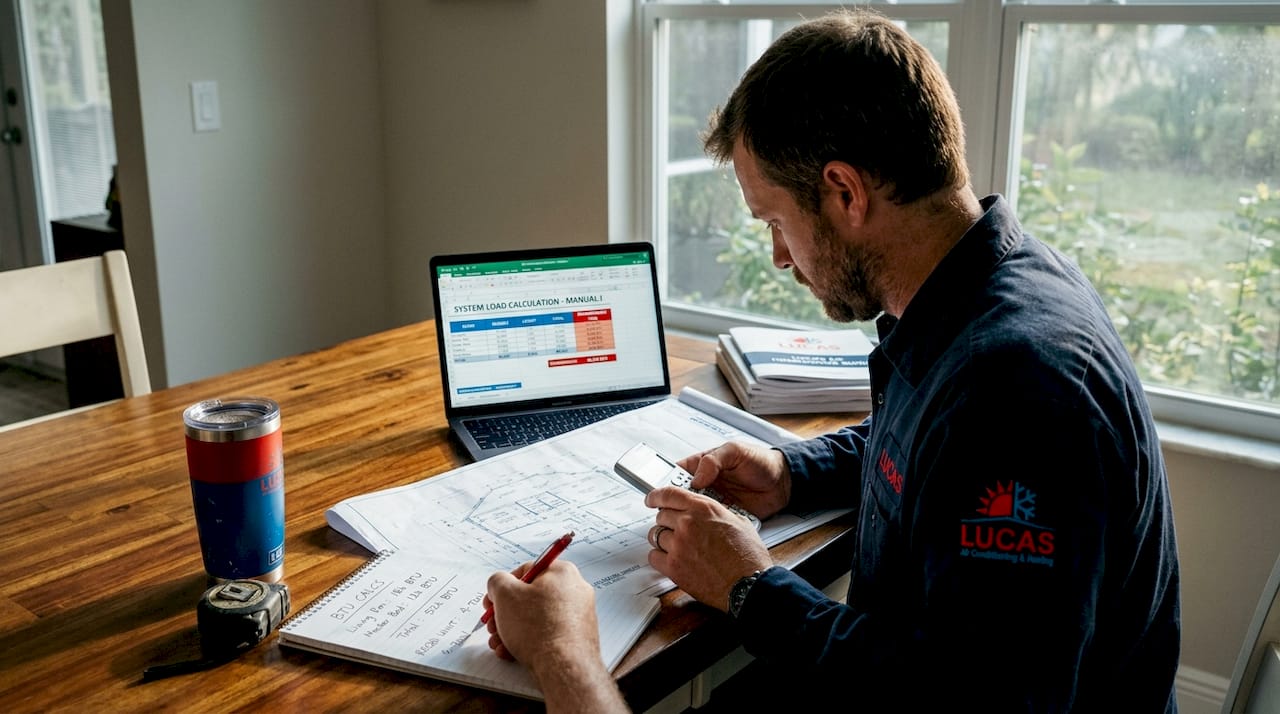
Manual J is the standard method for residential load calculations in Florida and across the country. Developed by the Air Conditioning Contractors of America (ACCA), it produces room-by-room and whole-building heating and cooling loads under specific design conditions. Florida’s building code actually requires Manual J calculations for new construction and major HVAC replacements in many jurisdictions.
Here’s why Manual J beats the old “rule of thumb” approach every time:
| Feature | Manual J | Rule of thumb |
|---|---|---|
| Room-by-room analysis | Yes | No |
| Accounts for humidity | Yes | Rarely |
| Considers window orientation | Yes | No |
| Adjusts for insulation quality | Yes | No |
| Florida climate design data | Yes | No |
| Accuracy | High | Low to moderate |
The rule of thumb method typically assigns 400 to 600 square feet per ton of cooling. In Florida, that approach can leave you with a system that’s 20 to 30 percent oversized, which means short-cycling, humidity problems, and higher energy bills from the first month.
Here’s how a proper Manual J calculation is performed:
- Collect design conditions: The outdoor temperature and humidity levels your system must handle on the hottest and coldest days of the year. In Central Florida, summer design temperatures typically reach 93 to 95 degrees Fahrenheit with high humidity.
- Measure the building envelope: Every wall, ceiling, floor, window, and door is measured and documented, including material types and insulation values.
- Assign U-factors and R-values: Each building component gets a thermal resistance rating that tells the software how much heat it allows through.
- Calculate solar heat gain: Window orientation, shading, and glass type all determine how much solar energy enters each room.
- Add internal and infiltration loads: Occupancy levels, appliances, lighting, and air leakage are all factored in.
- Run the calculation: Software sums all the components to produce peak heating and cooling loads for each room and the whole house.
- Select equipment: The system is chosen to match the calculated load, not the other way around.
Pro Tip: Always ask your HVAC contractor if they use Manual J and whether they can walk you through the results. A contractor who can’t explain their load calculation is one you should think twice about hiring.
When you’re ready to use this information to make a decision, our guide on choosing an HVAC system in Florida walks through how load data translates into real equipment choices. You can also explore how HVAC affects home comfort in ways that go beyond just temperature.
The science behind the numbers: How it actually works
Manual J is only as good as its details. Let’s unpack the science that makes accurate load calculation so powerful for Central Florida homes.
At its core, load calculation uses physics. The backbone equation for heat transfer through building materials is:
Q = U × A × ΔT
Where Q is the heat flow rate in BTU/h, U is the thermal transmittance of the material (how easily heat passes through it), A is the surface area in square feet, and ΔT is the temperature difference between inside and outside. The physics backbone used in load calculations handles solar gains and moisture and air infiltration as additional components layered on top of this fundamental equation.
In practical terms, this means every square foot of your ceiling, every window pane, and every exterior wall contributes a specific number to the final load. A single-pane window facing west in Eustis, Florida, adds far more heat gain than the same window facing north, because of direct afternoon sun exposure. That’s not something a rule of thumb can capture.
Here’s what scientifically accurate load calculation actually delivers for your home:
- Even comfort in every room: No more hot spots in the master bedroom or freezing cold in the hallway.
- Proper dehumidification: A correctly sized system runs long enough to pull moisture out of the air, keeping relative humidity between 40 and 60 percent indoors.
- Lower energy bills: Right-sized equipment doesn’t waste energy cycling on and off repeatedly. It runs efficiently at the load it was designed for.
- Longer system life: Short-cycling caused by oversizing puts extra wear on the compressor and other components, shortening the system’s lifespan by years.
- Fewer repairs: Systems that run as designed experience less mechanical stress and fewer breakdowns.
- Better indoor air quality: Consistent airflow and humidity control reduce mold growth and dust accumulation.
Understanding HVAC zoning becomes much more meaningful once you have accurate load data for each room. Zoning systems use that data to deliver exactly the right amount of conditioned air to each space, which is especially valuable in larger Central Florida homes with multiple sun exposures.
What a typical load calculation includes: Step-by-step breakdown
Understanding the process makes it less intimidating. Here’s what really happens during a load calculation visit, step by step.
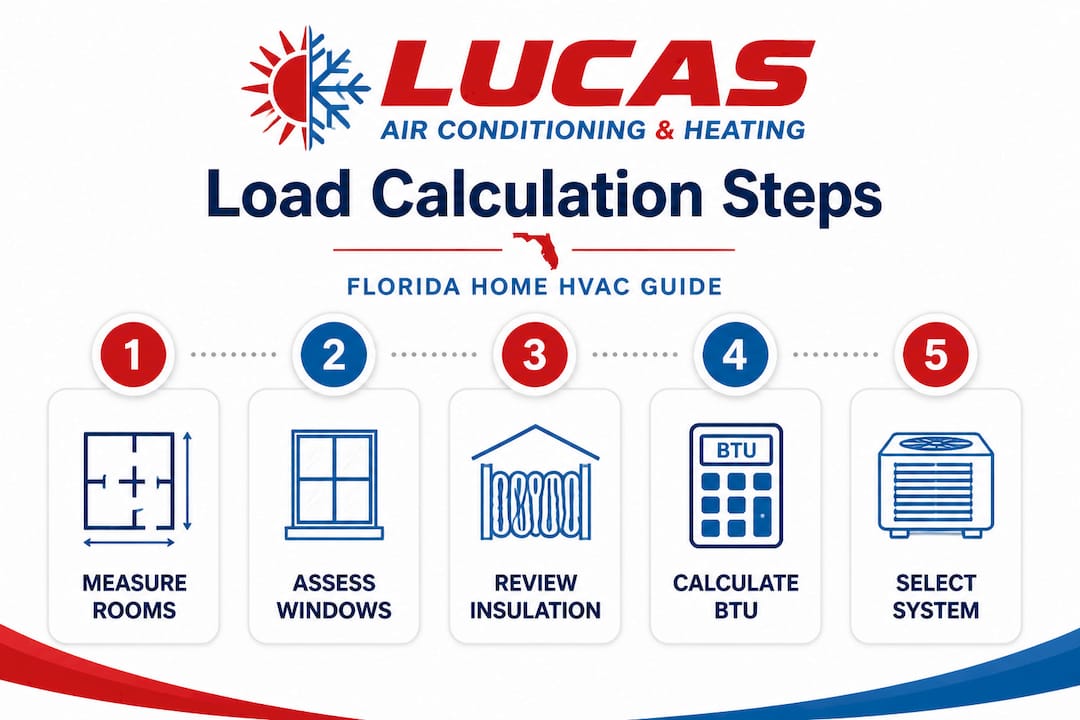
When a qualified HVAC technician arrives to perform a load calculation, they’re not just eyeballing the space. They’re collecting precise data that feeds into the Manual J software. Here’s what to expect:
- Initial walkthrough: The technician tours the entire home, noting room layout, ceiling heights, and any obvious air leaks or insulation issues.
- Measuring the building envelope: Every exterior wall, window, skylight, and door is measured. Window types (single pane, double pane, Low-E coating) are recorded.
- Documenting insulation: Attic, wall, and floor insulation values are noted. In older Florida homes, this step often reveals insulation that has degraded or was never adequate.
- Recording window orientation: Which direction each window faces matters enormously for solar gain calculations in Florida’s year-round sun.
- Assessing air infiltration: Older homes with single-pane windows, unsealed attic hatches, or gaps around plumbing penetrations have higher infiltration rates that add to the load.
- Gathering occupancy and appliance data: How many people live in the home, and what major heat-generating appliances are present? A home office full of computers adds meaningful internal heat gain.
- Inputting climate data: The software uses local design conditions for Central Florida, not national averages.
- Generating the report: The output includes design heating load and design cooling load in BTU/h for each room and the whole house.
To prepare for this visit, gather your home’s floor plans if you have them, any documentation on window upgrades, and your current utility bills. The more information you provide, the more accurate the calculation.
Pro Tip: Request a printed or digital copy of your completed load calculation report. Then compare the total BTU/h figure to the system capacity your contractor recommends. If those numbers don’t align closely, ask why. You deserve to see the math before committing to a major investment.
For a full picture of what happens after the load calculation is complete, our HVAC installation guide walks through every phase of the process from start to finish.
Why cutting corners on load calculation costs more in Florida
Here’s the uncomfortable truth that many contractors won’t tell you: skipping a proper load calculation is faster and cheaper for them, but you pay for it every month for the next 15 years.
We’ve seen this play out repeatedly in Central Florida. A contractor uses a quick square footage estimate, installs a system that’s slightly too large, and the homeowner is thrilled with the fast installation. Then summer arrives. The system blasts cold air for eight minutes, shuts off, and the humidity climbs back up. The homeowner turns the thermostat down to 68 degrees trying to feel comfortable. Energy bills spike. Mold starts growing in corners. The compressor fails in year seven instead of year fifteen.
Florida’s climate amplifies every sizing mistake. The combination of intense solar gain, high outdoor humidity, and a cooling season that runs nine to ten months a year means there’s almost no margin for error. What might be a minor comfort issue in a milder climate becomes a real problem here.
The surprising costs of skipping proper load calculation include:
- Uneven temperatures: Rooms farthest from the air handler stay warm because the system shuts off before conditioning the whole house.
- Chronic humidity: Short-cycling never allows the system to run long enough for effective dehumidification.
- Mold and mildew: Persistent indoor humidity above 60 percent creates ideal conditions for mold growth, especially in closets and under sinks.
- Inflated energy bills: An oversized system uses more electricity per cycle and cycles more frequently than a right-sized system.
- Premature equipment failure: Compressors are not designed for constant start-stop cycling. Every unnecessary cycle shortens the system’s working life.
- Comfort complaints that never get resolved: Many homeowners spend years adjusting thermostats and calling for repairs when the real issue is a system that was never sized correctly.
The cheapest install is rarely the best value for Central Florida property owners. A contractor who invests the time to do a real Manual J calculation is showing you exactly how they approach their work. That commitment to comfort accuracy is worth more than a fast quote.
Get professional load calculations and system sizing the right way
Knowing what load calculation involves puts you in a much stronger position when it’s time to replace or upgrade your HVAC system. The next step is working with a contractor who treats this process as non-negotiable, not optional.

At Lucas Air Conditioning and Heating, every new system installation and upgrade includes a proper load calculation as part of the process. We don’t guess. We measure, calculate, and match your system to your home’s real needs. Our team serves homeowners and property managers across Central Florida, from Eustis to The Villages and beyond. If you’re ready to work with a trusted HVAC contractor who takes sizing seriously, we’re here to help. You can also explore our full HVAC installation overview to understand exactly what to expect from start to finish. Schedule your consultation today and start with the right numbers.
Frequently asked questions
Why can’t I just use square footage to size my HVAC system?
Square footage alone ignores windows, insulation quality, humidity, and dozens of other factors. A proper load calculation accounts for all of them to deliver real comfort and efficiency.
What information do I need for a load calculation?
Your HVAC technician will need your home’s age, square footage, window types, insulation levels, and room usage patterns. The design outputs from this data include precise BTU/h figures for heating and cooling.
How often should a load calculation be updated?
Any time you renovate, replace windows, add insulation, or install new HVAC equipment, a fresh load calculation is essential to make sure your system still matches your home’s actual needs.
What’s the risk of oversizing or undersizing an HVAC system?
Both lead to real problems. Oversized systems short-cycle and fail to dehumidify, while undersized systems run constantly and can’t keep up. Either way, latent load issues drive up bills, reduce comfort, and shorten equipment life.
Recommended
- HVAC considerations for real estate in Central Florida – Lucas Air Conditioning and Heating
- Commercial HVAC standards for Central Florida properties – Lucas Air Conditioning and Heating
- Energy-saving HVAC tips for Central Florida homeowners – Lucas Air Conditioning and Heating
- HVAC Lifespan Factors – What Florida Homeowners Need – Lucas Air Conditioning and Heating
