
TL;DR:
- Healthcare HVAC systems require strict adherence to ASHRAE 170 standards for airflow, filtration, and pressure.
- Regular, documented inspections and maintenance are essential to ensure compliance and minimize infection risks.
- Florida-specific environmental factors demand more frequent coil cleaning and tailored component upkeep.
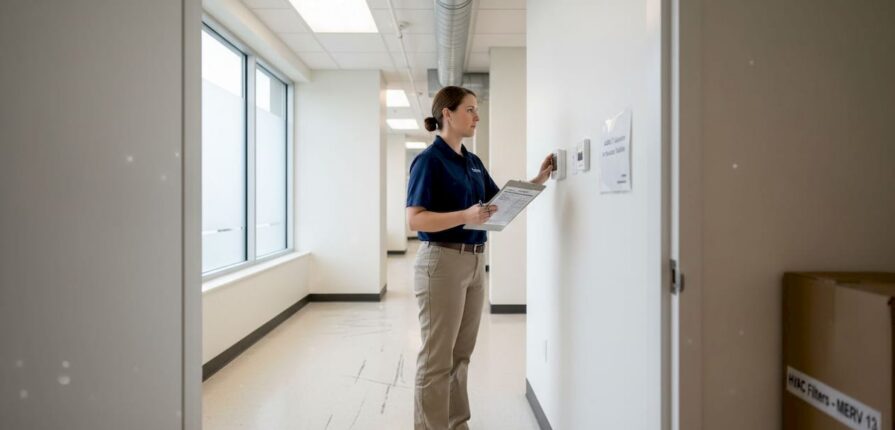
Managing HVAC systems in a medical office is nothing like managing them in a standard commercial building. A single lapse in filtration, air pressure, or humidity control can expose patients to airborne pathogens, trigger a failed inspection, or worse, contribute to a hospital-acquired infection. ASHRAE 170 sets minimum standards for airflow, filtration, temperature, and humidity in healthcare environments, and regulators expect full documentation to prove compliance. For facility managers in Central Florida, where heat and humidity add extra pressure on every component, staying ahead of these requirements is not optional. This checklist gives you a clear, actionable framework to protect patients and stay audit-ready year-round.
Table of Contents
- Understanding regulatory standards for medical office HVAC
- Daily, monthly, quarterly, and annual HVAC inspection tasks
- Filtration, air changes, and pressure control essentials
- Coil, duct, and mechanical maintenance for Florida environments
- Why balancing energy codes and regulatory compliance is critical
- Connect with expert HVAC maintenance solutions
- Frequently asked questions
Key Takeaways
| Point | Details |
|---|---|
| ASHRAE 170 is mandatory | Medical office HVAC maintenance must follow ASHRAE 170 standards to ensure compliance and patient safety. |
| Use frequency-based checklist | Daily, monthly, quarterly, and annual tasks are essential for reliable HVAC system operation and audit-readiness. |
| Florida requires extra vigilance | Humidity, coastal salt, and mold risks mean coil and duct cleaning should happen more often in Florida medical offices. |
| Document actual vs. target values | Recording measured versus required values for air changes, pressure, and filtration simplifies compliance audits. |
| Balance energy and safety | Demand-controlled ventilation systems can help meet energy codes without sacrificing crucial healthcare standards. |
Understanding regulatory standards for medical office HVAC
Before you can manage compliance, you need to know exactly what the rules require. ASHRAE 170 specifies air changes, pressure relationships, filtration, temperature, and humidity for every type of medical office space. It is the gold standard that accreditation bodies, state health departments, and infection control teams reference when they walk through your facility.
Here are the key requirements every facility manager should know:
- Air changes per hour (ACH): Exam rooms require a minimum of 6 ACH. Operating rooms need 15 or more. Waiting areas require at least 2 ACH.
- Pressure relationships: Isolation rooms must maintain negative pressure to contain airborne pathogens. Clean rooms and pharmacies require positive pressure to prevent contamination from entering.
- Filtration: Most patient care areas require MERV 14 filters at minimum. Immunocompromised patient areas require HEPA filtration, which captures 99.97% of particles at 0.3 microns.
- Temperature: Patient rooms must stay between 70°F and 75°F. Operating rooms require tighter control, typically between 68°F and 73°F.
- Humidity: Relative humidity must stay between 30% and 60% in most care areas to prevent both mold growth and static discharge near sensitive equipment.
Florida adds its own layer of complexity. High ambient humidity accelerates mold growth inside ductwork and on evaporator coils. Coastal facilities near the Gulf or Atlantic face salt-laden air that corrodes metal components faster than inland systems. These local factors mean Central Florida medical offices cannot simply meet national minimums and call it done. They need more frequent inspections and a maintenance schedule calibrated to the climate.
Pro Tip: Keep a laminated reference card posted in your mechanical room listing the ACH, pressure, temperature, and humidity targets for each space type in your facility. Your technicians will thank you during spot checks.
The stakes are real. An estimated 722,000 hospital-acquired infections (HAIs) occur in the US each year, and HVAC systems play a direct role in mitigating airborne transmission. Reviewing commercial HVAC essentials is a useful starting point before diving into the healthcare-specific requirements.
Daily, monthly, quarterly, and annual HVAC inspection tasks
Regulatory compliance is not a one-time event. It is built through consistent, documented maintenance across daily, monthly, quarterly, and annual cycles. Maintenance tasks include daily logs, monthly filter checks, quarterly ACH measurements, and annual HEPA tests.
Here is a structured breakdown of what each cycle requires:
- Daily: Log temperature and humidity readings for all patient care zones. Check that pressure differential indicators on isolation rooms show correct values. Note any alarms or system alerts in your maintenance log.
- Monthly: Inspect filters visually for loading and bypass. Replace any filter showing visible damage or exceeding pressure drop limits. Check condensate drain pans for standing water or biological growth.
- Quarterly: Measure actual ACH using a calibrated flow hood or tracer gas method. Verify pressure relationships with a digital manometer. Inspect belts, motors, and fan blades for wear. Clean coils if operating in a high-humidity Florida environment.
- Annually: Perform HEPA filter integrity testing using a photometric aerosol challenge. Calibrate all temperature and humidity sensors against a traceable reference. Inspect full ductwork for leaks, debris, and biological contamination.
| Task | Frequency | Compliance impact |
|---|---|---|
| Temperature and humidity logging | Daily | High |
| Filter inspection and replacement | Monthly | High |
| ACH verification | Quarterly | Critical |
| Pressure relationship check | Quarterly | Critical |
| HEPA integrity test | Annually | Critical |
| Full duct inspection | Every 3 to 5 years | High |
Pro Tip: Use a digital CMMS (computerized maintenance management system) to auto-schedule tasks and generate audit-ready reports. Paper logs get lost; digital records do not.
The payoff for rigorous filtration is significant. HEPA filters remove 99.97% of particles at 0.3 microns and have been shown to reduce airborne pathogen levels by 88% in controlled healthcare settings. Understanding HVAC inspection importance and reviewing a home HVAC checklist can help you build the right habits before scaling them to a medical environment.
Filtration, air changes, and pressure control essentials
With the inspection schedule mapped out, it is crucial to understand what makes medical office air safe. Three elements work together: filtration efficiency, air exchange rate, and room pressurization. Miss any one of them and the other two cannot compensate.
HEPA filters provide 99.97% removal and are the key tool for reducing airborne pathogens in high-risk patient areas. Standard MERV 8 filters used in most commercial buildings capture only about 20% of particles in the 1 to 3 micron range. That gap is enormous when your patients are immunocompromised.
| Space type | Required ACH | Pressure relationship | Minimum filtration |
|---|---|---|---|
| Exam room | 6 | Neutral | MERV 14 |
| Operating room | 15+ | Positive | HEPA |
| Isolation room | 12 | Negative | HEPA |
| Waiting area | 2 | Neutral | MERV 8 |
| Pharmacy | 4 | Positive | MERV 14 |
Pressure monitoring is not just about meeting a number on paper. It is about creating a physical barrier against pathogen migration. A negative pressure isolation room pulls air inward so that contaminated air does not escape into hallways. A positive pressure operating room pushes clean air outward so that corridor air cannot enter during a procedure. Both require continuous monitoring and documented verification.
“Document actual vs. target values for surveyors” is the standard expectation from accreditation bodies. Side-by-side comparison of measured and required values is what separates a passing audit from a citation.
Document actual vs. target values for every parameter during each inspection cycle. Surveyors want to see the gap between what your system is doing and what it is supposed to do, along with corrective actions when values fall out of range. Reviewing a business HVAC workflow can help you structure that documentation process efficiently.
Coil, duct, and mechanical maintenance for Florida environments
Filtration and air changes are only part of the equation. Physical components require targeted care, especially in Florida. The combination of year-round heat, high humidity, and coastal salt exposure creates conditions that degrade HVAC components faster than almost anywhere else in the country.
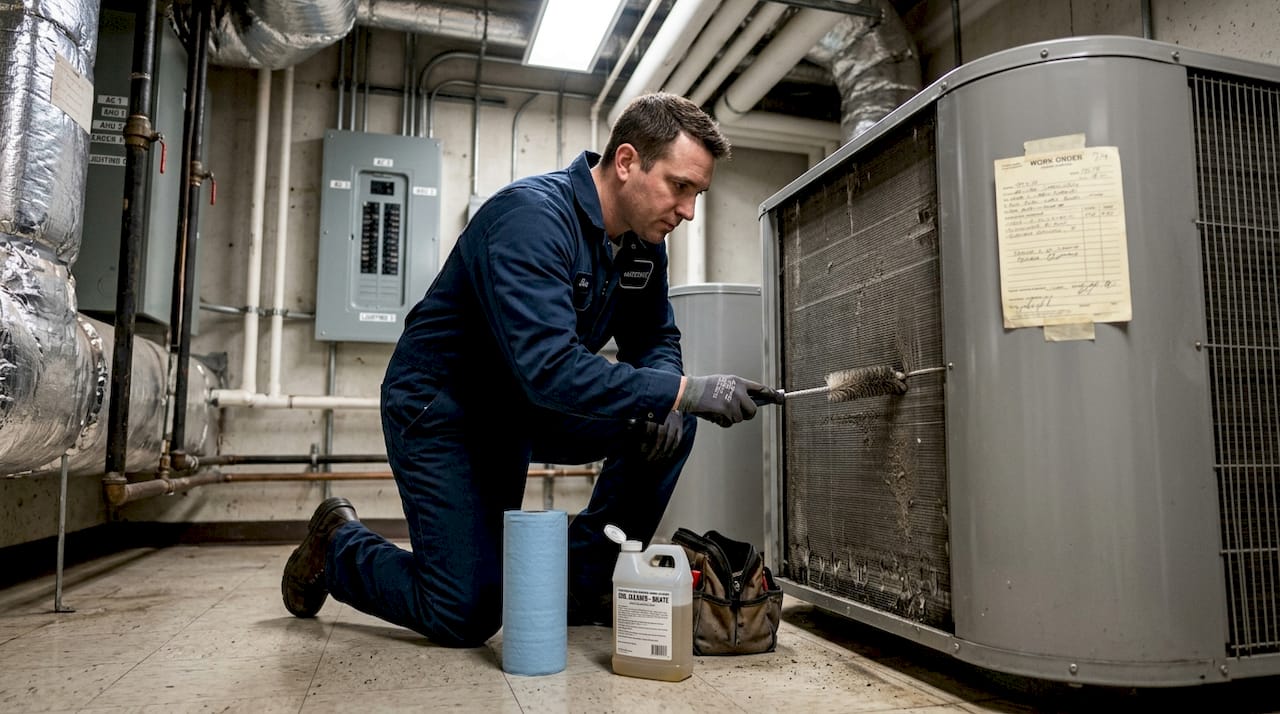
Duct cleaning every 3 to 5 years per NADCA (National Air Duct Cleaners Association) standards is the national baseline, but quarterly coil cleaning in Florida healthcare facilities is essential to prevent mold and Legionella growth. Legionella bacteria thrive in warm, stagnant water, and a neglected condensate drain pan is an ideal breeding ground.
Here is what a Florida-specific mechanical maintenance program should cover:
- Evaporator and condenser coils: Clean quarterly using an EPA-registered coil cleaner. Inspect for biological fouling, corrosion, and bent fins that restrict airflow.
- Condensate drain pans and lines: Flush monthly with a biocide solution. Confirm free drainage to prevent standing water.
- Ductwork integrity: Inspect for gaps, disconnected sections, and microbial growth at least every 3 years. In humid climates, consider more frequent visual checks.
- Belts and motors: Inspect belt tension and wear monthly. Replace before failure, not after. A failed belt in a medical office can shut down ventilation to a patient care area.
- Outdoor units: Rinse condenser coils monthly in coastal locations to remove salt deposits. Coastal salt corrosion accelerates deterioration and can cut equipment lifespan in half without regular rinsing.
Pro Tip: Schedule coil cleaning to coincide with your quarterly ACH measurements. If coils are fouled, airflow drops and ACH values fall below compliance thresholds. Cleaning first gives you accurate readings.
For additional guidance on keeping systems clean and efficient, the HVAC cleaning tips library covers practical approaches for Florida conditions. You can also review COVID-19 HVAC measures for added context on how ventilation upgrades directly support infection control goals.
Why balancing energy codes and regulatory compliance is critical
Here is the tension that most HVAC guides skip over: energy codes and healthcare ventilation standards do not always point in the same direction. Florida’s energy code pushes facility managers toward variable air volume (VAV) systems and demand-controlled ventilation (DCV) to cut utility costs. Those strategies work well in offices and retail spaces. In medical environments, they can quietly undermine compliance.
ASHRAE 170 sets minimum ACH values that must be maintained continuously. VAV systems, by design, reduce airflow when occupancy or load drops. If a VAV system dips below the minimum ACH during a low-occupancy period, you have a compliance violation even if no one noticed. DCV systems face the same risk unless they are specifically validated to never fall below the ASHRAE 170 floor for each space type.
The solution is not to avoid energy-efficient technology. It is to configure and validate it correctly. Set VAV minimums at or above the required ACH for each space. Commission DCV systems with healthcare-specific setpoints. Document every configuration decision for surveyors. A preventative maintenance guide can help you build the habits that keep both energy performance and compliance on track simultaneously.
Connect with expert HVAC maintenance solutions
Running a compliant, efficient HVAC program in a Central Florida medical office takes more than a good checklist. It takes a service partner who understands both the regulatory requirements and the local environmental conditions that make this region uniquely demanding.
At Lucas Air Conditioning and Heating, we work with commercial facility managers across Central Florida to deliver year-round preventative maintenance agreements built around your compliance calendar. From HEPA filter verification to coil cleaning and pressure documentation, our team handles the technical details so you can focus on operations. We also offer HVAC installation services when aging systems can no longer meet current standards. Review our business HVAC workflow guide to see how we structure commercial service for maximum reliability and audit readiness.
Frequently asked questions
What are the minimum air changes per hour required for medical office spaces?
Exam rooms require 6 ACH at neutral pressure and waiting rooms require 2 ACH, per ASHRAE 170 space requirements. Operating rooms require 15 or more ACH under positive pressure.
How often should healthcare facility HVAC ducts be cleaned?
Duct cleaning every 3 to 5 years is the NADCA standard, but Florida medical offices should schedule quarterly coil cleaning to prevent mold and Legionella growth in the high-humidity environment.
What is the main compliance risk for legacy HVAC systems in medical offices?
Legacy systems installed before ASHRAE 170 2008 standards may not meet current ventilation or filtration minimums, creating audit exposure and increased infection control risk that can only be resolved through system upgrades.
Why is pressure monitoring important in healthcare HVAC maintenance?
Pressure monitoring protocols prevent cross-contamination by confirming that isolation rooms maintain negative pressure and clean areas maintain positive pressure, which is the physical foundation of infection control.
How do facility managers document HVAC compliance effectively?
Record actual vs. target values for ACH, pressure differentials, temperature, and humidity side by side in every inspection report so surveyors can immediately verify compliance without requesting additional data.
