
TL;DR:
- Central Florida’s HVAC systems operate over double the national average hours annually, leading to faster wear and failures. Preventative maintenance, including monthly filter changes and semi-annual professional checks, is essential to reduce costs, extend equipment life, and maintain indoor air quality. Regular vigilance against moisture, salt corrosion, and debris is crucial for the region’s climate to prevent costly breakdowns.
Central Florida’s air conditioners don’t get a break. While a system in Minnesota might run a few hundred hours each summer, your unit in Lake County or Orange County is grinding through 2,500 to 3,000 hours every single year, double the national average. That kind of runtime turns small neglected issues into expensive failures fast. This guide walks you through a clear, step-by-step preventative maintenance process so you can protect your investment, lower your energy bills, and stop worrying every time the temperature spikes.
Table of Contents
- Understanding preventative maintenance: Why it matters for Florida HVAC
- Key tools and supplies for preventative HVAC maintenance
- Step-by-step preventative maintenance process: Monthly, semi-annual, and annual tasks
- Common mistakes and troubleshooting in Florida’s climate
- How to verify results and keep records
- The overlooked advantage: Why moisture control is your secret weapon in Central Florida
- Let the experts handle your maintenance — and keep your cool all year
- Frequently asked questions
Key Takeaways
| Point | Details |
|---|---|
| Follow a maintenance schedule | Stick to monthly, semi-annual, and annual tasks to cut costs and keep your system efficient. |
| Use the right tools | Prepare with the correct filters, cleaners, and safety gear for smooth, effective HVAC upkeep. |
| Don’t skip humidity and drain tasks | Managing moisture and keeping drains clear are essential for Florida’s unique challenges. |
| Record your outcomes | Track energy bills and maintenance actions to catch issues early and boost ROI. |
Understanding preventative maintenance: Why it matters for Florida HVAC
Not all maintenance approaches are the same, and the difference between them is money in your pocket or money lost on emergency repairs.
Reactive maintenance means you fix something after it breaks. The AC stops cooling at 2 p.m. on a July Saturday, and now you’re paying overtime rates and sweating through the weekend. Preventative maintenance means you follow a scheduled routine to stop that breakdown from happening in the first place. Predictive maintenance goes one step further using sensor data and system monitoring to forecast failures before they occur, which is more common in large commercial buildings.
For most homeowners and property managers in Central Florida, preventative is the sweet spot. It’s affordable, structured, and proven to work. Research shows that preventive maintenance yields a 545% return on investment, cuts costs by 30 to 40% compared to reactive maintenance, and delivers 5 to 20% energy savings. That’s not a small number. On a system running year-round in Florida’s heat and humidity, those savings add up fast.
Here’s a quick look at how the three approaches compare:
| Approach | When it happens | Typical cost impact | Best for |
|---|---|---|---|
| Reactive | After failure | Highest (emergency rates) | No one, really |
| Preventative | Scheduled routine | Lowest long-term | Homeowners, small properties |
| Predictive | Data-driven alerts | Medium upfront, low long-term | Large commercial buildings |
Florida HVAC systems carry an extra burden that systems in other states simply don’t face. The role of HVAC systems in this region goes beyond cooling. They also manage humidity, filter salt air near the coast, and cycle nearly nonstop for eight to ten months out of the year. That kind of load demands a strict maintenance schedule, not a casual “I’ll get to it when I notice a problem” attitude.
Key benefits of a solid preventative maintenance routine include:
- Lower monthly energy bills from a system running at peak efficiency
- Extended equipment lifespan by reducing unnecessary wear on components
- Fewer emergency repair calls, which means fewer stress-filled weekends
- Better indoor air quality, especially important if anyone in the home has allergies or respiratory concerns
- Maintained warranty compliance, since many manufacturer warranties require documented routine maintenance
Now that you see why skipping maintenance is so costly, let’s break down what a preventative process actually looks like.
Key tools and supplies for preventative HVAC maintenance
With the benefits in mind, you’ll want to gather the right tools and materials before you start, so you don’t waste time hunting mid-task.
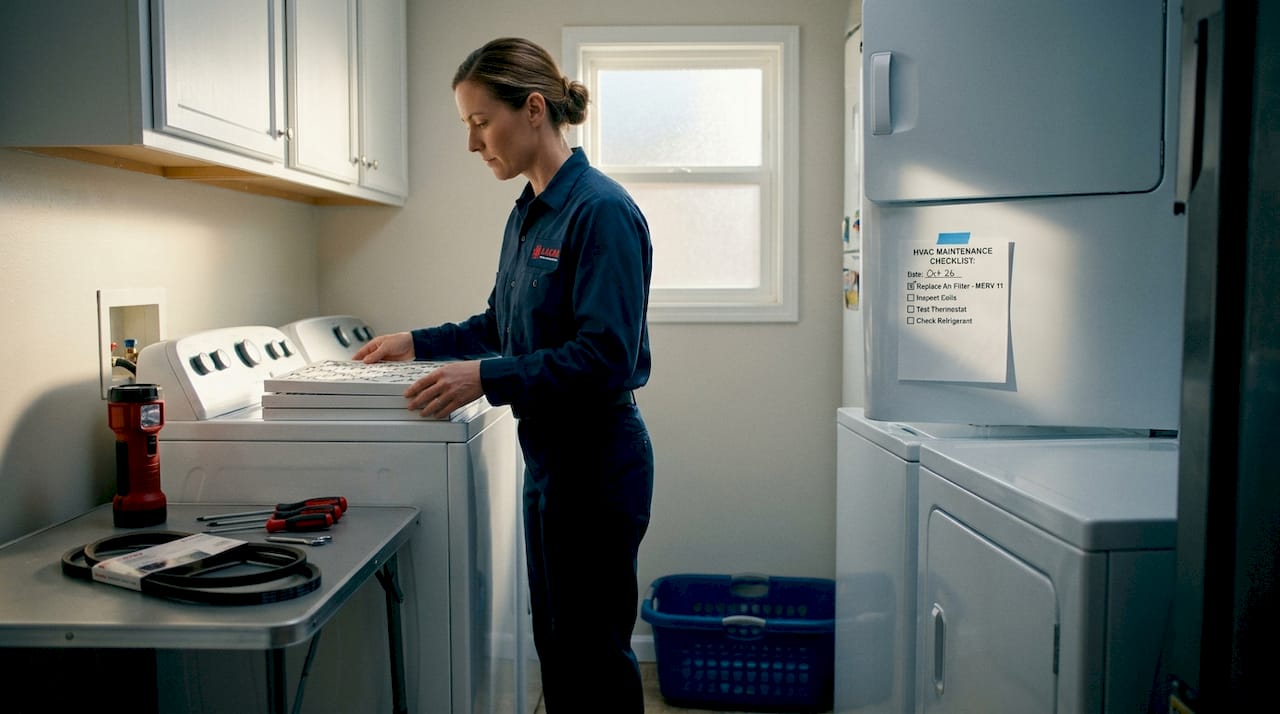
Monthly filter changes and airflow checks are the most critical first-line steps any homeowner can take, and they require almost no special equipment. Here’s what to have on hand:
Basic homeowner supplies (for monthly tasks):
- Replacement air filters sized for your unit (keep a 3-month supply)
- A flashlight for inspecting the condensate drain pan and air handler cabinet
- White distilled vinegar or a biocide tablet for drain line maintenance
- A soft brush or microfiber cloth for wiping down vents and registers
- A basic thermometer to verify supply and return air temperatures
Optional DIY tools (for deeper cleaning tasks):
- Coil cleaner spray (no-rinse formula works well for evaporator coils)
- A small hand vacuum for clearing debris from the drain pan or air handler base
- Protective gloves and safety glasses
- Filter gasket material to seal gaps around the filter slot
- A wet/dry shop vacuum with a hose attachment to flush the drain line from outside
Professional-grade equipment your technician brings:
- Refrigerant pressure gauges to check charge levels
- Digital manifold sets for precise refrigerant diagnostics
- Electrical test meters (multimeters) to check capacitors and contactors
- Duct leak detectors to find where conditioned air escapes
Pro Tip: Buy your replacement filters in bulk from a home improvement store or online retailer. Keeping a stack near your air handler removes every excuse to skip a monthly change. In Central Florida’s dusty, pollen-heavy air, a clogged filter forces your system to work harder and can raise your electricity bill by 5 to 15% on its own.
For a deeper breakdown of what each maintenance task involves, the HVAC maintenance guide at Lucas Air covers the full process in plain language.
Once you have everything set, it’s time to follow the schedule and complete each task. Let’s break this down by frequency.
Step-by-step preventative maintenance process: Monthly, semi-annual, and annual tasks
Following a structured frequency is what separates homeowners who rarely call for repairs from those who seem to need a technician every season. Here’s the breakdown:
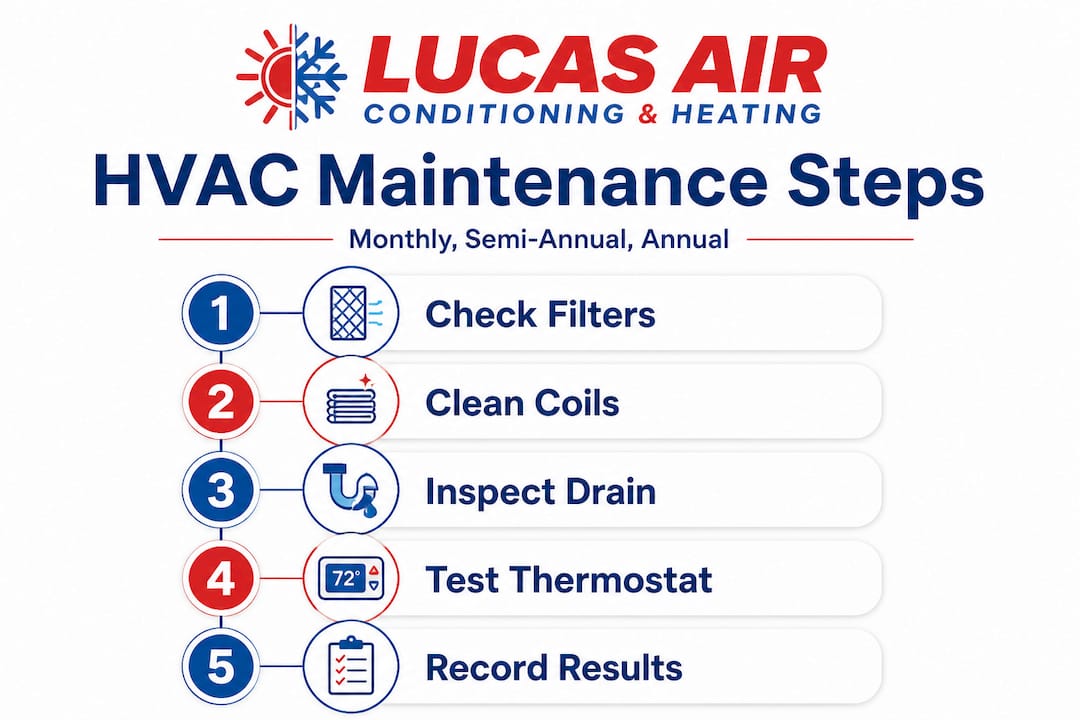
Monthly owner tasks:
- Replace or inspect the air filter. In Central Florida, replace every 30 days without exception.
- Check the condensate drain pan for standing water, which signals a clog forming.
- Pour a quarter cup of white vinegar down the drain line to prevent algae buildup.
- Walk around the outdoor unit and clear any debris, leaves, or grass clippings within 24 inches.
- Listen for unusual sounds: rattling, grinding, or squealing all deserve attention before they become failures.
- Check that all vents are open and unblocked by furniture or curtains.
Semi-annual professional service tasks:
According to scheduled maintenance standards for Florida systems, a licensed technician should perform these tasks every six months, ideally in spring before peak cooling season and in fall before any heating demand:
- Clean the evaporator and condenser coils thoroughly.
- Check and adjust refrigerant levels if needed.
- Inspect all electrical connections, capacitors, and contactors for wear.
- Flush the condensate drain line completely with a biocide solution.
- Lubricate all moving parts including the blower motor.
- Test thermostat calibration and system controls.
Annual tasks (owner and professional combined):
- Schedule a full duct inspection to check for leaks, disconnected sections, or mold growth.
- Have the system’s efficiency tested with airflow measurements at supply and return vents.
- Inspect the air handler cabinet and outdoor unit for corrosion, especially in homes within 10 miles of the coast where salt air accelerates metal deterioration.
- Review and update your maintenance log with all completed services and any observations.
“In Central Florida, indoor humidity should stay at or below 55% year-round. If your system struggles to hold that number even after a coil cleaning, it may be undersized or developing a refrigerant issue that needs professional attention.”
Florida-specific edge cases you need to know:
- Hurricane prep: Before a named storm, turn the system off, cover the outdoor unit with a breathable cover (never plastic wrap, which traps moisture), and secure any loose debris in the yard that could strike the condenser fins.
- Drain clogs in summer: Florida’s high humidity means your system pulls a lot of moisture from the air. A drain line can clog within weeks in peak summer. If water backs up into the pan, your system will shut itself off as a safety measure. Keep that monthly vinegar flush as a non-negotiable habit.
For a printable version of these tasks organized by month, the HVAC maintenance checklist at Lucas Air is a great resource to keep on your refrigerator or in your property management binder.
Even the best process can go wrong if you’re not careful. Here’s what to watch out for and how to fix it fast.
Common mistakes and troubleshooting in Florida’s climate
Most HVAC failures in Central Florida trace back to a handful of avoidable mistakes. Knowing them gives you a serious edge.
The biggest mistakes homeowners make:
- Skipping filter changes because the system “seems fine.” A dirty filter restricts airflow and forces the blower motor to work overtime, shortening its life by years.
- Ignoring the drain pan. Standing water breeds mold and bacteria within 24 to 48 hours in Florida’s heat. Mold and drain clogs are primary failure modes, and monthly attention eliminates most of the risk.
- No storm preparation. Leaving the outdoor unit unprotected during a storm lets debris damage condenser fins. Even small dents reduce efficiency measurably.
- Allowing vegetation to crowd the outdoor unit. Shrubs, grass, and vines restrict airflow and trap moisture against the cabinet.
- Not monitoring indoor humidity. If humidity climbs above 60%, your system is either struggling or undersized. High humidity accelerates mold on coils and in ducts.
Pro Tip: If your drain line clogs despite monthly vinegar flushes, use a wet/dry vacuum at the exterior drain line opening to pull the clog out from the bottom. This is faster and more effective than trying to push it through from the top. A two-minute job could save you a service call.
“Salt corrosion is an underestimated threat for Central Florida homeowners near Lake County waterways or coastal areas. Ask your technician about applying a coil coating spray during annual service to significantly slow metal deterioration.”
If you ever face a breakdown despite your best efforts, having a reliable number for HVAC emergency repair in your area means you’re never stuck for long.
How to verify results and keep records
After all the work, it’s essential to verify results and set up a maintenance log so nothing falls through the cracks.
Tracking your maintenance is not busywork. It tells you whether the system is improving or declining over time, helps you spot patterns, and provides documentation that protects your warranty and your property value.
How to build a simple maintenance log:
- Create a spreadsheet or use a free app like Google Sheets. Columns should include date, task completed, observations, parts replaced, and technician name if applicable.
- After every filter change, note the condition of the old filter: light gray is normal, dark brown or black means air quality or seal issues need investigation.
- After each professional service, ask for a written report and store it with your home records.
- Track your monthly energy bills alongside service dates. A well-maintained system should hold relatively steady energy consumption. A sudden spike signals a problem worth investigating.
- Note any unusual sounds, smells, or performance issues with the date they started. This saves time when a technician asks “when did this start?”
Performance benchmarks to watch:
- Supply air from vents should be roughly 15 to 20 degrees Fahrenheit cooler than the return air temperature.
- Energy bills should not spike more than 10 to 15% year over year without a clear reason (rate increase, extra occupants, new appliances).
- Noise levels should remain consistent. New sounds almost always mean a component is wearing out.
For property managers handling multiple units, computerized maintenance management systems (CMMS) are the industry standard for tracking work orders, vendor invoices, and compliance documentation. These platforms send automatic reminders, store service records digitally, and make it easy to prove maintenance history to tenants, insurance companies, or future buyers.
Pro Tip: Use record keeping tips from Lucas Air to build a simple template you can adapt whether you’re managing one home or a dozen units.
The overlooked advantage: Why moisture control is your secret weapon in Central Florida
Here’s something most general HVAC articles won’t tell you. Standard cleaning, replacing filters, wiping coils, is necessary, but in Central Florida it’s not enough on its own. The real driver of premature failure in this region is moisture, not dust.
Florida’s moisture and humidity create conditions that accelerate every form of HVAC degradation. Mold grows on coils within days of a missed cleaning. Drain lines clog faster than anywhere else in the country. Salt-laden air speeds up corrosion on cabinet panels, copper refrigerant lines, and electrical contacts.
In our experience working with Central Florida homeowners, the properties that go five, six, even seven years without a major repair are the ones where the owner treats humidity control as seriously as they treat filter changes. That means running the system consistently rather than turning it off when they leave for a few days, which would let humidity spike indoors. It means checking that the condensate pan is bone dry every single month. It means investing in a whole-home dehumidifier if the system alone can’t hold indoor humidity below 55%.
The seasonal tune-ups outlined in a seasonal HVAC tune-ups plan address many of these moisture issues, but the vigilance between professional visits is what actually prevents the catastrophic failures. A technician visits twice a year. You interact with your home every day. That daily awareness, checking that the air feels right, that the vents aren’t musty, that the pan is clear, is the actual secret weapon.
Let the experts handle your maintenance — and keep your cool all year
Knowing what to do is half the battle. Having the right team to back you up is the other half.
At Lucas Air Conditioning and Heating, we’ve helped Central Florida homeowners and property managers build reliable maintenance routines since 2018. Our detailed HVAC maintenance guide gives you the full checklist and scheduling tools to stay ahead of every season. And when you’re ready for professional hands on your system, our team of experienced technicians is available to handle everything from coil cleaning to full efficiency tests. As a veteran-owned business rooted in Eustis, Florida, we treat every customer’s home like it’s our own. Connect with us as your trusted local HVAC contractor and let’s build a plan that keeps your system running strong year-round.
Frequently asked questions
How often should HVAC filters be changed in Central Florida?
Filters need monthly replacement in Central Florida due to the region’s high pollen, dust, and humidity levels. A 30-day cycle is the minimum, not a suggestion.
What are the signs of poor HVAC maintenance?
Rising energy bills, reduced cooling output, and frequent short cycling are common warning signs. Standing water in the drain pan and visible mold are immediate red flags that need attention right away.
Is DIY HVAC maintenance enough for Florida homes?
DIY monthly tasks handle the basics well, but semi-annual professional service is a Florida minimum given the extended runtimes and climate demands. Skipping professional visits leaves refrigerant levels, electrical components, and coil condition unchecked.
How much money can preventative maintenance save me?
Preventative maintenance cuts costs by 30 to 40% compared to reactive repairs and delivers 5 to 20% energy savings annually. On a Florida system running nearly year-round, that’s a meaningful amount of money back in your pocket each year.
Why does Florida’s climate require more frequent HVAC care?
Florida systems run twice as long as the national average each year, and the combination of high humidity, salt air, and heat accelerates wear on every major component. Monthly and semi-annual care isn’t excessive for this climate. It’s the baseline for keeping a system reliable.
