

TL;DR:
- The evolution of air conditioning began with industrial humidity control in 1902 and has progressed to AI-powered systems today. Modern systems use environmentally friendly refrigerants and offer energy-efficient, adaptive cooling solutions for various home types. This technological shift enhances comfort while emphasizing environmental responsibility and future-proof compliance.
The evolution of the air conditioner is defined as the progression from Willis Carrier’s 1902 industrial humidity control system to today’s AI-powered, energy-efficient climate technology. Carrier’s original machine was never meant to cool people. It was built to stop moisture from warping paper at a Brooklyn printing plant. That single industrial problem launched one of the most consequential technologies in modern history. What followed over the next 120 years reshaped architecture, public health, urban planning, and the way millions of people live and work every day.
What were the key milestones in the history of air conditioning?
The history of air conditioning begins with a specific engineering problem, not a comfort goal. Willis Carrier’s 1902 humidity control system defined four core functions that still guide modern HVAC design: temperature control, humidity control, air circulation, and air filtration. That framework has never been replaced. It has only been refined.
The major milestones in AC development follow a clear progression:
- 1902: Willis Carrier installs the first modern electrical air conditioning system at the Sackett-Wilhelm Lithographing Company in Brooklyn, New York. The goal is humidity control, not cooling.
- 1932: The first window air conditioning units reach the residential market. They are luxury items priced between $10,000 and $50,000, the equivalent of $200,000 to $1.2 million in 2025 dollars. Ownership is limited to the wealthy.
- 1940s: Portable and automotive air conditioning systems emerge. The U.S. military accelerates development for use in vehicles and field equipment.
- 1960s–1970s: Ductless mini-split systems and variable refrigerant flow technology appear, primarily in Japan. These systems allow zone-specific cooling without the need for ductwork.
- 1980–1981: Inverter compressors are introduced, allowing AC units to vary their cooling speed rather than cycling on and off. This single advancement dramatically reduces energy waste and extends equipment life.
The jump from 1932 pricing to mass adoption tells you everything about how technology matures. What costs a million dollars in one generation becomes a standard household appliance in the next.
Pro Tip: If your home still runs a single-speed compressor system, upgrading to an inverter-based unit is the single highest-impact change you can make for both comfort and energy savings.
How have refrigerants and environmental considerations evolved?
Refrigerants are the chemical compounds that make cooling physically possible. The wrong choice damages the atmosphere. The right choice determines how long your system stays legally serviceable.

Early air conditioners relied on chlorofluorocarbons, or CFCs, as their primary refrigerant. CFCs are highly effective at transferring heat, but they destroy the ozone layer when released into the atmosphere. The 1987 Montreal Protocol triggered a global phase-out of CFCs, pushing the industry toward hydrofluorocarbons, or HFCs. HFCs solved the ozone problem but introduced a new one: they are potent greenhouse gases with a high global warming potential.
The current transition moves toward low-carbon A2L refrigerants and natural alternatives like CO2 and ammonia. A2L refrigerants are mildly flammable but carry a fraction of the climate impact of HFCs. This shift affects every homeowner because refrigerant choice determines long-term serviceability and environmental compliance.
| Refrigerant Type | Era | Key Issue |
|---|---|---|
| CFCs (R-11, R-12) | Pre-1990s | Ozone layer destruction |
| HFCs (R-410A, R-22) | 1990s–2020s | High global warming potential |
| A2L (R-32, R-454B) | 2020s onward | Mildly flammable, low climate impact |
| Natural (CO2, ammonia) | Emerging | Near-zero climate impact, higher cost |
Key facts about the refrigerant transition:
- R-22, once the dominant residential refrigerant, was fully phased out in the United States by january 2020.
- Systems built before 2010 likely still use R-22 or older HFCs, making future servicing expensive.
- A2L refrigerants require updated equipment and technician training, which affects installation costs.
- Choosing a system with a future-proof refrigerant now avoids costly retrofits later.
What are the main types of air conditioning systems available today?
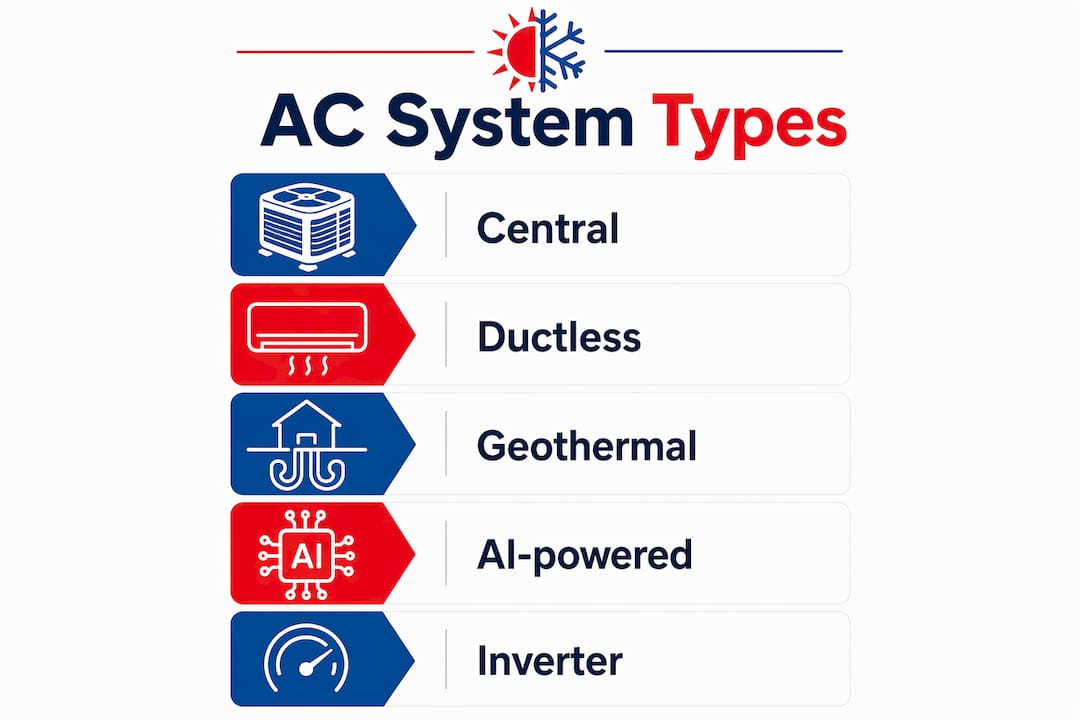
No single air conditioner fits every home. System selection depends on home size, existing ductwork, budget, and sustainability goals. The development of AC technology has produced four distinct system categories, each suited to different situations.
Central air conditioning
Central AC uses a network of ducts to distribute cooled air throughout an entire home from a single outdoor unit. It is the most common system in American homes built after 1970. The main limitation is the ductwork itself. Ducts leak, collect debris, and require regular maintenance to perform efficiently.
Ductless mini-split systems
Ductless mini-splits deliver zone-specific cooling without any ductwork. Each indoor unit controls a single room or zone independently. This makes them ideal for older homes, room additions, or any space where running ducts is impractical. Energy losses from duct leakage are eliminated entirely.
Geothermal heat pumps
Geothermal systems use the stable temperature of the earth below the frost line to exchange heat. They are the most energy-efficient option available. Upfront installation costs are significantly higher than conventional systems, but operating costs are substantially lower over the system’s lifespan. They are best suited to homeowners with a long-term ownership horizon.
AI-powered air conditioning systems
Modern AI-powered AC systems analyze outdoor temperature, indoor humidity, occupancy, and electricity use simultaneously to adjust cooling in real time. These systems move beyond programmable thermostats. They learn your schedule, adapt to weather changes, and reduce energy use without any manual input.
| System Type | Best For | Key Advantage | Main Limitation |
|---|---|---|---|
| Central AC | Whole-home cooling | Consistent temperature | Duct maintenance required |
| Ductless mini-split | Zoned or ductless homes | No duct energy loss | Higher per-zone cost |
| Geothermal heat pump | Long-term homeowners | Lowest operating cost | High upfront cost |
| AI-powered systems | Tech-forward households | Adaptive, automatic efficiency | Requires smart home integration |
Pro Tip: When choosing your HVAC system, ask your contractor about the refrigerant type used in any new unit. Systems using A2L refrigerants are better positioned for long-term regulatory compliance.
How has air conditioning shaped modern life and where is it headed?
Air conditioning is no longer a luxury. 66% of American homes have air conditioning as of 2026. That figure reflects a complete shift in what people consider a basic comfort standard, not an upgrade.
The impact of air conditioning on modern living extends well beyond temperature:
- Public health: Reduced heat-related illness and mortality, particularly for elderly residents and those with chronic conditions.
- Productivity: Office and school environments with controlled temperatures show measurably better cognitive performance.
- Architecture: Buildings designed after widespread AC adoption use less natural ventilation, making mechanical cooling a structural dependency rather than a supplement.
- Urban growth: Cities in hot climates like Phoenix, Houston, and Orlando grew dramatically only after residential AC became affordable. Central Florida’s population boom is directly tied to accessible cooling.
“AI-powered cooling represents a shift from reactive to intelligent living environments, with systems quietly adapting to occupant patterns and energy use behaviors.”
The future of cooling technologies points toward systems that are nearly invisible in operation. AI integration means your AC will know you are coming home before you arrive, pre-cool the space, and scale back the moment you leave. Modern HVAC features already include occupancy sensors, humidity-responsive controls, and energy use dashboards that show you exactly where your cooling dollars go.
The Carrier Corporation, the company Willis Carrier founded, reported $18.6 billion in sales in 2018. That number reflects the scale of an industry built entirely on solving one humidity problem in a Brooklyn print shop. The next phase of that industry is defined by software as much as hardware.
Key takeaways
The evolution of the air conditioner traces a direct line from Willis Carrier’s 1902 industrial humidity fix to AI-powered systems that learn your habits, adapt to weather, and cut energy waste automatically.
| Point | Details |
|---|---|
| Origins were industrial | Carrier’s 1902 system targeted humidity control for printing quality, not human comfort. |
| Early units were unaffordable | 1932 window units cost the equivalent of up to $1.2 million in 2025 dollars. |
| Refrigerants drive compliance | Choosing a system with A2L refrigerants now avoids costly regulatory retrofits later. |
| System type determines fit | Central AC, mini-splits, geothermal, and AI systems each serve different home profiles. |
| AI is the next standard | Modern AI-powered systems adapt to occupancy and habits, reducing energy use without manual control. |
The part of this story most people miss
Most articles about AC history treat it as a straight line from invention to improvement. The real story is more complicated. The industry spent decades optimizing for cooling power while largely ignoring what the refrigerants were doing to the atmosphere. CFCs were effective and cheap. The damage they caused was invisible until it was not.
That pattern is worth keeping in mind as AI-powered systems become the new standard. The efficiency gains are real. The energy savings are real. But the electricity those systems consume still has to come from somewhere. In most of the United States, that means a grid still partially powered by fossil fuels. Smarter cooling is better cooling, but it is not zero-impact cooling.
What I find genuinely encouraging is the refrigerant transition. A2L alternatives and natural refrigerants like CO2 represent a real course correction, not just a marketing shift. Homeowners who pay attention to refrigerant type when buying a new system are making a decision that matters beyond their utility bill. They are choosing equipment that will remain serviceable and compliant as regulations tighten.
The energy-saving practices that matter most are not dramatic. Regular tune-ups, proper refrigerant levels, and choosing the right system size for your home deliver more consistent savings than any single technology upgrade. The history of air conditioning is a story of incremental gains compounding over time. Your home’s efficiency works the same way.
— Lucasair
Lucasair can help you apply 120 years of AC progress to your home
Understanding how air conditioning technology has developed is useful. Putting that knowledge to work in your specific home is where Lucasair comes in.

Lucasair serves residential and commercial customers across Central Florida, including Eustis and the surrounding counties. Whether you are replacing an aging system with an inverter-based unit, upgrading to a ductless mini-split for a new addition, or simply scheduling a tune-up to keep your current system running at peak efficiency, Lucasair’s team brings the expertise to match the right solution to your home. Start with the HVAC installation guide to understand what a professional installation involves, or reach out directly to schedule a consultation. Veteran-owned and community-focused, Lucasair treats every job as a long-term investment in your comfort.
FAQ
Who invented the first modern air conditioner?
Willis Carrier invented the first modern electrical air conditioning system in 1902. The system was designed to control humidity at a printing plant in Brooklyn, New York, not to cool people.
What were the first residential AC units?
Window air conditioning units first sold in 1932 were priced between $10,000 and $50,000, equivalent to $200,000 to $1.2 million in 2025 dollars. They were luxury items available only to the very wealthy.
What refrigerant does my AC system use?
Systems installed before 2010 likely use R-22 or older HFC refrigerants, both of which face phase-out regulations. Newer systems use HFCs like R-410A or next-generation A2L refrigerants with lower environmental impact.
What is an inverter air conditioner?
An inverter air conditioner uses a variable-speed compressor that adjusts its output to match the current cooling demand. Inverter technology, introduced in 1980–1981, reduces energy waste compared to older single-speed systems that cycle fully on and off.
How do AI-powered air conditioners work?
AI-powered AC systems analyze outdoor temperature, indoor humidity, occupancy patterns, and electricity use to adjust cooling automatically. They learn your schedule over time and pre-condition your space without manual input.
Recommended
- Air Conditioner Invention History: A Complete Timeline – Lucas Air Conditioning and Heating
- Thermodynamics of Air Conditioning: How It Works – Lucas Air Conditioning and Heating
- HVAC trends 2026: Smart solutions, efficiency, comfort – Lucas Air Conditioning and Heating
- First Air Conditioning: A Central Florida Homeowner’s Guide – Lucas Air Conditioning and Heating
