

TL;DR:
- Willis Carrier invented modern air conditioning in 1902, controlling temperature and humidity with electricity. His system solved a printing industry’s moisture problem and laid the foundation for residential HVAC systems today. Carrier’s science and engineering innovations enabled global urban growth and transformed how humans live and work.
Willis Haviland Carrier invented modern air conditioning in 1902, creating the first electrically powered system that controlled both temperature and humidity simultaneously. That single achievement separated his work from every cooling attempt that came before it. Carrier’s invention did not start as a comfort solution. It began as a fix for a printing problem, and it ended up reshaping how humans live, work, and build cities. Understanding who invented AC means understanding the specific engineering problem Carrier solved and why no one before him had solved it the same way.
Who invented modern air conditioning and what did Carrier actually build?
Willis Carrier’s first modern air conditioning system was installed in 1902 at the Sackett-Wilhelms Lithographing and Publishing Company in Brooklyn, New York. The printing company faced a specific and costly problem. Humidity caused paper to expand and contract between printing passes, which threw off ink alignment in multi-color jobs. The result was blurred, misregistered prints that wasted materials and time.
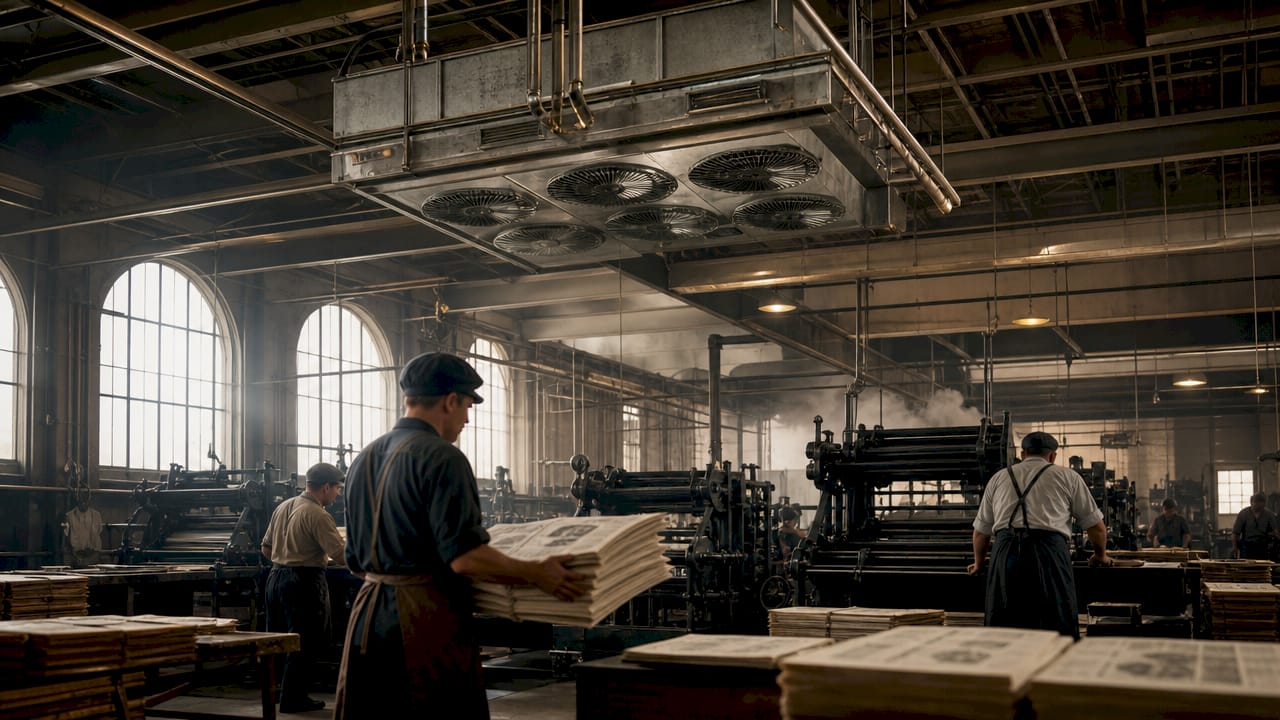
Carrier’s solution was not simply to cool the air. He designed a system that circulated air over chilled coils, removing moisture from the air in the process. By controlling dew point, he could hold humidity at a precise level regardless of outdoor conditions. That combination of temperature control and humidity control, powered by electricity, defined what we now call modern air conditioning.
The system worked through four core steps:
- Warm, humid air was drawn into the unit.
- The air passed over cooling coils filled with cold water or refrigerant, dropping its temperature below the dew point.
- Moisture condensed out of the air onto the coils and drained away.
- The now-dry, cooled air was circulated back into the workspace at a controlled temperature.
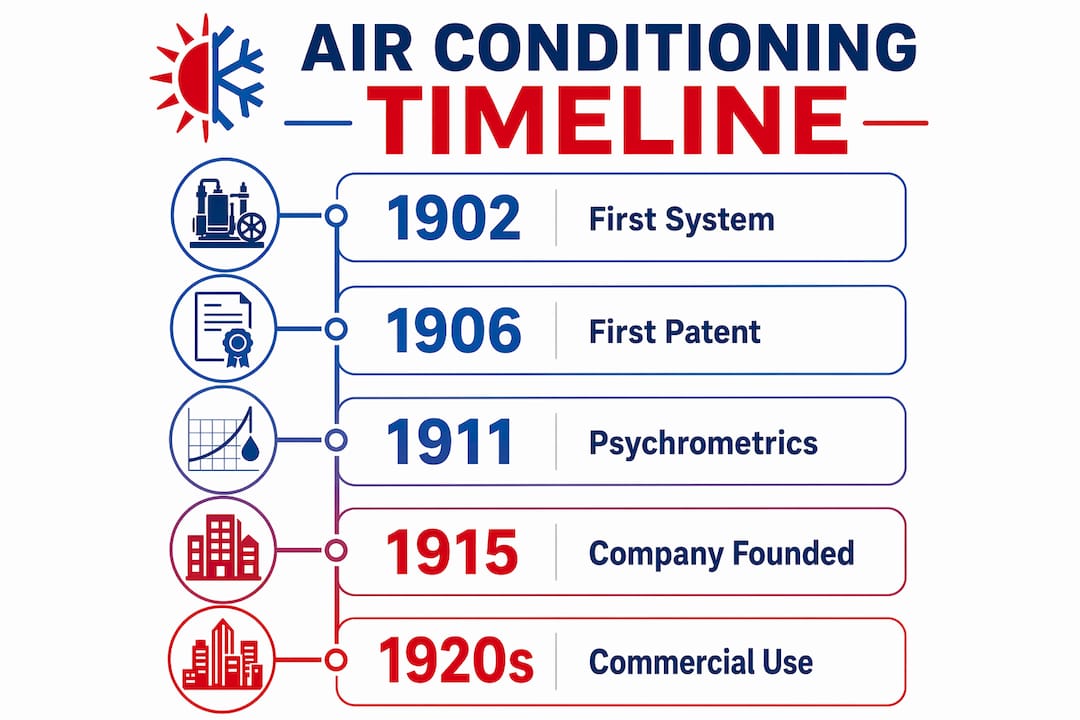
In 1906, Carrier filed U.S. Patent 808,897, the world’s first patent for a spray-type air conditioning apparatus. That patent described a system that could both humidify and dehumidify air by adjusting the temperature of the water used in the spray. It was a flexible design that went well beyond the 1902 installation.
Pro Tip: When studying the history of air conditioning, focus on the 1906 patent rather than just the 1902 installation. The patent formalized the science and made the technology transferable to other industries.
How does Carrier’s system compare to earlier cooling methods?
The history of air conditioning includes many earlier attempts at cooling, but none of them achieved what Carrier did. The difference is not just technical. It is conceptual.
Earlier cooling methods relied on ice harvested from frozen lakes and rivers, mechanical refrigeration for food storage, or passive ventilation through building design. Frederic Tudor built a profitable ice trade in the early 1800s by shipping ice from New England to warmer climates. John Gorrie, a Florida physician, experimented with mechanical ice-making in the 1840s to cool hospital rooms for fever patients. These were real advances, but they addressed only temperature, not humidity, and they could not maintain precise, repeatable conditions.
Modern air conditioning integrates electrical refrigeration, humidity control, and ventilation in a single system. That integration is what earlier methods lacked entirely.
The table below shows the key differences between pre-Carrier cooling and Carrier’s 1902 design:
| Feature | Pre-1902 cooling methods | Carrier’s 1902 system |
|---|---|---|
| Power source | Ice, passive airflow, steam | Electricity |
| Temperature control | Partial, inconsistent | Precise and repeatable |
| Humidity control | None | Integrated and controlled |
| Ventilation | Passive only | Mechanical circulation |
| Industrial application | Limited | Designed for industrial use |
One terminology point matters here. Stuart W. Cramer, a textile engineer in North Carolina, coined the term “air conditioning” in 1906. Cramer used it to describe adding moisture to dry factory air to improve textile production, comparing the process to water conditioning. Carrier adopted the term and applied it to his broader system. Cramer’s contribution was linguistic. Carrier’s was the complete engineering system.
The four functions that define modern air conditioning are:
- Temperature regulation
- Humidity control
- Mechanical ventilation
- Air filtration and purification
Carrier’s 1902 design addressed all four. No prior system did.
What impact did Carrier’s invention have on industry and society?
Carrier’s invention was designed to solve industrial problems, not to cool homes. That origin shaped how the technology spread. Industries adopted it first, and comfort followed later.
The printing industry was the first beneficiary. Textile mills came next, using controlled humidity to prevent thread breakage and static buildup. Pharmaceutical manufacturers used it to protect moisture-sensitive compounds. Movie theaters installed early air conditioning systems in the 1920s to attract summer audiences, which turned out to be one of the most effective marketing moves in entertainment history. Department stores followed, using cool air to keep shoppers inside longer.
The societal effects were just as significant:
- Air conditioning enabled population growth and economic development in the Southern United States, regions that had previously been considered inhospitable for large-scale industry and dense urban settlement.
- Cities like Houston, Phoenix, Miami, and Atlanta grew into major metropolitan centers largely because air conditioning made year-round indoor work and living practical.
- The shift of American political and economic power toward the Sun Belt in the second half of the 20th century is directly connected to the widespread adoption of residential air conditioning.
Carrier Corporation, founded in 1915, drove the commercialization of this technology. The company moved from industrial installations to residential window units and eventually to the central HVAC systems that now define home comfort. Carrier’s company grew from a single engineering solution into a global industry that shapes how buildings are designed worldwide. You can trace the full air conditioner invention timeline from Carrier’s Brooklyn installation through the modern systems in use today.
How did Carrier’s science establish the foundation of HVAC technology?
Carrier did not just build a machine. He built the science behind the machine. That distinction matters for anyone studying the development of HVAC technology.
In 1911, Carrier presented his Rational Psychrometric Formulae to the American Society of Mechanical Engineers. Psychrometrics is the science of the physical and thermodynamic properties of air and water vapor mixtures. Before Carrier’s formulae, engineers had no reliable way to predict how air would behave when cooled, heated, or exposed to moisture. His equations gave them that ability.
The core principle Carrier identified was the law of constant dew-point depression. This law states that when air is cooled to its dew point, the moisture content of the air can be predicted and controlled. That predictability is what turned air conditioning from a custom installation into a repeatable engineering practice. Any engineer with Carrier’s formulae could design a system for a new building without starting from scratch.
The 1906 patent for the “Apparatus for Treating Air” formalized the hardware side. The 1911 formulae formalized the science. Together, they gave the HVAC industry both a tool and a theory. Modern HVAC engineers still use psychrometric charts derived from Carrier’s original work to design systems for hospitals, data centers, clean rooms, and homes. The humidity management principles that Carrier established in 1902 are the same principles your home HVAC system uses today.
Pro Tip: If you want to understand how your home’s air conditioner works, look up a psychrometric chart. Carrier’s 1911 formulae are the reason that chart exists, and reading it will show you exactly what happens to air as it moves through your system.
The history of air conditioning is not a story of one invention appearing from nowhere. It is a story of Carrier synthesizing refrigeration science, fluid mechanics, and thermodynamics into a single, controllable system. That synthesis is his real contribution.
Key takeaways
Willis Carrier invented modern air conditioning in 1902 by combining electrical refrigeration, humidity control, and ventilation into one system, a design that no prior cooling method had achieved.
| Point | Details |
|---|---|
| Carrier’s 1902 installation | The Sackett-Wilhelms printing plant was the first site of a modern, electrically powered air conditioning system. |
| Humidity control was the breakthrough | Controlling moisture, not just temperature, is what separated Carrier’s system from all earlier cooling methods. |
| The 1906 patent formalized the hardware | U.S. Patent 808,897 described the first spray-type apparatus capable of both humidifying and dehumidifying air. |
| Psychrometrics built the science | Carrier’s 1911 formulae gave engineers a predictive model for indoor climate control that is still in use today. |
| Societal impact was enormous | Air conditioning enabled urban and economic growth across the Southern U.S. and reshaped global building design. |
Carrier’s legacy is bigger than most history books admit
Most people think of air conditioning as a comfort invention. That framing undersells what Willis Carrier actually did. He solved a precision manufacturing problem using a combination of sciences that had never been combined that way before. The comfort came later, almost as a side effect.
What strikes me most about Carrier’s story is the gap between the invention and the recognition. He installed his first system in 1902, but the residential air conditioning boom did not arrive until the 1950s. For nearly half a century, this technology lived inside factories and theaters while most people had no idea it existed. The engineering was decades ahead of the market.
Students researching the invention of air conditioning often get stuck on the question of who deserves credit. Cramer named it. Gorrie cooled rooms. Others built refrigeration machines. But Carrier is the one who integrated all of it into a system that could be engineered, replicated, and scaled. That is the definition of a modern technology. The principles Carrier established in 1902 and 1911 are still the foundation of every modern HVAC system installed today, including the ones keeping Central Florida homes comfortable through brutal summer heat.
The lesson for students is this: great inventions are rarely single moments of genius. They are the result of someone seeing a specific problem clearly and having the scientific tools to solve it completely.
— Lucasair
How Lucasair connects Carrier’s legacy to your home comfort
Carrier’s 1902 breakthrough established the science. What Lucasair does is apply that science to homes and businesses in Central Florida every day.

Whether you need a new system installed or an existing one serviced, the principles behind your HVAC unit trace directly back to Carrier’s original design. Lucasair, founded by Army Veteran Cameron Lucas in Eustis, Florida, offers residential and commercial HVAC installation services built on those same engineering fundamentals. The team handles everything from system selection to full installation, tune-ups, and preventative maintenance. If you want to understand what goes into a proper HVAC installation before scheduling service, Lucasair’s step-by-step guide walks you through the entire process.
FAQ
Who invented modern air conditioning?
Willis Haviland Carrier invented the first modern air conditioning system in 1902. His system was the first to control both temperature and humidity using electrical power.
Where was the first air conditioner installed?
The first modern air conditioning system was installed at the Sackett-Wilhelms Lithographing and Publishing Company in Brooklyn, New York, in 1902. Carrier designed it to prevent humidity from warping paper and misaligning ink during multi-color printing.
Who coined the term “air conditioning”?
Stuart W. Cramer, a textile engineer, coined the term “air conditioning” in 1906 to describe adding moisture to factory air. Willis Carrier later adopted the term for his broader temperature and humidity control system.
What is psychrometrics and why does it matter for HVAC?
Psychrometrics is the science of air and water vapor mixtures. Carrier’s 1911 Rational Psychrometric Formulae gave engineers a reliable way to predict and control indoor air conditions, forming the scientific foundation of all modern HVAC design.
When did air conditioning move from industrial to residential use?
Air conditioning spread from industrial plants to movie theaters and department stores in the 1920s, then to residential homes in the 1950s. Carrier Corporation, founded in 1915, was the primary force behind that commercial expansion.
Recommended
- Air Conditioner Invention History: A Complete Timeline – Lucas Air Conditioning and Heating
- First Air Conditioning: A Central Florida Homeowner’s Guide – Lucas Air Conditioning and Heating
- Thermodynamics of Air Conditioning: How It Works – Lucas Air Conditioning and Heating
- Air Conditioning Terminology: A Homeowner’s Guide – Lucas Air Conditioning and Heating
