
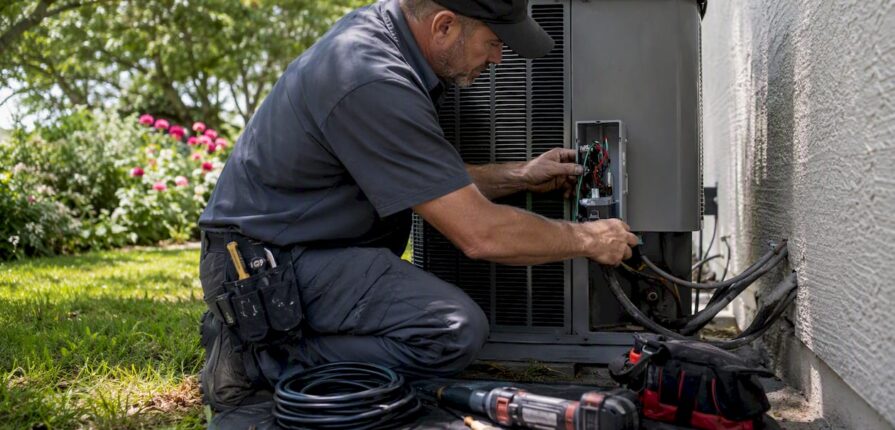
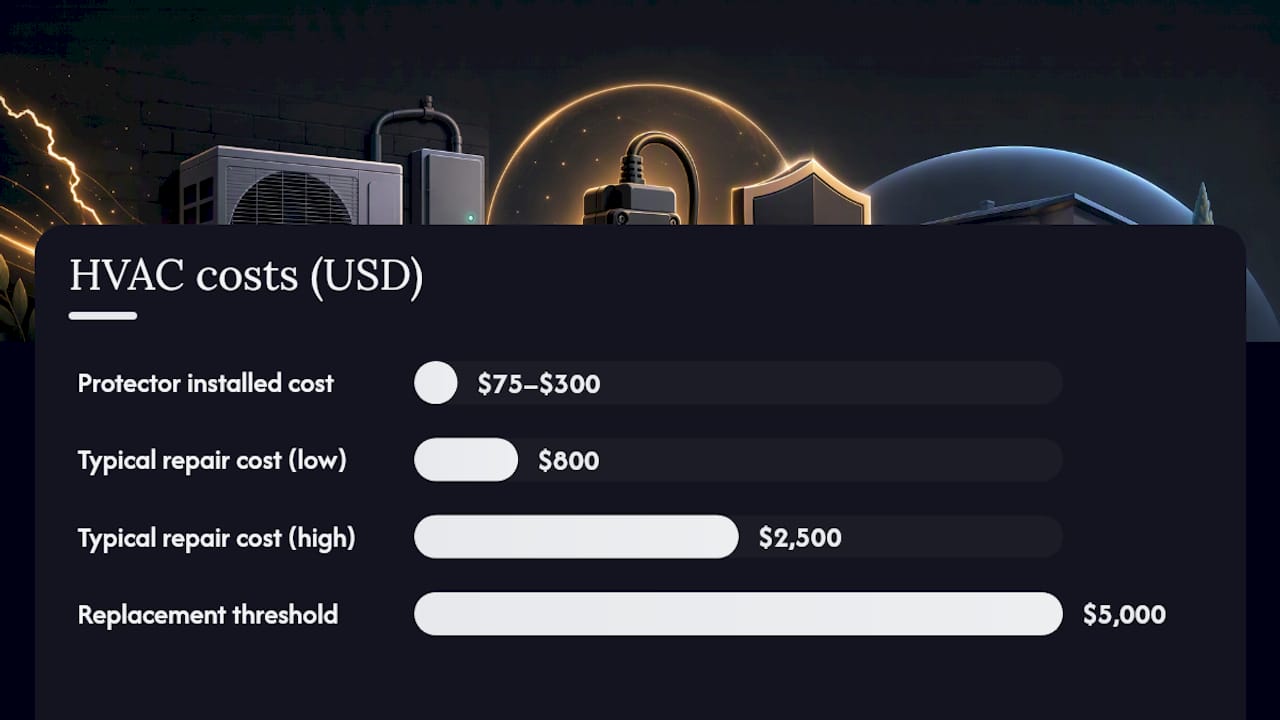
For most homeowners with a modern inverter-driven system, yes, a dedicated HVAC surge protector is worth every dollar. The device itself runs $15–$80 in parts and $75–$300 fully installed, while a single control-board or inverter-board failure can cost $800–$2,500 or more to repair. That math alone makes the case. The relevant standard to look for is UL 1449, and the device type you want at the outdoor unit is a Type 2 SPD (surge protective device). Lucas Air Conditioning and Heating installs these routinely in Central Florida, where afternoon thunderstorms make surge risk a near-daily reality during summer.
The one exception: if your system is 12–15 years old and already showing its age, run the $5,000 rule before spending anything. Multiply the system’s age by the estimated repair cost. If the result clears $5,000, replacement beats repair, and adding surge protection to a dying unit is money better spent on the new system.
- Parts cost: $15–$80 per device
- Installed cost: $75–$300 (varies by complexity)
- Inverter/control board repair: $800–$2,500+
- Break-even: one prevented surge event
Key Takeaways
A dedicated HVAC surge protector is worth installing on any modern inverter-driven system, with a typical installed cost of $75–$300 against repair bills that routinely reach $800–$2,500.
| Point | Details |
|---|---|
| When it’s worth it | Any inverter or variable-speed system under 10 years old justifies the $75–$300 installed cost against $800–$2,500+ board repairs. |
| Use the $5,000 rule | Multiply system age by repair cost; if the result exceeds $5,000, replace the system instead of adding protection. |
| Layer your protection | A whole-home panel SPD alone leaves the condenser exposed; add a Type 2 SPD at the outdoor disconnect to close the last-meter gap. |
| Key specs to demand | Require UL 1449 listing, 400V or lower clamping voltage, 20kA+ surge rating, IP65 enclosure for outdoor installs, and a visible status indicator. |
| Lucasair installs SPDs locally | Lucasair offers standalone and bundled SPD installs across Central Florida, with surge reviews included in preventative maintenance agreements. |
Table of Contents
- What does an HVAC surge protector actually protect?
- Costs, installation pricing, and simple ROI examples
- Whole-home SPDs vs dedicated HVAC SPDs vs integrated disconnects
- When is surge protection strongly recommended vs optional?
- How to choose the right device and what to ask your installer
- Installation logistics, lifespan, and when to replace
- What Lucasair sees in the field: local pricing and real examples
- Lucasair handles surge protection from inspection to installation
- Sources
What does an HVAC surge protector actually protect?
A surge protective device works by detecting a voltage spike and diverting the excess energy to ground before it reaches your equipment. The workhorse component inside most SPDs is a metal oxide varistor (MOV), a sacrificial element that absorbs the transient and clamps the voltage to a safer level. That “let-through voltage” is the number that matters most: the lower it is, the less energy reaches your system’s electronics.
What’s actually at risk inside your HVAC system:
- Inverter and IGBT boards on variable-speed and heat-pump systems (the most expensive single component to replace)
- Control/PCB boards that manage thermostat signals, fan staging, and defrost cycles
- ECM (electronically commutated motor) drives on variable-speed air handlers
- Contactors and sensors that can arc or fail from repeated transient stress
What an SPD won’t reliably stop: a direct lightning strike. A direct hit delivers far more energy than any MOV can absorb. SPDs protect against the far more common indirect surges — nearby strikes, utility switching, and the repetitive small transients from motor starts and grid fluctuations that cause cumulative wear over time. Older single-speed systems with simple contactors were relatively tolerant of these events. Modern inverter systems, with their dense circuit boards and microprocessors, are not.
Costs, installation pricing, and simple ROI examples
A professionally installed point-of-use AC surge protector typically runs under $300, making it one of the lowest-cost upgrades available for a system that might represent a $5,000–$15,000 investment.
| Protection level | Parts cost | Installed cost | What it covers |
|---|---|---|---|
| Basic Type 2 at condenser | $15–$80 | $75–$175 | Outdoor unit electronics |
| Type 2 + new disconnect bundle | $80–$150 | $150–$300 | Outdoor unit + updated disconnect |
| Whole-home panel Type 1 SPD | $100–$300 | $200–$500 | All circuits from service entrance |
Three scenarios that show the math clearly:
- New inverter heat pump, no SPD. A single surge damages the inverter board: $1,200–$2,500 repair, plus a service call. A $200 installed SPD would have covered the risk for less than 15% of that cost.
- 10-year-old standard AC, SPD already installed. A summer lightning event trips the SPD’s status indicator. You replace the SPD for $100–$150. Without it, the same event likely kills the control board: $400–$800 repair.
- 15-year-old system, $600 compressor repair needed. Run the repair-versus-replace calculation: 15 × $600 = $9,000, well above the $5,000 rule threshold. Skip the SPD and put that money toward a new system instead.
The ROI framing is simple: treat the installed SPD cost as an insurance premium. One prevented board failure pays for several years of that “premium” at once.
Whole-home SPDs vs dedicated HVAC SPDs vs integrated disconnects
These are not competing products. They protect different points in the electrical path, and the gap between them is where equipment gets damaged.
Type 1 vs Type 2 SPDs under UL 1449:
- Type 1 is installed at the main service entrance, before the meter or at the main panel. It handles large surges from the utility side.
- Type 2 is installed downstream, at a subpanel or at the equipment disconnect. It handles residual surges that pass through Type 1 protection and internal transients from motors and compressors.
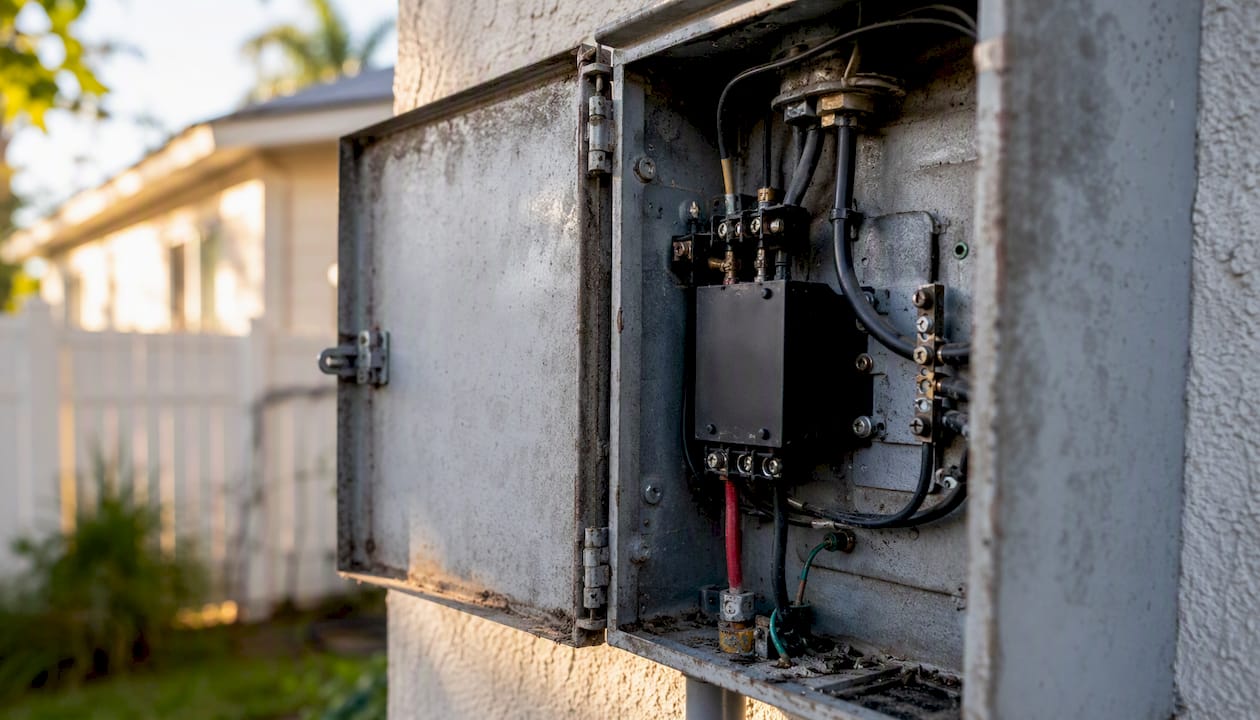
A whole-home panel SPD provides baseline protection but leaves the outdoor condenser exposed. The cable run from your main panel to the outdoor unit is an unprotected entry point. Any surge that couples onto that wire after the panel SPD arrives at the condenser with full force. A point-of-use Type 2 SPD mounted at the condenser disconnect closes that gap.
Key trade-offs to understand:
- Whole-home SPD alone: protects panel-connected devices but not the “last meter” to the condenser
- Point-of-use Type 2 at condenser: closes the last-meter gap; the minimum effective residential installation
- Integrated disconnect + SPD combo: cleaner installation, single enclosure, preferred when the existing disconnect is aging or undersized
- Layered (Type 1 + Type 2): recommended for homes in high-thunderstorm regions or with unstable grid history
For enclosure ratings: outdoor units need IP65-rated enclosures (dust-tight, water-jet resistant). An indoor air handler disconnect can use IP20. Never install a consumer-grade power strip or plug-in surge suppressor on hardwired HVAC equipment. The ACHR News notes that HVAC-rated SPDs must handle repetitive surges and the heat/humidity environment that consumer devices are not built for.
When is surge protection strongly recommended vs optional?
Install now — high priority:
- New inverter-driven heat pump or variable-speed AC (expensive electronics, long expected service life)
- Any system under 10 years old in a thunderstorm-prone area (Florida, Gulf Coast, Southeast, Midwest)
- Homes with a history of unexplained HVAC control failures or tripped breakers after storms
- Properties with long service runs from the main panel to the outdoor unit
- Commercial properties or rentals where downtime has a direct cost
May be optional:
- Systems 12–15 years old that are already candidates for replacement (apply the $5,000 rule first)
- Homes with a recently installed whole-home Type 1 SPD and short cable runs to the condenser in a low-storm-frequency area
- Older single-speed systems with no inverter boards or ECM motors (lower electronics exposure)
The $5,000 rule is the clearest tie-breaker. If age × repair cost exceeds $5,000, the system is a replacement candidate regardless of surge risk. If it comes in well under $5,000, protecting that system with a $150–$200 SPD is straightforward math.
Pro Tip: If you’re in Central Florida, the question isn’t really “if” a surge will happen — it’s “when.” The state leads the country in lightning strikes per square mile. For any system under 10 years old here, a point-of-use SPD at the condenser is as standard as a drip pan.
How to choose the right device and what to ask your installer
The spec sheet matters more than the brand name. Here’s what to verify before approving any SPD installation:
- UL 1449 listing — non-negotiable. This is the safety standard for SPDs in the U.S. If a device isn’t UL 1449 listed, don’t install it.
- Device type — Type 2 for point-of-use at the condenser or air handler disconnect; Type 1 only at the main service entrance.
- Clamping voltage — lower is better; look for 400V or below for 240V equipment.
- Surge current rating (kA) — a minimum of 20kA per mode for residential; 40kA+ for high-exposure areas.
- Enclosure rating — IP65 for any outdoor installation.
- Status indicator — a visible LED or window that shows whether the MOV is still functional. Without this, you won’t know if the device has been consumed by a prior surge.
- Connected-equipment warranty — some products include $10,000–$25,000 in connected-equipment coverage; ask for the warranty documentation before installation.
Questions to ask your technician:
- Where exactly will the SPD be mounted, and will it be coordinated with any panel-level protection?
- What is the replacement policy after a surge event? Is the status indicator visible without opening the enclosure?
- Does the device come with a connected-equipment warranty, and what documentation do I need to keep?
- Is this device rated for outdoor installation at my condenser?
Red flags: a technician who recommends a consumer power strip for a hardwired unit, quotes a device with no UL 1449 listing, or can’t explain the clamping voltage spec. Vague answers on those three points are a signal to ask for a second opinion.
Installation logistics, lifespan, and when to replace
Most residential SPD installations take 1–2 hours. The labor cost drivers are:
- Whether a new disconnect box is needed (adds $50–$150 in parts and labor)
- Conduit requirements for the outdoor run
- Three-phase service (commercial properties) vs single-phase residential
- Distance from the main panel to the outdoor unit
Typical installation points: the outdoor condenser disconnect, the indoor air handler disconnect, and the main service entrance panel. Full layered coverage uses all three. A standalone point-of-use install at the condenser is the most common residential starting point.
Lifespan and replacement:
SPDs are sacrificial by design. Each surge event consumes some of the MOV’s capacity. In a high-thunderstorm area like Central Florida, plan for a 5–7 year service life rather than the 10-year maximum you’d see in a low-exposure region. Always replace an SPD after a confirmed major surge event, even if the status indicator still shows green, because internal degradation isn’t always visible.
Routine ownership actions:
- Check the status indicator monthly, especially after storm season
- Keep the original receipt and warranty documentation in your HVAC file
- Ask your technician to inspect the SPD during your annual HVAC maintenance visit
- If you notice unexplained control-board behavior after a storm, treat the SPD as suspect and have it tested
Pro Tip: After any significant lightning event nearby, have your technician check the SPD before assuming the system is fine. A consumed MOV looks intact from the outside but offers zero protection.
What Lucasair sees in the field: local pricing and real examples
Lucas Air Conditioning and Heating serves Central Florida, a region where surge protection isn’t a theoretical upgrade — it’s a practical necessity. Here’s how Lucasair typically structures SPD work:
- Standalone Type 2 at the condenser disconnect: $125–$200 installed, depending on the existing disconnect condition. This is the most common add-on during a tune-up or new system install.
- Bundled disconnect + Type 2 SPD: $200–$300 installed when the existing disconnect is outdated or undersized. Lucasair recommends this combination on any system over 5 years old where the disconnect hasn’t been recently inspected.
- Whole-home panel SPD coordination: $250–$500 installed at the main service entrance, typically recommended alongside a new system installation or during a full electrical review.
Lucasair includes a surge protection review as part of its preventative maintenance agreements. During a maintenance visit, the technician checks the status indicator, notes the device age, and flags any unit that’s approaching end-of-life or that has been through a significant storm season without inspection.
A technician’s honest take on why we install SPDs as standard
At Lucasair, surge protection gets recommended on every new installation and every maintenance visit where it’s absent. The reason isn’t upselling. A control-board failure on a Friday afternoon in August means a customer without air conditioning over a weekend, an emergency service call, and a repair bill that dwarfs the cost of the SPD we could have installed months earlier. SPDs are sacrificial devices, not perfect shields. A direct lightning strike will still damage equipment. But the repetitive small transients and indirect surges that happen dozens of times a year in Florida? Those are exactly what a properly rated Type 2 SPD is built to absorb. Layered protection — panel-level Type 1 plus point-of-use Type 2 — is the architecture we recommend for any home in a high-storm area.
Lucasair handles surge protection from inspection to installation
Lucas Air covers the full range of surge protection work for Central Florida homeowners and property managers: SPD inspections on existing systems, point-of-use Type 2 installs at the condenser or air handler, whole-home panel coordination, and HVAC repair services when surge damage has already occurred.
When you call or book online, have your system’s model and year ready, note any recent storm events or unexplained control issues, and ask specifically about bundling an SPD with your next tune-up or maintenance visit. Lucasair’s local service rates are transparent, and the team can walk you through the right device type for your specific unit and location.
Ready to protect your system? Request a quote from Lucasair in The Villages and Central Florida and ask about adding surge protection to your next service call.
Sources
- How Much Is an HVAC Surge Protector: Is It Worth It? – Jackson Systems
- HVAC Surge Protector: Complete Guide to Surge Protection for HVAC Systems – Trilpeak
- What is the $5,000 rule for HVAC systems? – CBS News
- AC surge protector: should you install one? Costs & benefits – HVACDatabase
Recommended
- 7 Key Benefits of HVAC Preventative Maintenance for Homeowners – Lucas Air Conditioning and Heating
- Preventative HVAC Care – How It Impacts Your Home – Lucas Air Conditioning and Heating
- HVAC preventative maintenance: 30% longer system life – Lucas Air Conditioning and Heating
- Upgrade your HVAC in 2026 for efficiency & cost savings – Lucas Air Conditioning and Heating
