
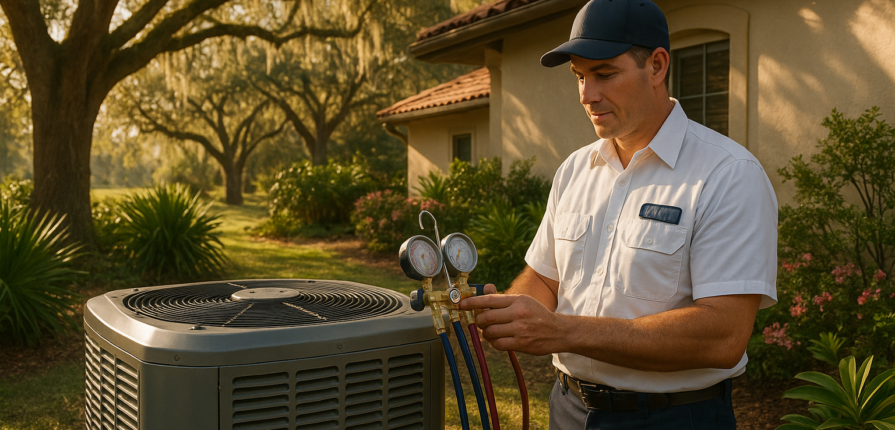
TL;DR: Florida’s heat and humidity push AC systems hard, shortening their useful life to roughly 10–15 years. Use the industry’s $5,000 Rule and a handful of clear red flags — refrigerant type, repair history, and efficiency losses — to decide whether a repair or a full replacement is the smarter investment. When in doubt, get an honest second opinion before spending a dollar.
Your AC stops cooling on a July afternoon in Lake County. A technician quotes you a repair. Now you’re wondering: is it worth fixing, or is it time to start fresh?
It’s one of the most consequential home decisions you’ll make — and it’s easy to get it wrong in either direction. Repair when you should replace and you’ll spend money on a dying system. Replace when a simple fix would do and you’ll pay thousands you didn’t need to spend.
This guide walks you through exactly how to make that call, with Florida’s climate in mind.
Why Florida Is Harder on AC Systems Than Most States
In northern states, a central AC might run three or four months a year. In Lake County and the surrounding communities, it runs nearly year-round. While homeowners in northern states might use their AC for just 3–4 months per year, Florida residents run their systems almost continuously — and that constant operation dramatically increases wear and tear on all components.
Florida’s tropical climate, characterized by high temperatures and humidity levels, puts significant strain on air conditioning systems. The long, hot summers mean your AC runs more frequently and for longer periods, which accelerates wear. Humidity also contributes to moisture buildup, leading to potential issues like rust, mold, and reduced efficiency.
The result: the average AC unit in the U.S. may last 15 to 20 years, but here in Florida the expected lifespan tends to be 10 to 14 years.
That shorter window matters a great deal when you’re weighing a repair bill.
The $5,000 Rule: A Simple Starting Point
The most widely used formula in the HVAC industry for this decision is called the $5,000 Rule. It’s a rule of thumb to help homeowners decide whether repair or replacement makes more sense in the long run. Multiply the age of your equipment by the estimated repair cost. If the number exceeds $5,000, you should consider replacing the unit. If it’s less, a repair may be the answer.
A quick example: a 9-year-old system with a $400 repair = $3,600. Repair it. A 12-year-old system with a $600 repair = $7,200. Start pricing replacements.
The rule is a useful screen, not a verdict. It has a known limitation: it doesn’t account for repair history. A system that has already needed two repairs in the past 24 months is a worse candidate for another repair than a system with a clean history, even if the math is technically in repair territory. Two or more unscheduled repairs in 24 months is an independent signal that the system is in general decline.
Age-Based Decision Tiers
Use your system’s age as a first filter, then layer in the $5,000 Rule and the factors below.
- Under 8 years old: Almost always repair. The system has plenty of life left.
- 8–12 years old: Repair if the cost is reasonable; start planning for replacement.
- 12–15 years: The decision point. Repair if it’s a small fix; replace if it’s major.
- 15+ years: Almost always replace. At this stage you’re paying to postpone the inevitable — usually at increasing cost.
ENERGY STAR recommends considering replacement when your heat pump or air conditioner is more than 10 years old, noting that correctly installed high-efficiency units can save up to 20 percent on heating and cooling costs.
The Refrigerant Factor — A Florida-Specific Red Flag
If your system was installed before 2010, there is a strong chance it uses R-22 refrigerant (also called Freon). This changes the math significantly.
R-22, also known as HCFC-22, was once the standard refrigerant in residential air conditioning. Due to its ozone-depleting properties, the EPA banned the production and import of R-22 on January 1, 2020. Since then, only recycled or reclaimed R-22 has been available for servicing existing systems, making repairs more challenging.
Reclaimed R-22 and pre-2020 stockpiles can still service existing equipment — which is why it now runs $150–$300 a pound. A refrigerant recharge that cost a few hundred dollars a decade ago can now cost well over $1,000 on an older system.
Meanwhile, the EPA’s regulations didn’t stop with R-22. As of January 1, 2025, new rules under the American Innovation and Manufacturing (AIM) Act are also phasing out R-410A for new systems due to its high Global Warming Potential. All new residential HVAC systems must now use refrigerants with a GWP below 750.
Bottom line: if your system uses R-22 and needs a refrigerant-related repair, replacement is almost always the smarter financial move.
Signs That Point Toward Repair
- The system is under 8–10 years old with no prior major repairs
- The failed part is minor — a capacitor, contactor, or clogged drain line (not a compressor or coil)
- The repair cost is under 30% of replacement cost and the $5,000 Rule result is below $5,000
- The system uses R-410A refrigerant (not R-22)
- Your home cools evenly and energy bills have been stable
Not sure what’s actually wrong? Sometimes what looks like a major failure is a small component. A failing capacitor, for example, can mimic a full system breakdown — and it’s one of the most affordable repairs a technician can make.
Signs That Point Toward Replacement
- The system is 12 years or older in Florida’s climate
- It uses R-22 refrigerant and needs a recharge or coil repair
- You’ve had two or more service calls in the past 24 months
- The repair involves a compressor or evaporator coil — major components that often cost more than half a new system
- Your energy bills keep climbing even when the system is running
- Some rooms stay too hot or too cold no matter how long the system runs
- Installation problems like oversizing, improper charging, and leaky ducts have caused efficiency losses and occupant discomfort that a repair won’t fully fix
Rising energy bills are one of the most consistent early warnings. If your cooling costs have been creeping up year over year, your system is likely losing efficiency — not just having a bad month. You can dig into why your AC is spiking your electric bill to separate an efficiency problem from a one-time repair issue.
The Efficiency Argument for Replacing Sooner
A newer, properly sized system isn’t just more reliable — it costs measurably less to run. An ENERGY STAR-certified unit, installed correctly, can save up to 20 percent on heating and cooling costs.
Replacing a 12-SEER unit from 2008 with a 16-SEER ENERGY STAR system could lower cooling costs by up to 30%. For a household spending $1,500 annually on cooling, that’s a $450 savings each year.
In a typical 2,000 sq ft home, that efficiency gap translates to $200–$400 per year in reduced cooling costs — and over a 12-year new system lifespan, that’s $2,400–$4,800 in cumulative savings, in addition to avoiding future repair costs on the aging system.
Improper installation can reduce system efficiency by up to 30 percent, costing you more on utility bills and possibly shortening the equipment’s life — which is why installation quality matters just as much as the unit itself. At Lucas Air, every installation includes a permit and follows manufacturer specifications to protect your investment from day one.
What a Replacement Actually Includes at Lucas Air
One reason homeowners hesitate on replacement is sticker shock. A full installation at Lucas Air starts at $7,500, which includes the unit, permit, a one-year labor guarantee, and a ten-year parts warranty. KwikComfort financing is available, and estimates on new installations are always free.
That’s not a raw equipment cost — it’s a complete, permitted, warrantied installation by a licensed Florida HVAC contractor (CAC1819409 / CAC1819837).
When You’re Not Sure: Get a Tune-Up First
If your system is on the fence — say, 9–11 years old with one prior repair — a precision tune-up gives you real diagnostic information before you commit to either path. Lucas Air’s tune-up is $125 and includes a full system inspection. If the technician finds nothing alarming, you get peace of mind and a cleaner-running system. If they find a developing problem, you make the replacement decision with actual data.
For ongoing protection, a Preventative Maintenance Agreement ($129/year) includes one annual tune-up, 15% off parts, and priority scheduling — so if something does go wrong, you’re not at the back of the queue in July.
Unusual sounds are often the first sign something’s wrong before a breakdown. If your system is rattling, squealing, or clicking in ways it didn’t before, it’s worth understanding what different AC noises mean before your next service call.
The Short Version: A Decision Checklist
- Check the age. Under 8 years → lean toward repair. Over 12 years in Florida → lean toward replace.
- Run the $5,000 Rule: Age × Repair Cost. Over $5,000? Consider replacing.
- Check the refrigerant. R-22 system needing a major repair? Replace.
- Count recent repairs. Two or more in 24 months? Replace.
- Check the component. Compressor or coil failure? Compare carefully against replacement cost.
- Check your bills. Rising energy costs suggest declining efficiency — factor in long-term savings.
If you’re weighing a repair or replacement on your Lake County or Orange County home, Lucas Air offers free estimates on new installations and honest, no-pressure diagnostics. Cameron Lucas and his team won’t recommend a replacement if a repair makes sense — that’s not how a veteran-owned business earns a 5.0-star rating and four consecutive Nextdoor Neighborhood Favorite awards.
Call or schedule online anytime. Emergency service is available outside regular business hours (Mon–Fri, 8:00 AM–5:30 PM) for Tavares, Eustis, Leesburg, Mount Dora, The Villages, Lady Lake, Fruitland Park, Umatilla, Sorrento, Howey-in-the-Hills, Apopka, and surrounding communities.
Recommended Reads
- How to Tell If Your AC Capacitor Is Failing — and What It Costs to Fix
- 8 Reasons Your AC Isn’t Cooling Enough (And What to Do About Each)
- What Different AC Noises Mean — and When to Call a Tech
