
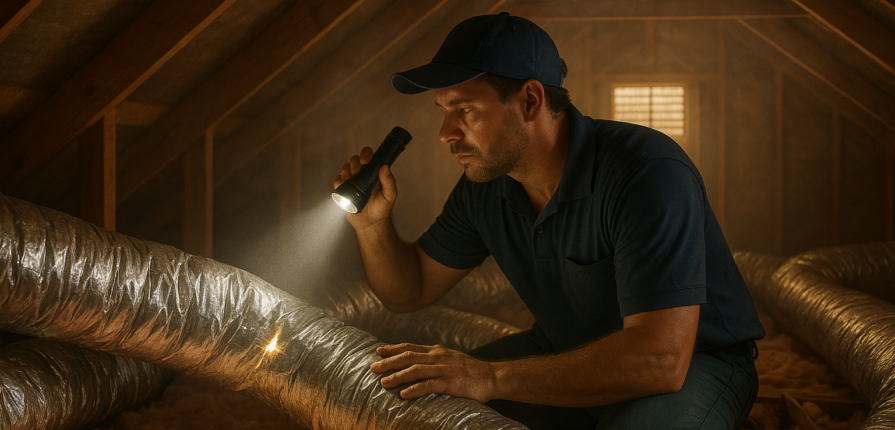
TL;DR: Ductwork running through a scorching Central Florida attic can lose 25-40% of your cooled air before it ever reaches a vent, driving up bills and shortening equipment life. This guide explains how attic duct insulation works, the R-value Florida homes need, and how to tell if your Tavares-area home’s ducts are costing you money.
If your air conditioner runs constantly but your home still feels warm in the back bedrooms, the problem might not be your AC unit at all. It could be hiding above your ceiling, in a 130-degree attic, where poorly insulated ductwork is quietly leaking the cold air you’re paying for.
This is one of the most common — and most overlooked — efficiency problems we see in homes across Tavares, Eustis, Mount Dora, The Villages, and the rest of Lake and Orange County. Let’s break down what attic duct insulation actually does, how it fails, and when it’s time to have it inspected.
What Is Attic Ductwork Insulation?
Most Central Florida homes built on a slab use a forced-air HVAC system with sheet metal or flexible ductwork routed through the attic. Because that attic space is unconditioned, it isn’t heated or cooled directly, and it absorbs intense radiant heat from the roof.
Duct insulation is the wrap (usually fiberglass with a foil or vinyl facing, rated by R-value) that surrounds that ductwork to slow heat transfer between the 60-degree air inside the duct and the superheated attic air around it. Insulation is different from duct sealing, which closes physical gaps and leaks at joints and connections — both matter, and one without the other leaves real efficiency on the table.
How It Works
Think of your ductwork like a garden hose carrying ice water through a hot car trunk. The insulation is the foam sleeve on the hose. Without it, heat seeps in through the metal walls (conduction) before the water ever reaches the faucet.
In an attic, the same thing happens to your cooled air.
The additional heat loss and gain of ducts in unconditioned, vented attics increases energy use for heating and cooling, and duct air leakage has been measured to commonly exceed 20% of conditioned air flow, resulting in significant energy loss.
Industry research compiled by the National Renewable Energy Laboratory found that
typical systems with ducts in attics or crawl spaces lose from 25% to 40% of the heating or cooling energy that passes through them
.
That loss happens two ways:
- Conduction — heat passing directly through thin or uninsulated duct walls
- Air leakage — cooled air escaping through gaps, loose connections, or damaged flex duct before it reaches your vents
According to ENERGY STAR,
leaky ducts can reduce heating and cooling efficiency by as much as 20 percent
. In a Central Florida attic that regularly exceeds 130°F in summer, both insulation quality and duct sealing determine how much of that loss you actually experience.
Why This Matters More in Lake and Orange County
Florida’s long cooling season means your AC and its ductwork work harder, longer, and more continuously than almost anywhere else in the country. A duct system that’s merely “fine” in a milder climate becomes a real money pit here, especially for:
- Snowbirds and seasonal residents whose homes sit closed up with the AC cycling against attic heat for months at a time
- The Villages and Lady Lake homeowners in older manufactured or site-built homes with original, aging ductwork
- Landlords and property managers in Leesburg, Fruitland Park, and Umatilla trying to control utility costs across multiple units
- Restaurant and commercial building owners in Mount Dora or Apopka where rooftop or attic-run package units serve large, heat-sensitive spaces
If your system seems to be struggling to keep up, it’s worth reviewing our guide on 8 reasons your AC isn’t cooling enough — attic duct loss is frequently the hidden culprit behind “my AC runs all day but the house never feels cool.”
What R-Value Do Florida Attics Need?
Central Florida falls into DOE Climate Zone 2.
The U.S. Department of Energy recommends R-30 minimum for Zone 2 uninsulated attics, and Energy Star sets R-38 as the target for all Southern US homes.
For the ductwork itself (not the attic floor insulation),
ENERGY STAR recommends insulating ducts in unconditioned areas like attics, crawlspaces, and garages with duct insulation that carries an R-value of 6 or higher
, and higher-performance systems often target R-8. If your ductwork is original to an older home, it was likely installed well below that benchmark — or has compressed and degraded over time.
Pros of Properly Insulated Attic Ductwork
- Lower cooling bills — less energy wasted heating up attic air instead of cooling your living space
- More even temperatures room to room, especially in additions or rooms farthest from the air handler
- Less strain on your AC, which can extend compressor life and reduce repair frequency
- Better indoor air quality — sealed, insulated ducts are less likely to pull in attic dust, insulation fibers, or moisture
- Reduced condensation risk on duct exteriors in humid Florida attics, which can lead to mold or wood rot over time
Cons and Limitations
- Insulation alone doesn’t fix leaks. Wrapping a leaky duct in insulation slows conduction but does nothing for air escaping through a torn seam or disconnected joint — sealing has to happen first or alongside it.
- It degrades over time. Florida attic heat, humidity, pests, and age cause duct wrap to compress, tear, or fall away from the ductwork, reducing its effective R-value.
- It’s not a DIY-friendly attic job in most cases — Florida attics are brutally hot, and improperly done insulation work can trap moisture or create new problems.
- Cost. Full duct insulation or replacement is a real investment, though it’s usually smaller than a full AC replacement and pays back over time through lower bills.
Signs Your Attic Ductwork May Be the Problem
- Some rooms are noticeably warmer than others, especially rooms farthest from the air handler
- Your energy bills have crept up without a change in habits
- You can feel warm air coming from supply vents even when the AC is running
- Your attic access hatch feels unusually hot to the touch, or you can see visible gaps, sagging, or torn insulation on ducts when you look up there
- Unusual whistling, rattling, or popping sounds from the duct system — if you’re hearing odd noises, our breakdown of what different AC noises mean can help you figure out if it’s ductwork or the unit itself
- Dust, musty odors, or allergy symptoms that seem tied to the AC running
When It’s Time to Call a Professional
Attic duct problems rarely show up as one dramatic failure — they show up as a slow bleed in comfort and higher bills that homeowners often blame on the AC unit itself. A proper diagnosis involves checking:
- Duct insulation condition and R-value throughout the attic run
- Joint and connection integrity (sealing, not just taping)
- Airflow balance between supply and return
- Whether ductwork is properly sized and supported, not crushed or kinked
This is exactly the kind of inspection we build into every Lucas Air Conditioning and Heating precision tune-up and Preventative Maintenance Agreement — because an AC that’s working perfectly can still underperform if the ductwork delivering its air is compromised. As a veteran-owned company founded by Army veteran Cameron Lucas, we believe in giving homeowners straight answers, not upsells — if your ducts just need sealing and re-insulating rather than a whole new system, that’s what we’ll tell you.
What to Do Next
If you suspect your attic ductwork is working against your AC rather than with it, don’t wait for peak summer to find out. Seasonal transitions in spring and fall are the easiest time to get an inspection scheduled before Florida’s heat returns in full force. Check our current seasonal specials for ways to save on an inspection or tune-up.
Serving Tavares, Eustis, Leesburg, Mount Dora, The Villages, Lady Lake, Fruitland Park, Umatilla, Sorrento, Howey-in-the-Hills, Clarcona, Astor, Paisley, Grand Island, Zellwood, and Apopka, our licensed technicians (CAC1819409, CAC1819837) can evaluate your attic ductwork alongside your AC system and give you an honest, no-pressure recommendation.
Recommended Reads
- HVAC Contractor in Tavares, FL
- Landing Page for Seasonal Specials – Online Booking – Lucas Air Conditioning and Heating
- Landing Page for Seasonal Specials – Lucas Air Conditioning and Heating
