
TL;DR: Your HVAC system does more than cool your home — it filters, dehumidifies, and circulates the air your family breathes, which directly affects allergy and asthma symptoms. In Central Florida’s humid climate, poorly maintained ducts, the wrong filter, or excess indoor moisture can turn your AC into an allergen amplifier instead of a defense system.
If your family sneezes more at home than outside, your HVAC system is probably part of the problem — or the fix. In Lake and Orange County, where humidity sits high for most of the year, your air conditioner is not just a comfort appliance. It is the primary filter, dehumidifier, and air-mover for everything your household breathes.
Here is how your system actually affects allergies, what the research says about fixing it, and when it is time to call a technician instead of just changing a filter.
Why Indoor Air Quality Is a Bigger Deal in Central Florida
Florida’s climate creates a near-perfect environment for indoor allergens.
Florida’s combination of high outdoor humidity (70–90%), year-round operation of HVAC systems, and older housing stock
makes indoor air quality harder to manage here than in most other states.
Two allergen sources thrive specifically because of our weather:
- Dust mites:
dust mites, a leading trigger for asthma and allergies, absorb moisture directly from the air and thrive when relative humidity exceeds 50%
. - Mold spores:
mold can begin growing within 24–48 hours when moisture is present on surfaces
, and
when humidity rises above 60%, mold spores can begin developing on surfaces such as drywall, wood, insulation, and carpeting
.
Because our AC systems run almost year-round — not just in summer — they are constantly cycling air through ductwork, coils, and filters that either trap these allergens or, if neglected, help spread them.
How Your HVAC System Actually Controls Indoor Air Quality
According to the EPA, there are three ways to improve the air inside a home:
source control to eliminate pollution sources, improved ventilation to increase outdoor air coming indoors, and air cleaners or higher-efficiency HVAC filters to supplement the first two
. Your HVAC system plays a direct role in two of those three.
1. Filtration
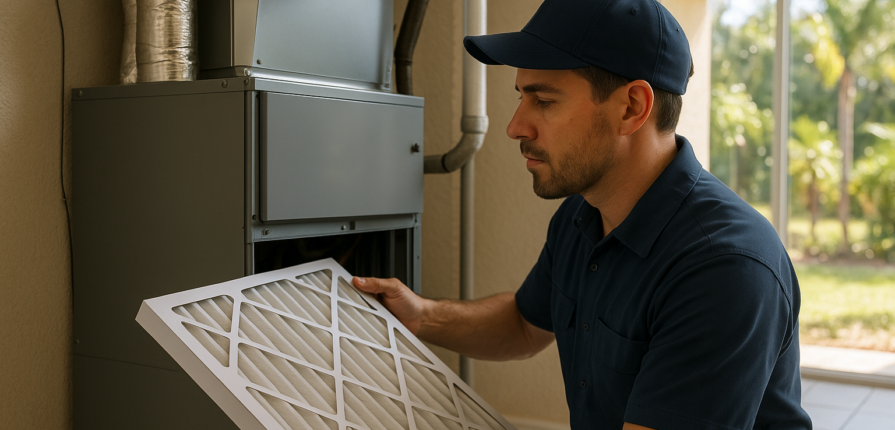
Every time your system runs, air passes through a filter before it reaches your living space. The filter’s MERV (Minimum Efficiency Reporting Value) rating determines what gets captured.
2. Dehumidification
As your AC cools air, it also pulls moisture out of it. This is one of the most important — and most overlooked — allergy defenses in a Florida home, since controlling humidity controls dust mites and mold at the source.
3. Circulation
Your ductwork distributes air throughout the home. Leaky, dirty, or poorly sealed ducts can pull in attic dust, insulation fibers, and moisture, then circulate them into every room.
MERV Ratings Explained: Choosing the Right Filter for Allergies
MERV ratings range from 1 to 16 for standard residential and commercial filters, with higher numbers capturing smaller particles. Here’s what the research shows for allergy sufferers:
- MERV 1–4:
primarily designed to protect the HVAC equipment by preventing large dust and debris from coating coils and fans, but does very little for indoor air quality because it allows the vast majority of microscopic allergens to pass right through
. - MERV 8–11:
good for most Florida homes — captures pollen, mold spores, and dust mite allergens
. - MERV 11–13:
allergists and indoor air quality professionals most commonly recommend MERV 11 to MERV 13 for residential allergy management
, and
a MERV 13 filter must capture at least 50% of particles in the 0.3 to 1.0 micron range, making it far more effective against the sub-micron fragments of pet dander, mold, and bacteria that are most likely to provoke allergic reactions
.
One caution: jumping straight to the highest-rated filter isn’t automatically better.
Going higher sounds appealing but creates system problems that outweigh the filtration benefits
if your blower and ductwork weren’t designed for the added airflow resistance. This is exactly the kind of system-specific question a technician should answer during a tune-up, rather than guessing at the hardware store.
In our humid climate, filters also load up faster.
In a humid climate like Florida, it is recommended to check your AC filter monthly and replace it every 30 to 90 days
.
Humidity Control: The Most Overlooked Allergy Fix
Most Lake County homeowners focus on filters and forget humidity, but moisture control may matter more.
Experts recommend maintaining indoor humidity between 30% and 50%
to prevent mold growth and reduce dust mite populations.
An oversized or poorly maintained AC unit can actually make humidity worse — it cools the air quickly without running long enough to properly dehumidify it.
Ensuring your AC is properly sized — not oversized — also helps with humidity control
. This is one reason a professional load calculation matters for replacements in Tavares, Mount Dora, and surrounding communities, rather than simply matching the old unit’s tonnage.
Ductwork, UV Lights, and Whole-Home Options
For households dealing with persistent allergy or asthma symptoms, filtration alone sometimes isn’t enough. Additional options worth discussing with your technician include:
- Duct cleaning and sanitization: removes accumulated dust, pet dander, and mold growth inside ductwork that a filter never touches.
- UV germicidal lights: installed in the ductwork or at the coil to reduce microbial growth.
- Whole-home dehumidifiers: integrated into the HVAC system for homes that stay above 50% humidity even with the AC running.
- Smart thermostats with humidity monitoring: let you track and respond to humidity swings in real time, which matters most for snowbirds and seasonal residents who leave homes unoccupied for weeks at a time.
These upgrades fall under indoor air quality and smart thermostat installation, and they’re worth a conversation during your seasonal tune-up rather than waiting until symptoms get worse.
Signs Your HVAC System Is Hurting Your Indoor Air Quality
- Musty odors near vents, especially when the system first kicks on
- Visible dust buildup around registers shortly after cleaning
- Family members’ allergy or asthma symptoms ease up when they leave the house
- Condensation on windows or unusually sticky indoor air
- Weak airflow from vents, which can point to duct leaks or a struggling system — see our guide on why your AC isn’t cooling enough for more on airflow troubleshooting
If you also notice unusual odors from your system, our breakdown of why an AC might smell like burning covers when that points to an electrical issue versus something in the ductwork.
Pros and Cons of Upgrading Your HVAC for Allergies
Pros
- Noticeably fewer allergy and asthma symptoms at home
- Reduced mold risk in Florida’s humid climate
- Better sleep quality and fewer sinus issues reported by many allergy sufferers
- Lower long-term maintenance costs when ducts and coils stay cleaner
Cons
- Higher-MERV filters can restrict airflow on older or undersized systems
- Whole-home dehumidifiers and UV lights add upfront cost
- Filters need more frequent changes in humid climates, adding to maintenance routine
- None of these upgrades replace proper humidity control or regular maintenance — they work together, not as standalone fixes
When It’s Time to Call a Technician
A few scenarios where a filter swap won’t cut it:
- Humidity in your home consistently reads above 50% even with the AC running regularly
- You notice a musty smell that doesn’t go away after changing the filter
- Allergy symptoms are new or worsening despite good housekeeping
- Your system is more than 10–12 years old and hasn’t had a full duct inspection
- You hear unusual sounds from the system — our guide to what different AC noises mean can help you figure out if it’s worth a service call
A Preventative Maintenance Agreement that includes an annual tune-up is one of the simplest ways to catch these issues early, especially in a climate where systems run nearly year-round.
Local Context: Why This Matters Across Our Service Area
From Tavares and Eustis to The Villages, Mount Dora, Leesburg, and out toward Astor, Paisley, Grand Island, and Zellwood, homes face the same core challenge: heat and humidity that never fully let up. Retirees and 55+ community residents, snowbirds who leave homes unoccupied part of the year, and landlords managing rental properties all depend on their HVAC system to keep humidity — and the allergens it feeds — in check, even when no one is adjusting the thermostat daily.
If you’re planning a system upgrade, check our current seasonal offers before scheduling, since tune-ups and indoor air quality add-ons are often bundled during specific times of year.
The Bottom Line
Your HVAC system is either working for your family’s allergies or against them — there’s no neutral setting. Regular filter changes matched to the right MERV rating, humidity control, clean ductwork, and a properly sized system are the foundation. For most Central Florida homes, that combination does more for allergy relief than any single product or gadget.
Recommended Reads
- Landing Page for Seasonal Specials – Online Booking – Lucas Air Conditioning and Heating
- Landing Page for Seasonal Specials – Lucas Air Conditioning and Heating
- 8 Reasons Your AC Isn’t Cooling Enough (And What to Do About Each)
