
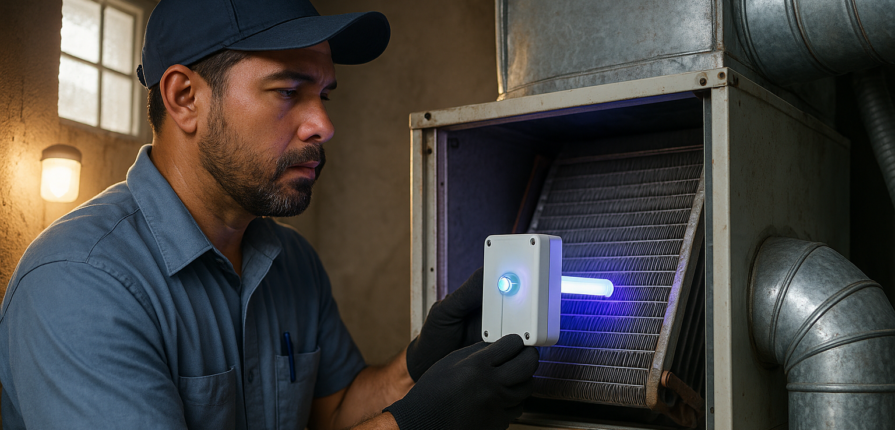
TL;DR: UV-C (germicidal) lights installed near your evaporator coil are genuinely effective at preventing mold and biofilm on the coil itself, which matters a lot in Central Florida’s humidity. They are not a substitute for filtration and won’t scrub every airborne germ, so the EPA recommends pairing them with good filters, not using them alone.
If you’ve had a technician mention adding a UV light to your air handler, you’ve probably wondered whether it’s a real upgrade or just an add-on. In humid parts of Lake and Orange County — from Tavares and Mount Dora to Zellwood and Grand Island — the answer matters more than it does in drier climates.
Here’s a straight, no-upsell explanation of how UV-C air purifiers work inside an HVAC system, what they genuinely do well, where they fall short, and when they’re worth installing.
What Is a UV Light Air Purifier for HVAC?
A UV light air purifier, also called a UV-C germicidal light or UVGI (ultraviolet germicidal irradiation) system, is a small lamp installed inside your air handler or ductwork.
UV-C specifically, at wavelengths of 100 to 280 nanometers with 254 nm being most germicidal, damages the DNA and RNA of microorganisms, preventing them from reproducing.
Most residential systems are mounted so the light shines directly on the evaporator coil, which is the cold, wet component inside your indoor unit.
Coil sterilization refers to UV lights mounted directly over the evaporator coil that run 24 hours a day, 7 days a week, providing constant protection and preventing biological growth from forming on the wet coil.
How UV-C Light Actually Works
The science is well-established.
UV-C photon absorption causes adjacent thymine bases in the DNA strand to bond abnormally, forming thymine dimers that distort the DNA helix and block the enzymes that copy DNA during cell division, so the organism cannot reproduce.
Manufacturer lab testing backs this up for coil applications specifically.
In laboratory testing, one major manufacturer’s UV lamp solution demonstrated reductions of molds penicillium citrinum and aspergillus niger on an aluminum surface of 99.99% and 99.9% respectively in just 4 hours.
Where UV Lights Excel: The Coil and Drain Pan
This is the application that’s actually proven to work in a residential system. Because the coil is a stationary, constantly wet surface that the light can irradiate around the clock, exposure time is long enough to matter.
- Mold prevention on the coil:
The evaporator coil is a persistently moist surface ideal for mold and biofilm growth, and a UV-C lamp shining on the coil 24/7 is effective at preventing mold colonization — the strongest, most well-supported application of residential HVAC UV systems. - Protecting system efficiency:
Biofilm accumulates on evaporator coils and drain pans over time, insulating the coil surface and reducing heat transfer, while UV light keeps coils clean continuously, maintaining your system’s rated efficiency and extending equipment life. - Reducing musty odors: Coil-mounted lights address the moldy smell that often comes from a dirty coil, since they attack the growth at its source.
Where UV Lights Fall Short
This is the part manufacturers’ marketing often glosses over, and it’s important to understand before you buy.
- They don’t sanitize your whole airstream.
A coil-mounted UV light only treats the coil surface — air passing over the coil moves too quickly for meaningful UV-C exposure, so the lamp does not meaningfully reduce airborne microorganisms in the passing airstream. - They’re not a filter replacement. The federal government is explicit on this point.
UVGI cleaners use ultraviolet radiation from UV lamps that may destroy biological pollutants growing on HVAC surfaces, but they should be used with, not as a replacement for, filtration systems, since typical UVGI cleaners used in homes have limited effectiveness in killing bacteria and molds. - Some units can generate ozone.
You should avoid portable air cleaners and furnace/HVAC filters that intentionally produce ozone, a lung irritant, and note that UV lights without adequate lamp coatings may have the potential to emit ozone.
Confirm any system you install is rated at the standard 253.7 nm germicidal wavelength. - Bulbs wear out. UV-C lamps lose output over time and typically need replacement on a set schedule to stay effective, which is why professional installation and maintenance matter.
UV Lights vs. Air Purifiers: Different Jobs
These two technologies solve different problems, and confusing them leads to disappointment.
UV lights help reduce biological contaminants inside HVAC systems, while air purifiers are generally better at removing airborne particles from indoor air — the best option depends on whether the goal is controlling mold and bacteria or reducing dust, allergens, pet dander, and smoke particles.
If odor and dust are your main concern, a quality filter upgrade or an indoor air quality assessment from Lucas Air Conditioning and Heating will likely do more for you than UV alone.
Why This Matters More in Central Florida
Humidity is the single biggest reason UV coil treatment is worth discussing locally.
The average humidity in Orlando is 74% year-round
, and
a comfortable and healthy indoor humidity level for a Florida home is between 40% and 55% RH, which is critical for preventing the growth of mold and mildew.
That gap between outdoor humidity and the healthy indoor target means your AC runs long hours removing moisture almost year-round in Tavares, Eustis, Leesburg, Mount Dora, The Villages, Lady Lake, Fruitland Park, Umatilla, Sorrento, Howey-in-the-Hills, Apopka, Clarcona, Astor, Paisley, Grand Island, and Zellwood. Constant moisture on the coil is exactly the condition that invites mold and biofilm, which is why coil-mounted UV is a more relevant upgrade here than in a dry climate.
Is a UV Light Worth Installing?
A UV-C coil light is a reasonable investment if any of these apply to your home or property:
- You’ve had recurring mold or biofilm on your evaporator coil
- Your home or building has persistent musty odors when the AC runs
- A family member, tenant, or employee has mold sensitivity or respiratory issues
- You manage a rental, HOA common area, restaurant, or commercial space where indoor air quality affects liability or tenant comfort
- You’re already scheduling a new AC installation or major maintenance and want to add protection for the new coil
It’s not a magic bullet for allergies, viruses floating through a room, or general dust — those problems call for better filtration, duct sealing, or a standalone purifier instead.
Adding UV Protection to Your System
UV lights are typically added during a new AC installation or as part of a broader indoor air quality upgrade on an existing system. They pair well with a high-efficiency system, since a clean coil is part of what keeps your SEER2 rating performing as designed over the life of the equipment.
If your system already struggles with musty odors or you’ve noticed mold on the coil during a tune-up, ask about it at your next seasonal maintenance visit. As a veteran-owned, licensed HVAC contractor (CAC1819409, CAC1819837) serving Lake and Orange County, we’ll tell you honestly whether UV makes sense for your specific coil and humidity load — no upselling, just the facts.
Recommended Reads
- HVAC Contractor in Tavares, FL
- Landing Page for Seasonal Specials – Online Booking – Lucas Air Conditioning and Heating
- Landing Page for Seasonal Specials – Lucas Air Conditioning and Heating
