
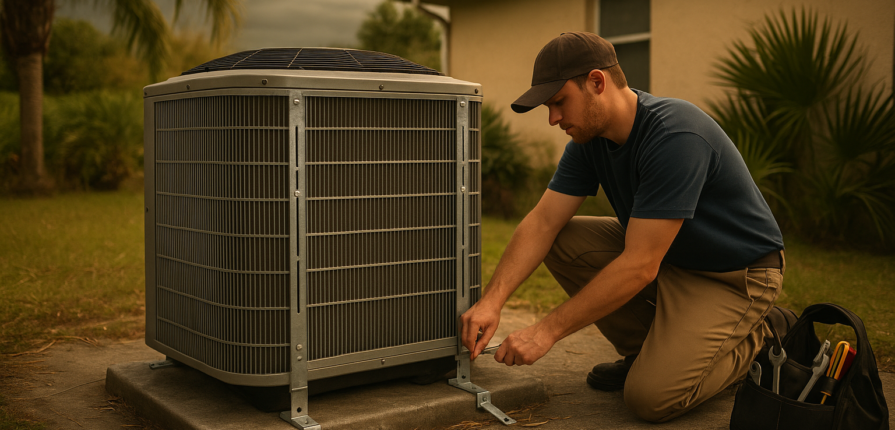
TL;DR: To get your AC ready for a hurricane, check that the outdoor unit is strapped to its pad and clear anything nearby that could hit it. Cool the house down early, then turn the system off at the thermostat and both breakers before the storm arrives. When it’s over, inspect the unit before you turn the power back on, and leave it off if floodwater reached it.
Hurricane prep for an AC unit comes down to four things. Make sure the outdoor condenser is strapped to its pad, and clear anything that could hit it. Cool the house down early, then shut the system off at the thermostat and both breakers before the storm arrives. When the storm has passed, check the unit before you turn the power back on.
In Tavares and the rest of Lake County, a storm’s eye usually isn’t the biggest danger to your AC. The bigger risks are oak and pine limbs blowing around, standing water in low yards, and power that flickers on and off for hours. The North Atlantic hurricane season runs June 1 to November 30, and most storms form between August and October. Keep this checklist handy until December.
What do you need before a storm is in the forecast?
You need about an hour, a flashlight, and to know where your AC breakers are. Most of this prep costs nothing.
- The location of your indoor breaker panel and the outdoor disconnect box next to the condenser
- Tape or labels to mark the AC breakers. A split system usually has two: one for the indoor air handler and one for the outdoor unit.
- Pruning tools, or a tree service lined up, for limbs that hang over the unit
- A breathable cover made for AC condensers and a way to tie it down (optional)
- Phone photos of your condenser, its pad, and the data plate, to have on file for insurance and your technician
Hurricane prep for your AC unit: the step-by-step checklist
Do steps 1 through 4 early in the season, or now if you haven’t yet. The season isn’t over until November 30. Save steps 5 through 8 for when a storm is 24 to 48 hours away.
- Check the hurricane straps. Look at the metal straps or brackets that hold the condenser to its pad. Florida’s mechanical code says outdoor equipment and its supports must be installed to resist wind pressure. If the straps are rusted or loose, or screws are missing, have a licensed technician fix them before the next storm.
- Clear the area around the unit. Bring in patio chairs, planters, trash cans, and yard tools. Cut back branches that hang over the condenser. In Zellwood and other neighborhoods with big oak canopies, limbs are the most common thing to hit an outdoor unit.
- Have the system checked. A pre-season tune-up is a good time to have a technician look at the anchoring, the electrical connections, and the condensate drain line. A clogged drain plus days of heavy rain and humidity can lead to water problems indoors.
- Label your breakers and ask about surge protection. Mark both AC breakers so anyone in the house can find them in the dark. Ask a licensed pro whether a surge protector at the unit makes sense for your system.
- Pre-cool the house. While the power is still steady, set the thermostat a few degrees cooler than normal. Close the blinds on the sunny side. A cooler house stays bearable longer if the power goes out.
- Turn it off at the thermostat, then flip both breakers. Do this before the outer bands arrive, not after the lights start flickering. Ready.gov warns that power may return with surges or spikes, and those can damage equipment that’s still connected.
- Cover only the top, and only after the system is off. A breathable cover tied down over the top helps keep falling debris out of the fan. Never wrap the whole unit in plastic. Plastic traps moisture inside the cabinet.
- Check the unit before you restart it. Wait until the power has been stable for a few hours. Then take off the cover and look for debris in the coil, bent fan blades, standing water, or any sign the unit moved on its pad. If everything looks normal, turn the breakers back on first, then the thermostat.
Which storm protections are worth it for your outdoor unit?
Straps and shutting off the breakers do the most for the least money. The other options depend on your lot and your system.
| Protection | What it guards against | Who should handle it | Watch out for |
|---|---|---|---|
| Hurricane straps or tie-downs | Wind tipping or sliding the condenser | Licensed HVAC technician | Rust, loose screws, straps cut during past repairs |
| Breakers off before the storm | Surges, brownouts, rapid on-off cycling | Homeowner | Forgetting the second breaker for the air handler |
| Surge protection at the unit | Spikes when the grid comes back | Licensed pro | It doesn’t replace turning the breakers off |
| Breathable top cover | Leaves, twigs, and small debris | Homeowner, after shutdown | Running the unit while it’s covered |
| Raised pad or stand | Standing water around the base | Licensed pro | A raised unit still needs to be anchored |
Is it safe to turn the AC back on after a hurricane?
Yes, if no water reached the system, you don’t see any damage, and the power has been steady for a few hours. Flooding is the deal-breaker. The Department of Energy’s Building America Solution Center notes that floodwater is likely to completely destroy the electrical parts of an outdoor HVAC unit. If water reached the condenser or the air handler, leave the breakers off.
That matters most for homes on low lots near Lake Dora or along the St. Johns River near Astor, where yards can hold water after days of rain.
Signs you need to call a pro after the storm
- Floodwater touched the outdoor unit or the indoor air handler
- The condenser shifted, tilted, or pulled away from its straps
- The fan blades are bent or the coil fins are crushed
- You hear buzzing, smell burning, or the breaker trips again
- The outdoor fan won’t spin, or the system blows warm air
- You find water pooling around the indoor unit
A unit that runs after a storm can still be hurt. Damage from surges and flooding can shorten its life. If your system was already older, our guide on how long an AC unit lasts in Florida and what shortens its life can help you plan ahead.
What prep mistakes cost Lake County homeowners the most?
The costliest mistakes happen in the last few hours before and after a storm, not months ahead.
- Running the AC through flickering power. Every brownout and surge hits the compressor and control boards. Turn it off early.
- Turning on a flooded unit to see if it works. Powering up wet equipment can ruin parts that might have been saved.
- Wrapping the condenser in a tarp. It traps moisture, and a loose tarp can catch the wind.
- Running a portable generator too close to the house. Ready.gov says to use generators only outdoors and at least 20 feet from windows, doors, and attached garages.
- Leaving for the summer without a plan. Snowbirds and landlords should have a neighbor or property manager who knows where the breakers are and won’t restart a flooded system.
Why Tavares homeowners call Lucas Air Conditioning and Heating
- Lucas Air Conditioning and Heating, LLC is a veteran-owned company founded in 2018 by U.S. Army veteran Cameron Lucas, who served with the 82nd Airborne Division.
- The company is based at 15800 Old US Hwy 441 in Tavares.
- It holds Florida licenses CAC1819409 and CAC1819837.
- A Precision Tune-Up is $125.
- The Preventative Maintenance Agreement is $129 per year and includes one tune-up, 15% off parts, and priority scheduling.
- Emergency service is available outside regular hours, which are Monday through Friday, 8:00 AM to 5:30 PM.
- If a storm ruins your system, installations start at $7,500, which covers the unit, the permit, a one-year labor guarantee, and a ten-year parts warranty.
- KwikComfort financing is available, and estimates on new installations are free.
- The company has a 5.0-star Google rating.
You can also see current seasonal specials and book a pre-storm checkup online.
Want someone to check your straps, wiring, and drain line before the next storm? Call (352) 805-0359 or schedule an appointment online.
Frequently Asked Questions
Should I leave a cover on my AC unit all hurricane season?
No. Put a breathable cover on the top only after the system is turned off for a storm, and take it off before you turn the power back on. Leaving it on all season traps moisture, and running a covered unit can damage it.
Do I need to shut off my AC for a tropical storm, or only a hurricane?
If the forecast calls for strong winds and likely power outages, treat a tropical storm the same way. Flickering power and surges can damage the compressor and control boards no matter what the storm is called.
What should snowbirds do with their AC before leaving for the summer?
Before you leave, have the system checked and make sure the straps on the outdoor unit are tight. Then pick a neighbor or property manager who knows where the AC breakers are, can shut them off before a storm, and will call a licensed technician rather than restarting a unit that took on water.
Will my homeowners insurance cover hurricane damage to my AC?
That depends on your policy and on whether the damage came from wind, flooding, or a power surge. Take photos of your unit before the season starts, then photograph any damage before repairs so you have a record for your insurer.
Can I get AC service after a storm outside regular business hours?
Lucas Air Conditioning and Heating offers emergency service outside its regular hours of Monday through Friday, 8:00 AM to 5:30 PM. Preventative Maintenance Agreement members also get priority scheduling.
Recommended Reads
- Landing Page for Seasonal Specials – Online Booking – Lucas Air Conditioning and Heating
- Landing Page for Seasonal Specials – Lucas Air Conditioning and Heating
- How Long Does an AC Unit Last in Florida — and What Shortens Its Life?
Sources
