
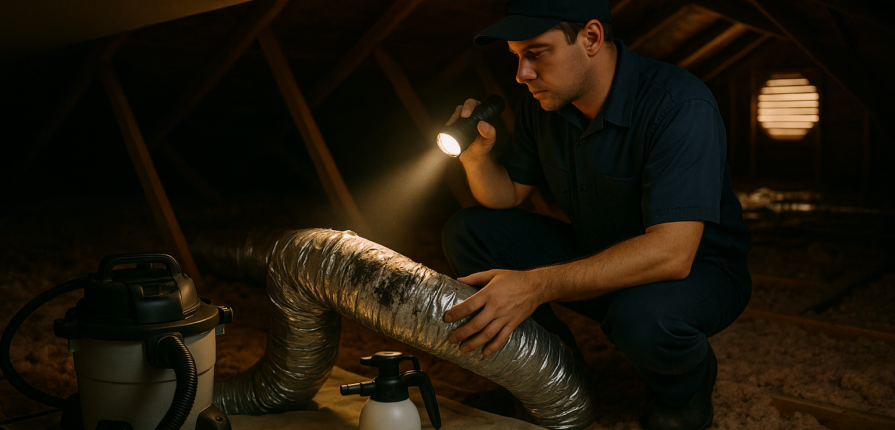
TL;DR: Mold in AC ducts grows when moisture sits on dust inside the system. Common causes are a clogged drain pan, ducts that sweat in a hot attic, or a system that never runs long enough to dry the air. A real fix means cleaning or replacing the moldy parts and fixing the moisture source. Insulated ducts that get moldy usually need to be replaced, not cleaned.
Mold in AC ducts almost always comes from moisture sitting on dust inside the system. The usual sources are a wet coil, a backed-up drain pan, or ductwork that sweats in a hot attic. In Tavares and across Lake County, our humid air makes that easy. Getting rid of it takes two steps: clean or replace what’s moldy, then fix the moisture source.
Skip the second step and the mold comes back. Below is how it starts, how to tell if what you see is really mold, and what a proper fix looks like.
What causes mold in AC ducts in Central Florida?
Mold needs three things: moisture, food like dust, and time. Your AC makes moisture every day it runs. Warm air passes over the cold evaporator coil, water condenses, and it drips into a drain pan. If that water can’t drain, or if cold duct surfaces meet humid attic air, mold gets a foothold.
The EPA says indoor relative humidity should be kept below 60 percent, and ideally between 30 and 50 percent. Homes on the lakes around Tavares, or out near the St. Johns River in Astor, deal with outdoor humidity well above that for much of the year. These are the most common causes in Central Florida homes:
- Clogged condensate drains. Standing water in the pan feeds growth right next to the blower.
- Sweating ducts. Torn insulation or loose joints in a hot attic let cold duct surfaces collect water.
- Oversized systems. ENERGY STAR notes that short run times do not allow the system to effectively remove humidity. The house feels cool but stays damp.
- Closed-up homes. Snowbirds who shut the AC off or set it very high for the summer can come home to musty ducts.
- Leaky return ducts. A return that pulls air from the attic or garage drags in hot, wet air.
How can you tell if it’s really mold in your ducts?
You can’t know for sure from smell alone, but a few signs together point strongly to mold. Dark marks on supply grilles are often just dust or water stains, so look for a pattern instead of one spot.
Signs you should call a pro
- A musty smell when the AC kicks on that fades after it shuts off
- Black or green fuzzy spots around vents that come back after you wipe them
- Water dripping from ceiling registers, or stains on the ceiling around them
- Allergy-type symptoms like sneezing or itchy eyes that ease when you leave the house
- A hygrometer reading above 60 percent indoors, or a house that feels cool but clammy
- Standing water or slime in the drain pan under the air handler
Much of a duct system can’t be seen without tools. The EPA tells homeowners to ask the service provider to show you any mold they say they found. That’s a fair thing to ask any technician, us included.
Is mold in your AC ducts dangerous?
It can be, especially for people with allergies or asthma. The EPA’s mold guide lists sneezing, runny nose, red eyes and skin rash as common reactions. It also says mold can trigger asthma attacks in people who are allergic to it.
The same guide gives one clear rule: do not run your HVAC system if you know or suspect it has mold, because it can spread mold throughout the building. In a Florida summer, you can’t leave the AC off for long, especially in a home with older adults or young kids. So getting it checked fast beats waiting it out.
Can mold in AC ducts be cleaned, or do the ducts need replacing?
It depends on what the duct is made of. Hard sheet-metal ducts can usually be cleaned. Insulated ducts are different. Per the EPA, insulated ducts that get wet or moldy can’t be cleaned well and should be replaced. Many Central Florida homes use flex duct or fiberglass duct board, and both are insulated. That’s why replacing the affected sections is often part of the fix here.
| System part | Typical material | Can it be cleaned? | Usual fix |
|---|---|---|---|
| Main trunk and rigid runs | Bare sheet metal | Yes | Professional cleaning, with treatment only if needed afterward |
| Flex duct runs | Plastic liner over fiberglass insulation | Not well once moldy | Replace the affected runs |
| Duct board and lined plenums | Fiberglass board | Not well once moldy | Replace the affected sections |
| Evaporator coil and drain pan | Metal coil, metal or plastic pan | Yes | Clean the coil, clear the drain, clean the pan |
| Supply registers and grilles | Metal or plastic | Yes | Remove, wash and reinstall |
Be careful with sprays. The EPA says biocides and sealants should go on, if at all, only after the system has been cleaned of visible dust and debris. Spraying a chemical over a damp, dirty duct doesn’t touch the cause.
How do you keep mold from coming back?
Control the moisture. The EPA puts it plainly: the key to mold control is moisture control. Here’s what that looks like in a Florida home:
- Keep indoor humidity at or below 50 percent. A low-cost hygrometer shows you where you stand.
- Keep the condensate drain line clear so the pan never holds standing water.
- Set the thermostat fan to AUTO instead of ON so the coil can drain between cycles.
- Change filters on schedule so dust doesn’t coat the coil and duct walls.
- Seal and re-insulate leaky or sweating ducts in the attic.
- If you leave for the summer, don’t shut the AC off. Ask your technician for a setting that keeps humidity in check while you’re gone.
- When you replace a system, make sure it’s sized correctly. A system that runs longer, steadier cycles pulls more water out of the air.
A dirty, wet coil also hurts cooling. If your system has been struggling too, see our list of reasons your AC isn’t cooling enough. A yearly tune-up catches most moisture problems early. Our Precision Tune-Up is $125. The Preventative Maintenance Agreement is $129 a year and includes one tune-up, 15% off parts and priority scheduling. You can check current seasonal specials and book online.
Why homeowners call Lucas Air Conditioning and Heating
We’re a local, veteran-owned HVAC contractor in Tavares, FL, and we work in neighborhoods from Clarcona to Zellwood. Here are the facts:
- U.S. Army veteran Cameron Lucas, who served with the 82nd Airborne Division, founded the company in 2018.
- Our shop is at 15800 Old US Hwy 441 in Tavares.
- We hold Florida licenses CAC1819409 and CAC1819837.
- Our services include duct cleaning and sanitization, indoor air quality work and AC repair.
- We have a 5.0-star Google rating.
- We’re a four-time Nextdoor Neighborhood Favorite.
- Style Magazine named us Best of the Best 2025.
- Emergency service is available outside our regular hours of Monday to Friday, 8:00 AM to 5:30 PM.
We’ll show you what we find, explain what’s causing it, and recommend only the work you need.
If you smell mustiness or see growth around your vents, call Lucas Air Conditioning and Heating at (352) 805-0359 or schedule an appointment online.
Frequently Asked Questions
Can I clean mold off my AC vents myself?
Yes. You can take off the supply grilles and wash them with detergent and water. If the spots come back quickly, the moisture source is inside the system, and a technician needs to find it.
Why does my AC smell musty only when it first turns on?
Usually water has been sitting on the coil or in the drain pan between cycles. When the blower starts, it pushes that damp, stale air through the ducts. If the smell keeps coming back, get the drain and coil checked.
Should I have my ducts cleaned every year to prevent mold?
The EPA doesn’t recommend routine duct cleaning, only cleaning when it’s needed. Some examples are substantial visible mold, pests, or heavy dust coming out of the vents. Keeping humidity and drainage under control does more to prevent mold than scheduled cleaning.
How fast can mold grow after an AC leak?
The EPA advises drying water-damaged areas within 24 to 48 hours to prevent mold. If your air handler overflows or a register drips, deal with it right away instead of waiting for a dry spell.
Recommended Reads
- HVAC Contractor in Tavares, FL
- Landing Page for Seasonal Specials – Online Booking – Lucas Air Conditioning and Heating
- Landing Page for Seasonal Specials – Lucas Air Conditioning and Heating
