
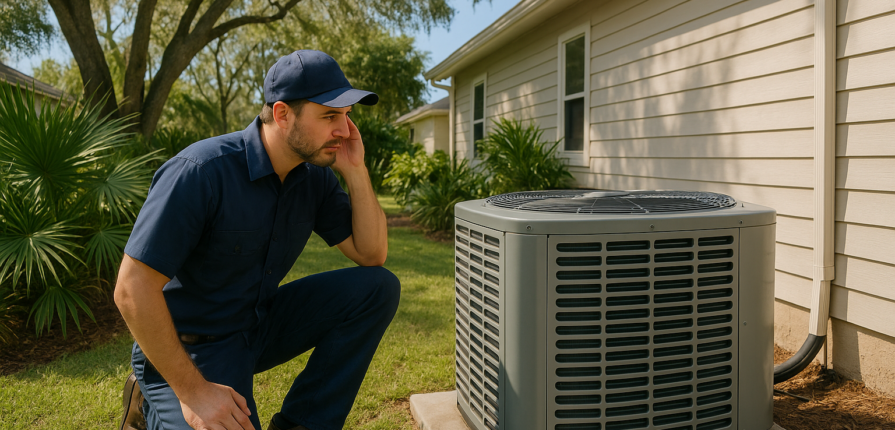
TL;DR: Most AC noises are your system’s way of signaling a problem — some are minor, others demand you shut the unit off immediately. This guide breaks down eight common sounds, what’s causing each one, and exactly when to pick up the phone and call a technician.
Your air conditioner is supposed to hum quietly in the background — not bang, screech, or rattle like something is about to break loose. In Central Florida, where systems run hard from spring straight through fall, unusual noises are one of the earliest signs that something has gone wrong inside your equipment.
The good news: most sounds have a clear cause. Knowing what you’re hearing can help you decide whether to grab a screwdriver, swap a filter, or shut the system off and call a licensed technician right now.
Normal AC Sounds vs. Warning Signs
Before diagnosing anything, it helps to know what normal sounds like. A gentle hum from the motor or the whoosh of air through the vents when the system is running are typical — they usually indicate the unit is working properly.
It’s when those normal sounds become noticeably louder or change suddenly that a problem needs inspecting. Below are the eight most common sounds Lake County homeowners report — and what each one means.
8 Common AC Noises Decoded
1. Banging or Knocking
Urgency: High — shut the system off.
Banging from the compressor is a sign of loose parts inside — such as a piston pin or connector rod — as well as parts on the outside of the compressor. A misaligned blower can also cause fan blades to knock against the housing.
Call a professional to address the banging right away, or further damage may be caused as the unit continues to run. If loose parts repeatedly strike against others, the banging will worsen and more expensive service may be required.
2. Rattling
Urgency: Moderate — inspect before calling.
Screws or bolts can become loose due to vibrations, small objects can get caught in the outdoor unit, and old fan blades can become imbalanced — all producing a rattling sound. If the unit has not been cleaned and you have not had an annual check-up, leaves, sticks, and dirt particles can find their way into the condenser and cause rattling or banging.
What you can do: Turn off power at the outdoor disconnect, tighten any loose screws on the metal casing, and clear debris from the fan cage. If the rattling persists, have a professional inspect the motor and other components.
3. Hissing
Urgency: High — call a tech. Do not ignore.
Hissing is one of the trickiest sounds because it can have two very different causes. A heavily clogged air filter restricts airflow, which can cause a loud whistling or howling sound as air is forced through tiny gaps. That version stops once you replace the filter.
The more serious cause: a refrigerant leak. A hissing or bubbling noise often accompanies a refrigerant leak as the pressurized gas escapes through cracks or pinholes in copper tubing or at soldered joints. A refrigerant leak typically sounds like a continuous, pressurized hiss or bubbling noise near the indoor coil — and unlike a filter whistle, this sound may persist for several minutes after the system shuts down as internal pressures slowly equalize.
Refrigerant leaks reduce your AC’s efficiency and can be hazardous to your health — this noise needs professional attention to prevent further system damage. Per the U.S. EPA, refrigerant leak repair must be handled by an EPA Section 608 certified technician who can locate the source, seal it, and legally recharge the system. Adding more refrigerant without fixing the underlying leak is not EPA-compliant and will not solve the problem long-term.
4. Screaming or Screeching
Urgency: Severe — shut the unit off immediately.
Squeaking, squealing, screaming, or screeching noises could be an indication of bad fan motor bearings or a fan belt being either worn out or broken. The most likely cause of a screaming sound is a refrigerant leak, which not only damages your air conditioner but can be hazardous to your family’s health. Screaming could also signal high internal pressure within the compressor, which can also be dangerous.
High-pitched screaming or hissing, loud banging, and grinding require emergency AC repair. If you hear these, shut off your system and call an HVAC technician immediately.
5. Buzzing
Urgency: Moderate to high — call a tech.
Buzzing is typically caused by electrical issues such as a failing capacitor, a faulty contactor relay, or loose wiring. It can also occur if a metal panel is loose and vibrating against the frame of the outdoor unit. If the copper lines connected to your air conditioner are touching each other, they can also cause a buzzing sound.
If you hear a consistent buzzing noise, turn off the system and have a professional inspect the electrical components. Delaying can lead to system shorts or compressor damage.
6. Clicking — Repeated or Constant
Urgency: Low to moderate — watch it closely.
A single click when your system starts or stops is completely normal — that’s the contactor engaging. It’s normal to hear a soft hissing or gurgling sound for a minute or two after your AC shuts off as refrigerant pressures equalize. However, persistent clicking or loud banging after shutdown can indicate an electrical relay fault or a failing damper. Repeated clicking during a startup attempt that never fully starts often points to a bad capacitor or contactor — a straightforward repair for a licensed tech.
7. Rattling or Cracking From the Ducts
Urgency: Low — but worth monitoring.
If the sound is coming from your ductwork, this is a common noise — it’s the sound of metal ducts expanding due to the rush of air. In Florida’s humidity, ducts also expand and contract with temperature changes. If the popping comes from another source or doesn’t go away, it might be time to call a technician to find out what’s going on.
If your system is struggling to push air and you’re also noticing warm spots in rooms, check out our guide on 8 Reasons Your AC Isn’t Cooling Enough — duct leaks and airflow issues often go hand-in-hand with these sounds.
8. Gurgling or Bubbling
Urgency: Moderate — have it checked.
A gurgling noise from the indoor unit typically means one of two things: the condensate drain line has a clog and water is backing up, or refrigerant is escaping in larger quantities. If you hear a gurgling or bubbling sound from your indoor unit, use a wet/dry vacuum to clear any algae or debris buildup from the outdoor condensate drain as a first step. If the gurgling continues or is accompanied by ice on the lines or warm air from vents, call a tech.
Quick Reference: AC Noise Urgency Guide
- Screaming / screeching: Shut off immediately — refrigerant leak or compressor pressure
- Banging / knocking: Shut off immediately — loose or broken internal parts
- Hissing (continuous, near coils): Shut off and call — likely refrigerant leak
- Buzzing: Call soon — electrical fault or loose component
- Rattling: Inspect first, call if it persists — debris or loose hardware
- Clicking (repeated): Call — failing capacitor or relay
- Gurgling: Clear drain first, call if it continues
- Duct popping: Normal in most cases — monitor it
3 Things You Can Safely Do Before Calling
- Replace the air filter. The Department of Energy reports that routinely replacing the filter alone can lower an air conditioner’s energy consumption by 5 to 15 percent — and a clogged filter is behind more noise complaints than most homeowners realize.
- Clear debris from the outdoor unit. Turn off power at the disconnect switch, then remove leaves, sticks, or other objects from the fan cage.
- Check that all vents are open. Closed or blocked supply vents create back-pressure that can force air through gaps and produce hissing or whistling.
Beyond these three steps, stop. Using an air conditioner when it has a problem could lead to further damage, higher expenses, and safety issues. Repairing an AC system and its electrical components should always be left to HVAC professionals.
Why Noises Get Worse in Florida’s Climate
In Lake County and the surrounding communities — Tavares, Eustis, Leesburg, Mount Dora, The Villages — air conditioners run nearly year-round. That continuous operation puts real wear on fan motors, capacitors, and compressors faster than in cooler climates.
Keeping your cooling and heating system at peak performance means having a contractor do annual pre-season check-ups. Dirty evaporator and condenser coils reduce the system’s ability to cool your home and cause the system to run longer, increasing energy costs and reducing the life of the equipment. In other words, the strange noise you’re ignoring today is often the beginning of a compressor failure next summer.
According to ENERGY STAR, checking your central air conditioner’s refrigerant level and adjusting if necessary is a core part of proper annual maintenance — because too much or too little refrigerant will make your system less efficient, increasing energy costs and reducing the life of the equipment.
When to Call Lucas Air — Right Now vs. Schedule It
Call us right now if you hear: screaming, screeching, continuous hissing near the unit, or loud banging while the system is running. These are the sounds that can turn a $200 repair into a $2,000 compressor replacement — or worse, a full system failure in July.
Schedule a tune-up soon if you hear: buzzing, persistent clicking, rattling that doesn’t clear up after removing debris, or gurgling that doesn’t stop after clearing the drain line.
At Lucas Air Conditioning and Heating, our licensed technicians serve homeowners throughout Lake County and Orange County — from Tavares and Mount Dora to Apopka and The Villages. We offer a precision tune-up for $125, and our Preventative Maintenance Agreement ($129/year) includes one annual tune-up, 15% off parts, and priority scheduling so you move to the front of the line when something goes wrong.
Emergency service is also available outside our regular hours (Monday–Friday, 8:00 AM–5:30 PM). If your system is screaming at midnight in August, we’re not going to leave you without cooling.
Call us, describe the sound, and we’ll tell you straight — no upselling, no guesswork. That’s the Lucas Air way.
