
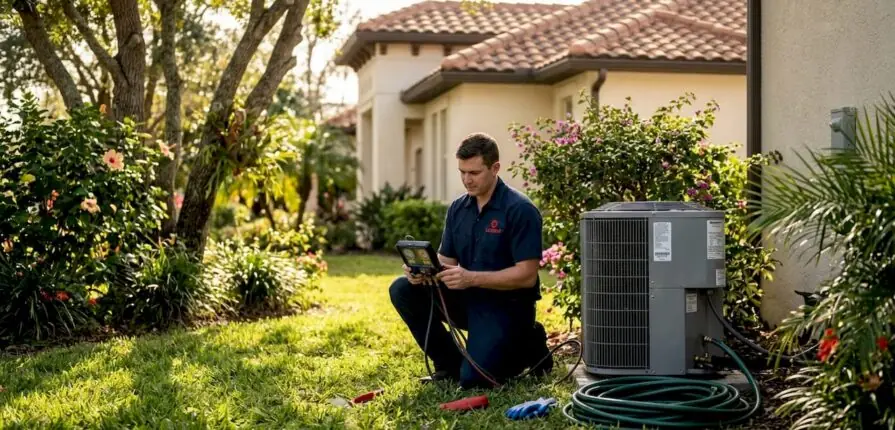
TL;DR:
- Airflow in an AC system determines the temperature and humidity levels in your home; poor airflow often causes discomfort and inefficiency.
- Proper diagnosis involves measuring static pressure and CFM, not relying on symptoms alone, to identify restrictions like leaks or blockages.
- Maintaining filters, sealing ducts, and scheduling professional airflow testing are essential steps to optimize system performance in Florida’s humid climate.
Airflow air conditioning refers to the measured volume of air your AC system moves through its ducts, coils, and registers, and it directly determines whether your home stays cool, dry, and energy efficient. In Central Florida’s punishing humidity, a system that moves too little air cannot dehumidify properly, which means you feel sticky even when the thermostat reads 72°F. Most homeowners blame the thermostat or assume the equipment is aging out. The real culprit is almost always airflow. Understanding how it works, what breaks it, and how to fix it puts you back in control of your comfort and your utility bill.
How does fan pressure relate to airflow in HVAC systems?
Airflow inside your AC system is not simply a setting the blower fan chooses. The actual volume of air delivered is the outcome at the intersection of fan capability and the resistance the system pushes against. Engineers call this the fan curve meeting the system resistance curve. Where those two lines cross is the airflow your home actually receives, not the airflow the equipment was rated for.
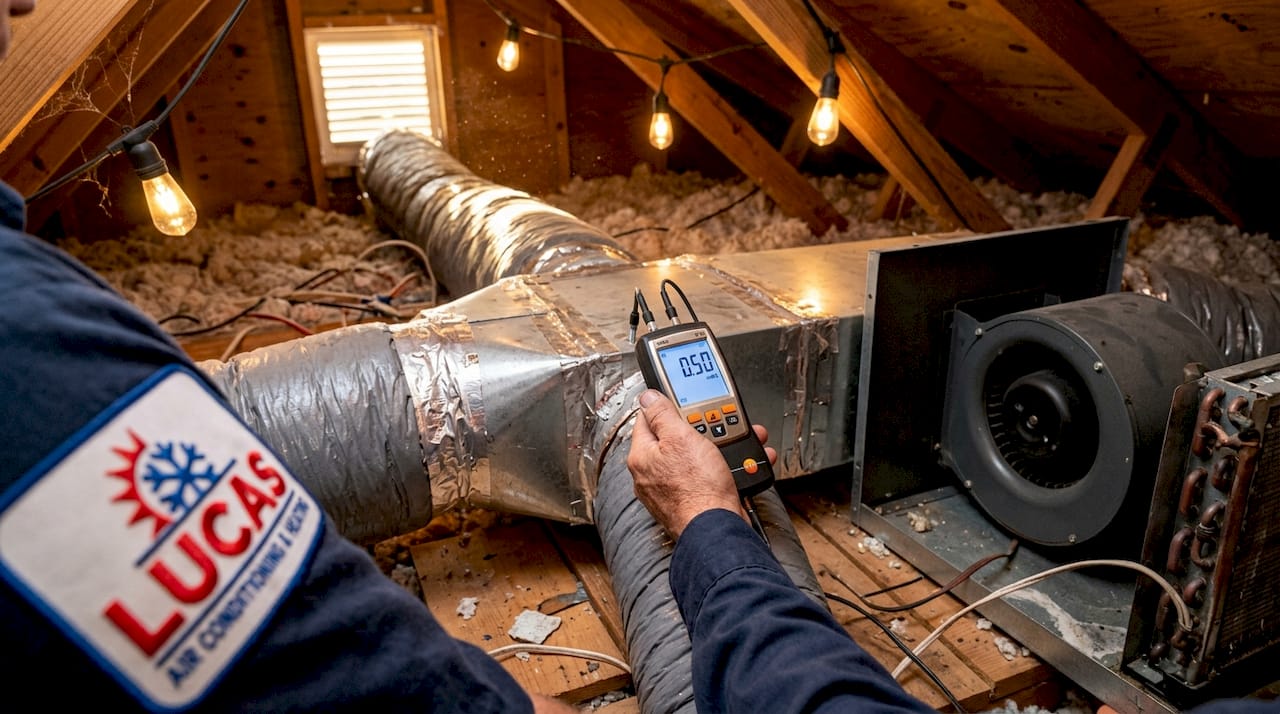
Static pressure is the force that resists the fan. Think of it like a thumb pressed over a garden hose. The water (air) slows down the moment resistance increases, even though the pump (fan) is working just as hard. Static pressure acts as an invisible brake, and reducing restrictions in your duct system improves airflow while simultaneously cutting noise and energy waste.
What makes this tricky is that small changes in duct restrictions can dramatically shift how much air reaches each room and how hard the motor works to get it there. A single clogged filter, a kinked flex duct, or an undersized return grille can push static pressure high enough to drop airflow by 20 to 30 percent. That is not a minor inconvenience. It is the difference between a system that keeps up on a 95°F August afternoon and one that runs continuously without ever reaching setpoint.
Pro Tip: Ask your HVAC technician for the total external static pressure reading at your next service visit. A healthy residential system typically operates below 0.5 inches of water column. Readings above that threshold signal a restriction worth investigating.
What common issues cause poor airflow in Central Florida AC systems?
Central Florida homes face airflow challenges that homeowners in drier climates rarely encounter. High humidity accelerates mold growth inside ducts, causes insulation to sag and block flex duct runs, and forces AC systems to work harder just to manage moisture. The result is a set of airflow problems that compound each other quickly.
The most frequent causes of restricted air flow in HVAC systems across the region include:
- Dirty or clogged filters. Clogged air filters restrict airflow, increasing system runtime and reducing efficiency. In Florida, filters load up faster because systems run nearly year round.
- Leaky ductwork. Gaps at connections, deteriorated mastic, and separated joints bleed conditioned air into attics and crawl spaces before it reaches living areas.
- Dirty evaporator coils. A coil coated in dust and biological growth restricts air passage and reduces heat transfer, cutting both cooling capacity and airflow.
- Blocked or closed registers. Furniture placed over floor vents, closed supply registers in unused rooms, and debris buildup inside return grilles all reduce delivered airflow.
- Humidity damage to flex duct. Florida attics routinely exceed 130°F in summer. That heat degrades flex duct liner over time, causing collapses that choke individual runs.
Insufficient airflow undermines dehumidification, raising indoor humidity and creating conditions where mold and dust mites thrive. For property managers overseeing multiple units, this is a liability issue, not just a comfort complaint. One building with chronically low airflow across several apartments will generate disproportionate maintenance calls and tenant turnover.
How is airflow accurately measured and diagnosed by HVAC professionals?
Guessing at airflow problems from symptoms alone leads to incorrect repairs. A technician who replaces a thermostat because a room feels warm, without measuring airflow first, may fix nothing and charge you for the privilege. Accurate diagnosis requires actual measurement.
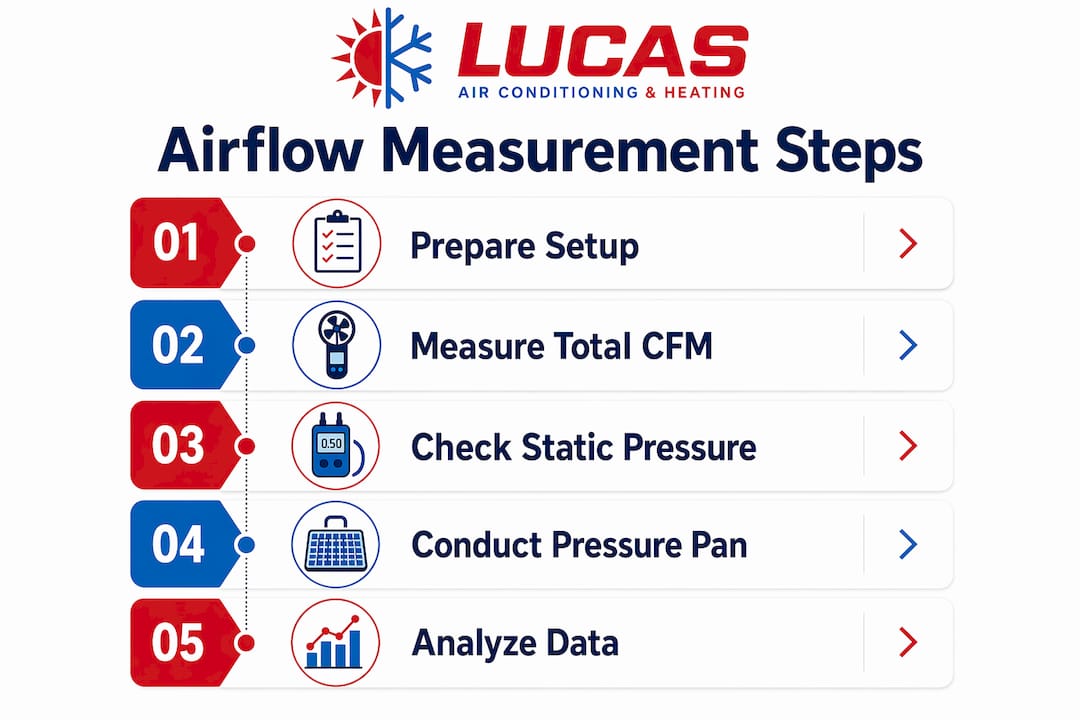
The two primary metrics professionals measure are total airflow in cubic feet per minute (CFM) and total external static pressure (TESP). A properly sized residential system should deliver roughly 350 to 400 CFM per ton of cooling capacity. A 3-ton system delivering only 800 CFM is operating at a significant deficit.
| Measurement | What it tells you | Healthy target |
|---|---|---|
| Total airflow (CFM) | Volume of air the system moves | 350 to 400 CFM per ton |
| Total external static pressure | Resistance the fan works against | Below 0.5 in. w.c. |
| Filter pressure drop | Restriction from the filter alone | Below 0.1 in. w.c. |
| Coil pressure drop | Restriction from the evaporator coil | Per manufacturer spec |
The TrueFlow airflow measurement system, developed by The Energy Conservatory, temporarily replaces the air filter with a calibrated flow grid. TrueFlow testing measures airflow, pressure drops, and duct imbalances that directly connect to comfort, humidity control, and equipment life. This tool gives technicians a precise CFM reading rather than an estimate based on equipment nameplate data.
Pressure pan testing adds another layer of detail. A technician places a pressure pan over each supply and return register while the system runs, reading the pressure differential to identify which specific duct runs are leaking or restricted. This method pinpoints problem areas without requiring a full duct blaster test.
Pro Tip: When scheduling a diagnostic visit, ask specifically for static pressure and CFM measurements. A technician who only checks refrigerant charge and filter condition is not performing a full airflow evaluation.
What practical steps can homeowners and property managers take to optimize airflow?
Improving air distribution in a Central Florida home does not always require expensive equipment. Most meaningful gains come from maintenance steps that are either free or low cost, performed consistently.
- Change filters on schedule. In Florida, monthly filter changes are realistic for most homes during peak cooling season. A MERV 8 filter balances particle capture with low pressure drop. Filters rated MERV 13 or higher can restrict airflow in systems not designed for them, so match the filter rating to your equipment specifications.
- Inspect and seal duct leaks. Broken duct connections are the first priority before attempting any airflow balancing. A disconnected duct joint in the attic can dump 20 to 30 percent of your system’s output into unconditioned space. Use mastic sealant, not duct tape, for lasting repairs at joints and connections.
- Keep all supply and return registers open and clear. Closing registers in unused rooms does not save energy. It raises static pressure throughout the system, reducing airflow everywhere and stressing the blower motor. Move furniture away from floor vents and vacuum return grilles quarterly.
- Schedule coil cleaning annually. An evaporator coil cleaning removes the biological growth and dust that accumulates in Florida’s humid conditions. Clean coils transfer heat efficiently and allow air to pass through without restriction. This single maintenance step often produces a noticeable improvement in both cooling performance and humidity control.
- Add professional airflow testing to your maintenance cycle. Integrating HVAC performance testing into routine maintenance gives property managers and homeowners a baseline to compare against year over year. A system that tested at 1,200 CFM last year and now measures 950 CFM has a problem worth finding before it becomes a breakdown.
For energy-saving HVAC tips specific to Central Florida properties, consistent airflow maintenance is the single highest-return activity available to most homeowners.
How do duct leakage tests and Florida building codes impact airflow?
Florida follows the International Residential Code (IRC) and International Energy Conservation Code (IECC) for duct performance. These codes set measurable limits on how much air a duct system is allowed to leak, and they require verification through testing on new construction and major renovations.
The IRC 2018 standard requires duct leakage of 4 CFM25 or less per 100 square feet of conditioned floor area for total leakage, or 3 CFM25 per 100 square feet for leakage to the outside. Testing uses a duct blaster, a calibrated fan that pressurizes the duct system to 25 pascals and measures the volume of air escaping through gaps and holes.
For existing homes, these code thresholds are useful benchmarks even when testing is not legally required. A duct system leaking at 15 CFM25 per 100 square feet is losing a substantial portion of conditioned air before it reaches living spaces. That waste shows up directly on your electric bill and in uneven room temperatures.
Key points for Central Florida property managers and homeowners:
- Ducts located entirely within conditioned space (inside the building envelope) are exempt from leakage testing under most code interpretations, because any leakage stays inside the home.
- Attic duct systems in Florida are almost never inside conditioned space, making leakage testing particularly relevant for the region’s typical construction.
- Addressing leaks at major disconnect points first produces the largest efficiency gains before moving to smaller sealing work at joints and seams.
For a deeper look at how HVAC design considerations affect duct placement and leakage risk in Central Florida construction, the duct location decision at installation time has lasting consequences for airflow reliability.
Key takeaways
Proper airflow air conditioning management is the foundation of comfort, humidity control, and energy efficiency in Central Florida homes, and it requires measurement, not guesswork.
| Point | Details |
|---|---|
| Airflow is a measured outcome | Fan capability and system resistance together determine actual CFM delivered, not equipment ratings alone. |
| Static pressure is the primary enemy | High static pressure from dirty filters, blocked registers, or leaky ducts reduces airflow and raises energy costs. |
| Florida humidity amplifies airflow failures | Low airflow in humid climates causes poor dehumidification, mold risk, and chronic comfort complaints. |
| Measurement beats assumption | TrueFlow and static pressure testing give accurate diagnostics; symptom guessing leads to wrong repairs. |
| Duct leaks are a top priority | Disconnected duct joints waste the most conditioned air and must be sealed before balancing other airflow issues. |
What I’ve learned after years of Florida airflow calls
The most common mistake I see homeowners make is treating airflow as a background issue, something the system handles automatically. It does not. Airflow is the result of dozens of physical conditions working together, and in Florida’s climate, those conditions degrade faster than in most of the country.
What surprises most people is how often a comfort complaint traced back to airflow has nothing to do with the equipment itself. The compressor is fine. The refrigerant charge is correct. The thermostat is accurate. But the duct system is leaking 25 percent of conditioned air into a 130°F attic, and nobody measured it because nobody thought to look there first.
The other pattern I see consistently: homeowners who add a higher-MERV filter thinking it will improve indoor air quality without checking whether their system can handle the added restriction. A MERV 13 filter on a system designed for MERV 8 can drop airflow enough to cause coil freeze and compressor stress. Better filtration is worth pursuing, but it has to match the system’s actual capability.
My honest recommendation is to treat airflow diagnostics as the first step in any comfort investigation, not the last resort after everything else fails. Measure static pressure. Measure CFM. Find the restriction. Then fix it. That sequence solves problems faster and costs less than replacing components that were never the issue.
— Lucasair
Let Lucasair diagnose and fix your airflow problems

Lucasair provides professional airflow diagnostics, ductwork repair, and full AC maintenance for homeowners and property managers across Central Florida. Cameron Lucas and the Lucasair team use static pressure testing and industry-standard airflow measurement tools to find exactly what is limiting your system’s performance, whether that is a leaking duct run, a restricted return, or a coil that needs cleaning. Fixing airflow problems before they become equipment failures saves money and keeps your home comfortable through every Florida summer. Review the residential HVAC repair guide to understand what a full diagnostic visit covers, or schedule your AC maintenance appointment with Lucasair today.
Need a hand? Lucas Air Conditioning and Heating offers evaporator coil cleaning in Tavares, FL for homes and businesses across Lake County.
FAQ
What is airflow in an air conditioning system?
Airflow in an AC system is the volume of air, measured in cubic feet per minute (CFM), that the blower moves through the ducts, coils, and registers. A properly sized residential system delivers 350 to 400 CFM per ton of cooling capacity.
Why is my AC running but the house still feels humid?
Low airflow is the most common cause. When air moves too slowly across the evaporator coil, the system cannot remove enough moisture from the air, leaving humidity high even when the temperature reads correctly on the thermostat.
How often should I change my AC filter in Florida?
Monthly filter changes are appropriate for most Florida homes during peak cooling season, because systems run nearly continuously and filters load up faster than in cooler climates. Match the filter’s MERV rating to your equipment specifications.
What does a duct leakage test measure?
A duct leakage test uses a duct blaster to pressurize the duct system to 25 pascals and measures how much air escapes through gaps and holes. The IRC 2018 standard sets a maximum of 4 CFM25 per 100 square feet of conditioned floor area for total leakage.
When should I call a professional for airflow issues?
Call a professional when rooms are uneven in temperature, humidity feels high despite normal thermostat settings, or your energy bills rise without a clear cause. A technician should measure static pressure and total CFM before recommending any repairs.
Recommended
- HVAC design considerations every Central Florida home needs – Lucas Air Conditioning and Heating
- Energy-saving HVAC tips for Central Florida homeowners – Lucas Air Conditioning and Heating
- Step-by-step air conditioner assessment guide for homeowners – Lucas Air Conditioning and Heating
- Upgrading HVAC systems in Central Florida: Your 2026 guide – Lucas Air Conditioning and Heating