
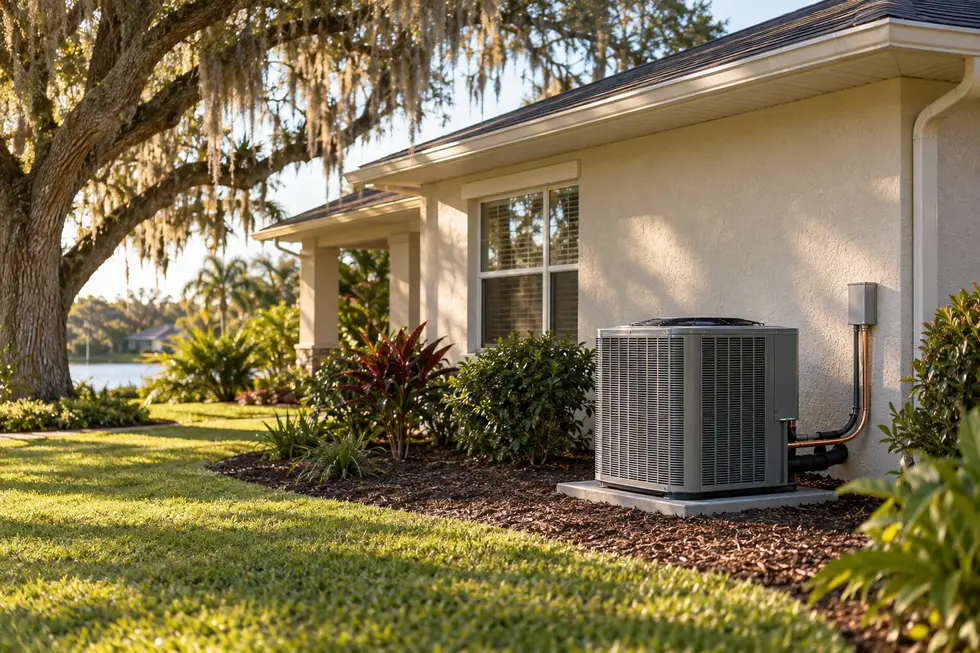
TL;DR: The R-22 phase-out ended new production and import of R-22 on January 1, 2020. It did not ban using or servicing existing systems, so your old AC can keep running legally. Because the R-22 supply keeps shrinking, a leak in an aging Central Florida system is usually the point where you should weigh repair against replacement.
The R-22 refrigerant phase-out in Florida does not make you replace a working air conditioner. Since January 1, 2020, no new R-22 can be made or imported in the U.S. Your existing system can still run and get serviced with reclaimed or stockpiled R-22. The catch is that supply keeps shrinking, so leak repairs get harder to justify.
That matters around Tavares, where an AC runs most of the year and plenty of older homes still have their original equipment. Below you’ll find what the federal rules actually say, how to tell if your system uses R-22, and how to decide what to do next.
What is R-22, and why was it phased out?
R-22 is an older refrigerant, often called Freon and listed on equipment as HCFC-22. For decades it was the standard in home air conditioners and heat pumps. It was phased out because it damages the ozone layer. Under the Clean Air Act and an international treaty called the Montreal Protocol, the U.S. stopped producing and importing it in stages.
The phase-out had two big steps. In 2010, manufacturers could no longer build or import new home HVAC equipment that used R-22. Then on January 1, 2020, making and importing R-22 itself ended. So almost any R-22 system still running today went in around 2010 or earlier. That means it’s at least 15 years old.
Is it illegal to keep using an R-22 air conditioner?
No. You can legally keep using and repairing an R-22 system. The EPA says it does not require anyone to retire equipment early, and owners can keep using recovered, reclaimed or stockpiled R-22 for as long as they need it. The plain-language rules are on the EPA’s homeowner FAQ.
A few things did change:
- You can’t buy a new central AC that runs on R-22.
- Homeowners can’t buy R-22 to recharge their own system.
- Anyone servicing R-22 equipment needs EPA Section 608 certification.
- It is illegal to knowingly vent refrigerant into the air during service or removal.
How do you know if your AC uses R-22?
Look at the metal nameplate on your outdoor unit. Find the line that lists the refrigerant type. If it says R-22 or HCFC-22, you have an R-22 system. If it says R-410A, R-454B or R-32, the R-22 phase-out doesn’t apply to you.
Age is another clue. A system installed before 2010 very likely uses R-22. Years of Florida sun can fade a nameplate until you can’t read it. If that’s happened to yours, take a photo of the model and serial numbers, and a technician can look them up.
How does the R-22 refrigerant phase-out affect Florida repair bills?
You’ll feel the phase-out most when your system develops a leak. The EPA warned that R-22 supply would decline and prices could rise. Every pound that goes into a leaking R-22 system comes from a limited pool of reclaimed or older stock.
We won’t list a per-pound price, because it moves with supply. These are the things that drive your bill:
- How much refrigerant the system has lost
- Whether the leak can be found and fixed for good
- Where the leak is. A leaking coil costs far more than a loose fitting or a bad valve core
- The diagnostic visit itself. At Lucas Air Conditioning and Heating, that’s $125 residential and $135 commercial
Florida makes this harder in two ways. Our cooling season is long, so an R-22 system in Tavares or Zellwood logs far more hours each year than one up north. And because heat pumps are the usual heating system here, a leak in an R-22 heat pump can take away your cooling in August and your heat on a January cold snap. If you’re seeing warning signs, our guide to refrigerant leak signs and what happens if you ignore them goes through each one.
What are your options with an R-22 system?
You have four realistic paths. The right one depends on the system’s age and condition, and on whether it’s leaking. One thing you can’t do is fill an R-22 system with R-410A. R-22 parts were never rated for R-410A’s higher pressures.
| Option | What it involves | Makes sense when | Watch out for |
|---|---|---|---|
| Keep it running and maintain it | Yearly tune-up, clean coils, catch small problems early | The system cools well and holds its charge | Any future leak means buying scarce R-22 |
| Fix the leak and recharge with reclaimed R-22 | Find the leak, repair it, then recharge with legally sourced R-22 | A small, fixable leak on an otherwise healthy system | Topping off without fixing the leak just loses refrigerant again |
| Retrofit to a substitute refrigerant | Recover the R-22, make the needed system changes, charge with an approved alternative | A technician confirms your equipment is a good candidate | Equipment usually runs best on the refrigerant it was designed for |
| Replace the full system | New, matched indoor and outdoor equipment built for a current refrigerant | Major leak, failed compressor, or a system 15+ years old | Higher upfront cost. A permit is required |
That note about retrofits comes from the EPA’s residential R-22 fact sheet. It also points out that non-ozone-depleting alternatives exist when the time comes.
Should you replace an R-22 system before it fails?
Not automatically. If your R-22 system cools well, holds its charge and gets regular maintenance, running it until it needs a major repair is a reasonable choice. The EPA designed the long phase-out so people could switch when they would normally replace their system.
Here’s how keeping an R-22 system stacks up:
- Pro: No replacement cost right now.
- Pro: It’s fully legal to use and service.
- Pro: A healthy, well-kept system can keep cooling for now.
- Con: R-22 supply is shrinking, and recharge prices may keep climbing.
- Con: The system is at least 15 years old, and Florida’s long cooling season adds wear.
- Con: A failed outdoor unit can’t just be swapped for a newer-refrigerant model. The indoor coil has to match.
Planning ahead still pays off. If your home in Paisley or Astor still has a system from the 2000s, replacing it on your own schedule in spring or fall beats an emergency swap in July. Snowbirds should have an R-22 system checked before leaving for the season, so a slow leak doesn’t turn into a dead system while the house sits empty. Landlords with R-22 units in rentals should budget for replacement now. If you do replace, new systems are built for newer refrigerants. Our guide to the R-454B refrigerant switch explains what changes with today’s equipment.
Why homeowners call Lucas Air about older R-22 systems
Lucas Air Conditioning and Heating is a veteran-owned company at 15800 Old US Hwy 441 in Tavares.
U.S. Army veteran Cameron Lucas, who served in the 82nd Airborne Division, founded it in early 2018.
We hold Florida license CAC1819409.
We have a 5.0-star Google rating from more than 1,000 reviews.
New systems start at $7,500 and include the permit, a one-year labor guarantee and a ten-year manufacturer’s parts warranty.
Estimates on new systems are free, and KwikComfort financing is available.
We replaced a 20+ year-old unit at The Frog and Monkey restaurant in downtown Mount Dora in four days.
Not sure whether your system runs on R-22, or whether it’s worth repairing? Call (352) 805-0359 or schedule an appointment online, and we’ll give you a straight answer.
Frequently Asked Questions
Can I buy R-22 and recharge my AC myself?
No. Homeowners can’t buy R-22 for do-it-yourself service. Federal rules require EPA Section 608 certification to buy and handle regulated refrigerants.
Does the R-22 phase-out affect R-410A systems?
Not directly. R-410A falls under a separate federal phasedown of HFC refrigerants, and existing R-410A systems can still be serviced with R-410A parts and refrigerant.
What happens to the R-22 when my old system is removed?
It has to be recovered, because it’s illegal to knowingly vent refrigerant into the air. Recovered R-22 can be cleaned to new-refrigerant standards and reused to service other existing systems.
Is a recharge worth it on a 20-year-old R-22 system?
It can be if the leak is small, can be found and fixed, and the rest of the system is healthy. If the leak is in a coil or the compressor is failing, replacing the system usually makes more sense than buying more scarce R-22.
Recommended Reads
- The R-454B Refrigerant Switch: What Florida Homeowners Need to Know
- AC Not Cooling Your House in Florida? Broken vs. Maxed Out
- 8 Reasons Your AC Isn’t Cooling Enough (And What to Do About Each)