

TL;DR:
- Early detection of common AC problems, such as refrigerant leaks and capacitor failures, can prevent costly repairs and system failures. Homeowners are advised to perform regular filter replacements and drain line flushes themselves, but should call professionals for refrigerant handling, blower motor repairs, or thermostat issues. Maintaining proactive schedules and seeking trusted professional diagnostics can extend system lifespan and ensure reliable cooling.
Your AC stops working on the hottest day of the year. Sound familiar? Common ac repair issues are responsible for countless emergency service calls every summer, and most of them start with warning signs that homeowners overlook for weeks. The good news is that recognizing the symptoms early puts you in control. You can make smarter decisions, avoid the largest repair bills, and stop a minor problem from turning into a full system replacement. This guide covers the most frequent AC problems, what causes them, and exactly what you should do about each one.
Table of Contents
- Key takeaways
- 1. Bad capacitor or contactor failure
- 2. Low refrigerant levels and refrigerant leaks
- 3. Clogged condensate drain line and drain pan issues
- 4. Failing blower motor and airflow problems
- 5. Thermostat problems causing incorrect cycling
- 6. Short cycling and what it signals
- 7. Frozen evaporator coils
- 8. Quick-reference comparison of common AC issues
- My honest take on preventing these problems
- Let Lucasair solve your AC problems the right way
- FAQ
Key takeaways
| Point | Details |
|---|---|
| Early detection saves money | Catching symptoms like weak airflow or strange noises early prevents small repairs from becoming expensive compressor failures. |
| Most leaks need a professional | Refrigerant handling requires certification; attempting DIY fixes on leaks can violate federal law and worsen the problem. |
| Filter changes prevent multiple issues | Replacing your filter every 1 to 3 months stops coil freezing, airflow problems, and short cycling before they start. |
| Repair vs. replace depends on age | Systems over 12 years old with repeated repair needs are often more economical to replace than fix. |
| Drain line clogs are DIY friendly | Flushing the condensate drain with a vinegar and water solution is one of the few AC fixes most homeowners can safely handle. |
1. Bad capacitor or contactor failure
The capacitor in your AC unit is a small, cylindrical component that gives the compressor and fan motors the electrical jolt they need to start. Without it, your system cannot turn on. The contactor works alongside it, acting as a switch that controls power flow to major components. Both wear out over time, and both are among the most common ac repair issues technicians see every season.
Symptoms to watch for:
- The unit hums but does not start
- The AC turns on intermittently or shuts off immediately
- You hear a clicking sound from the outdoor unit
- The fan spins slowly or not at all
Capacitor replacement typically costs $150 to $400, making it one of the more affordable professional repairs. Do not delay it. A failed capacitor forces other motors to work harder, and that stress shortens the life of your compressor, which is the most expensive part in the system.
Pro Tip: If your outdoor unit hums when it should be running, gently tap the side of the unit with a stick. If the fan starts spinning, that confirms a capacitor problem and not a wiring fault.
2. Low refrigerant levels and refrigerant leaks
Refrigerant is the substance your AC uses to absorb heat from indoor air and move it outside. Low refrigerant does not mean the AC “used some up.” It always means there is a leak somewhere in the system. This is one of the most consequential frequent AC system problems because it affects every part of the cooling process.
Signs your refrigerant is low:
- Warm air blowing from vents despite the thermostat being set correctly
- Ice forming on the outdoor unit or refrigerant lines
- A hissing or bubbling sound near the unit
- Higher than normal energy bills without a clear reason
High energy bills before peak heat are actually one of the earliest and most overlooked signs of refrigerant trouble. If your system is working harder to cool the same space, low refrigerant or dirty coils is usually the cause.
Refrigerant repairs must be handled by a licensed HVAC technician. If your system is older and uses R-22 refrigerant, the cost equation changes dramatically. R-22 was phased out of production, and the remaining supply is expensive and limited. In many cases, repairing a leak in an R-22 system costs more than replacing the unit with a modern, efficient model.
3. Clogged condensate drain line and drain pan issues
Every time your AC runs, it removes humidity from the air. That moisture collects in a drain pan and exits through a condensate drain line. Over time, algae, mold, and dirt accumulate inside that line and create a blockage. This is one of the most common ac repair issues in Florida specifically, where humidity levels are high for most of the year.
Here is what happens when the drain line clogs:
- Water backs up into the drain pan
- The pan overflows onto walls, ceilings, or flooring
- Many systems have a float switch that detects the overflow and shuts the AC off
- Musty odors develop from mold growth inside the line or pan
Cleaning the drain line with a mixture of water and white vinegar is a task most homeowners can tackle themselves. Pour about a cup of the mixture into the drain access port near the air handler, wait 30 minutes, and then flush with clean water. Do this every three months.
Pro Tip: If your AC shuts off randomly on humid days, check the drain pan first. A triggered float switch is one of the most common reasons for unexplained shutdowns, and clearing the line often gets the system running again in under an hour.
Call a professional when the clog is deep in the line, when you cannot locate the access port, or when mold is visible in the pan and surrounding areas.
4. Failing blower motor and airflow problems
The blower motor is responsible for pulling air across your evaporator coil and pushing cooled air through your ductwork into every room. When it starts to fail, you feel it immediately. Some rooms get cool, others stay warm, and the airflow from your vents feels weak even when the system is running.
Common symptoms of a failing blower motor:
- Significantly reduced airflow from vents
- Rattling, screeching, or banging noises from the air handler
- The system runs but indoor temperature barely changes
- Unusual spikes in electricity usage
Before assuming the blower motor is the problem, check your air filter first. A severely clogged filter creates the same weak airflow symptoms. Changing your filter every 1 to 3 months and checking it monthly during heavy-use seasons is the single easiest way to prevent this diagnosis.
If the filter is clean and airflow is still weak, the motor itself may need service. Fan motor repairs run $400 to $900 depending on the unit. On systems more than 10 years old, your technician may recommend full replacement instead of a repair, particularly if the motor has been failing gradually over time.
5. Thermostat problems causing incorrect cycling
A thermostat that is not reading temperatures accurately will cause your system to behave erratically. It might shut off before the room is cool enough, or run continuously past the set temperature. Many homeowners assume the worst when this happens, fearing compressor damage or refrigerant loss, when the actual fix is a $20 battery replacement or a simple recalibration.
Location matters more than most people realize. A thermostat placed near a sunny window, above a heat-producing appliance, or in a rarely used room will get inaccurate readings and signal the system incorrectly. Moving or reconfiguring a poorly placed thermostat can solve cycling problems without any parts or service calls.
Programmable and smart thermostats sometimes develop software glitches or lose their scheduling data after a power outage. Resetting the thermostat to factory settings and reprogramming it is a reasonable first step before calling for service. If problems continue after that, thermostat replacement runs $100 to $300 for most residential units.
6. Short cycling and what it signals
Short cycling means your AC turns on, runs for only a few minutes, and shuts off before completing a full cooling cycle. Then it starts again. This pattern is one of the more serious frequent AC system problems because short cycling signals a deeper issue and actively causes damage the longer it continues. Every start cycle puts peak stress on the compressor.
Causes include refrigerant leaks, oversized units, dirty coils, a failing compressor, or thermostat errors. An oversized system is a common culprit in homes where the AC was replaced without a proper load calculation. A unit that is too powerful for the space cools it too fast, shuts off, and then cannot maintain the temperature without constant cycling.
Short cycling leads to uneven cooling, higher energy bills, and accelerated wear on the compressor. If you notice your outdoor unit cycling on and off more than four or five times per hour, that is a clear signal to call a technician.
7. Frozen evaporator coils
When the evaporator coil freezes, you may see ice forming on the refrigerant lines outside, notice warm air from vents, or find water pooling around the air handler as the ice melts. The two most common causes are restricted airflow from a dirty filter and low refrigerant preventing the coil from absorbing heat properly.
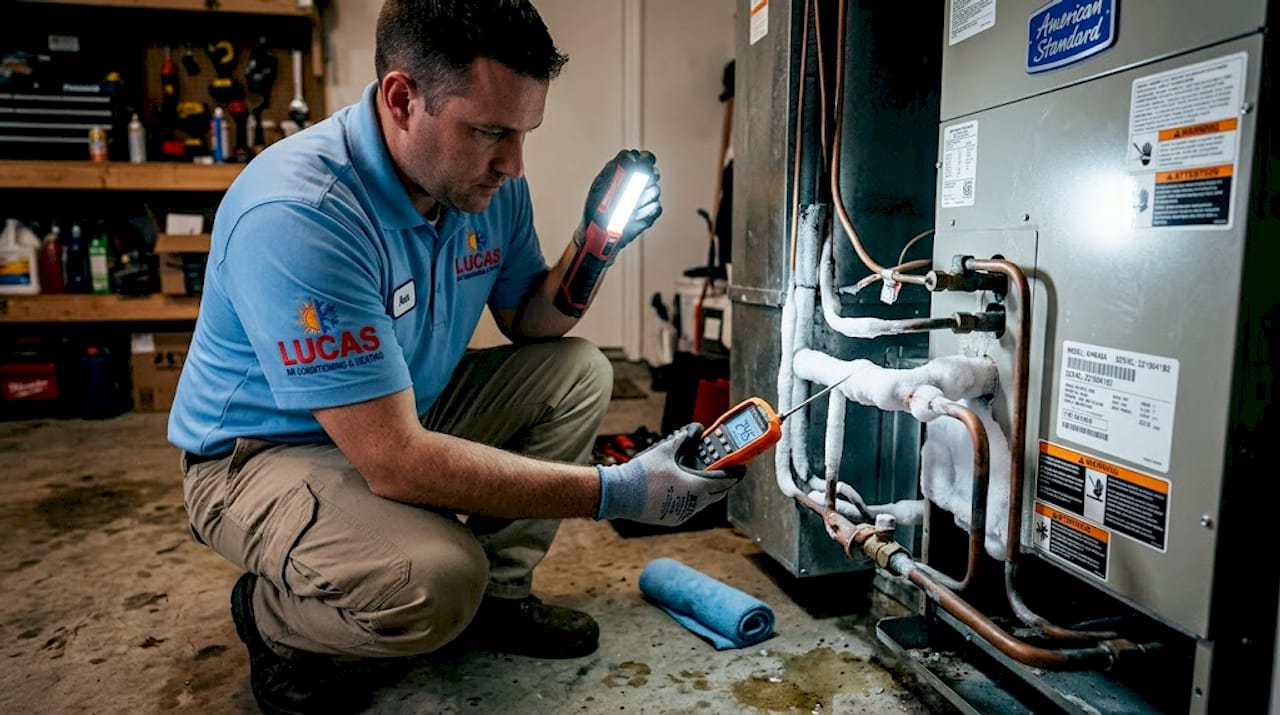
The first thing to do is turn the system off and let the coil defrost completely. This can take several hours. While it defrosts, check and replace the filter. Once defrosted, turn the system back on with a fresh filter and see if normal cooling returns. If the coils freeze again, the cause is low refrigerant or a deeper airflow obstruction, and a technician needs to investigate.
Running the AC continuously when coils are frozen makes the problem worse and risks damaging the compressor.
8. Quick-reference comparison of common AC issues
Use this table to assess your situation and decide what to do next.
| Issue | Main symptom | Urgency | DIY possible? | Repair cost range |
|---|---|---|---|---|
| Bad capacitor | Unit hums, won’t start | High | No | $150 to $400 |
| Refrigerant leak | Warm air, ice on lines | High | No | Varies widely |
| Clogged drain line | Water leaks, musty smell | Medium | Yes | $75 to $250 |
| Blower motor failure | Weak airflow, rattling | Medium | No | $400 to $900 |
| Thermostat issues | Erratic cycling | Low to medium | Sometimes | $100 to $300 |
| Short cycling | Frequent on/off | High | No | Varies by cause |
| Frozen coils | Ice on unit, warm air | Medium | Partly | $0 to $400+ |
My honest take on preventing these problems
I have seen it over and over: a homeowner ignores a strange sound or a slight drop in cooling performance for a few weeks, then calls for service after the compressor fails. Compressor repairs routinely exceed $1,200 and often push homeowners toward full replacement. The frustrating part is that the early warning signs were there.
In my experience, the homeowners who avoid those situations do three things consistently. They change their filter without waiting to see a problem. They schedule a spring tune-up before the heat hits. And they call for a diagnosis when something feels off, rather than waiting to see if the problem resolves itself.
On the DIY versus professional question: I think homeowners can and should handle filter changes, drain line flushes, and thermostat battery swaps. Everything beyond that has real risk, either from electrical hazards, refrigerant regulations, or the chance of causing further damage. Knowing where that line is will protect both your system and your wallet. The HVAC maintenance checklist approach is the most reliable path I have found for keeping systems healthy between professional visits.
— Lucasair
Let Lucasair solve your AC problems the right way
When an AC issue goes beyond a filter swap or drain flush, you need someone you can trust to diagnose it correctly the first time. Lucasair serves homeowners throughout Central Florida with honest assessments, professional repairs, and transparent pricing. Whether you are dealing with a refrigerant leak, a failing capacitor, or a system that simply will not keep up with summer heat, the team at Lucasair has the experience to fix it.

Start with the residential repair guide to understand exactly what to expect from a professional service visit. Or, if you are ready to book, visit the AC repair services page to schedule with a licensed technician. Lucasair also offers preventative maintenance plans that catch the most common issues before they become costly emergencies. Veteran-owned and community-focused, Lucasair is built on the kind of service that earns long-term trust.
FAQ
What are the most common AC repair issues?
The most frequent issues include failed capacitors, refrigerant leaks, clogged condensate drain lines, blower motor failures, and thermostat problems. Most present with recognizable symptoms like weak airflow, warm air from vents, or unexplained shutdowns.
How do I know if my AC is low on refrigerant?
Signs include warm air blowing from vents, ice forming on the outdoor unit or refrigerant lines, hissing sounds, and rising energy bills. Low refrigerant always indicates a leak and requires a licensed HVAC technician to repair.
Can I fix AC problems myself?
Some tasks are safe for homeowners, including replacing filters, flushing the condensate drain line with vinegar, and changing thermostat batteries. Anything involving refrigerant, electrical components, or motor replacement should be handled by a certified technician.
How often should I schedule AC maintenance?
ENERGY STAR recommends checking filters monthly during peak-use seasons and replacing them at least every three months. A professional tune-up once per year, ideally in spring before cooling season, prevents most of the common issues covered in this guide.
When does it make more sense to replace than repair?
If your system is 12 or more years old and requires multiple repairs in a single season, replacement is usually the smarter financial decision. Older units also lack compatibility with modern, energy-efficient components, making ongoing repair costs higher.
Recommended
- 6 Signs of HVAC System Issues Every Homeowner Should Know – Lucas Air Conditioning and Heating
- Step-by-Step AC Maintenance: Keep Your Florida Home Cool – Lucas Air Conditioning and Heating
- 7 Benefits of Regular Air Conditioning Maintenance – Lucas Air Conditioning and Heating
- Essential AC Tune-Up Steps Every Florida Homeowner Needs – Lucas Air Conditioning and Heating
