
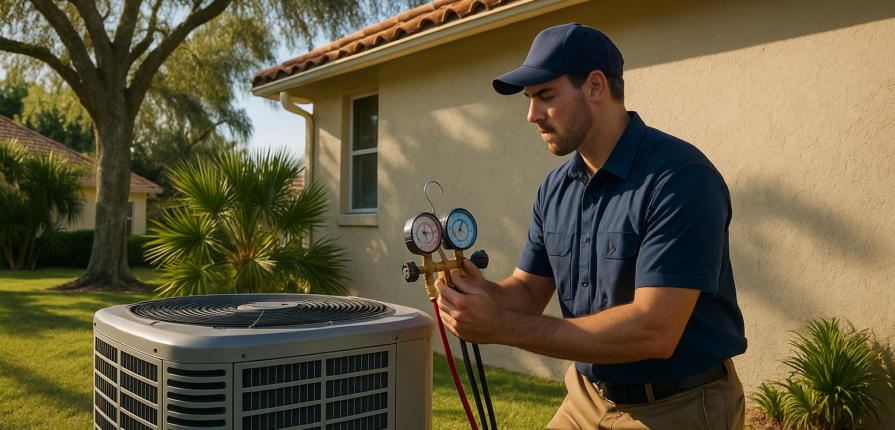
TL;DR: An AC that runs but blows warm air is almost always caused by one of six issues: wrong thermostat settings, a clogged air filter, a tripped outdoor breaker, dirty condenser coils, a frozen evaporator coil, or a refrigerant leak. Most homeowners can rule out the first three in under 20 minutes — the rest need a licensed technician.
It is 92°F outside, your AC is humming away, and yet the air coming through your vents feels lukewarm — or even hot. If you live in Tavares, Mount Dora, The Villages, or anywhere else in Lake County, you know that is not just uncomfortable. In a Florida summer, it can become a health concern fast.
The good news is that most cases of an AC blowing warm air trace back to one of six causes, and several of them are free to fix yourself in minutes. Here is what to check — in order — before you call anyone.
1. Your Thermostat Is Set to the Wrong Mode
Start here, every time. A malfunctioning or incorrectly set thermostat can cause your AC to blow warm air if it is set to “Heat” or “Fan Only” instead of “Cool.”
When the thermostat fan is set to “On” instead of “Auto,” it circulates unconditioned, room-temperature air during off-cycles — so air blows from the vents but nothing is actually cooling it. That is a free fix before you schedule any service call.
What to do: Confirm the thermostat is set to Cool, the fan is on Auto, and the target temperature is lower than the current room temperature. If you have a programmable or smart thermostat, check that no schedule override is active.
2. A Clogged Air Filter Is Starving the System of Airflow
A dirty filter will slow down airflow and make the system work harder to keep you cool — wasting energy. Nearly half of the energy used in your home goes to heating and cooling. That means a $5 filter can have an outsized impact on your comfort and your electric bill.
A dirty air filter restricts airflow and can cause your system to overheat, forcing it to blow warm air as a protective measure. Worse, a clogged filter starves the system of airflow, which can make the air feel weak and warm — and over a day or two it can freeze the indoor coil into a block of ice, stopping cooling entirely.
The U.S. Department of Energy estimates a clean filter cuts an air conditioner’s energy use by 5 to 15 percent. ENERGY STAR recommends checking your filter every month: if it looks dirty after a month, change it — and at a minimum, change it every three months.
What to do: Pull the filter and hold it up to light. If you cannot see light through it, replace it now. In a Florida home running AC nearly year-round, monthly checks are smart. Check out our guide on why your AC might be spiking your electric bill — a dirty filter is one of the most common culprits there too.
3. The Outdoor Breaker Has Tripped
This one surprises homeowners more than any other. Your AC has two power feeds: one for the indoor air handler and one for the outdoor condenser. If only the outdoor breaker trips, the indoor blower keeps running and pushing air — but there is nothing cooling it, so you get warm air.
Power outages and surges commonly trip the AC breaker, reset the thermostat to a default program, or damage the capacitor. After any storm or power blip, this is the second thing to check.
What to do: Go to your breaker panel and look for a tripped breaker labeled for the AC or condenser. Check the breaker panel and the outdoor disconnect box, reset a tripped breaker once, and confirm the outdoor fan is spinning. If the breaker trips again immediately, stop — do not keep resetting it. That is a sign of an electrical fault that needs a licensed technician.
4. Dirty Condenser Coils Are Trapping Heat Outside
Your outdoor unit’s job is to dump the heat it pulls from your home into the outside air. When the condenser coils are coated with dirt, pollen, grass clippings, or debris, that heat transfer slows to a crawl.
Dust, grass clippings, leaves, pollen, and other contaminants can block the spaces between the coil fins. The U.S. Department of Energy notes that these obstructions reduce coil effectiveness, elevate condensing temperature, and reduce cooling efficiency.
Even a fine layer of dust on the condenser coil reduces its efficiency. An EPA study found that as little as 0.042 inches of dirt on condensing coils can cause a 21% drop in efficiency. In Central Florida, where systems run nearly year-round, the hot, humid environment causes air conditioning systems to accumulate coil contamination faster than systems in cooler, drier regions, with high humidity that promotes biological growth, heavy pollen, and storm-driven debris all contributing.
What to do: Visually inspect the outdoor unit. Trim vegetation and clear away any debris from around the unit to maintain proper airflow. Actual coil cleaning — using appropriate cleaners and pressure — should be left to a technician. This is one reason a precision tune-up pays for itself: a tech will clean both coil sets, not just spray down the cabinet.
5. The Evaporator Coil Is Frozen
It sounds counterintuitive, but a frozen coil means your AC blows warm air — or almost no air at all. If your AC is running but the air from your vents feels warm or the flow is weak, a dirty or frozen evaporator coil could be blocking the air.
Causes include restricted airflow from a dirty filter or closed vents, low refrigerant, a failing blower motor, or running the system when outdoor temperatures drop below about 60°F. Once the coil ices over, the ice buildup blocks airflow, leading to poor performance and higher energy bills — and if left unaddressed, it can cause water damage from melting ice and even lead to compressor failure, one of the most expensive parts to replace.
What to do: If you see ice on the indoor unit or the refrigerant lines, turn the system to Off and set the fan to On. Running the blower without the compressor pushes room-temperature air across the coil and thaws it faster — expect anywhere from two to eight hours. Call a technician if it freezes again. A recurring freeze means an underlying fault — and repeated freezing can turn a $200 problem into a $2,000 one.
If ice on the coil is a recurring issue, it may be connected to a larger airflow or refrigerant problem. Our article on 8 reasons your AC isn’t cooling enough covers the full picture.
6. You Have a Refrigerant Leak
Refrigerant is the substance that makes cooling physically possible. Refrigerant is the lifeblood of your cooling system. A leak reduces the refrigerant level, preventing the system from absorbing heat effectively — which results in the air conditioner blowing warm air.
One important fact homeowners often do not know: refrigerant does not get used up the way oil does. If the level is low, there is a leak somewhere. Topping off refrigerant without fixing the leak is not a repair — it is a temporary band-aid that will fail again.
EPA Section 608 certification is required for any technician who opens a refrigerant circuit on residential equipment. You cannot legally vent refrigerants. This is not a DIY repair under any circumstances. A professional technician must locate the leak, repair it, and recharge the system.
Warning signs of a refrigerant leak include warm air despite a running system, ice on the refrigerant lines, a hissing or bubbling sound near the indoor or outdoor unit, and a sudden spike in energy bills. For a full breakdown, see our guide on signs your AC has a refrigerant leak — and what happens if you ignore it.
Quick Diagnostic Checklist: Start Here Before You Call
- Thermostat: Set to Cool, fan on Auto, setpoint below room temp?
- Air filter: Can you see light through it? If not, replace it.
- Breaker panel: Is the outdoor condenser breaker on? Reset once if tripped, then confirm the outdoor fan spins.
- Outdoor unit: Is it running? Any visible debris packed against the coil fins?
- Indoor unit: Any ice visible on the coil or refrigerant lines?
- Still warm? The fault is likely refrigerant, a failed capacitor, or a compressor issue — time to call a licensed HVAC technician.
When to Call Lucas Air (and What to Expect)
At Lucas Air Conditioning and Heating, we serve homeowners throughout Lake County and Orange County — Tavares, Eustis, Leesburg, Mount Dora, The Villages, Lady Lake, Apopka, and surrounding communities. Our precision tune-up ($125) includes coil inspection and cleaning, refrigerant level check, electrical component testing, and a full system evaluation — everything needed to catch the causes on this list before they leave you sweating.
If you need same-day diagnosis or emergency service outside of regular hours, we are available. No upselling, no runaround — just honest answers from a veteran-owned team that has been earning 5-star reviews in this community since 2018.
Call us or request service online. If your system needs replacement rather than repair, free estimates are available and KwikComfort financing makes it simple to move forward without delay.
Recommended Reads
- 8 Reasons Your AC Isn’t Cooling Enough (And What to Do About Each)
- What Different AC Noises Mean — and When to Call a Tech
- Why Does My AC Smell Like Burning? Common Causes and When to Worry
