
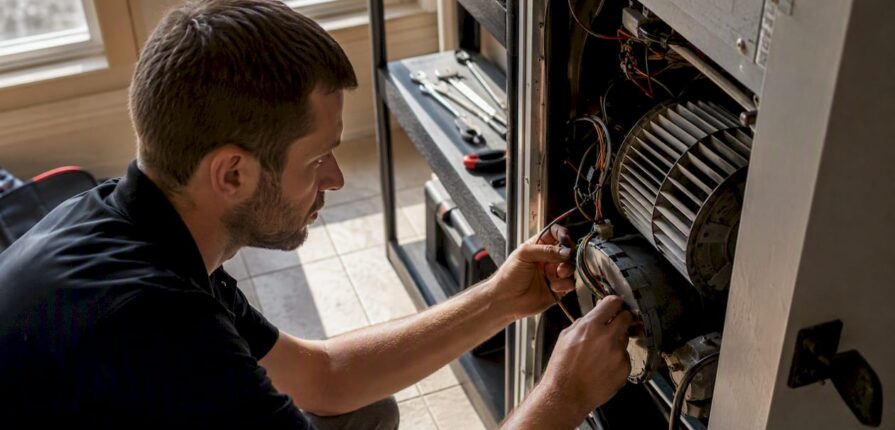
Expect to pay a wide range to replace an AC blower motor, with most homeowners paying a moderate amount once parts and labor are combined. According to Angi’s 2026 market data, that wide range is real, and it comes down to three things: the motor technology in your unit, how accessible the blower compartment is, and whether the tech finds anything else wrong during the visit.
The three biggest cost drivers:
- Motor type: A basic PSC (single-speed) motor costs far less than an ECM variable-speed unit. The part alone can swing from under $100 to over $600.
- Labor and access: An easy closet swap takes 1–2 hours. An attic-mounted or rooftop unit can double that.
- Ancillary parts: A failed capacitor, worn bearings, or a cracked blower wheel often show up on the same invoice.
That threshold is the clearest decision signal in HVAC repair economics.
Key Takeaways
Most homeowners pay a moderate amount to replace an AC blower motor, but factors like motor type, access difficulty, and additional parts can significantly increase the total cost.
| Point | Details |
|---|---|
| Expected cost range | Most jobs land between $350 and $700; ECM motors and difficult access push totals toward $1,800. |
| Top cost drivers | Motor technology (PSC vs. ECM), labor hours, and ancillary parts like capacitors and blower wheels. |
| 30% replacement rule | If repair cost exceeds roughly 30% of a new system’s price, get a full replacement estimate before approving the repair. |
| Diagnose before ordering | A $75–$150 diagnostic can reveal a failed capacitor instead of a failed motor, saving hundreds on an unnecessary part. |
| Lucasair for Central Florida | Lucasair provides on-site diagnostics, itemized quotes, and blower motor replacement with financing available across Central Florida. |
Table of Contents
- How much does AC blower motor replacement actually cost?
- How motor type and horsepower change what you pay
- What labor actually costs and how long the job takes
- Other parts that show up on your invoice
- Should you replace the blower motor or the whole system?
- How long do blower motors last, and what does failure look like?
- DIY versus hiring a pro: what the trade-off actually looks like
- How to get a quote you can actually compare
- Lucasair’s local pricing context and how we approach blower motor jobs
- The pricing surprises contractors see most often
- Lucasair handles blower motor diagnostics and replacement in Central Florida
- Sources
How much does AC blower motor replacement actually cost?
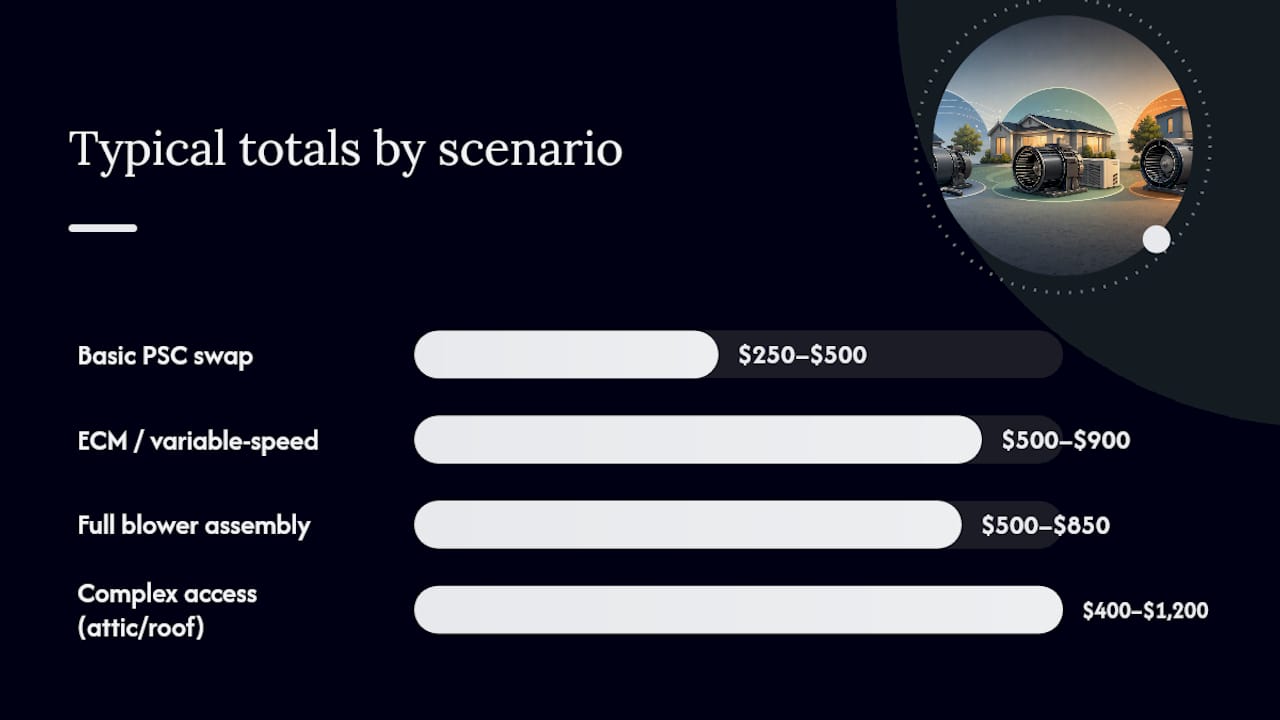
The table below maps four common scenarios to realistic cost bands. These figures reflect Pick Comfort’s 2026 homeowner data and Carrier’s published guidance on furnace blower motor replacement.
| Scenario | Parts cost | Labor estimate | Typical total |
|---|---|---|---|
| Basic PSC single-speed swap | $80–$200 | $150–$300 | $250–$500 |
| ECM / variable-speed motor | $300–$650 | $200–$400 | $500–$900 |
| Full blower assembly replacement | $250–$500 | $250–$450 | $500–$850 |
| Complex access (attic, rooftop) | $80–$650 | $350–$700 | $400–$1,200 |
A few things push totals toward the high end fast. Emergency or after-hours calls typically add $75–$150 to the labor line. And if the tech needs to remove the evaporator coil to reach the blower, add another 1–2 hours of labor.
Regional variance matters too. Central Florida labor rates tend to be moderate compared to coastal metros, but summer peak season (June through September) can add a premium when every HVAC company in the area is booked solid. Florida-specific cost drivers like humidity, attic heat, and year-round runtime also accelerate motor wear, which means Florida homeowners often face this repair sooner than the national average suggests.
Pro Tip: Always ask for an itemized quote that separates parts, labor hours, and any trip or diagnostic fees. A single-line “blower motor replacement: $750” tells you nothing about where the money is going.
How motor type and horsepower change what you pay
The motor sitting inside your air handler determines the parts cost more than almost anything else. There are three main types, and they are not interchangeable.
- PSC motors (permanent split capacitor): The standard single-speed motor found in most residential systems built before 2010. Parts typically run $80–$200. They are straightforward to replace and widely available.
- Two-stage motors: Less common in residential systems, but found in some mid-range units. Parts cost $150–$350. Installation complexity is similar to PSC.
- ECM motors (electronically commutated motors): The variable-speed motors in higher-efficiency systems. Parts alone run $300–$650 or more, and programming the control board adds time. Pick Comfort’s scenario data puts ECM jobs at the top of the typical homeowner range.
Horsepower also matters. A 1/4 HP motor in a smaller system costs less than a 1/2 HP or 1 HP unit in a larger air handler. The difference between a 1/3 HP PSC and a 1 HP ECM can be $300 in parts alone before labor enters the picture.
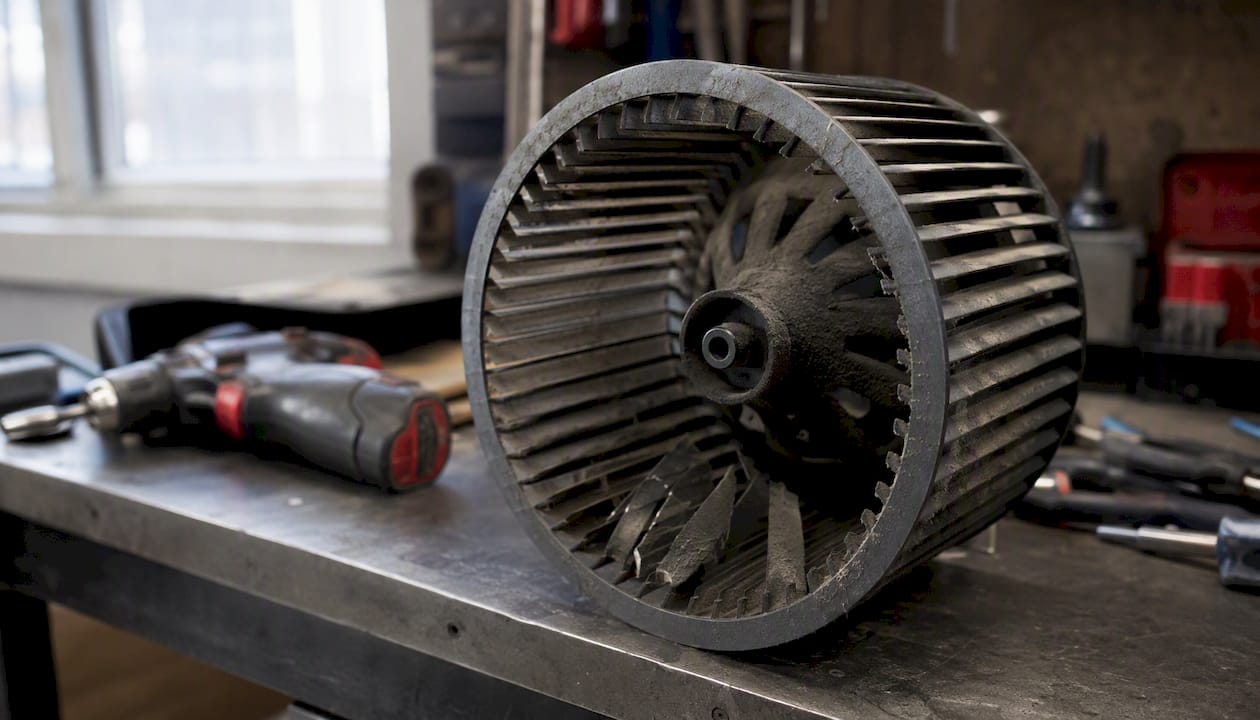
When the blower wheel itself is cracked, out of balance, or caked with debris that won’t clean off, you’re looking at a full blower assembly replacement rather than just the motor. That adds $150–$300 to the parts cost and 30–60 minutes of labor.
Pro Tip: Before ordering any motor, pull the model number off the existing unit’s label, not just the air handler nameplate. A mismatched motor, even one close in specs, can cause control board errors, poor airflow, and premature failure, turning a $300 repair into a $900 one.
What labor actually costs and how long the job takes
Labor is where quotes diverge most. A technician replacing a PSC motor in an accessible closet-mounted air handler can finish in 60–90 minutes. That same job in an attic unit with a tight crawl space and no pull-down stairs takes 2.5–3.5 hours, and the tech is billing every minute.
Typical labor scenarios:
- Easy access, PSC swap: 1–1.5 hours at $100–$150/hr = $100–$225 in labor
- ECM motor with control board programming: 2–3 hours = $200–$450 in labor
- Attic or rooftop unit, any motor type: 2.5–4 hours = $250–$600 in labor
- Coil removal required: Add 1–2 hours to any of the above
RepairPal’s estimator confirms that the parts-versus-labor split varies significantly by job complexity. On a difficult attic ECM job, labor can exceed the parts cost.
After-hours and weekend calls add $75–$150 in most markets. During peak cooling season in Florida, some contractors charge a seasonal premium or have extended lead times, which is its own cost if your system is down in July.
Other parts that show up on your invoice
A blower motor doesn’t fail in a vacuum. When a tech opens the air handler, they often find related components that contributed to the failure or are close to failing themselves.
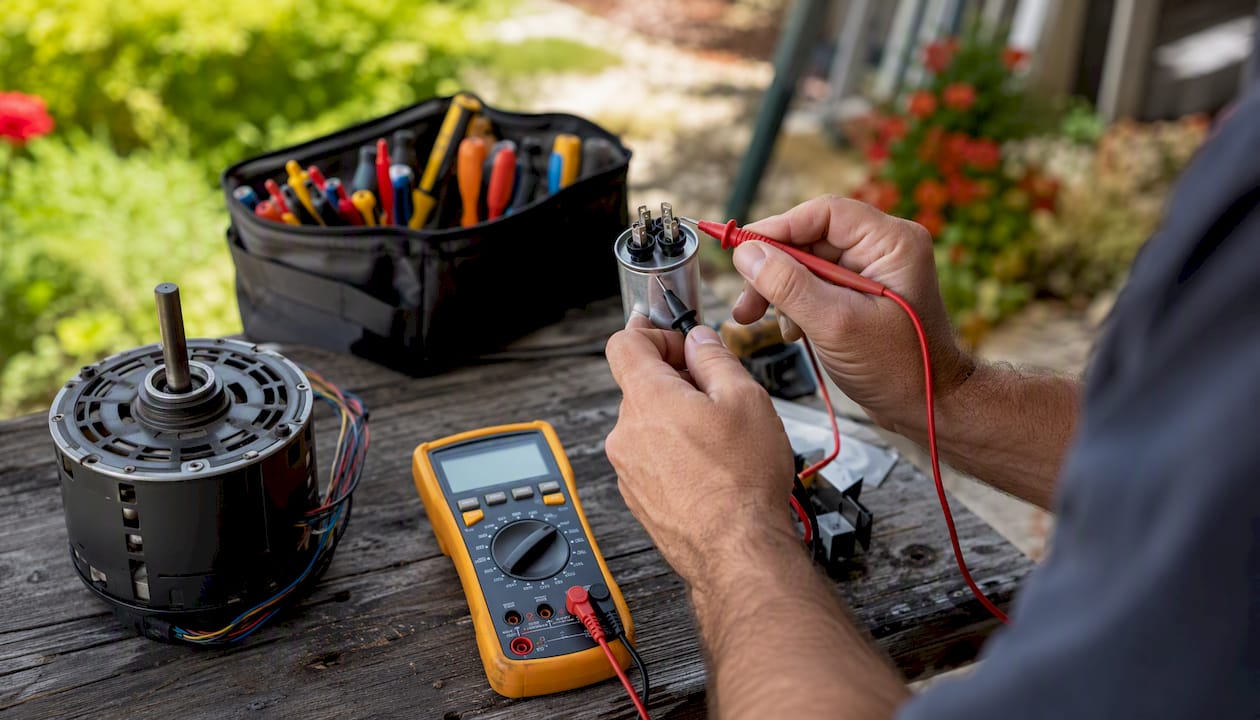
- Run capacitor: The single most common add-on. A failed capacitor is sometimes the only reason the motor stopped working. Replacement costs $15–$60 for the part. Carrier’s guidance emphasizes testing capacitors and control components before condemning the motor itself.
- Blower wheel: If it’s cracked or out of balance, add $50–$150 for the part.
- Bearings: On older motors with serviceable bearings, replacement runs $20–$50. Most modern motors are sealed and replaced as a unit.
- Belt (belt-drive systems): Older commercial or large residential units may use a belt. Replacement is $10–$30 but adds diagnostic time.
- Control board: If the motor failure damaged the board, that’s $150–$400 in parts alone.
- Diagnostic fee: Most contractors charge $75–$150 for the service call and diagnosis, sometimes credited toward the repair.
The diagnostic-first principle matters here. A properly scoped diagnosis often avoids unnecessary motor replacement. Testing a run capacitor has saved homeowners from replacing a $400 motor to fix a $15 part, according to DG Floors’ replacement guide.
Pro Tip: Ask the tech to test the capacitor before pulling the motor. If the capacitor is bad and the motor windings test clean, you may be done for under $100. This one question can save you hundreds.
Should you replace the blower motor or the whole system?
HVACDatabase’s decision guide applies this threshold and adds system age as an equally important variable.
Here’s how to think about it by age:
Under 8 years: Repair almost always makes sense. The system has significant useful life remaining, and a blower motor replacement at $350–$700 is a reasonable maintenance cost. Check whether the motor is still under the manufacturer’s parts warranty first.
8–15 years: This is the judgment zone. A $400 PSC swap on a well-maintained 10-year-old system is fine. A $900 ECM replacement on a 14-year-old unit with a history of repairs deserves a full-system quote for comparison. Lucasair’s AC life expectancy guide covers this age-based decision in detail.
Over 15 years: Lean toward replacement unless the system is in excellent condition and the repair is simple. R-22 refrigerant systems (phased out in 2020) add urgency here. If the system uses R-22 and needs a major repair, the refrigerant cost alone can tip the math toward a new system.
Repeated failures are a separate signal. If this is the second or third significant repair in three years, the system is telling you something.
How long do blower motors last, and what does failure look like?
Most residential blower motors can last many years under normal conditions, though lifespan varies with usage and maintenance. What shortens that range: running the system with a dirty filter for months at a time, water intrusion near the air handler, excessive heat in attic installations, and infrequent maintenance. Wikipedia’s air filter entry notes that poor filtration accelerates motor stress by forcing the motor to work harder against restricted airflow.
Common failure symptoms to watch for:
- Weak or no airflow from vents despite the system running
- Clicking or grinding noise at startup or during operation
- Humming with no airflow (motor trying to start but failing, often a capacitor issue)
- Burning smell from vents or the air handler cabinet
- Tripped circuit breaker that resets but trips again when the system runs
- Higher energy bills without a change in usage patterns
Before calling a technician, run through this quick homeowner check:
- Replace or inspect the air filter. A clogged filter can mimic motor failure symptoms.
- Check the circuit breaker and reset it once if tripped.
- Listen at the air handler: a hum with no airflow points to capacitor or motor; silence points to control board or thermostat.
- Check the thermostat settings and confirm the fan is set to “Auto,” not “Off.”
- Look for visible water pooling near the air handler, which can indicate a drain issue affecting the system.
For a broader checklist of common AC repair issues, Lucasair’s homeowner guide covers the most frequent failure patterns in Central Florida systems.
DIY versus hiring a pro: what the trade-off actually looks like
A competent DIYer can replace a PSC blower motor. The part costs $120–$250, the job takes 2–3 hours with the right tools, and the total out-of-pocket is well under $300. A pro doing the same job typically brings the total to $400–$700 once labor and markup are included, based on OTP-HVAC’s DIY cost comparison.
That savings is real. But there are three reasons to think carefully before going the DIY route:
- Capacitor risk: Run capacitors store a lethal charge even after the power is off. Discharging one incorrectly can cause serious injury. This is not a theoretical risk.
- Warranty voiding: Most manufacturer warranties require licensed contractor installation. A DIY motor swap on a system still under warranty can void coverage on the entire unit.
- ECM complexity: ECM motors often require control board programming and parameter matching. A wrong configuration causes the motor to fail again within weeks.
When DIY makes sense: A straightforward PSC motor swap on an out-of-warranty system, performed by a homeowner comfortable with electrical work who has confirmed the capacitor is discharged. When it does not: any ECM motor, any system still under manufacturer warranty, any job involving coil removal or refrigerant lines, and any situation where the diagnosis is uncertain.
HVACDatabase’s safety guidance is direct on this: the diagnosis step is where most DIY mistakes happen. Replacing a motor that was never the problem is an expensive lesson.
For a broader look at where DIY home repairs go wrong, One Day Doors & Closets’ guide on DIY pitfalls covers the same pattern across home improvement projects: the cost of a mistake often exceeds the cost of hiring a pro from the start.
Pro Tip: If you’re unsure whether the motor is actually bad, call a tech for a diagnostic only. Pay the $75–$150 fee, get a written diagnosis, then decide whether to DIY the repair or have them do it. That fee is cheap insurance against buying the wrong part.
How to get a quote you can actually compare
Contractors can’t give you an accurate number without specific information. Walking in with the right details gets you a real quote instead of a ballpark that doubles on arrival.
What to have ready before you call:
- Unit model number and serial number (on the nameplate inside the air handler cabinet)
- Symptoms and when they started
- Date of last service and what was done
- Whether the system is under manufacturer or extended warranty
- Where the air handler is located (closet, attic, rooftop, garage)
- Your preferred appointment window
Questions to ask every contractor:
- Is the replacement motor OEM or aftermarket, and what brand?
- What warranty covers the part, and what covers the labor separately?
- Does the quote include post-installation testing and cleanup?
- Are there any additional fees: disposal, permits, refrigerant handling?
- What is the labor rate, and how many hours are estimated?
- If you find something else wrong during the job, will you call me before proceeding?
Comparing quotes line by line matters. A $550 quote with itemized parts and labor is more trustworthy than a $480 flat-rate quote with no breakdown. The flat-rate quote may be fine, but you have no way to know if the motor is a $90 aftermarket unit or a $300 OEM part.
Before the tech arrives, run through Lucasair’s pre-call checklist to make sure you’ve covered the basics and can give the contractor accurate information from the start.
Pro Tip: Get at least two quotes for any job over $500. Not because the first contractor is wrong, but because itemized competing quotes reveal whether a labor estimate is reasonable for your specific access situation.
Lucasair’s local pricing context and how we approach blower motor jobs
Lucasair is Lucas Air Conditioning and Heating, a veteran-owned HVAC contractor based in Eustis, Florida, serving Central Florida since 2018. Cameron Lucas founded the company after his Army service, and the business has built its reputation on transparent pricing and straightforward communication with homeowners and property managers across Lake, Orange, and Sumter counties.
A representative Lucasair blower motor job looks like this:
Example quote (not a guaranteed price, for illustration only):
Diagnostic fee: $89 | PSC blower motor (OEM): $165 | Labor (1.5 hrs): $195 | Run capacitor (found failed during diagnosis): $45 | Total: $494
Parts carry a 1-year manufacturer warranty. Labor is warranted for 90 days. No disposal or permit fees on this job type.
That example maps to the mid-range of the national cost bands. Lucasair’s published rates page gives current pricing context for Central Florida.
For homeowners who want to avoid the next blower motor failure, Lucasair’s preventative maintenance agreements include annual inspections that catch capacitor degradation, dirty blower wheels, and restricted airflow before they become motor failures. Financing is available for larger repairs and system replacements.
To schedule an on-site diagnostic, contact Lucasair directly through the website or call during business hours. The diagnostic visit includes a written findings report and a repair quote before any work begins.
Pro Tip: Ask about Lucasair’s military and first responder discount when you book. It applies to service calls and is worth mentioning upfront.
The pricing surprises contractors see most often
The quotes that go sideways usually share one of three patterns. First, the homeowner accepted a phone estimate without giving the contractor the unit model number, so the tech arrives and finds an ECM motor where a PSC was assumed. The quote doubles. Second, the homeowner skipped the diagnostic and ordered a motor online based on a YouTube video, only to find the motor was fine and the capacitor was the actual problem. Now they have a motor they don’t need and still owe a diagnostic fee. Third, the quote was a single line item with no labor breakdown, and the “1-hour job” turned into 3 hours because the attic access was never mentioned.
The fix for all three is the same: itemized quotes, a proper diagnostic before any parts are ordered, and honest answers about where the air handler is located. Contractors who give you a flat number over the phone without asking for the model number are guessing. That guess may be close, or it may be $400 off.
One more thing homeowners consistently underestimate: warranty status. A motor replaced under an active manufacturer warranty costs you nothing for the part. Calling a contractor without checking warranty status first is leaving money on the table.
Lucasair handles blower motor diagnostics and replacement in Central Florida
When your AC stops moving air, the fastest path to a real answer is an on-site diagnostic, not a phone estimate. Lucas Air covers residential and commercial HVAC repairs across Central Florida, including blower motor replacement, capacitor testing, ECM motor programming, and full blower assembly swaps.
The diagnostic visit includes a written report and a line-item quote before any work starts. If the repair makes economic sense, Lucasair’s team handles it the same day in most cases. If the system age or repair cost points toward replacement, you’ll get an honest assessment and a new system installation quote to compare. Financing is available for repairs and replacements, and preventative maintenance plans are available to keep the next motor running longer.
Schedule your diagnostic with Lucasair or visit the repairs page to see what a service visit includes.
Sources
- Furnace Blower Motor Repair & Replacement Guide | Carrier
- How Much Does a Blower Motor Replacement Cost in 2026?
- Blower Motor Replacement Cost Estimate | RepairPal
- AC Blower Replacement Cost: What Homeowners Pay 2026 – Pick Comfort
- AC Fan Motor Replacement Cost: 2024 Guide & Decision Tool | HVACDatabase
Recommended
- HVAC Maintenance Checklist for 2026: Avoid Costly Repairs – Lucas Air Conditioning and Heating
- How to Plan Central Florida HVAC Upgrades for Comfort and Savings – Lucas Air Conditioning and Heating
- Upgrade your HVAC in 2026 for efficiency & cost savings – Lucas Air Conditioning and Heating
- HVAC upgrade benefits 2026: save costs and boost efficiency – Lucas Air Conditioning and Heating
