
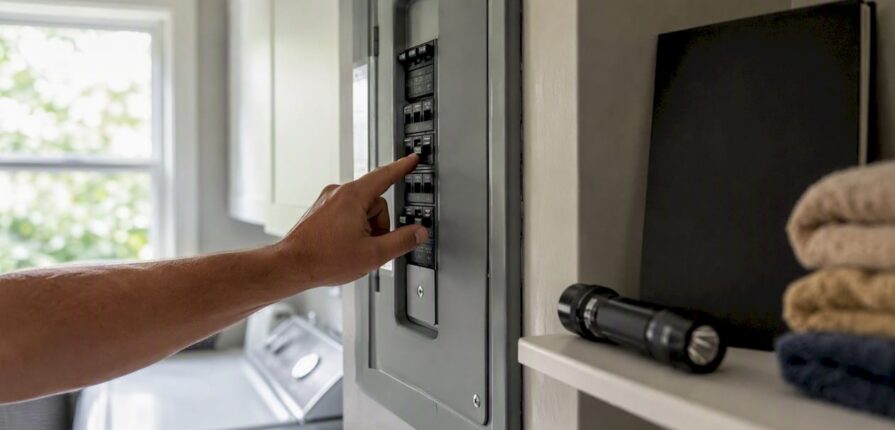
If your AC keeps tripping its breaker, the circuit is drawing more current than it’s rated to handle, or there’s a short somewhere in the system. The breaker isn’t the villain here. As AAA Calvert explains, a tripped breaker is doing exactly what it was designed to do: protecting your wiring and equipment from damage. The dangerous move is resetting it over and over without knowing why it tripped.
Before you call anyone, run through this short checklist. These are the only safe checks to do yourself:
- Reset once only. Flip the breaker fully off, wait 30 minutes, then flip it back on. If it trips again immediately, leave it off.
- Check your air filter. A clogged filter forces the system to work harder and can push amp draw over the breaker’s limit.
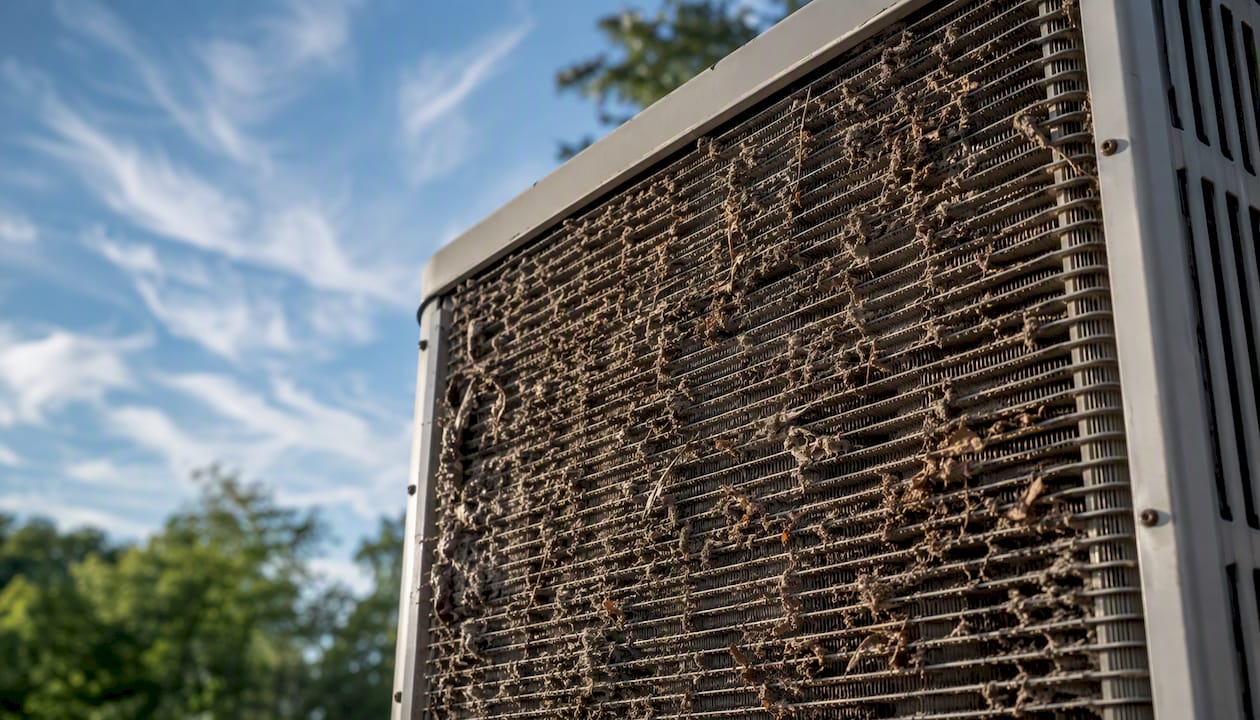
- Clear the outdoor unit. Remove any debris, vegetation, or objects blocking airflow around the condenser.
- Look at the refrigerant lines. Ice on the copper lines near the outdoor unit signals a problem that needs a technician.
- Note what you observe. Did the outdoor fan start? Did you hear humming? Did it trip instantly or after running for a while? Write it down.
Stop and call a pro immediately if:
- The breaker trips the moment you reset it
- You smell burning or see scorch marks on the panel
- The breaker feels hot to the touch
- You hear a loud hum but the unit doesn’t start
That second trip is your signal to leave the breaker off and schedule a diagnostic. Every forced restart after that risks turning a $200 capacitor repair into a $2,000+ compressor replacement.
Key Takeaways
A tripped AC breaker is almost always protecting you from a failing component — the second trip is your signal to stop resetting and call a professional before a small repair becomes a compressor replacement.
| Point | Details |
|---|---|
| Stop after the second trip | Repeated resets risk burning compressor windings and turning a small repair into a major one. |
| Timing identifies the cause | Instant trips point to shorts or capacitor failure; after-run trips usually mean dirty coils, low refrigerant, or overload. |
| Safe homeowner checks | Replace the filter, clear the outdoor unit, and reset once only — then observe and note what happens. |
| Breaker damage needs an electrician | Scorch marks, a mushy toggle, or heat at the panel are electrician calls, not HVAC calls. |
| Lucasair handles the diagnostic | Lucasair’s Central Florida technicians run full amp, capacitor, and refrigerant tests on the first visit, with financing available for repairs. |
Table of Contents
- Why does an AC trip its breaker? Common causes explained
- Safe troubleshooting steps to try before calling a technician
- How to tell if the breaker itself is the problem
- When should you call an HVAC tech versus an electrician?
- Maintenance habits that prevent future trips
- What repairs actually cost and how long they take
- What repeated resets actually risk
- Lucasair can diagnose your AC breaker issue today
- Sources
Why does an AC trip its breaker? Common causes explained
The timing of the trip is the single most useful diagnostic clue a technician gets before arriving on site. A trip that happens the instant the AC starts points to something completely different than one that happens after the system has been running for 45 minutes.
Dirty air filter
A severely clogged filter restricts airflow across the evaporator coil. The blower motor strains to pull air through, amp draw climbs, and eventually the breaker cuts power. This one is almost always a homeowner fix. Trips typically happen after the system has been running for a while, not at startup.
Dirty condenser coils
The outdoor coil sheds heat from the refrigerant. When it’s coated in dirt, grass clippings, or cottonwood, heat rejection suffers and the compressor has to work harder to maintain pressure. Amp draw rises steadily, and the breaker trips after a run cycle, often on the hottest days when the system is already working at its limit.
Failing capacitor
A weak or failed capacitor is one of the most common summer service calls in Florida. The capacitor gives the compressor and fan motor the electrical kick they need to start. When it’s failing, startup current stays elevated far longer than normal, and the breaker trips within seconds of the AC turning on. You may hear a brief hum followed by silence.
Fan motor failure
A seized or failing condenser fan motor draws locked-rotor current, which is many times higher than its normal running amperage. Trips happen at startup or shortly after. Without the fan moving air across the coil, the compressor overheats fast even if the motor itself isn’t the primary failure.
Compressor overload or locked rotor
A failing compressor is the most expensive scenario. When the compressor is mechanically seized, it draws enormous startup current and trips the breaker almost instantly. Repeated resets in this situation risk burning out the compressor windings entirely. Leave the unit off and call a technician — this is not a situation where one more reset will help.
Low refrigerant
Low refrigerant makes the compressor work harder to move heat, which increases amp draw. Common signs include ice forming on the refrigerant lines, reduced cooling, and the system running continuously without reaching the set temperature. Trips tend to happen after extended run cycles. Refrigerant issues always require a licensed technician.
Short circuit or ground fault
A short in the compressor windings, a chafed wire, or a failed contactor can cause an immediate trip every single time. There’s no safe homeowner check for this one. The breaker trips instantly on reset, and resolving this requires professional electrical testing.
Loose wiring connections
Loose lugs at the breaker or disconnect box create localized heat that mimics an overload. Trips are often intermittent and may correlate with the panel feeling warm. A licensed electrician can tighten connections and test with thermal imaging to confirm.
Worn or undersized breaker
Breakers wear out. After years of repeated trips and high-current cycling, the internal mechanism weakens and the breaker starts tripping at current levels it used to handle fine. An undersized breaker, one that was never correctly matched to the AC’s amperage rating, will trip regularly even when the system is healthy.
Symptom-to-cause quick reference:
| Trip timing | Likely cause | Safe homeowner check? |
|---|---|---|
| Instantly at startup | Capacitor failure, short/ground fault, locked compressor | No — call a pro |
| After a run cycle | Dirty coils, dirty filter, low refrigerant | Check filter and coils first |
| Intermittent, no pattern | Loose wiring, weak breaker, marginal overload | No — call electrician |
| After power outage or storm | Surge damage, contactor welded | No — call a pro |
| Trips with nothing running | Failed breaker | No — call electrician |
Pro Tip: Before calling for service, check these common AC issues so you can describe the symptom pattern accurately. Technicians diagnose faster when you can say “it trips about 20 minutes after startup” versus “it just keeps tripping.”
Safe troubleshooting steps to try before calling a technician
A structured homeowner checklist resolves a meaningful number of breaker-trip cases before a service call is ever needed. Work through these in order, and stop the moment you hit a safety checkpoint.
- Turn the thermostat to “off.” Before touching the breaker, set the thermostat to off so the AC won’t try to start the moment power is restored.
- Go to the electrical panel and flip the AC breaker fully off. Don’t just leave it in the tripped position. Move it firmly to off, then wait a full 30 minutes. This allows refrigerant pressures to equalize and gives the compressor a chance to cool down before it’s asked to start again.
- Inspect and replace the air filter. Pull the filter and hold it up to light. If you can’t see light through it, replace it before doing anything else. A 1-inch filter in a Florida home typically needs replacement every 30–60 days during peak cooling season.
- Walk outside and inspect the condenser unit. Clear any leaves, grass, or debris from around the unit. Confirm the fins aren’t crushed or blocked. Look at the refrigerant lines: if the insulated copper line is covered in ice, stop here and call a technician. Do not reset the breaker.
- Check the disconnect box near the outdoor unit. The disconnect should be fully seated. If it looks burned, melted, or the pull-out fuse holder is damaged, stop and call an electrician.
- Reset the breaker once. Flip it firmly to off, then to on. Go back outside and watch the condenser unit for 60 seconds. Does the fan start spinning? Do you hear the compressor hum and then kick in? Or does the breaker trip again immediately?
- If it trips again, leave it off. This is the hard stop. A second trip means the system is telling you something a reset won’t fix.
- Note everything you observed. Write down: did the fan start? Did you hear humming? How long before it tripped? Any smells? This information cuts diagnostic time significantly when the technician arrives.
Pro Tip: The 30-minute wait before a reset isn’t optional. Starting a compressor against high head pressure is one of the fastest ways to damage it. If you’re in a hurry, you’re making the repair more expensive.
For a more detailed walkthrough of what to check before the technician arrives, the AC repair pre-check guide from Lucasair covers the same ground with additional photos and context.
How to tell if the breaker itself is the problem
Sometimes the AC is fine and the breaker is the failure point. Circuit breakers sense overcurrent and open the circuit to protect wiring, but the mechanism itself wears out over time, especially after years of high-current cycling from a large AC compressor.
These are the physical signs that point to the breaker rather than the AC equipment:
- Hot to the touch. A breaker that feels noticeably warm or hot when the AC isn’t even running is a red flag. Some warmth under load is normal; heat at rest is not.
- Scorch marks or discoloration. Any brown or black marks on the breaker face, the panel interior, or the wiring insulation near the breaker indicate heat damage.
- Burning smell from the panel. Electrical burning has a distinct, sharp smell. If you notice it near the panel, don’t reset anything. Call an electrician.
- “Mushy” or loose toggle. A healthy breaker snaps firmly between on, off, and tripped positions. If the toggle feels soft, doesn’t snap cleanly, or won’t stay in the on position, the mechanism is worn.
- Trips with nothing else running. If the breaker trips even when the AC is off and no other loads are on that circuit, the breaker itself is the problem.
- Other circuits behaving oddly. Flickering lights, other breakers tripping, or a burning smell anywhere in the panel suggest a panel-level issue that goes beyond the AC breaker.
You can safely observe all of these from outside the panel. Do not open the panel cover, do not attempt to replace a breaker yourself, and do not reset a breaker that shows scorch marks or smells like burning. A licensed electrician handles breaker and panel work. An HVAC technician handles the AC equipment. These are two different calls, and mixing them up wastes time and money.
For a broader look at HVAC system warning signs, Lucasair’s guide covers the physical and operational signals worth knowing before a service visit.
When should you call an HVAC tech versus an electrician?
The right call depends on what you observed. Here’s the decision framework:
Call an electrician (or emergency service) when:
- The breaker trips instantly on reset with no AC running
- You see scorch marks, smell burning, or the panel is hot
- The breaker toggle is mushy or won’t hold position
- Other circuits in the panel are also behaving erratically
- The disconnect box near the outdoor unit shows burn marks
Call an HVAC technician when:
- The breaker trips at startup with humming (capacitor or compressor)
- The breaker trips after the system has been running (coils, refrigerant, overload)
- There’s ice on the refrigerant lines
- The outdoor fan doesn’t start but the compressor hums
- You’ve replaced the filter and cleared the unit and it still trips
What a technician will test on a diagnostic visit:
- Amp draw under load using a clamp meter, compared against the nameplate rating
- Capacitor health with a capacitance meter (a weak cap is often the whole story)
- Contactor condition — pitted or welded contacts cause hard starts and high current draw
- Compressor locked-rotor test to check whether the compressor can start safely
- Insulation resistance test on compressor windings to detect internal shorts
- Refrigerant pressure to assess whether low charge is forcing the compressor to overwork
- Thermal imaging on panel connections to find loose lugs generating heat
What to tell the technician before they arrive:
- Exactly when the trip happens (instantly, after X minutes, intermittent)
- Whether the outdoor fan started spinning
- Any sounds: humming, clicking, grinding, silence
- Whether you smell anything unusual
- Whether the panel or breaker felt warm
- Whether other circuits were affected
- Photos of the panel and outdoor unit if you can safely take them
This short list of observations materially reduces triage time. A technician who arrives knowing “it trips 15 minutes after startup, the fan runs, and there’s ice on the suction line” can often diagnose the problem before opening a single panel.
Pro Tip: Use Lucasair’s HVAC troubleshooting guide for Central Florida homeowners to build your observation notes before the tech arrives. It’s a five-minute exercise that can save an hour of diagnostic time.
Typical diagnostic visits run 45–90 minutes. Ballpark repair costs vary widely by cause: a capacitor replacement generally runs $150–$350 including labor; a contactor swap is similar. Refrigerant leak detection and repair starts around $200–$500 and can climb depending on the leak location. Compressor replacement is the expensive end, typically $1,200–$2,500 or more depending on the unit. Electrician panel work for a breaker replacement runs roughly $150–$300 for a single breaker. These are estimates — actual costs depend on your equipment, access, and local labor rates.
Maintenance habits that prevent future trips
Most breaker trips aren’t random failures. They’re the end result of deferred maintenance that pushed a marginal component past its limit on a hot afternoon.
- Replace filters on schedule. In Central Florida’s climate, a 1-inch filter needs changing every 30–60 days during cooling season. A 4-inch media filter can go 3–6 months. Mark it on your calendar.
- Keep the outdoor unit clear. Maintain at least 2 feet of clearance on all sides. Trim back shrubs, rinse the coil fins with a garden hose once a season, and never stack anything against the unit.
- Schedule an annual tune-up in spring. Before the heavy cooling season starts, a professional tune-up includes amp checks on the compressor and motors, a capacitor health test, contactor inspection, refrigerant pressure check, and connection tightening. This is the single most effective way to catch a failing capacitor or marginal compressor before it trips your breaker on the hottest day of July.
- Confirm your circuit is dedicated. Your AC should be on its own dedicated circuit, sized to the unit’s nameplate amperage. If other loads share that circuit, trips become more likely. An electrician can verify this quickly.
- Consider surge protection. A whole-home surge protector or a dedicated AC surge protector guards against voltage spikes from lightning and grid fluctuations, which are common in Florida and can damage contactors and control boards. Surge protectors for AC equipment are a relatively low-cost addition compared to the components they protect.
- Don’t skip the duct inspection. Restricted or leaking ducts force the blower to work harder, which increases motor amp draw over time.
Pro Tip: Spring is the right time for a seasonal AC tune-up. Scheduling in April or early May means you’re ahead of the summer rush and any marginal parts get replaced before they fail under peak load.
What repairs actually cost and how long they take
Knowing the ballpark before you call helps you make a faster decision about whether to schedule immediately or wait.
- Diagnostic visit: 45–90 minutes on-site; covers amp testing, visual inspection, and component checks. Most HVAC companies charge a service call fee that applies toward the repair if you proceed.
- Filter and coil cleaning: $75–$200 depending on condition and access. Often included in a tune-up.
- Capacitor replacement: $150–$350 parts and labor. Fast repair, often same-visit.
- Contactor replacement: $150–$350. Also typically a same-visit fix when the part is on the truck.
- Refrigerant leak detection and recharge: $200–$600+. Leak location affects cost significantly. A slab leak inside a coil is more expensive than an accessible fitting.
- Compressor replacement: $1,200–$2,500+. At this price point, the age of the system matters. A compressor replacement on a 12-year-old unit often leads to a conversation about full system replacement instead.
- Electrician breaker replacement: $150–$300 for a single breaker. Panel replacement, if needed, is a larger job starting around $1,500–$3,000.
The cost escalation pattern is predictable: every repeated reset on a failing compressor risks burning the windings, which turns a capacitor repair into a compressor replacement. Acting on the first or second trip is almost always cheaper than waiting.
What repeated resets actually risk
Here’s the honest technician’s view: the homeowners who end up with the biggest repair bills are almost never the ones who called too early. They’re the ones who reset the breaker six times over a weekend hoping it would sort itself out.
A tripped breaker is a symptom, not the problem. The breaker is doing its job. When a compressor is struggling to start, its locked-rotor current can reach many times its normal running amperage. Each forced restart hammers the windings with that current. The first reset might not cause permanent damage. The fifth one often does.
The other thing worth saying plainly: in Central Florida, the most common cause of a summer breaker trip is a failing capacitor. It’s a $150–$350 fix. Left alone, a struggling compressor trying to start without a functional capacitor can fail within a season. That’s a $1,500+ repair or a full system replacement. The math on calling early is not complicated.
Lucasair was founded by Army Veteran Cameron Lucas in Eustis, Florida, and the team has been diagnosing exactly these situations across Central Florida since 2018. The recommendation is always the same: leave the unit off after the second trip and get a technician on-site before the problem compounds.
Lucasair can diagnose your AC breaker issue today
When your AC breaker keeps tripping and the filter check didn’t fix it, the fastest path to a cool house is a same-day diagnostic from a technician who carries the most common parts on the truck.

Lucas Air serves homeowners and property managers across Central Florida, including Eustis, Tavares, The Villages, and surrounding communities. On a first visit, the team runs a full amp-draw test, checks capacitor health, inspects the contactor, and tests refrigerant pressure — the complete diagnostic picture, not just a visual check. Financing options are available for larger repairs or system replacements, so cost doesn’t have to delay a fix.
Veteran-owned and locally operated, Lucasair offers AC repair and diagnostic services with straightforward pricing and no upsell pressure. If you’re in the Tavares area, same-day AC repair appointments are available. Schedule online or call to book a diagnostic visit before the next hot afternoon.
Sources
- Why Does My Circuit Breaker Trip Every Time the AC Turns On? (And Why You Shouldn’t Keep Resetting It) – AAA Calvert
- How circuit breakers work – HowStuffWorks
- AC Breaker Keeps Tripping? Complete Troubleshooting Guide 2026
Recommended
- Step by Step AC Troubleshooting for Homeowners – Lucas Air Conditioning and Heating
- Things to Check Before Your AC Repair Call – Lucas Air Conditioning and Heating
- Common AC Repair Issues Every Homeowner Should Know – Lucas Air Conditioning and Heating
- Essential HVAC Preventative Maintenance Guide for Homeowners
