
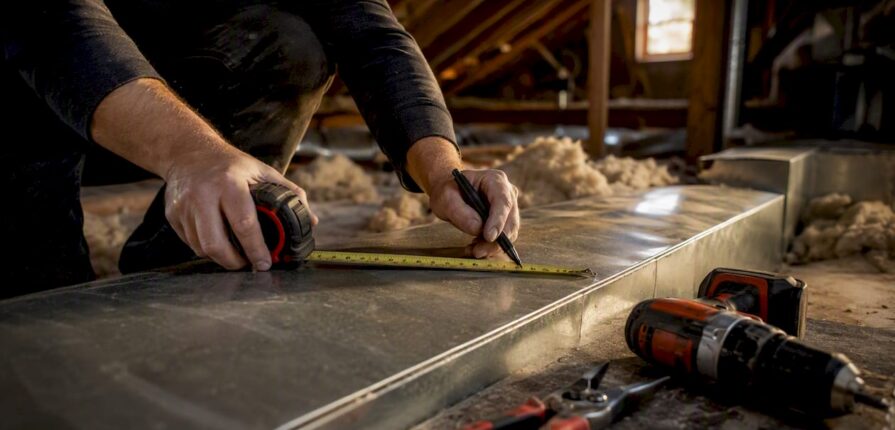
Most homeowners replacing a full duct system in 2026 spend somewhere between $1,400 and $7,000, with a national average near $3,500. Larger homes or jobs with tight access can result in significantly higher costs, sometimes exceeding typical ranges by several thousand dollars. Before you commit to replacement, however, consider that if leaks are your main issue, sealing options like manual sealing or Aeroseal can be substantially less expensive and still provide similar improvements in comfort.
Your immediate next steps:
- Inspect first. Walk every register, check for visible duct damage, and note rooms with weak airflow or temperature swings. Document what you find with photos.
- Test for leaks before assuming replacement. A duct blower test can tell you whether sealing is the smarter call.
- Get 2–3 written quotes from licensed HVAC contractors, each with line-item breakdowns for materials, labor, disposal, and permits.
Key Takeaways
Full duct replacement in 2026 typically costs $1,400–$7,000 for most homes, but sealing should be evaluated first, access is the biggest cost driver, and getting 2–3 written quotes is the only way to budget accurately.
| Point | Details |
|---|---|
| Typical cost range | Full replacement runs $1,400–$7,000 for most homes; large or hard-to-access homes can exceed $12,000. |
| Seal before you replace | DOE data shows 20–30% of conditioned air is lost to leaks; manual sealing ($350–$1,000) or Aeroseal (several thousand dollars) often solves the problem cheaper. |
| Access drives the price | Labor is 40–60% of the total bill; a tight crawlspace or inside-wall run can double labor hours versus an open attic. |
| Budget a contingency | Set aside 10–15% above your highest quote for hidden runs, insulation damage, or code-required upgrades found during demo. |
| Lucasair for Central Florida | Lucasair provides written, line-item duct inspection quotes in Central Florida, covering sealing, Aeroseal, and full replacement options. |
Table of Contents
- How much does duct replacement cost? A full breakdown
- What drives duct replacement prices up or down?
- Which duct material is right for your home?
- How site conditions change your quote
- What extras should you budget for?
- Should you seal, use Aeroseal, or replace?
- How to get accurate quotes and hire the right contractor
- Timelines, contingency planning, and regional pricing
- How Lucasair handles duct inspections and replacements in Central Florida
- What duct jobs actually look like from the field
- Get a straight answer on your duct costs from Lucasair
- Sources
How much does duct replacement cost? A full breakdown
The national average for a full duct replacement sits around $3,500, but that number hides a wide spread. A small home with an open attic and flex duct often sees costs below several thousand dollars. A 2,500 sq ft home with inside-wall runs and sheet metal can easily hit $8,000–$12,000. A second 2026 analysis places full replacement for a 2,000–3,000 sq ft home at $3,500–$12,000 with a national median near $5,800, reflecting how much access and material choice move the final number.
Per-linear-foot installed cost by material
“Installed” means the contractor supplies the duct, cuts and fits it, connects it to the air handler and registers, seals joints, and hauls away the old system. It does not typically include drywall patching, register upgrades, or system rebalancing unless those are listed separately.
| Material | Installed cost per linear foot |
|---|---|
| Flexible duct | $9–$25/LF |
| Galvanized spiral | $9–$37/LF |
| Rigid sheet metal | $20–$62+/LF |
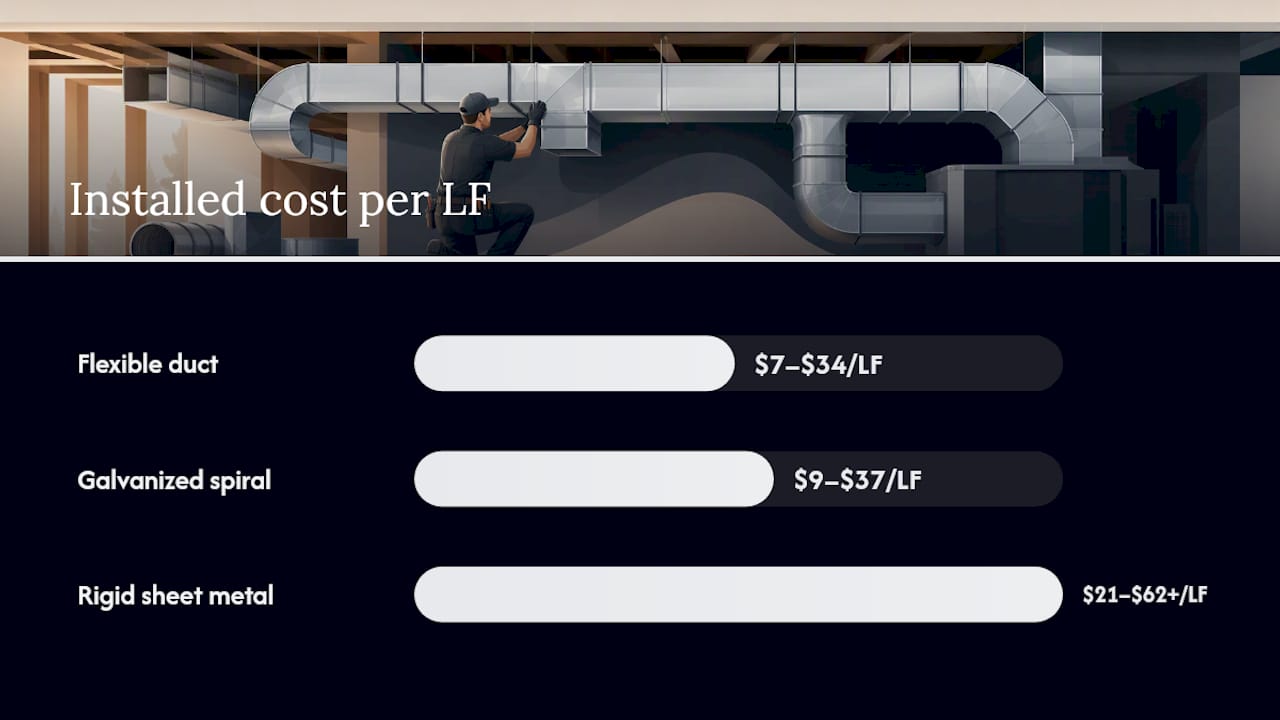
Per HVAC Project Cost’s 2026 data, flex duct runs $7–$34/LF installed across datasets, spiral $9–$37/LF, and rigid sheet metal $21–$62+/LF. The spread within each category reflects access difficulty more than the material cost.
Typical total cost by home size
| Home size (sq ft) | Typical total installed range |
|---|---|
| — | $1,400–$3,500 |
| 1,400–1,700 | $2,500–$5,800 |
| 2,000–2,500 | $3,500–$8,000 |
| 2,500–3,000 | $5,000–$12,000 |
| 3,000+ | $7,000–$12,000 |
Sealing as an alternative: Manual duct sealing generally costs a few hundred to around a thousand dollars, while Aeroseal aerosol sealing as a standalone treatment typically costs more, often several thousand dollars. For homes where leakage is the core issue, those numbers are worth comparing against a $5,000–$8,000 replacement quote.
What drives duct replacement prices up or down?
Labor accounts for 40–60% of a typical duct job, with crews charging roughly $83–$151 per hour. That means anything that slows the crew down hits your bill hard. Here are the main cost drivers to watch:
- Accessibility. An open, stand-up attic with no insulation in the way is the cheapest scenario. A tight crawlspace, inside-wall runs, or between-floor chases can double labor hours on the same linear footage.
- Scope. Partial replacement (one branch or one zone) costs less upfront but may not solve whole-system performance issues.
- Material choice. Sheet metal requires custom fabrication and more handwork on-site. Flex duct installs faster but has a shorter lifespan in humid climates.
- Removal and disposal. Pulling out old ductwork, especially if it contains fiberglass duct board or deteriorated flex, adds time and disposal fees.
- Permits. Many jurisdictions require a mechanical permit for full duct replacement. Permit requirements and local code standards vary significantly by municipality and can add both fees and required inspections.
- Resizing returns. Undersized return air ducts are one of the most common design flaws in older homes. Correcting them during replacement adds cost but improves system performance.
- Insulation. Ducts in unconditioned spaces (attics, crawlspaces) need insulation wrap. If the existing insulation is damaged or missing, that’s a separate line item.
- Local code requirements. Some municipalities require duct leakage testing post-installation, fire-stopping at penetrations, or specific sealing standards.
Keeping up with HVAC preventative maintenance reduces the likelihood of premature duct failure, which is worth factoring into your long-term cost picture.
Which duct material is right for your home?
Material choice affects both the upfront air duct installation price and how long you go before the next service call. Here’s how the four main options compare.
| Material | Installed cost/LF | Expected lifespan | Best for | Energy/comfort impact |
|---|---|---|---|---|
| Insulated flex duct | $9–$25 | 15–25 years | Residential branch runs, tight spaces | Good if properly supported; sags reduce airflow |
| Galvanized spiral | $9–$37 | 25–50 years | Exposed runs, commercial, high-velocity systems | Excellent; rigid shape maintains airflow |
| Rigid sheet metal | $20–$62+ | 30–50+ years | Main trunks, custom runs, high-performance builds | Best; lowest leakage when sealed properly |
| Duct board (fiberglass) | $10–$30 | 10–20 years | Low-cost residential, attic plenums | Moderate; degrades faster in humid climates |
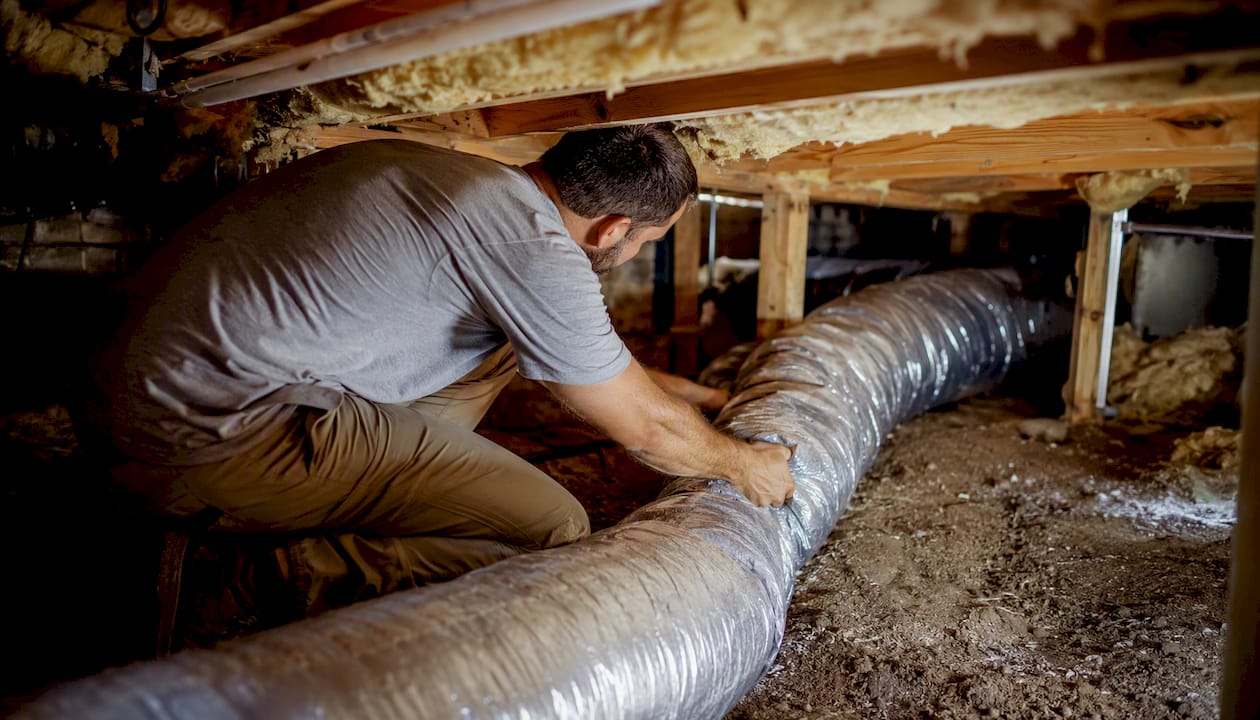
Insulated flex duct is the most common choice in residential replacement because it’s fast to install and handles curved runs without custom fabrication. The downside: it sags over time if not properly supported, and in Florida’s humidity, the outer jacket can degrade faster than in drier climates.
Galvanized spiral hits a sweet spot for durability and cost. It’s stiffer than flex, holds its shape, and works well in exposed basement or utility-room runs where aesthetics matter.
Rigid sheet metal is the premium option. It requires a sheet metal shop or skilled fabricator, which is why installed costs run higher. But it’s the most airtight when properly sealed and lasts the life of the building in most cases.
Duct board is worth knowing about mainly so you can recognize it. It’s the pink or gray fiberglass panel material used for plenums and some branch runs. It’s inexpensive to install but deteriorates in humid attics, and many contractors won’t use it for new work anymore.
Sheet metal needs more handwork on-site than flex, which is why the labor component of a sheet metal job is proportionally higher even before you factor in access difficulty.
How site conditions change your quote
The same 200 linear feet of duct can cost $2,000 in one house and $5,000 in another. The difference is almost entirely access. Accessibility and local code requirements are among the most significant cost multipliers contractors encounter.
Here’s what an estimator is mentally pricing when they walk your home:
- Stand-up basement or utility room: Easiest access. Crew can work upright, move freely, and stage materials nearby. Minimal added labor.
- Open attic with pull-down stairs: Common in Florida. Manageable if the attic has enough clearance and the existing insulation isn’t blocking duct runs.
- Low-clearance crawlspace: Crew works on their backs or knees. Every linear foot takes longer. Expect a meaningful labor premium over an open-attic job.
- Inside-wall runs: Requires opening drywall, which adds both labor and a separate drywall repair cost afterward.
- Between-floor chases (multi-story homes): The most expensive scenario. Accessing ducts between a first and second floor often means cutting into finished ceilings or walls.
- Attic with deep insulation: Crews have to move insulation out of the way, work around it, and restore it. Adds time and sometimes material cost.
Beyond access, watch for code-driven add-ons. Some jurisdictions require fire-stopping where ducts penetrate fire-rated assemblies, smoke barriers in commercial buildings, or post-installation leakage testing. These aren’t optional, and they don’t always show up in a first estimate.
Pro Tip: Before the estimator arrives, photograph every accessible duct run, note where registers are located, and measure the clearance in your attic or crawlspace. That information can cut 30–45 minutes off the site visit and reduces the chance of a change order when the crew discovers something unexpected.
What extras should you budget for?
Full duct replacement rarely ends at the duct itself. Budget for these common add-ons, and confirm each one is addressed as a separate line item on any written estimate:
- Drywall patching and painting: $200–$800+ depending on how many walls or ceilings were opened. Some contractors subcontract this; others don’t include it at all.
- Register and grille replacement: $10–$50 per register for standard residential sizes. Easy to overlook, but old registers that don’t seal properly undermine a new duct system.
- Zone dampers: $200–$500 per damper installed, plus controls. Relevant if you’re adding zoning during replacement.
- System balancing: $200–$500 for a full airflow balance after installation. Worth every dollar; skipping it often means uneven temperatures persist even with new ductwork.
- Disposal fees: $100–$400 depending on volume and local disposal rates. Always confirm this is included in the quote.
- Permit fees: Typically $50–$500 depending on jurisdiction and project scope. Some municipalities charge a flat fee; others base it on project value.
On the insurance question: standard homeowners insurance generally does not cover ductwork damaged by normal wear and tear. Coverage is typically limited to sudden, accidental events like fire or a fallen tree. Home warranties are different. Many plans cover duct repair or replacement for wear-and-tear failures, subject to plan limits and exclusions. Check your specific plan before assuming you’re covered or uncovered.
If you’re planning duct work alongside a broader remodel, coordinating the two projects can save mobilization costs. Integrating HVAC work into home renovations is worth planning carefully so you’re not opening walls twice.
Should you seal, use Aeroseal, or replace?
This is the decision most homeowners get wrong by defaulting to replacement when sealing would have done the job. The Department of Energy estimates that 20–30% of conditioned air is lost through duct leaks in a typical home. That’s a significant efficiency loss, and sealing addresses it at a fraction of replacement cost.
| Option | Typical cost | Best for | Timeline |
|---|---|---|---|
| Manual sealing (mastic/tape) | $350–$1,000 | Accessible joints, minor leakage | Half-day to 1 day |
| Aeroseal | several thousand dollars | Distributed leaks, hard-to-reach joints | 4–8 hours |
| Full replacement | $1,400–$12,000+ | Aged, contaminated, or collapsed ducts | 1–5 days |
Use this checklist to decide:
- Seal first if: Ducts are under 15 years old, structurally intact, and leakage is the primary complaint. Aeroseal is particularly effective when leaks are distributed through inaccessible joints.
- Consider replacement if: Ducts are over 20–25 years old, show visible collapse or contamination (mold, rodent damage), have significant insulation failure, or if more than 30–40% of the system is compromised.
- Replace alongside a new HVAC system when the air handler or condenser is also near end-of-life. Replacing ductwork at the same time as a new system saves mobilization costs and avoids a second round of disruption.
- Apply the $5,000 rule with context. Contractors sometimes reference an informal $5,000 rule for HVAC systems: if repair costs approach or exceed $5,000, full replacement may be more economical. That rule applies to whole-system economics, not isolated duct repairs. A $2,000 duct repair on an otherwise healthy 8-year-old system is usually worth doing.
How to get accurate quotes and hire the right contractor
Getting three quotes isn’t just about finding the lowest price. It’s about getting comparable quotes so you can actually evaluate what each contractor is proposing. Vague estimates make that impossible.
Before you call anyone, document your system: photograph accessible duct runs, note the age of the system, list every register location, and inspect your HVAC system for visible damage or disconnected sections. That documentation speeds every site visit.
Contractor vetting checklist:
- Valid state HVAC contractor license (verify with your state licensing board)
- General liability insurance and workers’ compensation
- Written, line-item estimate (not a single lump sum)
- References from similar jobs in the past 12 months
- Manufacturer certifications where relevant (e.g., Aeroseal-certified for sealing work)
Questions to ask on-site:
- What’s included in removal and disposal?
- Will you pull the required permits, and what’s the fee?
- How will you test and balance the system after installation?
- What warranty covers the labor, and what covers the materials?
- What happens if you find additional damage once the old duct is removed?
Red flags to walk away from:
- A single-number estimate with no line items
- A bid that’s 40%+ below the others with no explanation
- Pressure to sign before you’ve compared quotes
- No mention of permits on a full replacement job
- Contractor who can’t name the material they plan to install
For a prepared list of questions to bring to your estimate appointment, Lucasair’s HVAC installation questions for homeowners covers the full checklist.
Timelines, contingency planning, and regional pricing
A typical whole-home duct replacement follows this sequence: site visit and measurement (1–2 hours), permit application (1–10 business days depending on jurisdiction), demo and removal (half-day to 1 day), installation (1–3 days for most homes), and post-installation testing and balance (2–4 hours). Total elapsed time from first call to finished job: 1–3 weeks in most markets, longer if permits are slow.
Partial replacements (one zone or one branch) can often be completed in a single day once permits are in hand.
Hidden duct runs, unexpected insulation damage, and code-required upgrades discovered during demo are common. A contractor who finds a collapsed section behind a wall mid-job will need to address it. Having that buffer avoids a stressful mid-project conversation.
Regional pricing: Labor rates vary meaningfully across the country. High-cost coastal metros (San Francisco, New York, Boston) carry labor premiums of roughly 18–25% above the national average, while the Midwest and Southeast tend to run below it. Central Florida sits in the moderate range, though summer demand can tighten contractor availability and push prices up. For local pricing, Lucasair’s rates page gives a current reference point for Central Florida jobs.
Pro Tip: Schedule duct work in fall or early spring in Florida. Contractor availability is better, and working in an attic in July is brutal even for experienced crews.
How Lucasair handles duct inspections and replacements in Central Florida
Lucasair serves residential and commercial customers across Central Florida, including Eustis and the surrounding Lake County area. The inspection and quoting process is built around transparency: every written estimate breaks out materials, labor, disposal, and permit costs as separate line items, so you know exactly what you’re paying for.
What a Lucasair duct inspection covers:
- Visual inspection of all accessible duct runs, joints, and connections
- Airflow checks at registers to identify weak zones
- Assessment of insulation condition on attic and crawlspace runs
- Identification of disconnected, collapsed, or contaminated sections
- A written recommendation: seal, Aeroseal, partial replacement, or full replacement
Lucasair offers both manual sealing and Aeroseal services, so the recommendation is based on what your system actually needs, not on what generates the largest job. For homes where the duct system is sound but leaky, sealing is the first recommendation. Replacement is reserved for systems that genuinely need it.
Financing options are available for larger jobs, and Lucasair extends discounts to military personnel and first responders. For a full picture of the installation process, see the HVAC installation step-by-step guide.
Pro Tip: Ask your technician to photograph every accessible duct section during the inspection. That documentation protects you if a dispute arises later and gives you a baseline for future maintenance visits.
What duct jobs actually look like from the field
The surprises on duct jobs almost never come from the duct itself. They come from what’s around it. A tight attic that looked accessible from the pull-down stairs turns out to have a 14-inch clearance over the main trunk. A crawlspace that appeared dry on the site visit has standing water after a rain. An inside-wall run that wasn’t on the original plan shows up mid-demo.
The other thing that catches homeowners off guard is undersized return air. A house might have perfectly good supply ducts but a single 14×14 return for a 2,000 sq ft home. The system runs hard, the upstairs stays warm, and the homeowner assumes the ducts are the problem. Sometimes they are. But sometimes the fix is adding a return, not replacing everything.
One tactical tip worth remembering: before the estimator arrives, take a temperature reading at every register with an inexpensive infrared thermometer. Note which rooms are more than 3–4°F off the thermostat setpoint. That data takes five minutes to collect and tells a contractor more about your system’s actual performance than a visual inspection alone. It also reduces the chance of a vague estimate because the contractor has a specific performance problem to solve, not just “the ducts are old.”
Get a straight answer on your duct costs from Lucasair
Duct replacement quotes vary widely, and a number you find online is only useful once a contractor has seen your actual system. Lucasair offers on-site inspections for Central Florida homeowners and property managers that produce a written, line-item estimate with no pressure to sign.

The inspection includes a visual check of all accessible duct runs, airflow testing at registers, insulation assessment, and a written recommendation covering sealing, Aeroseal, partial replacement, or full replacement with costs broken out for each option. Financing is available for qualifying jobs, and military and first-responder discounts apply.
For residential and commercial duct and HVAC installation services in Central Florida, schedule your inspection with Lucasair today. Call, book online, or visit lucasair.com to get a written estimate you can actually use.
Sources
- Air Duct Replacement Cost in 2026: By Foot, By Home Size, and When to Seal Instead | Home Energy Decisions
- HVAC Ductwork Pricing: 2026 Guide to Costs | PipelineOn
- Ductwork Replacement Cost: 2026 Pricing by Home Size | HVAC Project Cost
- Is AC ductwork covered by a home warranty? | AHS
- Air duct replacement cost | Angi
Recommended
- Rates – Lucas Air Conditioning and Heating
- Upgrade your HVAC in 2026 for efficiency & cost savings – Lucas Air Conditioning and Heating
- HVAC upgrade benefits 2026: save costs and boost efficiency – Lucas Air Conditioning and Heating
- HVAC Maintenance Checklist for 2026: Avoid Costly Repairs – Lucas Air Conditioning and Heating
