
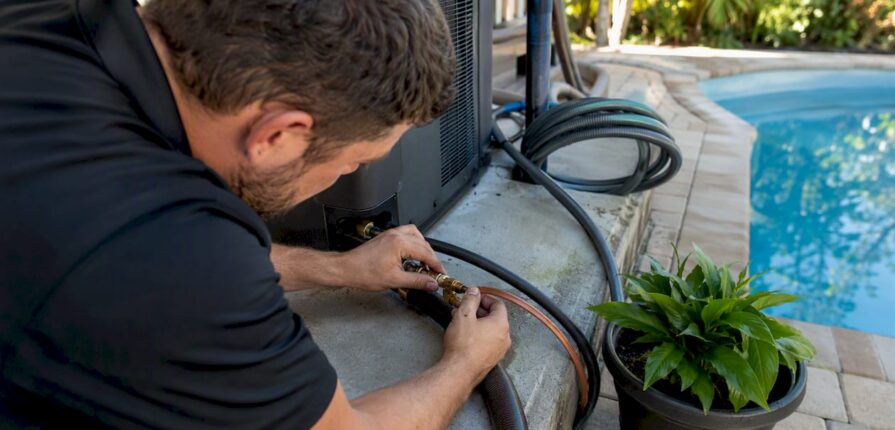
A pool heat pump runs $3,000–$9,000 installed for most residential pools, with the unit alone typically landing between $2,800 and $6,000. Operating costs average $50–$150 per month in warm climates, compared to $150–$400 per month for gas. If you swim regularly and live somewhere with mild winters, a heat pump usually pays for itself in 3–6 years and keeps paying you back for the next decade.
Here’s the short version of what you’re looking at:
- Unit only: $2,800–$6,000 depending on BTU size and brand
- Total installed: $3,000–$9,000 for most residential projects (LatestCost)
- Monthly operating cost: $50–$150 in warm climates vs. $150–$400 for gas (CostToRenovate)
- Payback period: Typically 3–6 years with regular use in warm climates
- Best fit: Homeowners who heat their pool at least 4–5 months per year in climates where air temps stay above 50°F
Pro Tip: If your existing gas heater is at end-of-life and you heat your pool regularly, replacing it with a heat pump is often the financially smarter move. The upfront cost is similar, but your monthly bills drop significantly.
Key Takeaways
Pool heat pumps cost $3,000–$9,000 installed for most residential pools and typically pay back their premium over gas in 3–6 years through lower monthly operating costs of $50–$150 versus $150–$400 for gas.
| Point | Details |
|---|---|
| Installed cost range | Most residential projects land between $3,000 and $9,000 depending on BTU size and electrical work. |
| Monthly operating advantage | Heat pumps run $50–$150/month in warm climates; gas heaters cost $150–$400/month for the same pool. |
| Payback period | Regular use in warm climates typically yields payback in 3–6 years; Central Florida often shorter. |
| Biggest hidden cost | Electrical panel upgrades add $600–$2,000 and are the most common budget surprise on installs. |
| Lucasair next step | Lucasair provides site-visit quotes, permit handling, and financing for Central Florida pool owners. |
Table of Contents
- What drives pool heat pump cost up or down?
- Breaking down the price: unit, labor, and total project ranges
- How much does it cost to run a pool heat pump?
- How to size a heat pump for your pool
- What happens on installation day and what extra costs to expect
- Lifespan, maintenance, and warranty: what to expect long-term
- Is a heat pump the right choice, or should you go with gas?
- A simple payback example you can run with your own numbers
- How to get an accurate installer quote
- Calculators and tools that give you real numbers
- A Lucas Air installer’s perspective on heat pump decisions
- What to do next: a quick action plan
- Lucasair handles pool heat pump installation in Central Florida
- Sources
What drives pool heat pump cost up or down?
The gap between a $3,000 project and a $9,000 one almost always comes down to five variables. Understanding them before you call an installer means you’ll know immediately whether a quote is reasonable or padded.
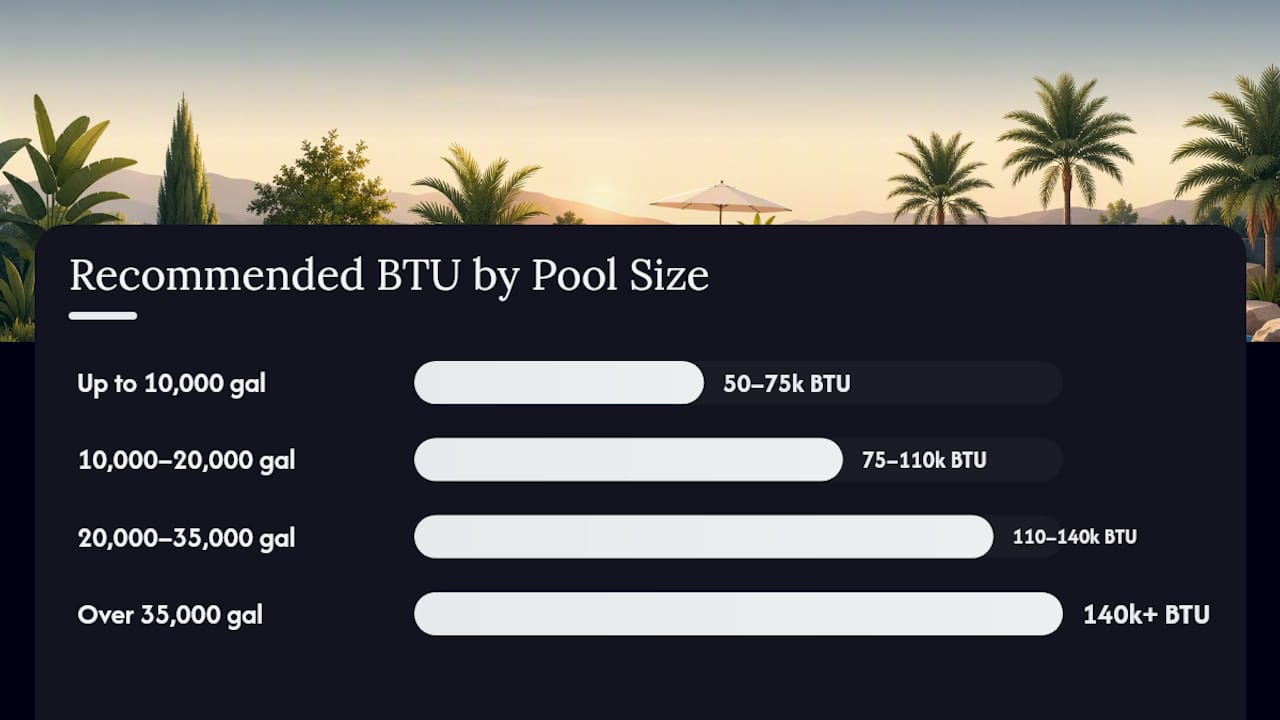
BTU size and pool volume are the biggest equipment-cost drivers. A small pool (10,000–15,000 gallons) might need a 50,000–75,000 BTU unit, while a large pool (30,000+ gallons) could require 120,000 BTU or more. Larger units cost more to buy and more to install because they draw higher amperage and need heavier wiring.
COP (Coefficient of Performance) measures how many BTUs of heat the unit produces per BTU of electricity consumed. A COP of 5.0 means the unit delivers five times the energy it draws. Higher-COP models, especially inverter-driven variable-speed units, cost $500–$1,500 more upfront but cut monthly bills noticeably. For a pool you heat often, that premium pays back fast. You can read more about how heat pump efficiency metrics affect your actual operating costs.
Electrical upgrades are the most common hidden cost. Most residential heat pumps require a dedicated 230V, 40–60A circuit. If your panel doesn’t have the capacity, a service upgrade can add $600–$2,000 to the project before the installer touches the heat pump itself.
Site access and layout matter more than most homeowners expect. Tight equipment pads, long refrigerant line runs, rooftop or wall mounts, and difficult plumbing tie-ins can each add $500–$2,000 to an install, pushing a mid-range project to the top of the cost band (Well Built Florida).
Climate and swim season length influence which unit you need. In Central Florida, a moderate-COP unit sized for the pool volume is usually sufficient year-round. In colder climates, you may need a larger unit or a model rated for low-ambient operation, both of which cost more.
Local labor rates and permitting fees vary by county and city. Florida permits for pool equipment typically run $75–$300, but some jurisdictions charge more and require inspections that add a half-day to the timeline.
Pro Tip: Ask your installer for a line-item quote that separates equipment, labor, electrical work, and permits. A single lump-sum number makes it nearly impossible to compare bids or spot inflated line items.
Breaking down the price: unit, labor, and total project ranges
The numbers below reflect typical U.S. residential projects. Your actual cost depends on the variables above, but these ranges give you a working budget.
Source: LatestCost and Well Built Florida
Three real-world scenarios show how these line items stack:
Small pool (12,000 gallons, 75,000 BTU unit): Equipment at $2,900, labor at $1,300, electrical at $400, plumbing and permits at $350. Total: roughly $5,000. This is the most common scenario for a modest residential pool with an existing adequate panel.
Medium pool (20,000 gallons, 100,000 BTU unit): Equipment at $4,200, labor at $1,800, electrical upgrade at $1,200, plumbing and permits at $500. Total: roughly $7,700. The panel upgrade is what pushes this project past the midpoint.
Large pool (35,000 gallons, 140,000 BTU unit): Equipment at $5,800, labor at $2,500, electrical at $1,500, site prep and permits at $700. Total: roughly $10,500. Large-pool projects with significant electrical work can exceed the typical $9,000 ceiling.
Consumer cost surveys from Angi put the average installed heat pump range at $2,500–$7,500, which aligns with the small-to-medium scenarios above. The large-pool scenario sits above that average because of the electrical upgrade.
How much does it cost to run a pool heat pump?
Operating cost depends on three things: your local electricity rate, how often you run the unit, and whether you use a pool cover. The Department of Energy publishes sample seasonal cost estimates using a COP of 5.0 and $0.1301/kWh, which gives a useful baseline for comparing cities.
Sample seasonal operating costs (DOE estimates, COP 5.0, $0.1301/kWh):
| City | Without Pool Cover | With Pool Cover |
|---|---|---|
| Miami, FL | $500–$700/season | $200–$350/season |
| Dallas, TX | $600–$800/season | $150–$400/season |
| Atlanta, GA | $700/season | $300/season |
| Los Angeles, CA | $550/season | $220/season |
| Kansas City, MO | $800/season | $350/season |
| New York, NY | $900/season | $400–$600/season |
| Chicago, IL | $1,000–$1,400/season | $450/season |
| Minneapolis, MN | $1,100/season | $500/season |
These figures assume a typical residential pool and a heat pump running in maintenance mode.
To estimate your own running cost, follow these steps:
- Find your pool volume in gallons (length × width × average depth × 7.5)
- Determine your target temperature rise (desired temp minus average low nighttime temp)
- Use a BTU calculator to find required heat output
- Divide BTU output by your unit’s COP to get BTU input, then convert to kWh (1 kWh = 3,412 BTU)
- Multiply kWh by your local electricity rate (check your utility bill)
- Multiply by hours of operation per month for a monthly estimate
For a faster estimate, the Pentair Pool Heat Pump Savings Calculator lets you plug in pool size, region, target temperature, and your electricity rate to get a side-by-side comparison against gas and electric resistance. Have your utility rate per kWh ready before you open it.
How to size a heat pump for your pool
Sizing is where most homeowners make the most expensive mistake: buying too small a unit and running it continuously at full load, which shortens compressor life and raises bills. The general rule is to size for your climate, not just your pool volume.
BTU rules of thumb by pool size:
- Pools up to 10,000 gallons: 50,000–75,000 BTU
- Pools 10,000–20,000 gallons: 75,000–110,000 BTU
- Pools 20,000–35,000 gallons: 110,000–140,000 BTU
- Pools over 35,000 gallons: 140,000+ BTU, often requiring two units
In colder climates or for pools with high surface area relative to volume, size up by one tier. A pool in Minneapolis needs a larger unit than the same pool in Miami, even at the same target temperature, because the ambient air temperature determines how efficiently the heat pump extracts heat.
Efficiency features worth paying for:
- Inverter/variable-speed compressor: These units modulate output to match actual heat demand rather than cycling on and off at full power. They run quieter, last longer, and often achieve higher effective COP in partial-load conditions, which is most of the time during maintenance heating.
- COP rating of 5.0 or higher: The DOE uses 5.0 as its baseline for efficiency estimates. Units with COP 6.0–7.0 are available and worth the premium if you heat frequently.
- Low-ambient operation rating: Standard heat pumps lose efficiency below 50°F and stop working below about 45°F. If you live somewhere with cool springs or falls, a unit rated for operation down to 40°F or lower extends your swim season without a gas backup.
- Titanium heat exchanger: Chlorinated pool water is corrosive. Titanium exchangers last significantly longer than cupronickel in high-chlorine environments.
Manufacturer examples to compare: Pentair’s UltraTemp and ThermalFlo lines, AquaCal’s TropiCal and HeatWave SuperQuiet series, and Hayward’s HeatPro line each cover the BTU ranges above with varying COP ratings and inverter options. Comparing spec sheets across these three brands gives you a solid baseline for what a given BTU and COP combination should cost.
What happens on installation day and what extra costs to expect
A standard pool heat pump installation takes 4–8 hours for a straightforward project. Here’s what a qualified installer covers:
Installer tasks, in order:
- Site assessment: confirm pad location, clearances, and airflow (most units need 24–36 inches of clearance on all sides)
- Pad or mounting: pour or level a concrete pad if one doesn’t exist, or confirm the existing pad is rated for the unit’s weight
- Plumbing tie-in: cut into the return line after the filter, install bypass valves and unions for future serviceability
- Electrical circuit: run a dedicated 230V circuit from the panel, install a weatherproof disconnect within sight of the unit
- Refrigerant charge: verify factory charge or add refrigerant if required by the unit’s installation specs
- Startup and testing: power up the unit, confirm flow rate and temperature rise, check for error codes, and walk the homeowner through controls
Common extra charges that show up after the initial quote:
- Panel or service upgrade: $600–$2,000 if ampacity is insufficient
- Trenching for electrical or plumbing runs: $300–$800 depending on distance
- New concrete pad: $200–$500
- Old unit removal and disposal: $100–$300
- Crane or hoisting for rooftop or elevated installs: $400–$1,000
- Long refrigerant line sets: $150–$400 for runs beyond 25 feet
Site constraints alone can add $500–$2,000 to a project that looked straightforward on paper. The best way to avoid surprises is to have the installer do a physical site visit before quoting, not a phone estimate.
Pro Tip: Before the crew arrives, clear a 6-foot perimeter around the equipment pad, confirm your electrical panel is accessible, and take photos of your current plumbing setup. It saves time and reduces the chance of a mid-job change order.
Lifespan, maintenance, and warranty: what to expect long-term
A well-maintained pool heat pump typically lasts 10–15 years. Neglected units, especially those with dirty coils or low refrigerant, often fail in 7–8 years. The difference is almost entirely maintenance.
Routine maintenance checklist:
- Clean the evaporator coil fins annually (a garden hose works; never use a pressure washer)
- Check and clear the area around the unit of leaves, debris, and vegetation quarterly
- Inspect plumbing unions and connections for leaks each season
- Verify refrigerant charge every 2–3 years if the unit seems to be losing efficiency
- Test the flow switch and thermostat settings at the start of each swim season
- Flush and balance pool chemistry before startup to protect the heat exchanger
Annual professional service plans for pool heat pumps typically run $150–$300 and usually include a coil cleaning, refrigerant check, electrical inspection, and startup test. That cost is worth it: a single compressor replacement runs $800–$2,000 in parts and labor, and most compressor failures trace back to deferred maintenance.
Warranty terms to read carefully:
- Compressor warranty: Look for 5–10 years. Some manufacturers offer a lifetime compressor warranty on premium models.
- Heat exchanger warranty: Titanium exchangers often carry 5–10 year coverage; cupronickel units may be shorter.
- Parts vs. labor: Many warranties cover parts but not labor after year one. A unit with a 5-year parts warranty and no labor coverage can still cost you $500–$1,000 in service calls during that period.
- Refrigerant coverage: Confirm whether refrigerant is included in warranty service calls or billed separately.
For a broader look at keeping your pool equipment running efficiently, the pool owner HVAC essentials guide covers maintenance schedules and paired-system considerations in more detail.
Is a heat pump the right choice, or should you go with gas?
The honest answer: it depends on how you use your pool and where you live. Heat pumps win on operating cost and lifespan. Gas wins on speed and cold-weather performance.
Side-by-side comparison:
| Factor | Heat Pump | Gas Heater |
|---|---|---|
| Upfront cost | $3,000–$9,000 installed | $1,500–$5,000 installed |
| Monthly operating cost (warm climate) | $50–$150 | $150–$400 |
| Heat-up speed | 1–3°F per day | Several degrees per hour |
| Minimum ambient temp | ~50°F for efficient operation | No air temp limit |
| Lifespan | 10–15 years | 7–12 years |
| Best for | Regular use, warm climates | Fast heat-up, cold climates, spas |
Heat pumps are designed for continuous maintenance heating, not on-demand rapid warm-up. If you leave your pool at temperature all season, a heat pump is almost always cheaper to operate over the life of the equipment. If you heat your pool only on weekends or need it warm within a few hours for a party, gas delivers that speed.
When gas or a dual-fuel setup makes more sense:
- You heat a spa that needs to go from 70°F to 104°F in under two hours
- Your climate regularly drops below 50°F during your swim season
- You heat the pool infrequently (fewer than 3 months per year)
A dual-fuel setup pairs a heat pump as the primary heater with a gas unit as backup. The heat pump handles day-to-day maintenance heating at low cost, and the gas unit kicks in for fast recovery after a cold snap or for spa heating. Automation controls can switch between the two based on ambient temperature or a timer. For homeowners who want efficiency most of the time but don’t want to be caught cold, this is the professional recommendation.
Heat pumps are 4–6x cheaper to operate per delivered BTU than gas in typical conditions, which is the core of the financial case. But that advantage disappears if the unit can’t operate efficiently because ambient temps are too low.
A simple payback example you can run with your own numbers
Here’s a conservative example comparing a heat pump against a gas heater for a 20,000-gallon pool in a warm climate, heated 8 months per year.
Step-by-step payback calculation:
- Upfront cost difference: Heat pump installed at $7,000 vs. gas heater installed at $3,500. Extra upfront cost: $3,500.
- Annual operating cost, heat pump: $100/month × 8 months = $800/year.
- Annual operating cost, gas: $275/month × 8 months = $2,200/year.
- Annual savings: $2,200 minus $800 = $1,400/year.
- Simple payback: $3,500 ÷ $1,400 = 2.5 years.
- 10-year net savings: ($1,400 × 10) minus $3,500 = $10,500 ahead over a decade.
In warm climates with regular use, payback commonly runs 3–5 years even with conservative assumptions. For homeowners in Central Florida who heat year-round or close to it, payback can be shorter because the swim season is longer and the heat pump operates efficiently almost every month.
Sensitivity note: If your electricity rate is above $0.15/kWh, your annual operating cost rises and payback extends slightly. If gas prices rise (as they have historically), the savings gap widens and payback shortens. Running the numbers at your actual utility rates using the Pentair savings calculator takes about five minutes and gives you a personalized estimate rather than a national average.
For homeowners weighing a pool heater upgrade, the payback math is often the deciding factor.
How to get an accurate installer quote
A vague quote is almost always a problem quote. Here’s how to get bids that are actually comparable.
Information to have ready before you call:
- Pool volume in gallons (or dimensions so the installer can calculate it)
- Current heater type and age
- Target water temperature and typical swim season months
- Electrical panel amperage and available breaker slots
- Photos of the equipment pad, existing plumbing, and electrical panel
- Whether you have a pool cover and what type
Questions to ask every installer:
- What BTU unit are you recommending and why?
- What COP rating does that unit carry?
- Does my panel need an upgrade, and is that included in the quote?
- Who pulls the permit, and is the permit fee included?
- What refrigerant type does the unit use, and is it still in production?
- What does the startup and commissioning process include?
- What warranty does the manufacturer offer, and what does your labor warranty cover?
- What’s your lead time from signed contract to install date?
Red flags on quotes:
- A single lump-sum number with no line-item breakdown
- No mention of permits or electrical work
- No written startup or commissioning procedure
- Vague warranty language (“manufacturer warranty applies” with no specifics)
- No site visit before quoting
Getting at least three quotes from licensed contractors gives you a realistic price range and surfaces any outliers. For a full list of questions to ask during the process, the HVAC installation questions checklist covers the full scope of what to confirm before signing.
Calculators and tools that give you real numbers
Online calculators are only as good as the inputs you give them. Here’s what to use and how to get accurate results.
Recommended tools:
- Pentair Pool Heat Pump Savings Calculator: Enter pool size, region, target temperature, and your electricity rate. It compares heat pump operating cost against gas and electric resistance side by side. Best for: getting a personalized monthly cost estimate before you talk to an installer.
Inputs that change results the most:
- Your local electricity rate per kWh (find it on your utility bill, not a national average)
- Whether you use a pool cover (can cut costs 30–50%)
- Your swim season length in months
- The COP of the specific unit being quoted
Run the calculator twice: once without a pool cover and once with one. The difference often justifies buying a quality solar or thermal cover immediately, even before the heat pump is installed. In many climates, a $300–$600 cover pays for itself in a single season by reducing the heat pump’s runtime.
A Lucas Air installer’s perspective on heat pump decisions
At Lucasair, the recommendation to switch from gas to a heat pump usually comes up in one of three situations: the existing gas heater is at or near end-of-life, the homeowner is heating the pool at least 5–6 months per year, or the monthly gas bills have become a recurring complaint.
When we typically recommend a heat pump:
- Gas heater is 8+ years old and showing efficiency or reliability issues (see our pool heater troubleshooting guide if you’re not sure where yours stands)
- The pool is used regularly, not just for occasional weekend parties
- The homeowner wants to extend the swim season without dramatically increasing energy costs
- The property has adequate electrical capacity or is willing to upgrade
Local tips for Central Florida homeowners:
- Siting matters for noise. Place the unit away from bedroom windows and neighbor property lines. Heat pumps produce 50–60 decibels of operating noise, similar to a window air conditioner.
- Florida’s mild winters mean most heat pumps here operate efficiently year-round, which is a significant advantage over colder-climate installations where the unit sits idle for months.
- Pairing a heat pump with a solar or thermal cover is the single highest-ROI upgrade for most Florida pool owners. The cover does the overnight work; the heat pump handles the rest.
- Permitting in most Central Florida counties is straightforward for pool equipment replacement, but it’s required. We handle permitting as part of every installation.
Lucasair quotes include a site visit, line-item pricing, permit coordination, and a written startup procedure. Financing options are available for homeowners who want to spread the upfront cost, and we offer maintenance plans that include annual coil cleaning, refrigerant checks, and priority service scheduling.
Pro Tip: If you’re on the fence about heat pump vs. gas, ask your installer to run the payback calculation with your actual utility rates and swim season. In Central Florida, the math almost always favors the heat pump for anyone heating more than 5 months per year.
What to do next: a quick action plan
Three steps that move you from reading to deciding:
- Check your swim season and usage pattern. If you heat fewer than 3 months per year or need rapid heat-up for a spa, a gas or dual-fuel setup deserves serious consideration. If you heat 5+ months, a heat pump is almost certainly the better long-term investment.
- Get your panel information and take photos. Know your panel’s amperage and available slots before calling installers. This single piece of information determines whether your project is a straightforward swap or a more involved electrical upgrade.
- Add a pool cover before or at the same time as the heat pump. A thermal or solar cover reduces the heat pump’s workload by 30–50%, which means a smaller unit may suffice and your monthly bills will be lower from day one.
For homeowners who heat frequently and want efficiency, a higher-COP inverter unit is worth the premium. For those with spas or cold-climate concerns, price out a dual-fuel setup before committing to heat pump only.
Lucasair handles pool heat pump installation in Central Florida
Lucas Air serves Central Florida homeowners who want a pool heat pump installed correctly, permitted, and backed by a real warranty, without the guesswork of managing multiple contractors.

The process starts with a site visit, not a phone estimate. Lucasair assesses your equipment pad, existing plumbing, and electrical panel before quoting, so the number you get reflects your actual project, not a national average. Installation includes permit coordination, a dedicated electrical circuit, plumbing tie-in with bypass valves, startup and commissioning, and a walkthrough of the controls. Financing is available for homeowners who want to spread the upfront cost over time.
For ongoing peace of mind, maintenance plans cover annual coil cleaning, refrigerant checks, and priority scheduling so your unit runs efficiently season after season. Ready to get a real number for your pool? Request a quote or call Lucasair to schedule your site visit.
Sources
- Pool Heat Pump Installation Cost 2026 – LatestCost
- Pool Heat Pump Cost: Realistic Price Ranges for US Buyers 2026 – Well Built Florida
- Pool Heater Cost in 2026: Gas vs. Heat Pump vs. Solar | CostToRenovate
- How much does it cost to install a swimming pool heater? | Angi
- Pool Heat Pump Savings Calculator | Pentair
Recommended
- Commercial Pool Heater Repair: Cut Costs 60% in 2026 – Lucas Air Conditioning and Heating
- What is a pool heat pump: Central Florida homeowner’s guide – Lucas Air Conditioning and Heating
- Upgrade your HVAC in 2026 for efficiency & cost savings – Lucas Air Conditioning and Heating
- Pool heater upgrade: comfort and savings in Central Florida – Lucas Air Conditioning and Heating
