
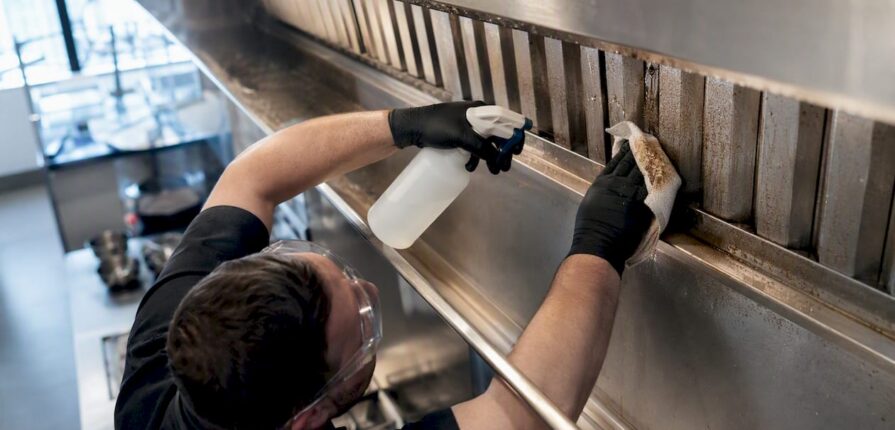
Do these five things this week to cut fire risk, protect food quality, and stay inspection-ready: verify your last hood-cleaning certificate is on file, check grease filters for buildup, swap any clogged make-up air (MUA) filters, visually inspect rooftop exhaust fans for grease drips, and confirm your fire-suppression system’s last service date.
This week’s priority actions:
- Pull your hood-cleaning certificate and check the date against your cooking volume (monthly for high-volume charbroil, quarterly for moderate use)
- Remove and inspect grease filters; clean or replace any that are saturated
- Check the MUA unit’s filter and swap it if airflow feels restricted
- Walk the rooftop and look for grease streaks on fan housings or drain pans
- Log today’s date in your maintenance binder as the baseline for your new schedule
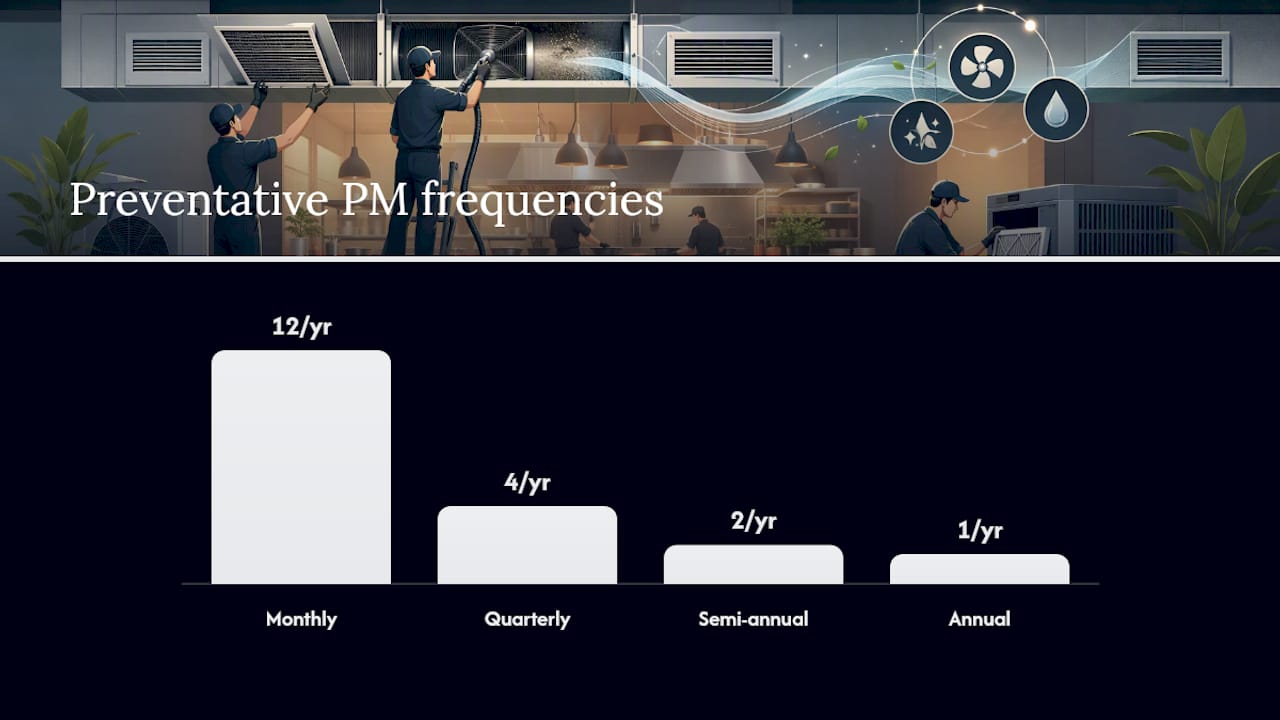
Quick maintenance schedule at a glance:
| Frequency | Task | Responsible |
|---|---|---|
| Daily | Visual check of grease filters; wipe hood surfaces | Kitchen staff |
| Weekly | Clean or replace grease filters; check condensate drain pan | Maintenance staff |
| Monthly | Inspect MUA filters; check fan belts; log grease depth | Manager or lead tech |
| Quarterly | Professional hood and duct cleaning (high-volume kitchens) | Licensed contractor |
| Semi-annual | Fire-suppression inspection; coil cleaning; full system check | Certified contractor |
| Annual | Full duct inspection; access panel check; system tune-up | Licensed contractor |
Key Takeaways
Regular, documented HVAC and exhaust cleaning is the single most effective action a food-service operator can take to reduce fire risk, pass inspections, and lower operating costs.
| Point | Details |
|---|---|
| NFPA 96 sets your frequency floor | Clean based on cooking volume and type; high-volume charbroil may require monthly service. |
| 1/8-inch grease depth triggers immediate cleaning | Measure with a gauge comb monthly; hitting this threshold overrides your calendar schedule. |
| Pair hood cleaning with suppression inspection | Schedule both on the same day to close compliance gaps and satisfy inspectors with one visit. |
| Documentation is the proof | Require signed certificates, timestamped photos, technician cert numbers, and hood stickers from every contractor visit. |
| Lucasair supports compliance | Lucasair provides preventative maintenance agreements, duct cleaning, and full service documentation for Central Florida food-service operators. |
Primary sources and further reading
The sources below are the ones inspectors and insurers expect you to know. Keep links or printed copies in your compliance binder.
- NFPA 96, Standard for Ventilation Control and Fire Protection of Commercial Cooking Operations — the governing standard for cleaning intervals, grease-depth thresholds, and documentation requirements
- Exhaust System Cleaning | UpCodes — local code tables with minimum cleaning frequencies and the 1/8-inch grease-accumulation trigger
- Fire Safety in Commercial Cooking Locations (FDNY guidance) — prescriptive checklist for approved contractors, recordkeeping, and inspection requirements
- ENERGY STAR: How It Works — maintenance and efficiency guidance supporting the case for routine coil and filter service
- Operations and Maintenance Best Practices, U.S. Department of Energy (FEMP) — O&M checklists and performance guidance for scheduled equipment maintenance
Table of Contents
- How your HVAC and exhaust system directly affect food safety and fire risk
- Neglected HVAC creates risks you cannot afford to ignore
- What a practical, inspection-ready cleaning schedule looks like
- How to clean each key component safely and effectively
- How to hire a qualified exhaust cleaning contractor
- NFPA 96 essentials and the records that satisfy inspectors
- How regular cleaning improves energy efficiency and equipment life
- A preventative maintenance workflow you can implement this week
- Lucasair keeps your kitchen compliant and your equipment running
- Sources
How your HVAC and exhaust system directly affect food safety and fire risk
Your kitchen’s exhaust hood, ductwork, make-up air unit, and rooftop fans are not separate systems. They work as one interdependent loop. When any part of that loop fails or gets dirty, the consequences show up fast: grease-laden vapor that doesn’t exit the building, negative pressure that pulls contaminated air back across food prep surfaces, and heat buildup that accelerates fire risk.
NFPA 96, the governing standard for commercial cooking ventilation and fire protection, sets cleaning intervals based on cooking type and volume precisely because grease accumulation in ducts is the leading cause of kitchen fires. A charbroil station running eight hours a day generates far more grease vapor than a light-duty sandwich prep line, and the standard reflects that difference.
Beyond fire risk, a dirty or unbalanced HVAC system affects food quality in ways that aren’t always obvious. When the MUA unit is clogged, the kitchen runs at negative pressure. That pulls unconditioned air through every gap: back doors, pass-throughs, even the front of house. Warm, humid air accelerates bacterial growth on exposed food and shortens refrigeration cycles. Odors from grease buildup also migrate into dining areas, which guests notice before you do.
Key regulatory fact: NFPA 96 requires cleaning intervals tied to cooking volume and type, not just a fixed calendar. High-volume solid-fuel and charbroil operations often require monthly cleaning. Moderate-volume operations typically fall on a quarterly schedule. The standard also mandates documented evidence of service that inspectors can review on-site.
For tips on restaurant air quality beyond the exhaust system, a restaurant HVAC maintenance guide covers the full picture of balancing supply, return, and exhaust airflow.
Neglected HVAC creates risks you cannot afford to ignore
A missed cleaning cycle rarely stays a minor inconvenience. The consequences stack quickly, and some are irreversible.
The real-world risks of skipping scheduled cleaning:
- Grease fires. Grease accumulating in ducts and on fan blades is fuel. A single flare-up from the cooking surface can ignite duct grease and spread fire through the entire exhaust system before suppression activates.
- NFPA 96 violations. Inspectors check cleaning certificates and grease depth. Failing either means a citation, a required re-clean before reopening, or both.
- Insurance voidance. Most commercial property policies require documented HVAC and exhaust maintenance. A fire traced to grease buildup in an uncleaned duct can void your claim entirely.
- Mold and microbial contamination. Clogged condensate drains and dirty coils create standing water, which feeds mold growth inside air handlers. That air circulates through your kitchen and dining room.
- Equipment failure. Fan motors running hot from grease-coated blades burn out faster. Compressors work harder when coils are dirty. Both failures hit during peak service when you can least afford downtime.
- Failed health inspections. Local health departments increasingly cross-reference fire department records. An expired cleaning certificate can trigger a health inspection failure even when food handling is otherwise clean.
The insurance exposure alone makes the case. A documented cleaning program costs a fraction of a denied claim or a business-interruption loss.
What a practical, inspection-ready cleaning schedule looks like
The right cleaning frequency depends on what you cook and how much of it. UpCodes reproduces local code tables that set minimum cleaning frequencies and add a clear trigger: clean again whenever grease depth exceeds 1/8 inch, regardless of when the last scheduled clean occurred.
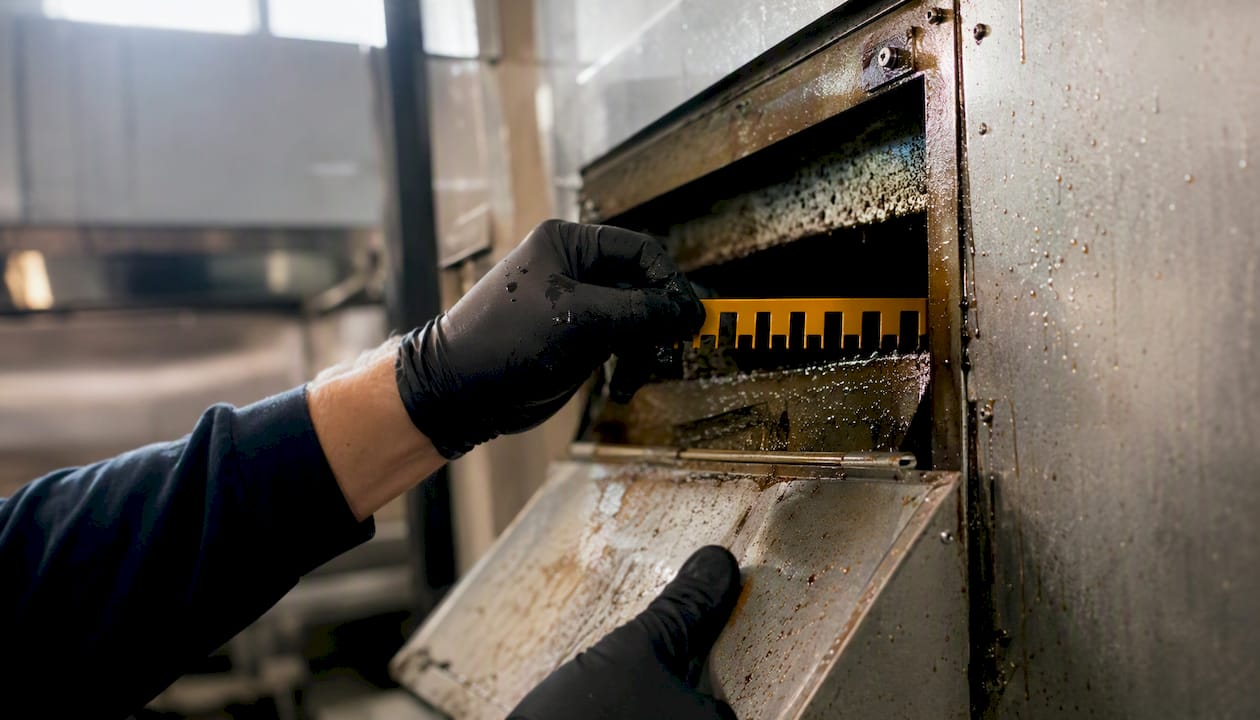
Cleaning frequency by cooking type and volume:
The 1/8-inch trigger is the critical override. If you measure grease depth at any point and it hits that threshold, schedule a professional clean immediately, regardless of where you are in your calendar cycle. A grease-depth-gauge comb is a low-cost tool that removes all guesswork from that decision.
Who handles what:
- On-shift kitchen staff: daily filter wipe-downs, grease cup emptying, visual checks
- Maintenance staff or manager: weekly filter swaps, monthly MUA filter changes, fan belt checks, grease-depth measurements
- Licensed exhaust-cleaning contractor: quarterly or more frequent hood-to-rooftop cleaning, duct interior cleaning, access panel service, documentation
- Certified fire-suppression technician: semi-annual suppression system inspection and testing (coordinate this with your hood cleaning visit)
Treat exhaust cleaning and suppression inspection as a paired event. Scheduling them separately creates compliance gaps and leaves you exposed if an inspector asks for both records on the same visit.
How to clean each key component safely and effectively
Hood and grease filters
- Turn off cooking equipment and allow surfaces to cool before touching anything.
- Remove grease filters and soak them in a food-safe degreaser solution (look for NSF-certified or food-safe-labeled products).
- Scrub filter mesh with a stiff brush, rinse thoroughly, and allow to dry before reinstalling.
- Wipe the interior hood surfaces with a food-safe degreaser and a clean cloth. Work top to bottom so loosened grease doesn’t contaminate already-cleaned areas.
- Check the grease collection cup or trough and empty it. Never let it overflow.
Do NOT use caustic oven cleaners inside the hood if surfaces are near food contact zones. Always verify the degreaser is rated food-safe.
Grease collection and drain trays
- Empty collection cups at the end of every service shift.
- Wipe the tray interior with a food-safe degreaser weekly.
- Check the drain line for blockages monthly; a clogged drain overflows into the duct.
Access panels and inspection ports
- Locate every access panel on your duct runs and confirm they open freely. Sealed or missing panels are an automatic inspection failure.
- Wipe panel edges clean so grease doesn’t seal them shut between professional visits.
- Log panel locations in your maintenance binder so contractors can find them without delay.
Duct interior visual checks
- Use a flashlight through open access panels to check for visible grease accumulation.
- If you can see grease coating more than a thin film on duct walls, call a contractor. Do not attempt interior duct cleaning without proper equipment and training.
Rooftop exhaust fans
- Lock out and tag out the fan circuit before any inspection or cleaning.
- Check fan blades for grease buildup and wipe accessible surfaces with a degreaser-dampened cloth.
- Inspect the grease drain on the fan housing; clear any blockage.
- Check belt tension and condition. A cracked or loose belt reduces airflow and accelerates motor wear.
- Confirm the fan spins freely by hand after lockout. Resistance indicates bearing wear.
Coils and condensate drains
- Evaporator and condenser coils should be cleaned by a licensed technician using a coil-cleaning system designed for commercial equipment. Goodway Technologies makes coil-cleaning equipment widely used in commercial HVAC service.
- Condensate drain pans should be checked weekly for standing water and flushed monthly with a diluted bleach solution (food-safe concentration) to prevent mold.
- A clogged condensate drain is one of the most common causes of water damage and mold in restaurant air handlers. It takes two minutes to check and costs nothing.
Pro Tip: Before any cleaning session, post a sign at the air handler and cooking equipment controls indicating maintenance is in progress. This prevents someone from switching on equipment while a technician is inside the duct or on the rooftop.
How to hire a qualified exhaust cleaning contractor
Hire only licensed, insured contractors with active credentials for exhaust-system cleaning. FDNY guidance requires approved companies and Certificate of Fitness holders for exhaust cleaning and mandates that owners retain records on-site. Most local fire departments follow similar requirements, and an expired approval means the service may be rejected during inspection.
Questions to ask before signing a contract:
- Are you licensed and insured for commercial exhaust-system cleaning in this jurisdiction?
- Do your technicians hold active certifications (IKECA, NFPA, or local Certificate of Fitness equivalent)?
- Will you provide before-and-after photos with timestamps for every visit?
- What is your scope of work? Does it include fan blades, duct interior to bare metal, and access panels?
- How do you handle inaccessible duct sections, and will you document them in writing?
- Will you place a service sticker on the hood with the date, company name, and technician cert number?
What to require before the contractor leaves:
- Signed service report with date, technician name, and certification number
- Before-and-after photos with timestamps
- Written note of any inaccessible areas and why
- Hood sticker placed per local code
- Copy of the company’s current license and insurance certificate
Red flags to walk away from:
- No documentation offered
- Scope limited to “hood surfaces only” without duct and fan cleaning
- No photos, or photos that don’t show the duct interior
- Technician cannot produce a current certification number on request
For a deeper look at what a compliant cleaning scope covers, the restaurant duct cleaning compliance guide walks through what inspectors actually check.
NFPA 96 essentials and the records that satisfy inspectors
NFPA 96 is the governing standard for commercial cooking ventilation and fire protection. It sets cleaning intervals by cooking type, specifies grease-depth thresholds, and requires documented evidence of service. Local fire codes typically adopt NFPA 96 by reference, so compliance with the standard is compliance with most local requirements.
Recordkeeping checklist for inspections:
| Document | What It Must Show | Where to Keep It |
|---|---|---|
| Cleaning certificate | Date, company name, technician cert number, areas cleaned | On-site binder, accessible to inspectors |
| Before-and-after photos | Timestamps, duct interior, fan blades, grease depth | On-site binder and digital backup |
| Hood sticker | Date of last clean, company name, next scheduled clean | Affixed to hood per local code |
| Suppression inspection report | Date, technician, system condition, next inspection due | On-site binder |
| MUA and coil service records | Date, filter type, technician name | On-site binder |
Inspector-prep checklist:
- Confirm the cleaning certificate date matches the hood sticker
- Verify the suppression inspection is current (typically semi-annual)
- Have technician certification numbers available for every recent service
- Confirm all access panels are present, labeled, and openable
- Check that grease collection cups are empty and clean
FDNY guidance also requires that records be kept on-site and available for immediate review. A binder at the manager’s station, organized by service date, is the simplest system that works.
How regular cleaning improves energy efficiency and equipment life
Dirty coils and clogged filters force HVAC equipment to work harder for the same output. ENERGY STAR guidance is clear that routine maintenance, including filter replacement and coil cleaning, reduces energy use and supports longer equipment life when implemented consistently. The DOE/EERE Operations and Maintenance best-practice materials back this up with checklists showing measurable performance and reliability gains from scheduled cleaning.
Specific performance wins from regular cleaning:
- Clean evaporator coils restore heat-transfer efficiency, reducing compressor runtime and energy draw
- Unclogged filters maintain proper airflow, preventing the static-pressure buildup that strains fan motors
- Clean condenser coils reduce refrigerant head pressure, which directly lowers compressor wear
- Clear condensate drains prevent water damage and mold remediation costs
- Lubricated and clean fan bearings extend motor life and reduce emergency replacement calls
- Balanced MUA airflow reduces the load on kitchen cooling equipment by preventing heat infiltration
The HVAC maintenance and energy savings case is straightforward: a system running at full efficiency costs less to operate and breaks down less often. For restaurant operators running equipment 12–16 hours a day, those savings compound quickly across a year.
Cleaning vs. deferred maintenance: a performance comparison:
| Metric | Maintained System | Deferred Maintenance |
|---|---|---|
| Coil heat-transfer efficiency | Near-rated capacity | Significantly reduced |
| Filter airflow resistance | Low (design spec) | High (restricted flow) |
| Compressor runtime per cycle | Shorter | Longer |
| Emergency repair frequency | Low | High |
| Equipment service life | Extended | Shortened |
For operators considering HVAC upgrades alongside a cleaning program, a well-maintained existing system often performs close to a new one, making the cleaning investment the smarter first step.
A preventative maintenance workflow you can implement this week
The most effective PM programs link three activities that most operators schedule separately: hood and exhaust cleaning, suppression inspection, and MUA service. Treating them as one coordinated event closes the compliance gaps that catch operators off guard during inspections.
Sample PM workflow:
- Set your baseline. Pull every existing service certificate, photo, and sticker. Note the oldest date. That gap is your starting point.
- Assign a maintenance lead. One person owns the binder, the schedule, and the contractor calls. Shared responsibility means no one does it.
- Schedule contractor visits by cooking volume. Use the NFPA 96 frequency table as your floor, not your ceiling. If grease depth hits 1/8 inch before the scheduled visit, call early.
- Pair hood cleaning with suppression inspection. Book both on the same day with coordinated contractors. One visit, two certificates, no gaps.
- Set monthly calendar reminders for in-house tasks. MUA filter swap, condensate drain flush, grease-depth check, fan belt inspection.
- Upload documentation before closing the work order. Scan or photograph every certificate and photo the contractor provides. Store digitally and in the on-site binder.
- Review the binder quarterly. Check that every certificate is current, every sticker matches the binder, and the next scheduled visits are booked.
In-house PM checklist (copy into your maintenance system):
- Monthly: MUA filter replaced, grease depth measured and logged, condensate drain flushed
- Monthly: Fan belt condition checked, grease collection cup cleaned
- Quarterly: Contractor hood-to-rooftop cleaning completed, certificate filed
- Semi-annual: Suppression inspection completed, report filed
- Annual: Full duct inspection, access panel audit, system tune-up
Pro Tip: A grease-depth-gauge comb costs under $20 and removes all subjectivity from the “does it need cleaning?” question. Measure at the same duct location every month and log the reading. If you hit 1/8 inch before your scheduled contractor visit, you have documented justification to call early, which protects you in any insurance or inspection dispute.
For a complete PM template and handoff process, the preventative maintenance workflow guide covers the full documentation cycle.
The one thing most operators get wrong about HVAC cleaning
Most kitchen managers treat the exhaust hood as the whole system. Clean the filters, wipe the hood face, done. The duct run above the hood, the fan on the roof, and the MUA unit feeding air back into the kitchen get checked once a year if they’re lucky.
That’s where the real exposure lives. A spotless hood with a grease-packed duct above it still fails inspection and still carries fire risk. The MUA unit with a filter that hasn’t been changed in six months is quietly starving the kitchen of fresh air and pushing the whole space into negative pressure. Cooks prop doors open to compensate, which pulls in unfiltered outdoor air across prep surfaces.
The fix is simple: extend your mental model of “the exhaust system” all the way from the cooking surface to the rooftop discharge point, and add the MUA unit as the other half of the same loop. Once you see it that way, the maintenance tasks write themselves.
Lucasair keeps your kitchen compliant and your equipment running
Lucas Air provides preventative maintenance agreements, duct cleaning, system tune-ups, and documented service records for commercial kitchens and food-service facilities in Central Florida. Every visit includes the documentation your inspectors expect: signed service reports, before-and-after records, and technician credentials on file.
For restaurant managers who need a single point of contact for HVAC cleaning, suppression coordination, and compliance recordkeeping, Lucasair handles the scheduling, the paperwork, and the follow-up so your binder stays current without you chasing contractors. Book a commercial HVAC inspection or tune-up to get a baseline assessment and a cleaning schedule matched to your cooking volume.
Sources
- Exhaust System Cleaning | UpCodes
- Fire safety in commercial cooking locations (FDNY guidance)
- How ENERGY STAR works — ENERGY STAR
- Operations & Maintenance best practices, U.S. Department of Energy (FEMP)
Recommended
- Restaurant duct cleaning: Keep compliant and customers happy – Lucas Air Conditioning and Heating
- How to maintain restaurant HVAC for efficiency and compliance – Lucas Air Conditioning and Heating
- Restaurant HVAC preventative maintenance workflow that works – Lucas Air Conditioning and Heating
- Top HVAC Upgrades for Restaurants: Boost Efficiency – Lucas Air Conditioning and Heating
