
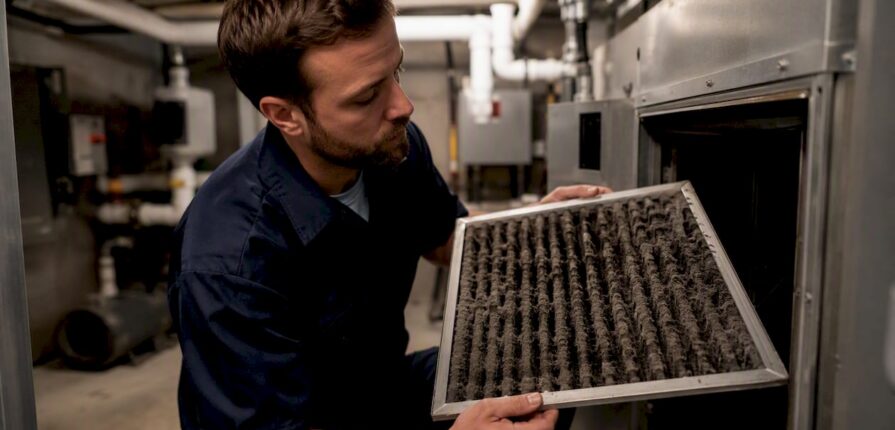
For allergy-friendly hotel rooms, the single biggest lever is proper filtration paired with humidity control and physical removal of allergen reservoirs (carpets, drapes, unencased bedding). Get those three things right and everything else on this list becomes maintenance, not triage.
If you manage a property, here are three things to assign before your next shift change:
- Confirm every air handling unit serving guest floors runs a MERV 13 filter where the equipment can support it, and drop true HEPA purifiers into rooms served by older PTAC or fan coil units that can’t take a MERV 13 upgrade.
- Set a written relative humidity target of 40 to 60 percent for guest rooms, laundry, and pool areas, and check it with an actual hygrometer, not a guess.
- Lock mattress and pillow encasements into your standard room inventory, not a special-request item buried in a closet three floors from housekeeping.
Here’s a fast triage checklist your engineering lead can run today:
- Pull filter records for the last 90 days. If anyone changed filters “because it’s the first of the month” instead of tracking pressure drop, that’s your first fix.
- Walk five guest rooms and check for musty odor near the supply vent. That smell means biological growth on the coil, not a dirty filter.
- Check RH readings in at least one room per floor. Anything consistently above 60% needs dehumidification attention now, per EPA guidance on mold risk.
- Confirm which rooms currently have encasements and HEPA units, and whether front desk staff know how to find that list during a booking call.
That EPA humidity threshold isn’t a suggestion. Relative humidity above 60% creates conditions where mold colonizes porous surfaces fast, and mold plus dust mites make up the bulk of what triggers allergic rhinitis and asthma flares in enclosed rooms. If your properties sit in a humid climate, this single number should drive dehumidifier purchasing decisions before you spend another dollar on air purifiers.
Key Takeaways
Allergy-friendly hotel rooms come down to three engineering fundamentals, filtration, humidity, and allergen removal, backed by documentation that guests and certification programs can actually verify.
| Point | Details |
|---|---|
| Filter rating drives capture | Target MERV 13 in AHUs that can handle it; use portable true HEPA units where the equipment can’t. |
| Humidity target is non-negotiable | Hold 40 to 60% relative humidity across guest rooms, laundry, and pool areas to prevent mold growth. |
| Housekeeping removes reservoirs | Wet extraction, bedding encasements, and change-on-arrival policies stop allergens from re-entering the air. |
| Certification builds trust | AllerEase® and ECARF give guests a verifiable standard instead of unsubstantiated “hypoallergenic” claims. |
| Contractor scope matters | Lucasair supports filtration upgrades, coil cleaning, and pressure-drop monitoring for properties formalizing an IAQ program. |
Table of Contents
- Allergy-Friendly HVAC Tips for Hotel Engineering Teams
- What Housekeeping and Room Design Do to Reduce Allergens
- The 10-Minute Hotel Room Allergy Checklist for Travelers
- How Hotels Certify and Market Allergy-Friendly Rooms
- When to Bring In an HVAC Contractor
- Frequently Asked Questions
- Sources
Allergy-Friendly HVAC Tips for Hotel Engineering Teams
The mechanical side of allergy control comes down to five things: filter rating, ventilation rate, humidity control, monitoring, and interior hygiene. Get sloppy on any one of these and the others can’t compensate.
Filter selection and the two-stage strategy
Post-pandemic hospitality guidance recommends MERV 11 to 13 for air handling units serving guest areas, with MERV 13 as the practical target where the AHU’s fan can handle the added resistance, according to Hotel Facility Guide’s filter program research. MERV 13 captures particles down to 0.3 to 1.0 microns, which covers most pollen, mold spores, and pet dander. MERV 8, by comparison, only reliably captures the larger stuff, dust and pollen mostly, and lets finer particulates straight through.
The catch: not every AHU can run a MERV 13 filter without strain. Higher-MERV media is denser, which raises static pressure and can starve the fan of airflow if the system wasn’t designed for it. Before you swap filters, validate the unit’s maximum allowable pressure drop with your equipment specs or a technician. Skip this step and you’ll trade allergen capture for weak airflow and warm rooms, which generates a different kind of guest complaint.
A two-stage setup solves the tension for a lot of older systems: run a MERV 8 pre-filter in front of a MERV 13 final filter. The pre-filter catches the bulk particulate load and extends the life of the finer, more expensive final filter, reducing how often you’re changing the good filter media.
For PTAC units and fan coils where a MERV 13 swap simply isn’t mechanically possible, that’s where a portable true HEPA air purifier in the room earns its keep. True HEPA media captures 99.97% of particles at 0.3 microns, a tighter standard than most MERV-rated filtration achieves, and it works independently of the central system’s limitations.
| Filtration approach | Particle capture | Best fit |
|---|---|---|
| MERV 8 pre-filter | Larger particulates, dust, pollen | Front-stage protection ahead of a finer filter |
| MERV 13 final filter (AHU-rated) | Fine particulates, most mold spores, pet dander | Central AHUs with adequate fan capacity |
| True HEPA (portable unit) | 99.97% at 0.3 microns | PTAC/FCU rooms, designated hypoallergenic rooms, high-sensitivity guests |
Ventilation rates and humidity targets
Guestroom ventilation guidance is typically expressed as 0.06 CFM per square foot plus 5 CFM per person, a formula drawn from ASHRAE-aligned hospitality standards. For variable-occupancy spaces like ballrooms and meeting rooms, demand-controlled ventilation using CO2 sensors adjusts fresh air intake based on actual occupancy rather than running a fixed rate around the clock, which saves energy while still flushing out allergen buildup during full-room events.
Humidity control matters just as much as filtration and arguably gets less attention. Keep occupied spaces between 40 and 60% relative humidity. Above that range, EPA data links elevated humidity directly to mold growth on porous surfaces, drapery, and even drywall behind wallpaper. Monitor RH in guest rooms, laundry rooms, pool and spa areas, and back-of-house storage, since these last two zones are where humidity creeps up unnoticed and eventually migrates into adjacent guest floors through shared HVAC returns.
A peer-reviewed environmental health study backs this up from the health side: indoor allergen exposure tied to building conditions, humidity chief among them, correlates directly with respiratory symptoms in occupants. That’s not an abstract engineering concern; it’s the mechanism behind the guest complaint that shows up in your review scores.
HVAC hygiene: the part everyone skips
Filter changes get attention because they’re visible and scheduled. Coil cleaning, drain pan maintenance, and blower wheel hygiene get skipped because they’re invisible until something smells wrong. Dirty coils and standing water in drain pans are a documented, under managed IAQ risk in hospitality settings, and a clean filter sitting downstream of a biologically fouled coil doesn’t protect anyone.
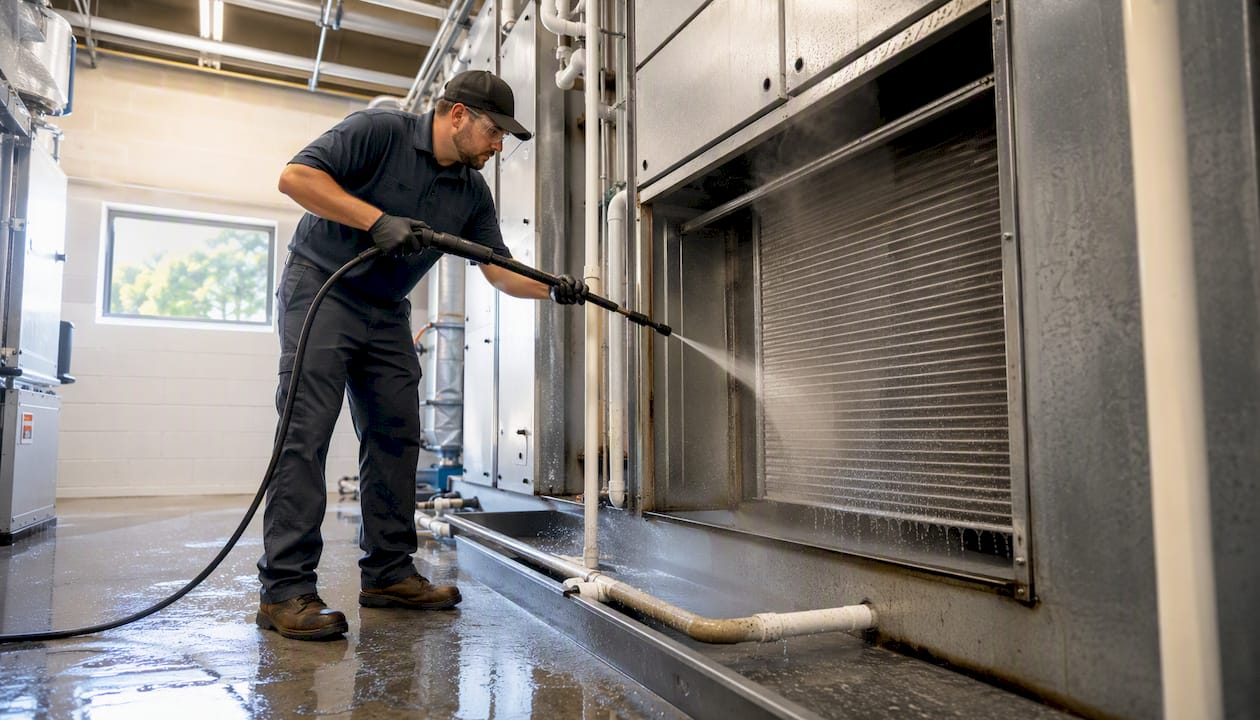
Pro Tip: Skip the harsh acid-based coil cleaners. Some common coil chemicals corrode aluminum fins over time and can off-gas irritants into the airstream, which is the opposite of what an allergy-friendly room needs. Ask your contractor about enzyme-based or low-pressure steam cleaning methods, which clean biological growth without the corrosive side effects.
| Component | Recommended frequency | Trigger to accelerate |
|---|---|---|
| MERV 8 pre-filter | Monthly to quarterly | Rising pressure drop on gauge |
| MERV 13 final filter | Quarterly | Differential pressure exceeds baseline |
| Coil cleaning | Semiannual | Musty odor or visible biological film |
| Drain pan and condensate line | Quarterly | Standing water, algae growth |
| Blower wheel | Annual | Reduced airflow, dust buildup on blades |
Skip the calendar-only approach where you can. Pressure-drop monitoring using a differential pressure gauge tells you exactly when a filter needs replacing based on actual airflow resistance, rather than an arbitrary date that either wastes a still-good filter or leaves a clogged one starving the fan. Pair that with CO2 sensors in meeting spaces, and continuous RH and PM2.5 monitors on guest floors, and you’ve got a documented, defensible IAQ program instead of a hunch.
What Housekeeping and Room Design Do to Reduce Allergens
HVAC systems move air. They don’t remove the allergen reservoirs sitting in your carpets, curtains, and unencased pillows. That job belongs to housekeeping and to the design decisions made when a room gets renovated.
Start with bedding. AllerEase® program criteria call for mattress and pillow encasements in every certified room, bedding changed on each guest arrival rather than a multi-night stay schedule, and quarterly confirmation that maintenance protocols are actually being followed. Wash linens at a temperature high enough to kill dust mites, generally 130°F or above, since cooler washes leave mite allergens intact even on freshly laundered sheets.
Soft surfaces are the bigger operational lift. Dry vacuuming pulls surface debris but leaves embedded allergens deep in carpet fiber and upholstery padding. Wet extraction cleaning removes allergens far more thoroughly than dry methods, and it should run on a fixed schedule for carpets and upholstered furniture rather than only when something looks visibly dirty. A partner resource worth reviewing for technique specifics is this guide to allergen removal in soft furnishings, which covers extraction methods that translate directly to hospitality housekeeping.
Design choices made at renovation time either help or sabotage this work for years. Short-pile synthetic carpet or hard flooring holds far fewer allergens than deep-pile carpet, and it’s what ECARF’s accommodation criteria specify for certified rooms. Washable synthetic drapery beats heavy fabric curtains that rarely get cleaned. Skip flowering plants in lobbies and public spaces; they’re a pollen source nobody thinks to blame.
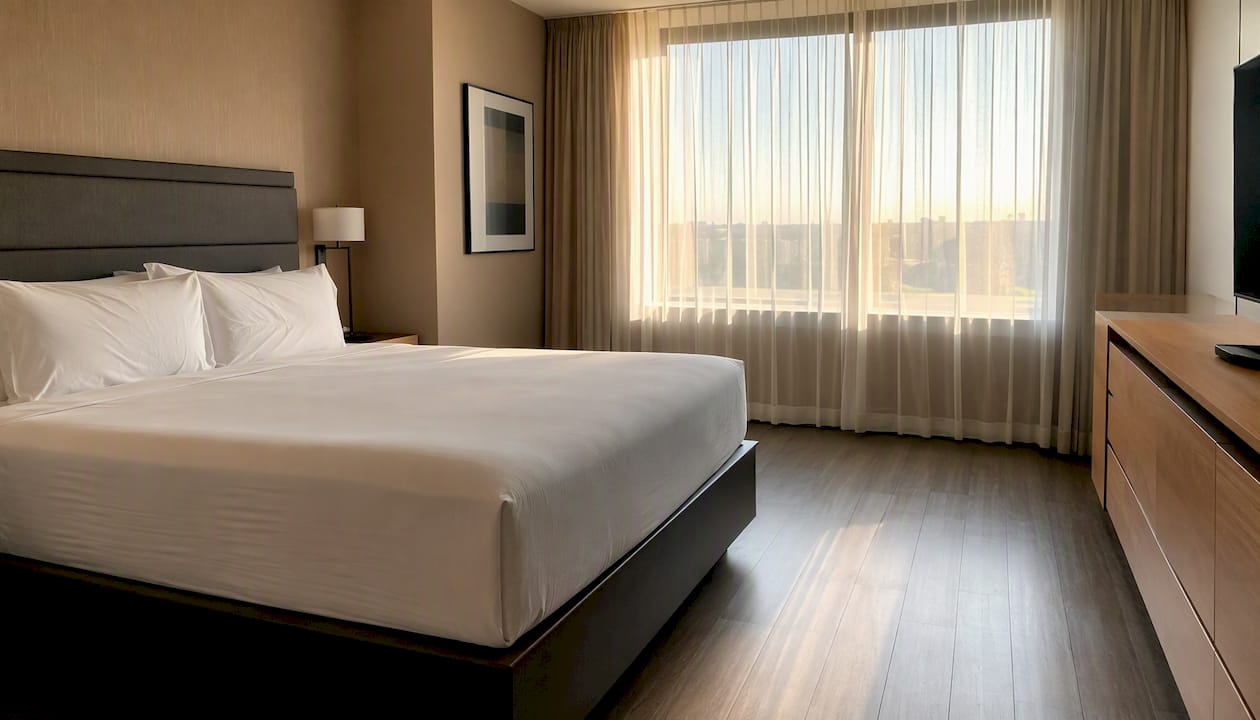
Operational policy closes the loop. Designate pet-free floors or clearly separated pet zones, and train housekeeping to flag any cross-contamination risk, a pet room cleaned with the same cart used next on a hypoallergenic room undoes the whole program in five minutes.
Pro Tip: Don’t just trust the checklist got followed. Run quarterly audits with photo evidence tied directly to your certification program’s criteria, encasements visible on the bed, purifier plugged in and running, filter change date logged. Photo documentation is what turns “we think housekeeping did it” into proof you can show an auditor or an upset guest.
The 10-Minute Hotel Room Allergy Checklist for Travelers
If you’re the one checking in, not managing the property, here’s what actually moves the needle in the time it takes to unpack.
- Scan the room for obvious allergen sources. Heavy fabric curtains, deep-pile carpet, and decorative throw pillows all hold dust and dander. If the room is loaded with soft surfaces and you’re sensitive, ask about a room change before you unpack.
- Check for a musty smell near the AC vent. That’s often a sign of a dirty coil or drain pan, and it means the air being pushed into the room is carrying more than just cool temperature.
- Ask front desk directly for a hypoallergenic or HEPA-equipped room. Say the words “allergy-friendly room with HEPA filtration” specifically. Many properties have designated rooms with purifiers and encasements that don’t show up as a default filter on the booking site.
- Confirm bedding encasements are in place. Pull back the top sheet and check the mattress edge. If there’s no zippered encasement and you’re allergic to dust mites, request one or bring your own.
- Turn on the bathroom exhaust fan for the first 20 to 30 minutes. This helps flush humidity and any lingering cleaning-product residue out of the space quickly.
- Run a portable HEPA purifier if you have one, or request one from the property. A travel-size true HEPA unit running for the duration of your stay measurably cuts particulate load in a closed room.
- Avoid upholstered chairs and decorative bedding as seating or lounging spots. These pieces rarely get deep-cleaned between guests.
- Pack hypoallergenic pillowcases or a washable travel sheet set. It’s a small addition to your bag that removes one major variable entirely.
- Ask about non-scented cleaning products and toiletries. Fragrance sensitivities are common alongside dust and mold allergies, and many properties will swap amenities on request.
- If symptoms start within the first hour, request a room change rather than waiting it out. A property with a genuine allergy program will have a backup room ready.
How Hotels Certify and Market Allergy-Friendly Rooms
Certification turns “we clean thoroughly” into a claim guests can actually verify, and that distinction matters when you’re competing on review platforms. Third-party certification carries more weight with travelers than vendor self-description, largely because guests trust an outside standard over marketing copy, and it gives your team a repeatable operational checklist instead of a vague aspiration.
Two programs anchor most hospitality allergy claims right now: AllerEase®, run through the World Hospitality Allergy Initiative, and ECARF, the European accommodation standard. Both set concrete, auditable criteria rather than leaving “hypoallergenic” as marketing fluff.
| Certification element | AllerEase® typical requirement | ECARF typical requirement |
|---|---|---|
| Bedding encasements | Mattress and pillow encasements standard in certified rooms | Allergen-proof encasings available on request |
| Air purification | HEPA purifiers in designated rooms | Ventilation maintained per manufacturer specs |
| Flooring/carpet | Not specified as a core criterion | Short-pile synthetic or uncarpeted, wet-cleaned regularly |
| Pet policy | Not a core criterion | Pet-free rooms or separated floors |
| Maintenance verification | Quarterly confirmation of protocols | Ongoing ventilation and cleaning schedule adherence |
Getting the guest-facing language right matters as much as the equipment. If a room isn’t certified, don’t call it “hypoallergenic” outright, that word carries a specific meaning to allergy sufferers and an unsubstantiated claim is exactly the kind of thing that generates a one-star review the moment a guest reacts. If it is certified, put the program name directly in the room description on your OTA listings and booking engine, not buried in a footnote. “AllerEase®-certified room with HEPA filtration and encased bedding” converts better than “clean, comfortable rooms” because it answers the exact question an allergy-conscious traveler is searching for.
On the cost side, the math tends to favor moving on this. A portable HEPA unit and a set of encasements run a modest per-room investment against what a single bad review costing you future bookings actually costs. Properties that market a genuine allergy-friendly program often see it reflected in guest retention and repeat bookings from a segment that has very few properties actively courting them, which supports a small ADR premium on those designated rooms rather than treating them as a cost center.
When to Bring In an HVAC Contractor
Some allergen problems are a housekeeping fix. Others are mechanical, and pushing past that line without a qualified contractor usually makes things worse, not better.
Call a contractor when you see recurring musty odors that persist after filter changes, visible biological growth on a coil during a routine inspection, an inability to hold your 40 to 60% humidity target no matter what housekeeping does, or airflow that drops noticeably after a filter upgrade (a sign the fan can’t handle the new media’s resistance).
Here’s what to put in the scope of work or RFP so you’re not just paying for “filter change and go”:
- Baseline and post-service differential pressure readings across every filter bank, documented in writing.
- Specified coil cleaning method, ideally enzyme-based or low-pressure steam rather than harsh acid chemicals that corrode fins.
- UV-C installation specs and placement, if that’s part of the scope, including expected lamp replacement interval.
- Filter rack modifications needed to accommodate a MERV 13 upgrade without airflow loss.
- Condensate pan and drain line inspection and validation, with photo documentation of before and after condition.
- Post-service airflow measurement at the register, not just at the unit.
Before signing anyone, ask about their hospitality experience specifically, whether they document work with written reports and photos, and whether they warranty the cleaning method against equipment damage. A structured installation and upgrade process with clear acceptance criteria protects you from a contractor who changes a filter, hoses a coil, and calls it done.
Pro Tip: Ask specifically what chemical the technician plans to use on your coils before they arrive on site. Corrosive coil cleaners can shorten equipment life and, per Goodway’s technical guidance on coil chemistry, some formulations create new airborne irritants during application, which is exactly what you’re trying to eliminate.
Why treating air quality as a visible amenity changes outcomes
Air quality has been the invisible utility of hospitality for decades, something guests only notice when it fails. That’s a mistake. A hotel room’s air is as much a guest-facing amenity as the mattress or the shower pressure, and properties that treat it that way, with visible encasements, a purifier a guest can see running, and language on the booking page that names the program, turn an operational cost into a competitive differentiator. From an HVAC operations standpoint, the properties that struggle most with allergy complaints aren’t usually the ones with old equipment. They’re the ones running calendar-based maintenance with no pressure-drop data and no humidity monitoring, reacting to guest complaints instead of catching problems before a guest ever notices. Fix the humidity, fix the filtration, and clean the parts of the system nobody sees, and the complaints tend to stop generating themselves.
How Lucasair Supports Hotel HVAC Programs
Getting the filtration math right, MERV 13 where the AHU allows it, HEPA where it doesn’t, plus a documented pressure-drop monitoring schedule, is exactly the kind of technical work that benefits from a contractor who’s done it before rather than a maintenance team guessing at specs between other priorities. Lucas Air works with residential and commercial properties across Central Florida on exactly this kind of system evaluation and upgrade work.
Services relevant to the items in this guide include:
- Filter program setup and MERV rating assessment for existing AHUs, including pressure-drop baseline documentation.
- Coil, drain pan, and blower cleaning using methods that avoid corrosive chemical damage.
- Differential pressure and airflow monitoring setup so replacement decisions are data-driven, not calendar-driven.
- System upgrades and filter rack modifications for properties moving to higher-efficiency filtration.
If your property is evaluating a filtration upgrade, a coil cleaning program, or needs a documented maintenance schedule that holds up to a certification audit, request a system evaluation and installation walkthrough to see what your current AHUs can support.
Frequently Asked Questions
What’s the single most effective allergy-friendly HVAC tip for hotels?
Prioritize filtration and humidity control together. A MERV 13 filter or true HEPA purifier catches allergens in the air, but if relative humidity climbs above 60%, mold growth generates new allergens faster than filtration can remove them.
Do all guest rooms need true HEPA purifiers, or just certified rooms?
Portable HEPA units are typically deployed in designated hypoallergenic rooms rather than the whole property, since central AHU filtration at MERV 13 handles most rooms adequately when the equipment supports it.
How often should hotel HVAC filters actually be changed?
Pressure-drop readings, not a fixed calendar, should trigger replacement. A filter that’s still performing well shouldn’t be tossed on a fixed date, and one clogging faster than expected shouldn’t wait for one either.
What should I say at the front desk to get an allergy-friendly room?
Ask specifically for “an allergy-friendly or HEPA-equipped room with bedding encasements.” Naming the exact features gets a faster, more accurate response than asking for a generic “clean room.”
Is a hotel legally required to disclose air quality or allergy-friendly certifications?
No general disclosure mandate exists across the hospitality industry, so certification programs like AllerEase® and ECARF exist precisely to give guests a verifiable standard beyond a property’s own marketing claims. Confirm specific claims directly with the property before booking if allergies are a serious health concern.
What humidity level should hotels maintain to reduce allergens?
Keep relative humidity between 40 and 60% in guest rooms and shared spaces, the range EPA guidance identifies as the threshold before mold growth risk increases significantly.
Sources
- AllerEase® Hotel Certification | World Hospitality Allergy Initiative (WHAI)
- ECARF Criteria for Allergy-Friendly Accommodations (ECARF Institute PDF)
Recommended
- HVAC Maintenance Cuts Hotel Energy Costs by 20% in 2026 – Lucas Air Conditioning and Heating
- Hotel HVAC energy-saving tips: cut costs 45% in 2026 – Lucas Air Conditioning and Heating
- Hotel Air Conditioning Tips for Managers in 2026 – Lucas Air Conditioning and Heating
- Best hotel HVAC systems: comfort, cost & efficiency – Lucas Air Conditioning and Heating
