

TL;DR:
- The invention of modern air conditioning stemmed from solving industrial humidity issues, not enhancing human comfort. Willis Carrier’s 1902 system controlled moisture to prevent printing errors, laying the foundation for today’s HVAC technology. The widespread adoption of residential air conditioning transformed American cities, migration, and architecture over the 20th century.
The modern air conditioner is defined as a system that controls both indoor temperature and humidity, first successfully built by Willis Carrier in 1902. Most people assume air conditioning was invented for human comfort. The truth is more interesting: Carrier’s original machine solved a printing problem, not a comfort problem. Understanding the air conditioner invention history reveals how one industrial fix reshaped where humans live, how cities grow, and what we expect from the buildings around us.
What were the early precursors to air conditioning?
The development of AC technology did not begin with Carrier. Several inventors laid the scientific groundwork decades earlier, each solving a piece of the puzzle.
- John Gorrie (1840s–1850s): A Florida physician, Gorrie used compressor technology to create ice and cool hospital air, motivated by the belief that heat caused disease. He received a U.S. patent in 1851 but could not secure funding to commercialize the invention. His core concept, using mechanical compression to lower air temperature, became the foundation for every refrigeration and cooling system that followed.
- James Harrison (1850s): The Australian-born journalist turned inventor built the first practical mechanical refrigeration system in 1856, using ether as a refrigerant. Harrison’s work proved that controlled cooling was industrially scalable, not just a laboratory curiosity.
- Stuart W. Cramer (1906): Cramer, a textile engineer in North Carolina, coined the term “air conditioning” to describe moisture control systems used in fabric mills. The phrase described humidity management first, temperature control second. That sequence matters for understanding what the technology was actually built to do.
These early milestones in cooling technology share a common thread. Every inventor was solving an industrial or medical problem, not designing for personal comfort. That industrial DNA stayed embedded in air conditioning for decades.
Pro Tip: When studying the air conditioning timeline, track humidity control separately from temperature control. The two functions were solved by different inventors at different times, and conflating them obscures how the technology actually developed.
How did willis carrier invent the first modern air conditioner?
Willis Carrier invented the first modern electrical air conditioning system in 1902 at the Sackett-Wilhelms Lithographing and Publishing Company in Brooklyn, New York. The problem was specific: seasonal humidity caused paper to expand and contract, throwing off ink alignment during color printing. Carrier’s assignment was to stop that.
His solution was not simply to cool the air. Carrier controlled humidity using the law of constant dew-point depression, a precise scientific principle that let him predict and maintain exact moisture levels regardless of outside conditions. That distinction matters. Carrier’s 1902 invention was the world’s first spray-type air conditioning equipment with true humidity control, not just a fan blowing over ice.
“Carrier established the four basic functions of air conditioning: heating, cooling, humidifying, and dehumidifying. Those four functions remain the industry standard today.”
Carrier filed his foundational patent in 1906. Five years later, in 1911, he presented his “Rational Psychrometric Formulae” to the American Society of Mechanical Engineers. That paper, often called the Magna Carta of Psychrometrics, unified the science of air and moisture relationships into a predictable, repeatable framework. Before 1911, AC system design was largely trial and error. After 1911, engineers could calculate the right system for any building before installing a single component.
Carrier’s 1906 patent and 1911 ASME presentation together moved air conditioning from an industrial experiment to a scalable science. That shift is what made mass adoption possible.

Pro Tip: Psychrometrics is the science of air and water vapor mixtures. If you encounter this term in historical texts about AC development, it refers specifically to Carrier’s framework for calculating humidity and temperature relationships in enclosed spaces.
How did air conditioning evolve commercially after 1902?
Carrier’s industrial invention took three decades to reach ordinary consumers, and the path was shaped by cost, engineering, and cultural change.
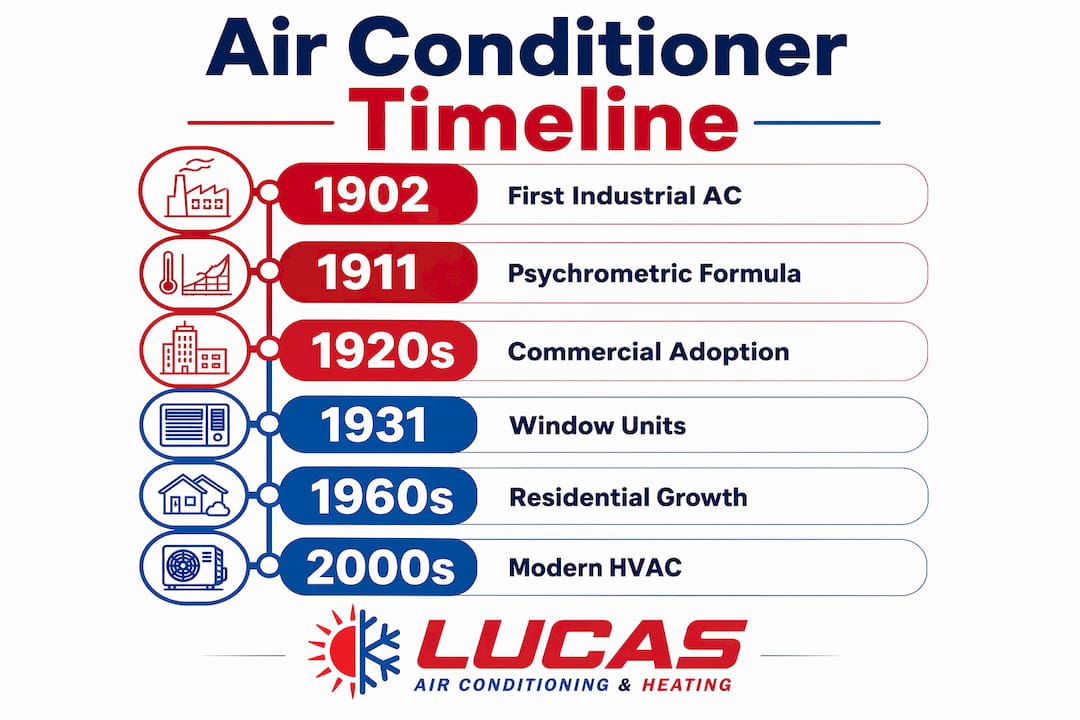
From factory floors to movie theaters
The first public spaces to adopt air conditioning were not homes. Movie theaters in the 1920s used large central cooling systems to attract summer audiences, turning the cinema into a social institution built partly on the promise of cool air. Department stores followed. Both industries discovered that comfortable customers stayed longer and spent more.
The window unit changes everything
The first practical window air conditioners were developed in 1931 by H.H. Schultz and J.Q. Sherman. The technology existed, but the price did not match the market. Window units retailed for $10,000–$50,000 in 1932 dollars, making them accessible only to wealthy households. That price point kept residential adoption minimal through most of the 1930s.
Automotive air conditioning followed a similar arc. Packard first offered factory-installed AC in 1939, positioning it as a luxury feature. It took another two decades before car AC became a standard expectation rather than a premium option.
Residential adoption: the numbers tell the story
| Era | Key Development | Adoption Rate |
|---|---|---|
| 1902–1930 | Industrial and commercial use only | Near 0% residential |
| 1931–1950 | Window units introduced, high cost | Under 1% of U.S. homes |
| 1960 | Post-war manufacturing lowers prices | ~12% of U.S. homes |
| 2002 | Mass market, standard appliance | Over 80% of U.S. homes |
AC penetration in American homes grew from roughly 12% in 1960 to over 80% by 2002. That 40-year acceleration reflects falling manufacturing costs, rising incomes, and a cultural shift in which air conditioning moved from luxury to expectation. The technology did not change people’s desire for comfort. It changed their ability to afford it.
What is the societal impact of the air conditioner?
The societal impact of air conditioning extends far beyond personal comfort. AC is now considered critical infrastructure, not a convenience. That reclassification reflects how deeply the technology reshaped human geography and economic productivity.
The most visible demographic effect is the growth of the American Sun Belt. Cities like Phoenix, Houston, Miami, and Atlanta became major population centers only after residential air conditioning made their climates livable year-round. Before widespread AC, summer heat in these regions limited both population density and economic activity. The transition from industrial to residential use drove one of the largest internal migration patterns in American history.
“AC reduced heat-related mortality, improved worker productivity, and enabled economic development in regions previously considered too hot for dense habitation.”
The Carrier Corporation itself became a measure of the technology’s scale. By 2020, the company employed 53,000 people and carried an $18.6 billion valuation. That figure reflects not just one company’s success but the size of the global industry Carrier’s 1902 invention created.
The evolution of air conditioners from industrial machines to household appliances also changed architecture. Buildings designed after widespread AC adoption no longer needed high ceilings, cross-ventilation, or shaded porches to manage heat. The result was a new architectural vocabulary built around mechanical climate control rather than passive design.
Pro Tip: If you are researching the history of air conditioning for academic work, look at U.S. Census Bureau migration data from 1950 to 1980. The population growth in Sun Belt states during that period maps almost exactly onto the timeline of affordable residential AC adoption.
Key takeaways
The air conditioner was invented as an industrial humidity control tool in 1902, and its evolution into a residential comfort standard took more than 50 years of engineering, cost reduction, and cultural change.
| Point | Details |
|---|---|
| Industrial origins | Willis Carrier built the first AC system in 1902 to solve a printing humidity problem, not for comfort. |
| Scientific foundation | Carrier’s 1911 Rational Psychrometric Formulae turned AC design from guesswork into a repeatable science. |
| Cost barrier to homes | Window units cost up to $50,000 in 1932 dollars, limiting residential use for decades. |
| Mass adoption timeline | U.S. home AC penetration jumped from 12% in 1960 to over 80% by 2002. |
| Societal reshaping | AC enabled the growth of Sun Belt cities and is now classified as critical infrastructure. |
Why the industrial origin of AC still matters today
Most people learn that Willis Carrier invented air conditioning and stop there. That framing misses the more instructive part of the story. Carrier did not set out to make people comfortable. He set out to keep paper flat. The comfort came later, almost as a side effect.
That distinction changes how you think about technological progress. The most transformative inventions rarely start as consumer products. They start as solutions to narrow, specific, industrial problems. Gorrie wanted to cool hospital wards. Carrier wanted to fix ink registration. Stuart Cramer wanted to control textile moisture. None of them were designing for the mass market. The mass market found them.
What I find genuinely underappreciated in the history of air conditioning is Carrier’s scientific discipline. His 1911 Rational Psychrometric Formulae was not a product launch. It was a published scientific framework, offered to the entire engineering community. That openness accelerated adoption faster than any patent protection could have. Carrier understood that if the science was sound and shared, the market would build itself.
The role of HVAC in home comfort today is a direct descendant of that industrial rigor. Every modern system still operates on the four functions Carrier defined: heating, cooling, humidifying, and dehumidifying. The hardware has changed. The physics has not.
— Lucasair
From history to your home: modern HVAC solutions
The same principles Willis Carrier formalized in 1902 power every system Lucasair installs and services in Central Florida today. Understanding where the technology came from makes it easier to appreciate what a well-designed, properly maintained system actually does for your home or business.

Lucasair, founded by Army Veteran Cameron Lucas in Eustis, Florida, brings that same engineering discipline to residential and commercial HVAC. Whether you are installing a new system or upgrading an aging unit, the process matters as much as the equipment. Start with Lucasair’s HVAC installation guide for homeowners to understand what a professional installation involves from start to finish. For homeowners ready to ask the right questions before signing a contract, the 2026 HVAC installation questions list covers everything you need to know before the first technician arrives.
FAQ
Who invented air conditioning and when?
Willis Carrier invented the first modern electrical air conditioning system in 1902 at a Brooklyn printing company. His system controlled humidity to solve color printing alignment problems, not to cool people.
Was air conditioning originally designed for comfort?
Air conditioning was not originally designed for human comfort. Carrier’s 1902 invention targeted industrial humidity control, and Stuart Cramer coined the term “air conditioning” in 1906 to describe textile moisture management.
What were the first home air conditioners like?
The first practical window units appeared in 1931, developed by H.H. Schultz and J.Q. Sherman. They cost up to $50,000 in 1932 dollars, making them a luxury item unavailable to most households.
What is the rational psychrometric formulae?
Carrier’s 1911 Rational Psychrometric Formulae is a scientific framework that defines the relationships between air temperature, humidity, and dew point. It gave engineers a reliable method for designing AC systems and is still the basis of modern HVAC calculations.
How did air conditioning change american society?
AC enabled the population growth of Sun Belt cities like Phoenix, Houston, and Miami by making hot climates livable year-round. Home AC penetration grew from 12% in 1960 to over 80% by 2002, reshaping American migration patterns and architecture.
Recommended
- First Air Conditioning: A Central Florida Homeowner’s Guide – Lucas Air Conditioning and Heating
- Air Conditioning Terminology: A Homeowner’s Guide – Lucas Air Conditioning and Heating
- HVAC trends 2026: Smart solutions, efficiency, comfort – Lucas Air Conditioning and Heating
- Hotel Air Conditioning Tips for Managers in 2026 – Lucas Air Conditioning and Heating
