

TL;DR:
- Understanding HVAC terminology empowers homeowners to make informed decisions and communicate effectively during service calls. Mastery of key terms like BTU, SEER2, CFM, and refrigerant-related concepts ensures proper system sizing, efficiency, and airflow management. This knowledge allows homeowners to detect issues early, ask the right questions, and select appropriate equipment for their specific needs.
Air conditioning terminology is the specialized vocabulary used to describe the components, functions, and performance metrics of HVAC systems in homes and properties. Knowing these terms transforms you from a passive bystander during a service call into an informed decision-maker who can ask the right questions, spot unnecessary upsells, and choose the right equipment. Whether you’re scheduling a repair, comparing new systems, or troubleshooting a comfort problem yourself, understanding common AC jargon is the foundation for every smart HVAC decision you’ll make.
What is air conditioning terminology and why does it matter?
Air conditioning terminology covers everything from the names of physical components to the abbreviations on an equipment spec sheet. Most homeowners encounter this vocabulary for the first time when something breaks, which is the worst possible moment to learn it. Knowing the difference between a condenser and an evaporator coil before a technician arrives means you can follow the diagnosis, verify the repair makes sense, and avoid paying for work you don’t need.
Accurate HVAC terminology knowledge enables clearer communication with technicians, reducing misdiagnosis and unnecessary repairs. That’s not a minor benefit. A single misunderstood term can turn a $150 capacitor replacement into a $1,200 compressor swap if you can’t follow what the technician is describing. The vocabulary covered in this guide focuses on the terms you’ll encounter most often as a homeowner, property manager, or DIY enthusiast in a residential setting.
Common terms for AC system types and components
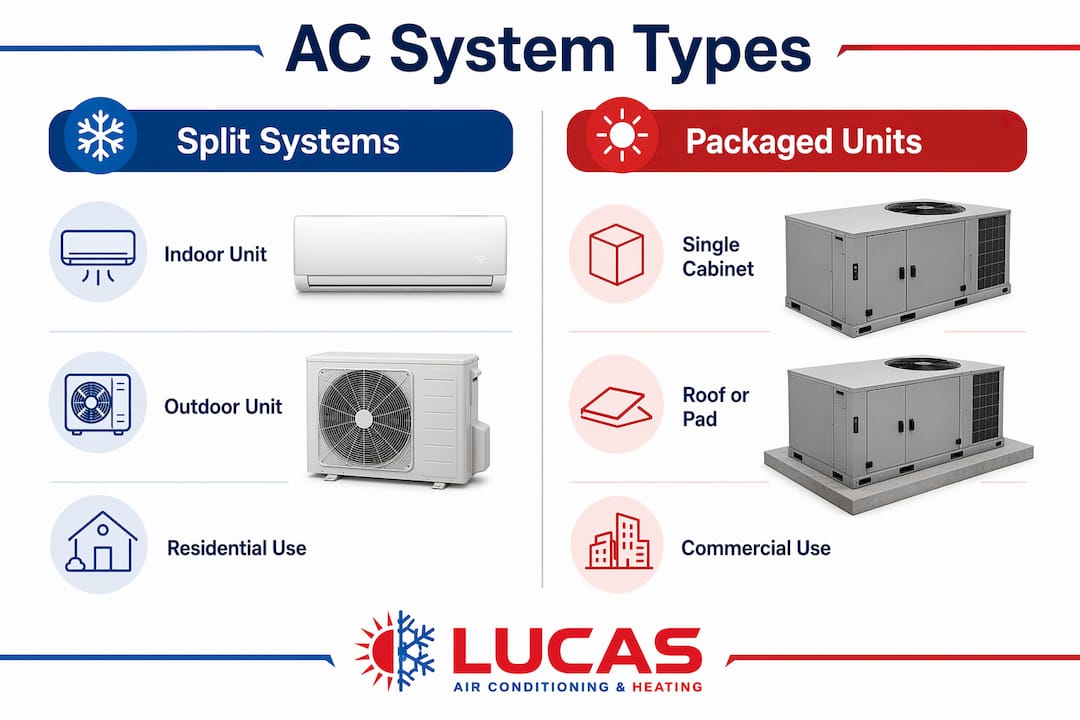
Split systems are the most common residential air conditioning configuration, consisting of an indoor unit and an outdoor unit. The outdoor unit houses the compressor and condenser, while the indoor unit contains the evaporator coil and air handler. This separation gives installers flexibility and makes individual components easier to service without shutting down the entire system.
Packaged units combine all components into a single cabinet, typically installed on the roof or on a concrete pad beside the home. They’re common in commercial buildings and some older homes in the South. Mini-split systems, also called ductless systems, are a variation of the split system that deliver conditioned air directly to individual rooms without ductwork.
| System type | Configuration | Best for |
|---|---|---|
| Split system | Separate indoor and outdoor units | Most residential homes |
| Packaged unit | All-in-one cabinet | Homes without attic space |
| Mini-split (ductless) | No ductwork required | Room additions, older homes |
| Heat pump system | Heating and cooling in one | Mild climates like Central Florida |
The major components you’ll hear about during any service call include the compressor (which pressurizes refrigerant), the condenser coil (which releases heat outside), the evaporator coil (which absorbs heat from indoor air), and the air handler (which circulates conditioned air through the ducts). The thermostat is the control interface that tells the system when to run and at what temperature.
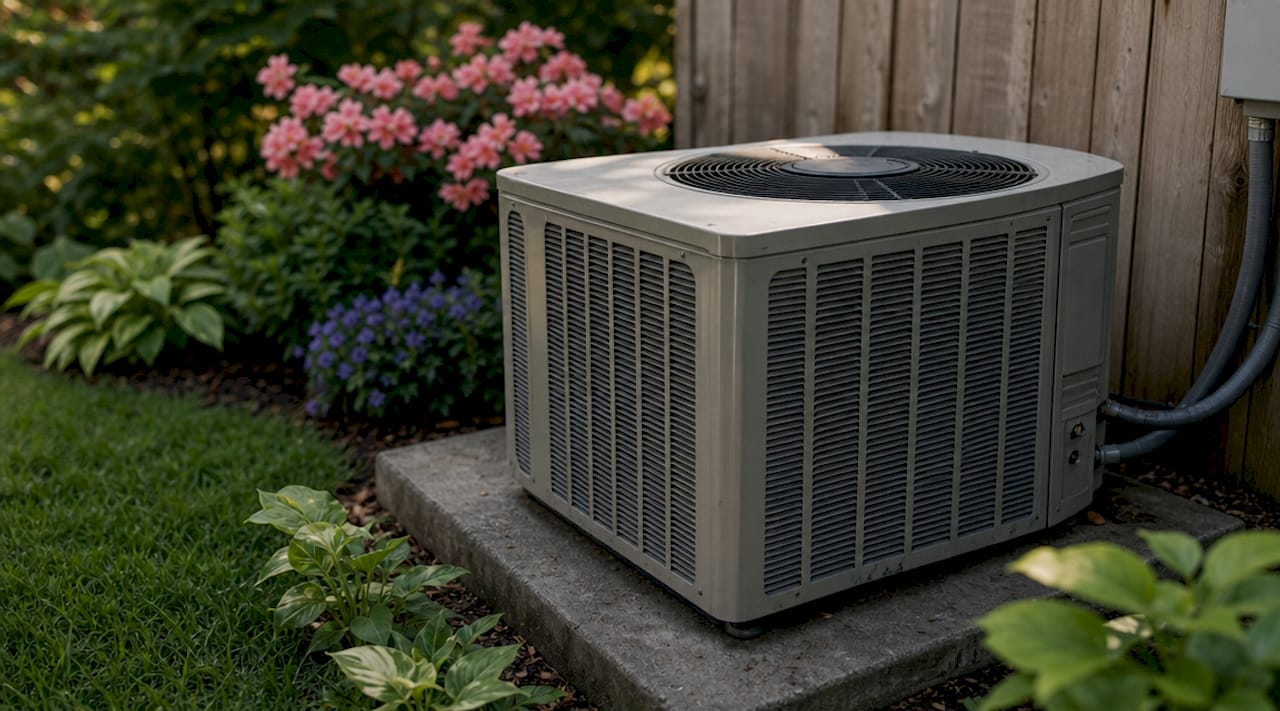
Pro Tip: Walk outside and look at your outdoor unit. If you see two copper lines running into your home, one thicker and insulated, you almost certainly have a split system. The thicker line is the suction line carrying cold refrigerant vapor back to the compressor.
What performance metrics should homeowners understand?
BTU, or British Thermal Unit, is the fundamental measurement used to size HVAC equipment. One BTU is the energy needed to raise one pound of water by one degree Fahrenheit. For air conditioners, BTU per hour describes cooling capacity. A 2,000 square foot home in Florida typically needs a system in the 36,000 to 48,000 BTU range, though the exact number depends on insulation, ceiling height, and sun exposure.
SEER stands for Seasonal Energy Efficiency Ratio and measures how efficiently a cooling system operates over an entire season. Higher SEER ratings mean lower electricity bills. SEER2 replaced the original SEER rating in 2023 and uses updated testing protocols that simulate higher external static pressure, making the efficiency numbers more realistic than the original standard. A system rated at SEER2 14.3 is roughly equivalent to the old SEER 15.
AFUE stands for Annual Fuel Utilization Efficiency and applies to furnaces and heating equipment. High-efficiency furnaces reach 95 to 98% AFUE, meaning nearly all the fuel burned becomes usable heat. Standard models run at 80% AFUE, so 20% of the energy goes up the flue. Homeowners often confuse AFUE with SEER because both are efficiency ratings, but AFUE applies to heating while SEER applies to cooling. Mixing them up leads to misguided equipment comparisons and poor purchasing decisions.
COP, or Coefficient of Performance, measures the ratio of heating or cooling output to electrical energy input. It’s most relevant for heat pumps, which are common in Florida because they provide both heating and cooling in one unit. A COP of 3.0 means the system produces three units of heat energy for every one unit of electricity consumed.
| Metric | What it measures | Typical range |
|---|---|---|
| BTU/hr | Cooling or heating capacity | 18,000 to 60,000 for residential |
| SEER2 | Seasonal cooling efficiency | 14.3 to 21+ |
| AFUE | Annual heating fuel efficiency | 80% to 98% |
| COP | Heat pump energy ratio | 2.0 to 4.5 |
Pro Tip: Ignoring load calculations based on BTU needs is the leading cause of HVAC performance problems in residential homes. An oversized system short-cycles, meaning it turns on and off too frequently, which causes humidity problems and premature wear on the compressor.
How do airflow and ventilation terms affect comfort?
CFM, or Cubic Feet per Minute, measures the volume of air moving through your duct system at any given moment. A properly sized residential system typically delivers 400 CFM per ton of cooling capacity. When CFM is too low, rooms feel stuffy and the evaporator coil can freeze. When it’s too high, you get noise and uneven temperatures.
Static pressure is the resistance air faces as it moves through ducts, filters, and coils. Think of it like blood pressure for your duct system. High static pressure forces the blower motor to work harder, shortening its lifespan and increasing energy use. Undersized ducts, clogged filters, and closed dampers all raise static pressure.
Supply air refers to conditioned air leaving the system and entering the living space through supply registers. Return air is the warm indoor air pulled back into the system to be cooled again. A balanced system has enough return air capacity to match the supply. When return air is restricted, the system runs at negative pressure, which pulls unconditioned air in through gaps in the building envelope.
Zoning systems divide a building into areas with independent temperature control using thermostats and motorized dampers. Each zone gets its own thermostat, and dampers in the ductwork open or close to direct airflow where it’s needed. Zoning is particularly useful in two-story homes where the upstairs runs significantly warmer than the downstairs.
Common airflow problems and their associated terms:
- Insufficient CFM: Caused by dirty filters, blocked returns, or undersized ductwork
- High static pressure: Results from closed dampers, kinked flex duct, or oversized equipment
- Short cycling: System turns on and off rapidly, often caused by oversized BTU capacity
- Hot or cold spots: Indicate duct leakage, poor duct design, or zoning imbalance
- Excessive humidity: Often a sign of low airflow across the evaporator coil
Essential controls, safety devices, and refrigerant terms
Thermostats, limit switches, flame rollout switches, and pressure switches are the primary controls and safety devices in residential HVAC systems. Understanding what each one does helps you describe a problem accurately when you call for service, which saves time and money.
The thermostat is the most familiar control, but modern smart thermostats like Ecobee and Nest go beyond simple temperature settings. They track runtime, alert you to unusual patterns, and can integrate with zoning systems. A limit switch shuts the furnace off if it overheats, protecting the heat exchanger from cracking. A flame rollout switch trips if flames escape the combustion chamber, which is a serious safety condition requiring immediate attention.
Refrigerant terminology is where most homeowners feel lost, but the core concepts are straightforward. Refrigerant cycles between a liquid and a gas to absorb and release heat. Superheat is the temperature of refrigerant vapor above its boiling point at the evaporator outlet. Subcooling is the temperature of liquid refrigerant below its condensing point at the condenser outlet. Technicians monitor superheat and subcooling to diagnose refrigerant charge problems that affect cooling efficiency and component longevity.
Key refrigerant and control terms to know:
- TXV (Thermostatic Expansion Valve): Meters refrigerant flow into the evaporator coil based on superheat readings
- Metering device: Any component that controls refrigerant flow, including TXVs and fixed orifices
- Refrigerant charge: The total amount of refrigerant in the system; too little or too much causes efficiency loss
- Pressure switch: Shuts the system down if refrigerant pressure falls outside safe operating limits
- Capacitor: Stores electrical charge to start and run the compressor and fan motors
Key takeaways
Knowing the right air conditioning terms gives you direct control over repair costs, equipment choices, and maintenance outcomes.
| Point | Details |
|---|---|
| Split systems dominate residential use | Identify yours by the two copper lines running from the outdoor unit into your home. |
| BTU and SEER2 drive equipment decisions | Match BTU capacity to your home’s load calculation and prioritize SEER2 ratings above 14.3. |
| AFUE applies to heating, not cooling | Confusing AFUE with SEER leads to wrong equipment comparisons during system upgrades. |
| CFM and static pressure govern comfort | Low CFM causes frozen coils; high static pressure burns out blower motors prematurely. |
| Superheat and subcooling reveal refrigerant health | Ask your technician for these readings at every tune-up to catch charge problems early. |
What I’ve learned from watching homeowners navigate HVAC conversations
Most homeowners walk into a service call knowing two words: “broken” and “expensive.” That’s not a criticism. HVAC systems are complex, and nobody teaches this vocabulary in school. But the gap in knowledge creates a real power imbalance between the homeowner and the technician, and not every technician uses that imbalance responsibly.
The single most common mistake I see is homeowners confusing AFUE with SEER when shopping for new equipment. A salesperson mentions a 96% efficiency rating, the homeowner assumes that applies to cooling, and they end up prioritizing the wrong spec for their climate. In Central Florida, where heating demand is minimal, SEER2 matters far more than AFUE for your monthly energy bill.
The second mistake is ignoring airflow terms entirely. A homeowner calls about hot rooms, the technician recommends a refrigerant recharge, and the real problem is a kinked flex duct reducing CFM to the back bedroom. Knowing what CFM and static pressure mean would have let that homeowner push back and ask for a duct inspection first.
Learning HVAC terminology for Florida homes doesn’t require becoming a technician. It requires knowing enough to ask the right questions. “What’s the static pressure reading?” and “Did you check superheat and subcooling?” are questions that immediately signal to a technician that you’re paying attention. That signal alone changes the quality of service you receive.
— Lucasair
Get expert HVAC service from a team that speaks your language
Understanding the vocabulary is step one. Putting it to work with a technician you trust is step two. Lucasair, founded by Army Veteran Cameron Lucas and based in Eustis, Florida, serves homeowners and property managers across Central Florida with residential HVAC services including installation, repairs, tune-ups, and preventative maintenance. The team explains every diagnosis in plain language, so you always know what’s being done and why. If you’re in The Villages or the surrounding area, Lucasair’s trusted HVAC contractors are ready to help you get your system running right. Schedule your appointment online or call to speak with a technician directly.
FAQ
What does SEER2 mean on a new AC unit?
SEER2 is the updated seasonal energy efficiency rating that replaced the original SEER standard in 2023. It uses more realistic testing conditions, so a SEER2 rating gives you a more accurate picture of real-world energy use than the old scale.
How do I know what size AC system my home needs?
System size is determined by a load calculation based on your home’s square footage, insulation levels, window area, and local climate. BTU per hour is the unit of measurement, and an undersized or oversized system both cause comfort and efficiency problems.
What is the difference between supply air and return air?
Supply air is conditioned air delivered into your living space through registers. Return air is the warm indoor air pulled back into the system to be cooled again. A balanced system needs adequate return air capacity to match the supply volume.
Why do technicians measure superheat and subcooling?
Superheat and subcooling measurements tell a technician whether the refrigerant charge is correct and whether the metering device is functioning properly. These readings catch problems that a simple pressure check would miss.
What is a zoning system in HVAC?
A zoning system divides your home into separate areas, each controlled by its own thermostat and motorized dampers in the ductwork. It improves comfort in multi-story homes and reduces energy use by conditioning only the spaces that need it.
Recommended
- Step-by-step air conditioner assessment guide for homeowners – Lucas Air Conditioning and Heating
- Common AC Repair Issues Every Homeowner Should Know – Lucas Air Conditioning and Heating
- HVAC Terminology Explained: Smart Decisions for Florida Homes – Lucas Air Conditioning and Heating
- Step by Step HVAC Repair Guide for Homeowners – Lucas Air Conditioning and Heating
