
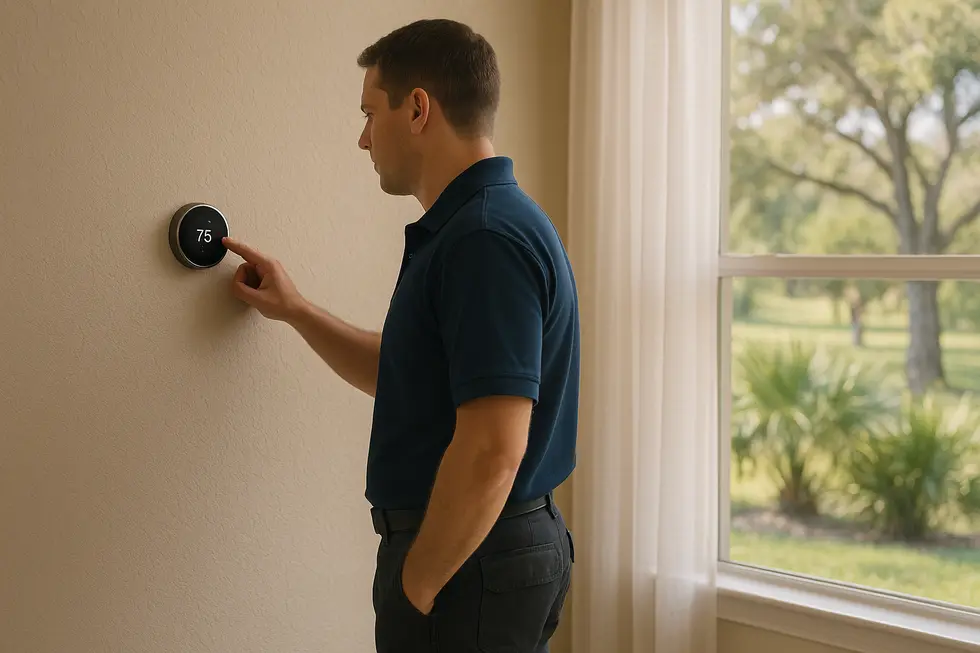
TL;DR: Start at about 78°F when you’re home and awake. Raise it 7 to 10 degrees when the house is empty for the day, and turn it up, not off, when you leave. In a humid place like Tavares, keeping indoor humidity below 60% matters just as much as the temperature you pick.
For most Tavares homes, the best thermostat setting for a Florida summer is about 78°F when you are home and awake. When the house is empty for the day, set it 7 to 10 degrees warmer. Just as important, keep indoor humidity below 60%. In Central Florida, humidity decides whether 78°F feels comfortable or sticky.
What is the best thermostat setting for a Florida summer?
Start at 78°F while you are home, then adjust for your comfort. Treat it as a starting point, not a rule. According to The Palm Beach Post, ENERGY STAR has said it does not recommend one temperature for every household. What really drives your bill is the gap between the temperature inside and the temperature outside. The smaller the gap, the less your AC has to run.
The U.S. Department of Energy says you can save as much as 10% a year on heating and cooling by adjusting your thermostat 7 to 10 degrees for 8 hours a day. In summer, that means turning it up while you are gone. You can find this tip in the DOE’s Energy Saver guide.
If you are used to 72°F, don’t jump straight to 78°F. Go up one degree every few days. Small steps are easier to live with. In Tavares and the rest of Lake County, the cooling season lasts for months, so even a degree or two adds up over a summer.
What should the thermostat be set to when you’re asleep or away?
The right number depends on who is home and for how long. Here is a simple guide for Central Florida summers.
| Situation | Suggested setting | Why it works | Watch out for |
|---|---|---|---|
| Home and awake | 78°F, then adjust for comfort | A good balance of comfort and cost | If it feels clammy, check the humidity before you turn it down |
| Asleep | About 78°F to 82°F | A few degrees warmer saves energy overnight | Run a ceiling fan if the bedroom feels warm |
| Away for the workday | About 85°F (7 to 10 degrees up) | Fits the DOE’s setback range | Schedule it to cool down before you get home |
| Away for a week or two | About 80°F | The system still runs enough to pull out moisture | Don’t shut the system off |
| Empty all summer (snowbird or vacant rental) | A humidity-first plan (see below) | Preventing mold matters more than saving the last dollar | Have someone check the home and the drain line |
Why does humidity matter so much in a Florida home?
Your air conditioner is also your main dehumidifier. As warm air passes over the cold indoor coil, moisture condenses on it, drips into a pan and drains outside. When that process falls behind, the house feels muggy even at 78°F. People then turn the thermostat down to make up for it, which costs money and often doesn’t fix the muggy feeling.
To help prevent mold, the EPA recommends keeping indoor humidity below 60%, and ideally between 30% and 50% (EPA guide to mold and moisture). UF/IFAS Extension suggests Florida homes stay around 55% or lower. You can check yours with a cheap hygrometer or a thermostat that shows humidity.
Three habits help your system pull moisture out:
- Set the thermostat fan to Auto, not On. In humid climates, a fan that never stops can blow the water sitting on the cold coil back into the house before it drains.
- Don’t crank the thermostat way down. UF/IFAS Extension notes that turning it down too quickly can raise indoor humidity.
- Keep the filter and condensate drain line clean so the coil can do its job.
Your equipment matters too. Systems that run longer at lower speeds, like two-stage and inverter units, usually spend more time removing moisture. Our guide to two-stage vs. inverter AC for Florida homes explains the difference.
Should you turn your AC off when you leave the house?
No. Turn it up, not off. In a closed-up Florida house with no AC running, heat and moisture build up fast, and your system has to work hard to catch up later. A moderate setback gets you most of the savings with less risk.
Pros of a daytime setback
- Less runtime during the hottest hours of the day.
- The DOE estimates yearly heating and cooling savings of up to 10% with a 7- to 10-degree setback for 8 hours.
- A programmable or smart thermostat can do it for you.
Cons of a daytime setback
- Humidity can creep up in an empty, closed house.
- On the hottest afternoons, the house may take a while to cool back down.
- The DOE advises heat pump owners to use setbacks only with a thermostat built for heat pumps. Not sure which system you have? See our heat pump vs. straight cool guide.
Snowbirds and seasonal residents in places like Astor and Zellwood have a different problem: a house that sits empty all summer. Florida Power & Light suggests that homes with a programmable thermostat cool to 72°F for two hours before sunrise, then stay at 88°F for the rest of the day. With a basic thermostat, FPL suggests 80°F with indoor humidity below 60%. The same thinking applies to a rental sitting empty between tenants. Before you head north, have the system checked and the drain line cleared. Our spring AC tune-up checklist covers what to look at.
Do ceiling fans and smart thermostats really save money?
Yes, if you use them the right way. The DOE says a ceiling fan lets you raise the thermostat about 4°F without feeling any less comfortable. In summer, run fans counterclockwise, and turn them off when you leave the room. A fan cools people, not the room.
A programmable or smart thermostat makes setbacks automatic, so you don’t have to remember them. Many smart models also show indoor humidity and let you check on the house from your phone. That’s handy if you’re a snowbird keeping an eye on a Tavares home from up north, or a landlord with an empty rental. Lucas Air Conditioning and Heating, LLC installs smart thermostats and indoor air quality equipment.
If your house can’t hold 78°F on a hot afternoon, or feels clammy no matter what you set, the thermostat may not be the problem. Dirty coils, a refrigerant leak, leaky ducts or a system that’s the wrong size can all cause this. Those are jobs for a licensed tech.
Why homeowners call Lucas Air Conditioning and Heating, LLC
- We are a veteran-owned, licensed HVAC contractor based at 15800 Old US Hwy 441 in Tavares.
- U.S. Army veteran Cameron Lucas of the 82nd Airborne Division founded the company in 2018.
- We hold Florida licenses CAC1819409 and CAC1819837.
- A precision tune-up costs $125.
- Our Preventative Maintenance Agreement costs $129 a year and includes one tune-up, 15% off parts and priority scheduling.
- We have a 5.0-star Google rating.
Want help choosing settings for your home, or figuring out why it feels muggy? Call (352) 805-0359 or book an appointment online.
Frequently Asked Questions
Is 72 degrees too cold for a Florida summer?
It’s not harmful, but it costs more. The bigger the gap between indoor and outdoor temperatures, the longer your AC runs. Most homes can be comfortable a few degrees warmer if humidity stays under control and the ceiling fans are on.
Does setting the thermostat lower cool the house faster?
No. Your AC puts out cold air at the same rate whether you set it to 65°F or 75°F. A lower setting just makes it run longer, and UF/IFAS Extension notes that dropping the temperature too quickly can raise indoor humidity.
Why does my house feel muggy at 78 degrees?
Indoor humidity is probably above 60%. Common causes are a thermostat fan left on On instead of Auto, a dirty coil or clogged drain line, or a system that cools fast and shuts off before it removes much moisture.
What humidity level should I aim for in a Florida home?
The EPA recommends staying below 60%, ideally 30% to 50%. UF/IFAS Extension suggests Florida homes stay around 55% or lower, which you can track with a hygrometer or a thermostat that has a humidity sensor.
Recommended Reads
- Spring AC Tune-Up Checklist: 9 Steps Before Florida Summer
- SEER2 Ratings Explained: What the Number Means and Why It Matters for Your Electric Bill
- Two-Stage vs. Inverter AC: Which System Is Right for Florida Homes?