
TL;DR: A spring AC tune-up checklist has two parts: about an hour of simple homeowner checks, plus a pro visit for refrigerant, electrical parts, coils, and blower airflow. In Tavares and the rest of Lake County, do both in March or April, before the heat settles in and HVAC schedules fill up.
A good spring AC tune-up checklist has two parts. First come simple jobs you can do yourself in about an hour. Second is a pro visit that checks refrigerant, electrical parts, coils, and airflow. In Tavares, try to finish both by late March or April, before the long hot stretch starts and HVAC calendars fill up.
This post covers when to book, the steps you can do yourself, and the warning signs that mean you shouldn’t wait. For a closer look at the technician’s side of the visit, see our guide to what a precision AC tune-up includes.
When should you schedule a spring AC tune-up in Central Florida?
Book it in March or April. The ENERGY STAR maintenance checklist says to have the cooling system checked in spring because contractors get busy once summer arrives. It also suggests using the spring time change as a reminder.
In Lake County, your AC never gets a real winter break. Many systems cycle on and off even in January. So in spring, you aren’t waking the system up. You’re catching wear before it starts running long hours every day. Atlantic hurricane season also starts June 1, so a spring visit is a good time to start storm prep. Our hurricane prep checklist for your AC unit picks up where this one ends.
If you’re a snowbird, book the visit before you head north for the summer, not after you come back. That way, any problem gets fixed while you’re still here to let a technician in.
Spring AC tune-up checklist: 8 steps you can do yourself
Most homeowners can do all eight in about an hour. Turn the system off at the thermostat first. Before you work near the outdoor unit, also switch off the disconnect box mounted on the wall next to it.
- Change or check the air filter. ENERGY STAR says to check filters once a month, because a dirty filter raises energy costs and can damage equipment. Spring pollen clogs filters fast, so start the season with a fresh one.
- Clear about 2 feet around the outdoor unit. Rake out oak leaves, pine needles, and grass clippings, and cut back shrubs. Homes near the woods around Astor or the farm fields near Zellwood often collect more debris than city lots.
- Rinse the condenser coil gently. With the power off, use a garden hose on a soft spray. Never use a pressure washer. It bends the thin aluminum fins, and bent fins block airflow. In April and May, watch for bug buildup too. UF/IFAS Extension notes Florida’s spring lovebug flight runs April through May and lasts four to five weeks.
- Check the condensate drain. Find where the drain line comes out of the house. It should drip steadily while the AC runs. Also look in the pan under the indoor unit for standing water. ENERGY STAR warns that a plugged drain can cause water damage and throw off indoor humidity.
- Test the thermostat. Put in new batteries if it takes them. Set it to cool, about 3 degrees below room temperature, and make sure the system starts within about 5 minutes.
- Open vents and clear return grilles. Move furniture, rugs, and boxes off supply vents and return grilles so air can move freely.
- Look at the refrigerant line insulation. The thicker copper line going to the outdoor unit should be wrapped in foam. Florida sun cracks and peels it over time. Point out any damage to your technician.
- Do a 15-minute test run. Feel the air at a vent near the indoor unit. It should feel clearly cold, not just cool. Listen for grinding, buzzing, or banging, and write down anything that seems off.
What does the technician check on a spring tune-up?
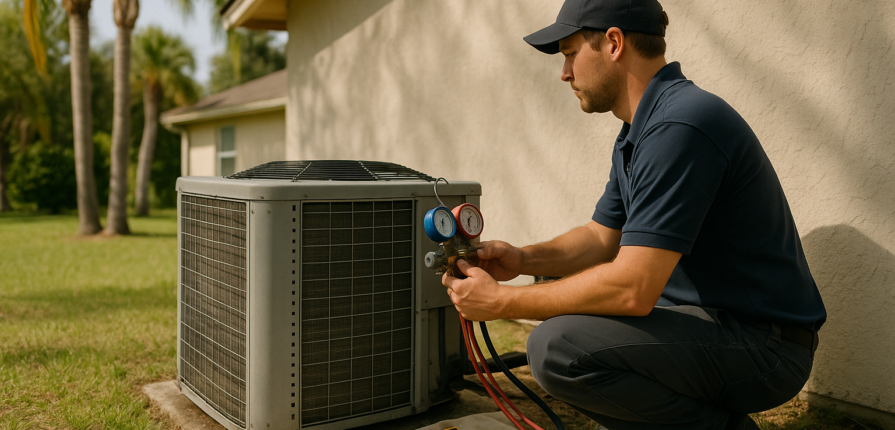
Step 9 is the pro visit. The technician handles anything that takes gauges, meters, and training. ENERGY STAR’s list of a typical check-up includes:
- Cleaning the evaporator and condenser coils. Dirty coils make the system run longer, which raises energy costs and shortens equipment life.
- Checking the refrigerant level. Too much or too little lowers efficiency and wears out the equipment sooner.
- Tightening electrical connections and measuring voltage and current on motors.
- Cleaning and adjusting blower parts. Airflow problems alone can cut efficiency by up to 15 percent.
- Inspecting the condensate drain.
The U.S. Department of Energy also warns that skipping maintenance can lead to poor performance and wasted energy (Energy.gov).
| Task | Who does it | How often | Why it matters |
|---|---|---|---|
| Check or change the air filter | Homeowner | Check monthly | Dirty filters raise bills and strain equipment |
| Clear debris around the outdoor unit | Homeowner | Monthly in spring and summer | Blocked airflow makes the unit work harder |
| Drain line and pan | Homeowner looks, pro cleans | Monthly look, yearly service | Clogs cause water damage and humidity problems |
| Refrigerant level | Pro only | Yearly | The wrong charge lowers efficiency and shortens equipment life |
| Electrical connections and motors | Pro only | Yearly | Loose or worn parts can keep the system from starting |
Which signs mean you should call a pro now?
Don’t wait for your scheduled tune-up if your spring test run turns up any of these:
- Air from the vents feels cool but not cold.
- The outdoor fan won’t spin, or the unit hums but doesn’t start.
- Ice forms on the copper line or the indoor coil.
- There’s water around the indoor unit, or the system keeps shutting itself off.
- You smell burning or hear clicking that keeps repeating.
- Your electric bill jumped during a mild month.
Weak cooling can have several causes. We walk through each one in 8 reasons your AC isn’t cooling enough. Don’t add refrigerant yourself or open the electrical panel on the outdoor unit. Those jobs belong to a licensed technician.
Is a one-time tune-up or a maintenance plan better?
A one-time tune-up is fine if your system is fairly new and you just want a yearly check. A plan makes more sense if your system is older or you’d rather not keep track of scheduling.
At Lucas Air Conditioning and Heating, a precision tune-up is $125. A Preventative Maintenance Agreement is $129 per year. It includes one tune-up, 15% off parts, and priority scheduling. The plan costs $4 more than a single tune-up, so the parts discount covers that gap on any part over about $27. Priority scheduling helps most in the summer, when no-cool calls stack up.
Why Lucas Air Conditioning and Heating is a fit for Tavares homes
- We’re based at 15800 Old US Hwy 441 in Tavares.
- The company is veteran-owned. U.S. Army veteran Cameron Lucas of the 82nd Airborne Division founded it in 2018.
- We hold Florida licenses CAC1819409 and CAC1819837.
- We have a 5.0-star rating on Google.
- We’re a four-time Nextdoor Neighborhood Favorite.
- Office hours are Monday through Friday, 8:00 AM to 5:30 PM, and emergency service is available after hours.
- Our technicians tell you what your system needs and what it doesn’t. We don’t upsell.
Learn more about our HVAC contractor services in Tavares, FL.
Want your system checked before the heat sets in? Call (352) 805-0359 or book your spring tune-up online.
Frequently Asked Questions
Should I put a cover on my outdoor AC unit in Florida?
Usually not. Outdoor units are built to sit out in the weather, and a cover can trap moisture and block airflow if someone turns the system on with the cover still in place.
Is a spring tune-up the same as a free estimate?
No. Lucas Air Conditioning and Heating gives free estimates on new installations only. A precision tune-up is $125, or it comes included with the $129-per-year Preventative Maintenance Agreement.
Does a brand-new AC still need a spring tune-up?
Yes. ENERGY STAR notes that even new systems lose performance without regular maintenance. Also check your warranty paperwork for any maintenance requirements.
Can I use my AC before the spring tune-up?
Yes, as long as it runs normally. If you see ice, water leaks, a burning smell, or warm air, turn it off and call a technician instead of waiting for the scheduled visit.
Recommended Reads
- What a Precision AC Tune-Up Includes — and Is It Worth It?
- 8 Reasons Your AC Isn’t Cooling Enough (And What to Do About Each)
- Why Is Your AC Spiking Your Electric Bill? 7 Likely Culprits
