
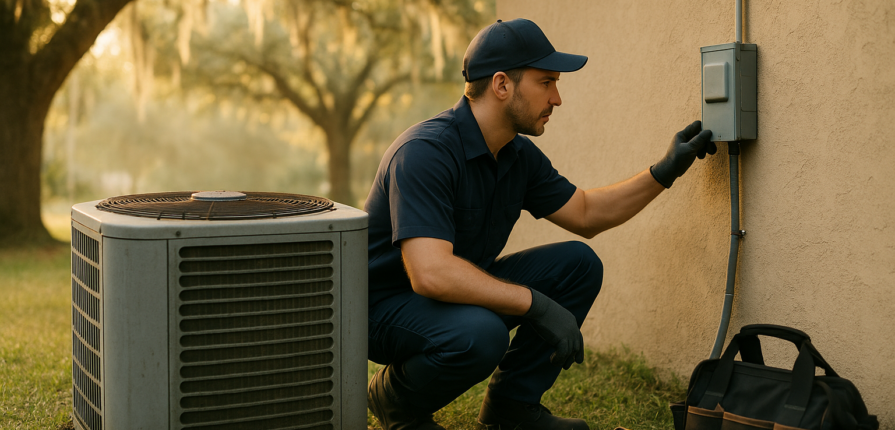
TL;DR: After a power outage, set your thermostat to Off, wait 15 to 30 minutes for the power to hold steady, reset any tripped AC breaker once, then switch back to Cool and watch the system for 15 to 20 minutes. If a breaker trips again, the outdoor unit hums but won’t start, or you smell burning, shut it off and call a licensed HVAC tech.
To restart your AC after a power outage, set the thermostat to Off, wait until the power holds steady, check both AC breakers, then switch back to Cool and watch the system for 15 to 20 minutes. If a breaker trips twice, the outdoor unit hums but won’t start, or you smell burning, stop and call a technician.
Here in Tavares and across Lake County, summer storms knock the power out a lot. Most of the damage happens in the first few minutes after the lights come back. This guide walks you through a safe restart, tells you what each problem usually means, and shows you how to protect your system before the next storm.
What Do You Need Before You Restart?
You don’t need any tools. You need a few minutes and these things:
- A flashlight, because breaker panels are often in a dark garage or closet
- Fresh batteries for your thermostat (most take AA or AAA)
- Your Wi-Fi password, if you have a smart thermostat
- A clear path to your outdoor unit and its disconnect box (the small gray box on the wall next to it)
- A phone or watch to time the wait
How Do You Safely Restart Your AC After a Power Outage?
Do these steps in order, and don’t skip the waiting. The waits protect the compressor, which is the most expensive part of your system.
- Set the thermostat to Off. Do this when the power goes out, or as soon as you notice. FEMA’s Ready.gov says to turn off or unplug appliances, because power can come back with short surges or spikes. Your compressor is a big motor, and it takes the worst of it.
- Wait for steady power. Once the lights come back, give it 15 to 30 minutes. Line crews are often still switching circuits, so the power can flicker or dip. If the lights blink again, start the wait over.
- Check both AC breakers. Most split systems have two: one for the indoor air handler and one for the outdoor condenser. A tripped breaker sits in the middle. Push it all the way off, then back on. Reset a tripped breaker only once.
- Look over the outdoor unit. Clear off branches and debris. Check for a burnt smell, melted wire, or scorch marks near the disconnect. If the unit sat in standing water, leave it off until a pro checks it.
- Reset the thermostat. If the screen is blank, put in new batteries. Make sure the time, mode, and schedule are right. A smart thermostat may need to reconnect to Wi-Fi.
- Switch to Cool. Set it 3 to 5 degrees below the room temperature. Many systems wait a few minutes on purpose before the outdoor unit starts. Be patient, and don’t keep flipping it on and off.
- Watch and listen for 15 to 20 minutes. The outdoor fan should spin, the compressor should hum evenly, and the air at your vents should feel cool. Water should start dripping from the condensate line outside.
What Does It Mean If Your AC Still Won’t Work?
Most of the time, the AC comes back after a breaker reset or a short wait. When it doesn’t, what you see and hear usually points to the cause.
| What you notice | Likely cause | What you can do | Call a pro? |
|---|---|---|---|
| Thermostat screen is blank | Dead batteries, a tripped air handler breaker, or a blown low-voltage fuse | Put in new batteries and check the indoor breaker | If it stays blank after both |
| Indoor fan runs, outdoor unit stays quiet | Built-in restart delay, or a tripped outdoor breaker or disconnect | Wait 10 minutes and check the outdoor breaker once | If it’s still quiet after 10 minutes |
| Outdoor unit hums, but the fan won’t spin | A weak or failed capacitor, often finished off by a surge | Turn the system off at the thermostat | Yes, right away |
| Breaker trips again right after reset | An electrical fault in the wiring, contactor, or compressor | Leave it off | Yes |
| System runs but blows warm air after 20 minutes | The compressor isn’t starting, a damaged control board, or another fault | Turn it off and check the filter | Yes |
A surge often finishes off a part that was already weak. A capacitor that was slowly failing can quit the moment the power snaps back on. If your system runs but can’t keep up after the outage, our guide to reasons your AC isn’t cooling enough covers what to check next.
What Mistakes Can Damage Your AC After the Power Returns?
The biggest mistake is turning the AC back on the second the lights come back. Here are a few others:
- Resetting a breaker over and over. A breaker that trips twice is warning you about a fault. Forcing it can hurt the compressor or the wiring.
- Setting the thermostat to 65 so the house cools faster. Most systems cool at the same rate no matter how low you set it. A big drop just makes the system run longer.
- Using a generator the wrong way. Ready.gov says to run generators only outdoors and away from windows. Never connect one to your home’s wiring unless an electrician has installed a proper transfer switch.
- Opening the outdoor unit’s panel. Capacitors can hold a charge even when the power is off. Leave the inside of the unit to a licensed tech.
- Ignoring a new noise. Clicking, buzzing, or grinding after an outage means something changed. Our guide to what different AC noises mean can help you describe it when you call.
Signs You Need to Call a Pro
- A breaker trips again right after you reset it
- The outdoor unit hums or buzzes, but the fan won’t spin
- You smell burning or see scorch marks or melted wire
- The unit sat in floodwater or standing water
- The system runs but still blows warm air after 20 minutes
- The thermostat stays blank after new batteries and a breaker check
How Can You Protect Your AC From the Next Storm Surge?
You can’t stop every surge, but you can lower the risk, and that matters here. The National Weather Service office in Melbourne says more people die from lightning in Florida every year than in any other state. In 2022, a national lightning report named Four Corners, where Lake, Orange, Osceola, and Polk counties meet, as the spot with the most lightning in the country.
- Turn the thermostat to Off when a strong storm rolls in or the lights start to flicker.
- Ask a licensed electrician about whole-home surge protection. The Electrical Safety Foundation International says it must be installed by a qualified electrician. It also says no surge protection can handle a direct lightning strike.
- Keep up with yearly maintenance. A tune-up can catch a weak capacitor or loose wiring before a surge finds it.
- Have a plan for when you’re away. Snowbirds and seasonal residents can check the system from a smart thermostat app, or ask a neighbor to look at it after a storm.
These steps work the same whether you live in downtown Tavares, along the St. Johns River in Astor, or out in Zellwood.
Why Call Lucas Air Conditioning and Heating, LLC?
We’re a local HVAC contractor in Tavares. Here are the plain facts:
- We’re veteran-owned, founded in 2018 by U.S. Army veteran Cameron Lucas of the 82nd Airborne Division.
- Our shop is at 15800 Old US Hwy 441 in Tavares.
- We hold Florida licenses CAC1819409 and CAC1819837.
- We repair air conditioners and heat pumps for homes and businesses.
- Emergency service is available outside our regular hours of Monday to Friday, 8:00 AM to 5:30 PM.
- Our Preventative Maintenance Agreement costs $129 a year and includes one tune-up, 15% off parts, and priority scheduling.
- We have a 5.0-star rating on Google.
If your AC won’t come back on after an outage, call Lucas Air Conditioning and Heating, LLC at (352) 805-0359 or schedule a service visit online.
Frequently Asked Questions
Will my AC turn back on by itself when the power returns?
Usually, yes. If the thermostat was still set to Cool, most systems start again on their own once power comes back. That’s why you should switch the thermostat to Off first, so the system doesn’t try to start while the power is still unstable.
Can a power surge damage my AC even if it wasn’t running?
Yes. A surge from lightning or the power grid can travel through the wiring and damage parts even when the system is idle. Setting the thermostat to Off lowers the risk, and turning off the AC breakers during a severe storm lowers it more.
Does homeowners insurance cover AC damage from a power surge?
It depends on your policy, so check with your insurance agent. If you do file a claim, a written diagnosis from a licensed HVAC technician that explains what failed can help.
Can I run my central AC on a portable generator?
Many portable generators can’t handle the startup load of a central AC system. Running a whole-home AC safely usually takes a correctly sized generator and a transfer switch installed by a licensed electrician.
Recommended Reads
- HVAC Contractor in Tavares, FL
- Landing Page for Seasonal Specials – Online Booking – Lucas Air Conditioning and Heating
- Landing Page for Seasonal Specials – Lucas Air Conditioning and Heating
Sources
