
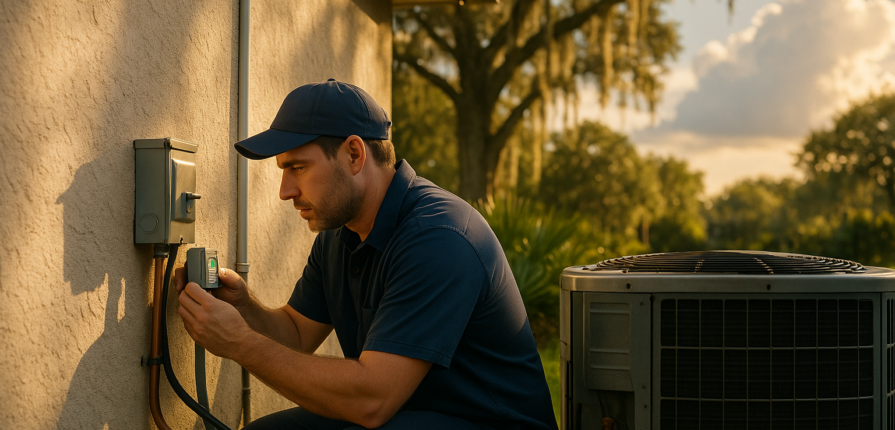
TL;DR: For most Central Florida homes, an AC surge protector is a sensible, low-maintenance way to protect the circuit boards and motors in modern air conditioners. Florida’s current building code requires surge protection at the home’s electrical panel, but older homes may not have it. A layered setup, with one device at the panel and another at the AC, gives the most coverage.
Yes. For most Central Florida homes, an AC surge protector is a smart, low-hassle add-on. Your outdoor unit and air handler hold circuit boards, motors and capacitors that a voltage spike can damage in a split second. In Tavares and the rest of Lake County, summer lightning makes that risk real, not theoretical.
Below, we explain what a surge protector does for your AC, what Florida code already requires, the main types, and when the extra layer pays off.
What does an AC surge protector actually do?
An AC surge protector sends a sudden spike of extra voltage to ground before it reaches your system’s electronics. Normal power passes through untouched. Only the spike gets diverted. According to Schneider Electric, a surge protective device (SPD) diverts current spikes to ground and clamps surge voltages before they reach the equipment connected to it.
Surges come from outside the home, like lightning and utility switching. Smaller ones can also start inside when large motors cycle on and off. A single big surge can kill a part on the spot. Smaller repeated ones can wear parts down over time.
Parts in an AC system that are most exposed include:
- The control board in the outdoor unit and air handler
- The drive board on inverter and variable-speed systems
- Electronically controlled blower motors
- Smart thermostats and their wiring
One limit to know up front: no surge protector can stop a direct lightning strike on your home or your unit.
Why does Central Florida lightning raise the stakes?
Central Florida gets some of the most lightning in the country, so surges here are routine. In 2022, Vaisala named Four Corners, where Lake, Orange, Osceola and Polk counties meet, the most lightning-dense spot in the U.S., with 474 lightning events per square mile (Bay News 9). Florida also topped AEM’s 2024 lightning density ranking. In AEM’s most recent report, it slipped to second behind Oklahoma. Local meteorologists point to sea breezes colliding along the I-4 corridor as the reason storms build here so often.
For homes in Tavares, Zellwood and Astor, that means summer afternoon storms are a normal part of life. Hurricane season adds outages, and power often flickers on and off as crews restore it. Each of those flickers can send a spike to your equipment. If the power has already blinked at your house, here is how to restart your AC safely after a power outage or surge.
Does Florida code require an AC surge protector?
Not on the AC itself, but the code now requires surge protection for the home’s electrical service. The Florida Building Code, 8th Edition (2023) uses the 2020 National Electrical Code and took effect December 31, 2023. Under section 230.67 of the 2020 code, NFPA explains that all dwelling units must have an SPD installed in the service equipment or right next to it. The rule also applies when an existing service is replaced.
What that means for you:
- Newer homes and homes with a recent panel replacement likely have panel-level protection already.
- Homes wired under older codes may not have any surge protection at all.
- Panel protection guards the whole house, but it sits far from your outdoor unit.
To check, look in or beside your main panel for a small device with an indicator light, or ask a licensed electrician. Work inside the panel is electrician territory.
Whole-house vs. at-the-unit: which type fits your AC?
Most homes get the best coverage from two layers: one device at the panel and one at the AC. Here is how the main options compare.
| Protection type | Where it’s installed | What it covers | Helps your AC? |
|---|---|---|---|
| Type 1 SPD | Before the main breaker, at the service entrance | Whole home, against surges coming in from outside | Yes, as a first line of defense |
| Type 2 SPD | On the load side of the main breaker, in or beside the panel | Whole home, all branch circuits | Yes, the most common whole-house option |
| Equipment-level protector | At the AC disconnect or on the unit’s circuit | That one piece of equipment | Yes, adds a layer right at the unit |
| Plug-in strip (Type 3) | A wall outlet | Only devices plugged into it | No, central AC is hardwired |
Keep in mind that a protector on the outdoor unit won’t cover an air handler in your garage or closet unless it’s on that same circuit. Ask what each device actually covers before you buy.
We can’t quote a price here because cost depends on several things: which type you choose, whether your panel has room for a new device, how much electrician labor is involved, and how many systems you need to protect.
What are the pros and cons?
For most homes the benefits outweigh the downsides, but it’s not a cure-all.
Pros
- Protects the circuit boards found in inverter and two-stage systems
- Covers hardwired equipment that a plug-in strip can’t reach
- Needs little upkeep beyond checking the indicator light
- Adds a second layer if your home already has panel protection
Cons
- Won’t stop a direct lightning strike
- Wears out over time and may need replacing after a big surge
- Doesn’t protect against long brownouts or sustained high voltage
- Adds an upfront cost, mostly for labor
When does a surge protector matter most?
It matters most when expensive electronics, older wiring and nobody being home all come together. Give it a closer look if any of these apply:
- You have or plan to buy an inverter or variable-speed system. These use more electronics than basic single-stage units.
- Your home was wired before the current code. You may have no surge protection at the panel.
- You’re a snowbird or seasonal resident. Your home sits empty through peak storm season, with no one to notice a dead system until the humidity has built up.
- You own rentals. A surge-damaged AC means an urgent tenant call in July.
- You have a pool or spa heater. Those heaters have control boards too.
If your AC still runs after a storm but cools poorly, the problem may not be surge damage. Work through these common reasons an AC isn’t cooling enough before you assume the worst.
Why Lucas Air Conditioning and Heating is a good fit
Here are the plain facts about us:
- We’re a veteran-owned company, founded in 2018 by U.S. Army veteran Cameron Lucas of the 82nd Airborne Division.
- We’re based at 15800 Old US Hwy 441 as a licensed HVAC contractor in Tavares, FL, serving Lake and Orange counties.
- We hold Florida licenses CAC1819409 and CAC1819837.
- We carry a 5.0-star Google rating.
- Our Preventative Maintenance Agreement is $129 a year and includes one tune-up, 15% off parts and priority scheduling.
- New installations start at $7,500 and include the permit, a one-year labor guarantee and a ten-year parts warranty.
- Emergency service is available outside our regular hours of Monday through Friday, 8:00 AM to 5:30 PM.
Lucas Air Conditioning and Heating doesn’t upsell. If the protection you already have is enough, we’ll tell you so.
Have questions about protecting your system before the next storm? Call (352) 805-0359 or book an appointment online.
Frequently Asked Questions
Can I plug my central air conditioner into a regular surge protector strip?
No. Central AC systems are hardwired on a dedicated circuit, so a plug-in strip can’t protect them. You need protection at the electrical panel, at the AC disconnect, or both.
How do I know if my surge protector is still working?
Most panel and equipment-level surge protectors have an indicator light that shows whether they’re still protecting. If the light is off or shows a fault, especially after a big storm, have the device checked and replaced if needed.
Does homeowners insurance cover AC damage from a power surge?
It depends on your policy, so ask your agent before storm season. If a surge damages your system, take photos and get a written diagnosis from a licensed technician to support your claim.
Will a surge protector help when power comes back after a hurricane outage?
It can help absorb spikes when power is restored or flickers on and off. It won’t protect against flooding or physical damage, so check the outdoor unit for debris and water before you turn the system back on.
Recommended Reads
- How to Restart Your AC After a Power Outage or Surge
- HVAC Contractor in Tavares, FL
- Landing Page for Seasonal Specials – Online Booking – Lucas Air Conditioning and Heating
