

TL;DR:
- Proper kitchen ventilation extends beyond cracking windows; it is essential for removing harmful indoor pollutants and ensuring safety. Ducted range hoods vent pollutants outside, while ductless options are less effective at removing gases and moisture. Regular maintenance, correct installation, and understanding airflow dynamics are crucial for optimal air quality and fire safety.
Most homeowners assume cracking a window is enough. It is not. The role of ventilation in kitchens goes far beyond odor control. Indoor air pollution from cooking can reach 2 to 5 times higher than outdoor levels when proper exhaust systems are absent. Whether you are managing a home kitchen or running a commercial food operation, understanding how ventilation actually works, what the real risks are when it fails, and how to choose and maintain the right system could be the difference between healthy air and a serious hazard.
Table of Contents
- Key takeaways
- The role of ventilation in kitchens: how it works
- Health and safety: what poor ventilation actually costs you
- Codes, standards, and installation best practices
- Choosing the right system for your kitchen
- Operating and maintaining your ventilation system
- My take on what most people get wrong
- Professional ventilation installation and service for Central Florida
- FAQ
Key takeaways
| Point | Details |
|---|---|
| Cooking generates serious pollutants | Gas stoves and high-heat cooking release carbon monoxide, nitrogen dioxide, and grease particles that accumulate fast indoors. |
| Natural ventilation rarely works alone | Mechanical exhaust systems are the most reliable way to protect kitchen air quality, especially in modern energy-efficient homes. |
| Code minimums are a floor, not a ceiling | IRC 2024 requires 100 CFM minimum, but real-world airflow after ducting is often lower than the rated spec on the label. |
| Hood placement and CFM both matter | Installing a hood at the wrong height or with a poorly designed duct run will undermine even an expensive system. |
| Maintenance determines long-term performance | Grease filter cleaning every one to three months is not optional. It is what separates a functional system from a fire risk. |
The role of ventilation in kitchens: how it works
To understand the importance of kitchen ventilation, you have to understand what is actually happening in the air when you cook. Every time you fire up a burner, you generate a mix of moisture, smoke, grease particles, carbon monoxide, and nitrogen dioxide. That air has to go somewhere. The question is whether it goes outside through a properly engineered exhaust system or gets recirculated through your living space.
There are two main categories of kitchen exhaust systems, and the difference matters more than most people realize.
Ducted (vented) range hoods pull air from above the cooktop and exhaust it directly outside through a duct. This is the gold standard. Range hoods venting outdoors remove moisture, heat, and combustion gases at the source before they can spread through the rest of the home. Ducted hoods require real ductwork, meaning proper sizing and routing, but their performance advantage is substantial.
Ductless (recirculating) hoods pull air through a charcoal or carbon filter and push it back into the kitchen. They capture some grease and reduce odors, but they do not remove moisture, heat, or gases. For many homeowners, they feel like a solution when they are really a compromise.
Beyond range hoods, here are the main ventilation components that contribute to kitchen air quality:
- Exhaust fans mounted in walls or ceilings provide spot ventilation and work well as supplemental systems, particularly in bathrooms connected to kitchens in open-plan layouts.
- Whole-house ventilation systems manage background air exchange but are not substitutes for source-capture at the cooktop.
- Makeup air systems compensate for the pressure drop created by high-powered exhaust fans. Mechanical exhaust systems create depressurization that can backdraft combustion appliances if makeup air is not supplied.
Airflow is measured in CFM (cubic feet per minute). The higher the CFM rating, the more air the hood moves. But here is something most product descriptions do not tell you: the rated CFM on the box is measured under laboratory conditions with no ductwork. Real-world installed airflow is almost always lower due to duct bends, length, and diameter restrictions.
Pro Tip: When shopping for a range hood, look for a model rated at least 20 to 30 percent higher CFM than you think you need. That buffer accounts for real-world duct losses.
Health and safety: what poor ventilation actually costs you
The health case for proper ventilation is not subtle. Gas stoves are a particular concern. Cooking with gas raises indoor nitrogen dioxide to concentrations that can worsen asthma and reduce lung function, especially in children and older adults. And that is before you factor in carbon monoxide and the ultrafine grease particles released during high-heat cooking.
Poor kitchen air quality creates a chain of compounding problems:
- Respiratory irritation from nitrogen dioxide and fine particulate matter, particularly with prolonged or daily exposure.
- Mold and moisture damage when steam from boiling and washing accumulates without extraction, feeding mold growth in walls and cabinets.
- Grease accumulation inside exhaust ducts, which creates a significant fire hazard. Grease-coated ducts become ignition fuel. That is not a theoretical risk. It is the cause of thousands of structure fires annually.
- Carbon monoxide buildup in homes where gas appliances are not properly vented, which can reach dangerous or lethal concentrations.
For commercial kitchens, the stakes are even higher. Open flames, industrial wok burners, and high-volume frying generate contaminant loads that residential systems cannot handle. NFPA 96 mandates Type I hoods with grease filters and fire suppression over all grease-producing equipment. This is not a suggestion. Operating without compliant commercial hood systems puts staff, customers, and property at direct risk.
“The EPA recommends running your range hood during cooking and leaving it on for 10 to 20 minutes after you finish to fully clear residual pollutants from the air.”
That lingering period matters. Gases and fine particles stay airborne well after the burner is off. Shutting down the hood the moment you plate your food means a portion of those pollutants settle back into your kitchen.
Codes, standards, and installation best practices
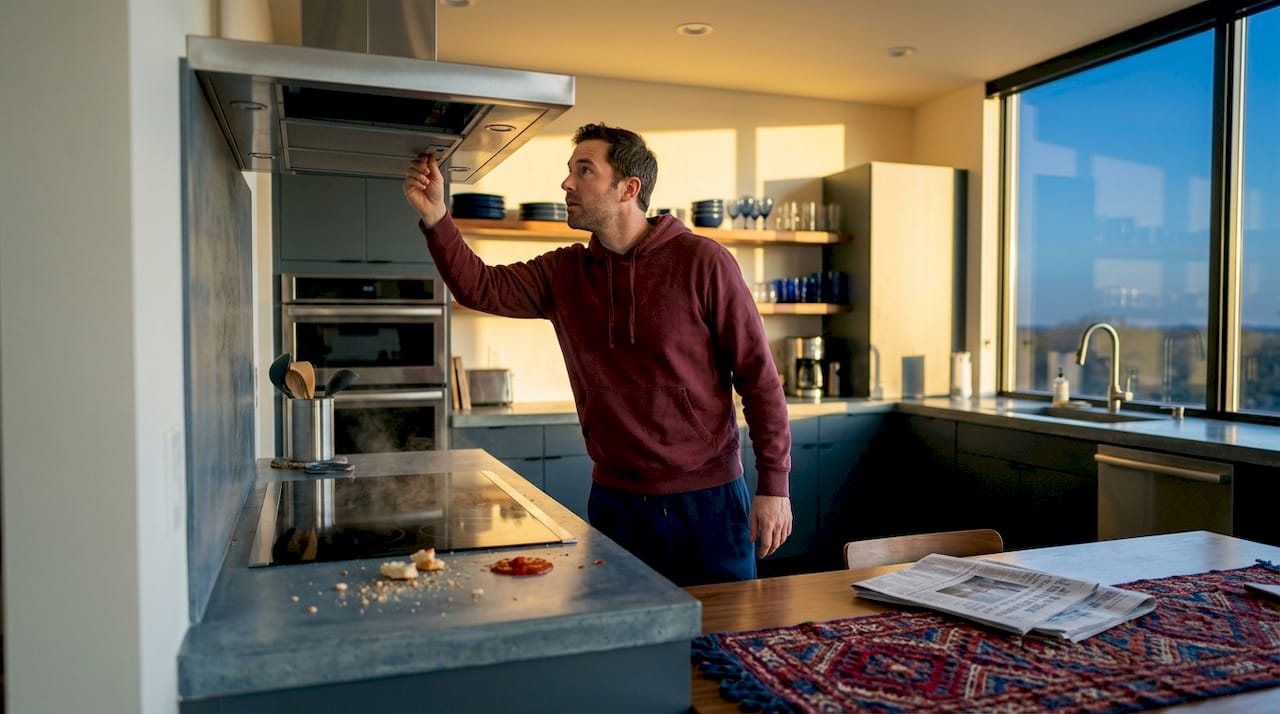
Knowing the rules helps you avoid both legal exposure and underperforming systems. The gap between what is code-legal and what actually works well is worth understanding.
Residential: IRC 2024 requirements
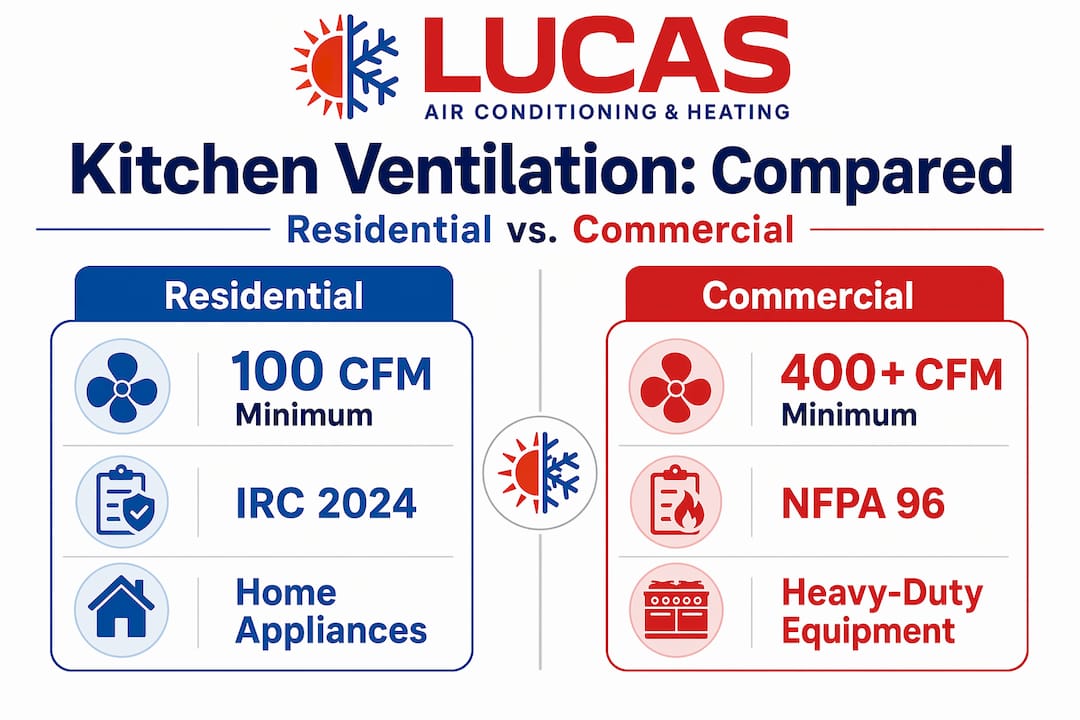
The International Residential Code 2024 sets a baseline for how to ventilate kitchen spaces in homes. The key numbers are 100 CFM intermittent or 25 CFM continuous delivered at the hood grille. Smooth metal ductwork is required, and there are strict limits on duct length and the number of bends allowed. The code also specifies minimum and maximum hood installation height above the cooktop.
Hood height between 24 and 30 inches above the cooktop surface is the safe zone. Below 24 inches creates a fire hazard. Above 30 inches, the hood loses its ability to capture the rising column of cooking air efficiently.
Residential vs. commercial: a quick comparison
| Factor | Residential (IRC 2024) | Commercial (NFPA 96) |
|---|---|---|
| Minimum airflow | 100 CFM intermittent | Determined by heat load and hood type |
| Hood type required | Standard range hood | Type I (grease) or Type II (heat/moisture) |
| Fire suppression | Not typically required | Required for Type I hoods |
| Duct material | Smooth metal recommended | Grease-rated steel required |
| Inspection frequency | Owner responsibility | Code-mandated regular inspection |
The installed vs. rated airflow problem
This is where most kitchen ventilation installations fall short. Installed-condition delivered airflow often differs significantly from the manufacturer’s rated airflow due to duct layout, total duct length, and the number of elbows in the run. A hood rated at 400 CFM might deliver 280 CFM after a 15-foot duct run with two 90-degree bends. That gap is almost never shown on product packaging.
Pro Tip: Ask your HVAC contractor to calculate delivered CFM based on your actual duct layout before finalizing your range hood selection. Checking the local HVAC standards for your area can also clarify what delivered airflow your jurisdiction actually requires.
Choosing the right system for your kitchen
Not every kitchen has the same needs, and not every ventilation solution fits every space. Here is how to match the system to the situation.
For homeowners with ducted access, a properly sized ducted range hood is the right call every time. Prioritize hoods with good CFM ratings relative to your cooktop BTU output and verify your duct run is within spec.
For homeowners without duct access (apartments, older construction), a high-quality ductless hood with carbon filters is better than nothing. Supplement it with an operable window or bathroom exhaust fan. Just be realistic about its limits regarding moisture and gas removal.
For commercial kitchens, the choice between hood types depends on what equipment sits underneath:
- Type I hoods are required over fryers, griddles, open flames, and any equipment producing grease-laden vapor.
- Type II hoods are appropriate for dishwashers, steam equipment, and heat-only appliances where grease is not a factor.
- Demand-controlled kitchen ventilation (DCKV) adjusts exhaust fan speed based on actual cooking activity, cutting energy costs significantly during idle periods without compromising air quality during peak cooking.
For open-plan residential kitchens, the EPA advises high capture efficiency at the source because cooking pollutants spread rapidly into connected living spaces. An undersized or poorly positioned hood in an open-plan layout can pollute your living room as quickly as your kitchen.
Operating and maintaining your ventilation system
Even the best kitchen exhaust system fails without consistent maintenance. Here is a straightforward routine that keeps systems performing safely.
- Run the hood before and during cooking. Start the fan before you light the burner so it is already moving air when pollutants begin forming.
- Let it run after cooking. Keep the hood running 10 to 20 minutes after you finish to clear residual gases and particles.
- Clean grease filters every one to three months. Filter cleaning frequency depends on how often and how heavily you cook. High-volume households and commercial kitchens need monthly attention.
- Replace charcoal filters in ductless hoods every six months. Once saturated, these filters stop capturing odors and fine particles.
- Schedule professional duct inspection annually. Grease migrates past filters over time. A restaurant duct cleaning service or residential duct inspection identifies buildup before it becomes a fire risk.
Pro Tip: A simple test for hood performance: hold a paper towel near the edge of the hood while cooking on high. If it does not get drawn toward the grille, your system is either undersized, clogged, or ducted poorly.
My take on what most people get wrong
I’ve inspected and worked with enough kitchen ventilation setups to tell you that the single most common mistake is trusting the label. Homeowners see 400 CFM on a box and assume that is what they are getting. It is not. The rated versus delivered airflow gap is real, and it is significant. Most residential installations I see are delivering 30 to 40 percent less airflow than the homeowner believes.
The second mistake is treating maintenance as optional. I’ve seen ductless hoods with charcoal filters that haven’t been replaced in three years. At that point, the hood is purely decorative. It is capturing nothing meaningful.
What actually separates good kitchen ventilation from nominal kitchen ventilation is not the price of the equipment. It is proper installation and consistent maintenance. A mid-range ducted hood with a clean filter, correctly installed ductwork, and a makeup air supply will outperform a premium hood with a kinked duct and a clogged filter every single time.
My experience also tells me that fire safety gets underestimated until something goes wrong. Grease in ducts is not an abstract risk. Treat your indoor air quality as a system, not an afterthought.
— Lucasair
Professional ventilation installation and service for Central Florida
If you are a homeowner in Central Florida or managing a food service operation, getting kitchen ventilation right requires more than reading the code. It requires a contractor who knows how to calculate real-world delivered airflow, size systems correctly, and keep them compliant with local requirements.

Lucasair provides residential and commercial installation of HVAC systems across Central Florida, along with ductwork repair and installation and maintenance for both homes and businesses. If your system has not been professionally inspected recently, or if you are planning a kitchen remodel, now is the time to get it right. The team at Lucasair can also walk you through an HVAC installation step by step so you know exactly what to expect before the work begins. Reach out to schedule your consultation.
FAQ
What does kitchen ventilation actually do?
Kitchen ventilation removes cooking byproducts, including moisture, smoke, grease particles, carbon monoxide, and nitrogen dioxide, from indoor air. Proper exhaust systems vent these pollutants outside before they affect occupant health or create fire hazards.
Is a ductless range hood good enough?
Ductless hoods reduce odors but cannot remove moisture, heat, or combustion gases the way ducted systems can. For gas cooktops or high-heat cooking, a ducted system venting outdoors is significantly more effective at protecting kitchen air quality.
How often should grease filters be cleaned?
Grease filters should be cleaned every one to three months depending on cooking frequency and volume. Commercial kitchens with heavy use need monthly cleaning to maintain airflow and prevent fire risks from grease accumulation.
What CFM do I need for my kitchen?
IRC 2024 requires a minimum of 100 CFM intermittent delivered at the hood grille for residential kitchens. High-output gas ranges or larger cooktops may require 300 to 600 CFM or more to effectively capture all cooking contaminants.
Can opening a window replace a range hood?
No. Natural ventilation alone is rarely sufficient for capturing cooking pollutants at the source. A window may help with general air exchange, but it cannot provide the directional capture efficiency needed to remove grease, gas, and fine particles produced during cooking.
Recommended
- The Role of Air Quality in Food Safety Explained – Lucas Air Conditioning and Heating
- Role of air quality in hospitality: a Central Florida manager’s guide – Lucas Air Conditioning and Heating
- How to maintain restaurant HVAC for efficiency and compliance – Lucas Air Conditioning and Heating
- Restaurant duct cleaning: Keep compliant and customers happy – Lucas Air Conditioning and Heating