
TL;DR:
- Poor ventilation in warehouses leads to increased costs, equipment failures, and worker discomfort. Proper design, system integration, and operational strategies improve airflow, reduce energy waste, and enhance safety and inventory preservation. Consulting experts helps ensure ventilation systems are optimized for building conditions and regulatory compliance.
Most warehouse managers think about ventilation once a year, usually after a heat complaint or a failed inspection. That framing costs you. The role of ventilation in warehouses extends far beyond pushing stale air out. It controls temperature stratification, manages moisture that destroys inventory, keeps workers safe from airborne contaminants, and directly affects how much you spend on energy every month. Get it right and your facility runs cleaner, cooler, and cheaper. Treat it as an afterthought and you pay for it in equipment failures, sick days, and regulatory fines.
Table of Contents
- Key takeaways
- The role of ventilation in warehouses goes deeper than air exchange
- Ventilation system components worth knowing
- Design challenges and how to get ahead of them
- Operational strategies to cut costs and improve comfort
- My honest take on warehouse ventilation mistakes
- How Lucasair can help you get this right
- FAQ
Key takeaways
| Point | Details |
|---|---|
| Ventilation is operational infrastructure | Poor airflow raises costs through energy waste, product damage, and worker health issues. |
| HVLS fans change the temperature equation | Strategic fan placement can reduce perceived temperature by up to 10°F without adding cooling load. |
| Design timing matters enormously | Integrating ventilation during building design prevents costly retrofits and condensation problems. |
| Sensors cut energy waste | Variable-speed drives and temperature sensors automate airflow adjustments, trimming utility bills. |
| Zoning solves uneven coverage | Dividing your facility into ventilation zones targets airflow where workers and products need it most. |
The role of ventilation in warehouses goes deeper than air exchange
Good warehouse air circulation does four jobs at once: it removes contaminants, controls temperature, manages humidity, and satisfies regulatory requirements. Most facilities handle one or two of these adequately and neglect the rest.
Contaminant removal is where the stakes are highest. Forklifts, cleaning chemicals, and packing materials all generate fumes and particulates. Local Exhaust Ventilation (LEV) captures hazardous substances at the source and outperforms general dilution ventilation in heavy industrial environments. If your facility handles fuels, solvents, or fine dusts, general ceiling fans are not a solution. You need extraction at the point of generation.
Temperature regulation is more complicated than it looks. Heat rises. In a warehouse with 30-foot ceilings, you can have 95°F air trapped near the roof while workers sweat at floor level. That separation is called thermal stratification, and it creates two problems: worker discomfort and wasted heat in winter. Proper warehouse air circulation breaks that stratification and distributes conditioned air where people actually work.
Humidity control protects your inventory. Moisture-laden air corrodes metal shelving, warps wood pallets, degrades electronics, and creates mold conditions in food storage areas. Maintaining air quality in warehouses means keeping relative humidity within a controlled range, not just managing temperature.
Regulatory compliance is non-negotiable. ASHRAE 62.1 requires facilities to maintain controlled building pressure and mechanical exhaust to meet indoor air quality standards. OSHA monitoring expectations add another layer of accountability. The importance of warehouse ventilation is not a matter of preference; it is built into the law.
- Remove contaminants at the source with LEV systems in high-risk zones
- Break thermal stratification with ceiling-level circulation fans
- Keep humidity within the product-safe range for your stored inventory
- Document your airflow systems to satisfy OSHA inspection requirements
Pro Tip: Measure CO2 levels in your facility as a proxy for overall air quality. Readings above 1,000 ppm in occupied zones signal that your ventilation rate is too low for the activity level in that area.
Ventilation system components worth knowing
Not all ventilation equipment solves the same problem. Matching the right hardware to your specific facility conditions is where most operators either win or waste money.
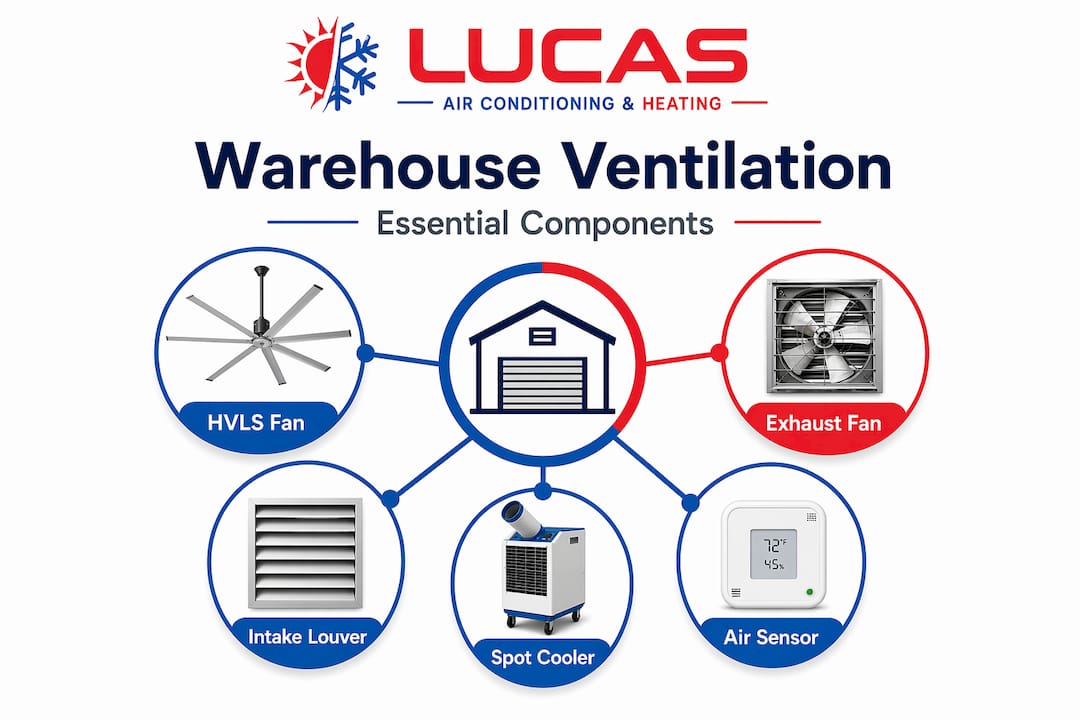
HVLS fans
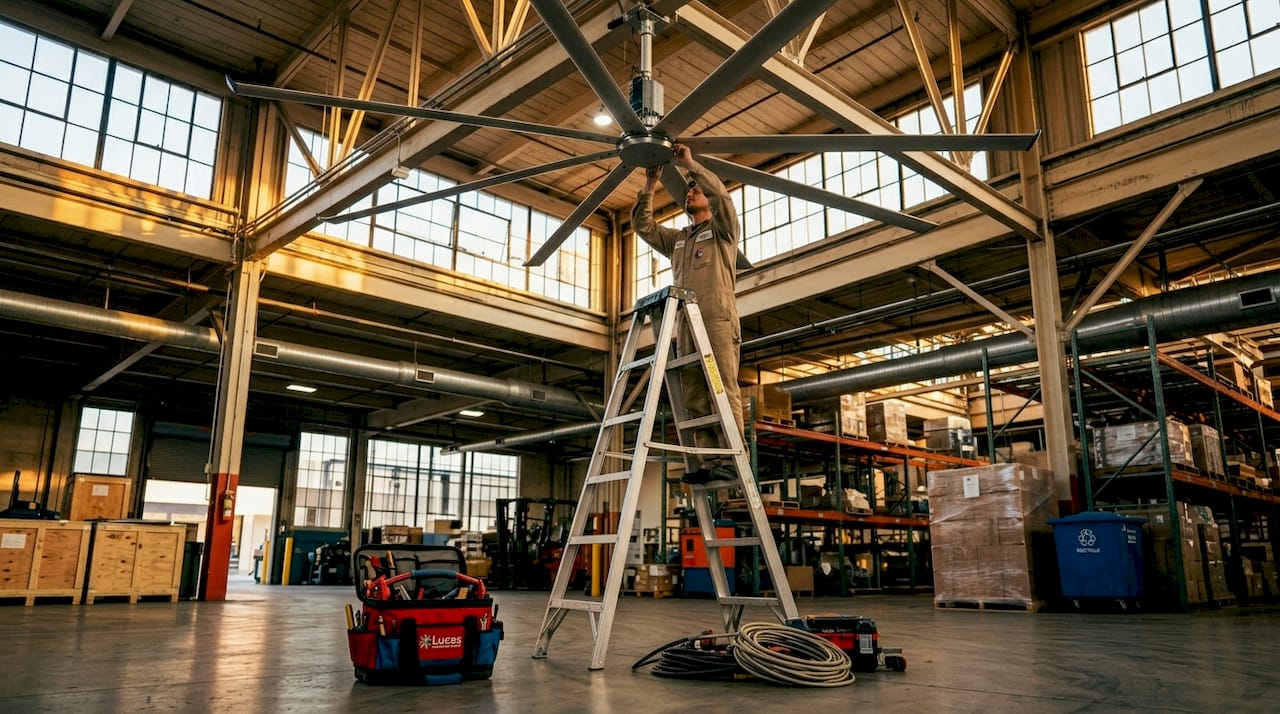
High-Volume, Low-Speed fans are the single most impactful upgrade for large open warehouses. HVLS fans can reduce perceived temperature by up to 10°F by continuously destratifying air across the full floor area. They move enormous volumes of air at low rotational speeds, which keeps energy consumption low while delivering floor-level airflow across hundreds of feet. In winter, you reverse the blade direction to push warm air that has pooled near the ceiling back down, recovering heat you already paid for.
Exhaust fans and intake louvers
Wall-mounted warehouse exhaust systems work best as part of a deliberate pressure strategy. The goal is to create controlled airflow from intake to exhaust, not random turbulence. Optimal intake placement is on the windward side at low level, while exhaust exits on the leeward side at high level. This crossflow design maximizes the distance fresh air travels before it exits, giving it time to actually cool and refresh the space.
Intake and exhaust positioned too close together cause short-circuiting, where outside air enters and exits almost immediately without sweeping through the building. This wastes energy and provides almost no relief for workers in the interior.
Spot coolers and localized airflow tools
HVLS fans and exhaust systems handle the macro-level environment. Spot coolers handle specific problem areas: server rooms inside warehouses, break rooms, loading dock stations, or areas where workers perform repetitive high-exertion tasks. These units deliver focused airflow without requiring you to condition the entire building to a lower temperature.
| Equipment type | Best application | Key limitation |
|---|---|---|
| HVLS fans | Large open floor areas, destratification | Less effective in subdivided spaces |
| Wall exhaust fans | General air change, heat removal | Requires matched intake or pressure drops |
| Local exhaust ventilation | Fume and dust control at source | High installation cost for targeted spots |
| Spot coolers | Small high-heat zones, worker stations | Not a whole-building solution |
| Ridge vents / roof exhausts | Passive heat removal in hot climates | No control, weather dependent |
Pro Tip: When placing HVLS fans, align them with your main aisle layout rather than the center of the bay. Fan placement aligned with aisles creates a sweeping air movement across the work area instead of pushing air directly into racking.
Design challenges and how to get ahead of them
The biggest mistake facility operators make is treating ventilation as something to figure out after the building is built. Ventilation design integrated early in the building project prevents condensation on steel structures, corrosion, and expensive retrofitting that rarely fully solves the original problem.
Thermal stratification and ceiling heat
Steel warehouse roofs absorb solar radiation throughout the day. By mid-afternoon, trapped heat near the ceiling can be 20 to 30 degrees hotter than the floor. Thermal mass and solar heat effects significantly influence ventilation needs and HVAC system design. Ridge vents and powered roof exhaust fans can bleed off that radiant heat before it radiates back down to the floor level, but only if they are sized correctly for the building’s heat load.
Racking and mezzanine obstructions
Tall pallet racking does not just store product; it acts as a wall to airflow. Inventory rack layouts create stagnant heat pockets wherever airflow cannot penetrate between shelves. Fans mounted without accounting for racking generate noise and turbulence near the ceiling while leaving workers in the aisles in still, hot air. Mezzanines compound the problem by creating a second enclosed zone below the main ceiling line that existing fans cannot reach.
Humidity and climate-specific pressures
In Central Florida’s humid climate, moisture infiltration is a year-round concern, not a seasonal one. Maintaining building pressure slightly positive, typically between +0.001 and +0.003 inches of water gauge, reduces infiltration of humid outside air. Building tightness assumptions must be conservatively estimated and field-verified because construction quality varies widely and leakage rates affect your pressure calculations significantly.
- Map the facility in thermal zones: loading docks, storage areas, and occupied workstations all have different ventilation requirements
- Account for racking height and density during fan specification, not after installation
- Design exhaust capacity to match or slightly exceed intake to manage building pressure deliberately
- Consult climate-responsive ventilation design principles before specifying equipment for humid or extreme-temperature regions
Pro Tip: If you manage an existing facility with racking already in place, use a thermal imaging camera during peak afternoon hours to map actual heat pockets. Those images give you the exact fan placement data that guesswork cannot provide.
Operational strategies to cut costs and improve comfort
You do not need to rebuild your system to meaningfully improve performance. Several targeted operational changes deliver measurable results in existing facilities.
- Install temperature and humidity sensors at work level, not ceiling level. Most warehouses monitor conditions near the roof where sensors are easy to mount. That data tells you what is happening 25 feet above your workers. Sensors at 5 to 6 feet measure the actual conditions your team experiences.
- Add variable-speed drives to existing fans. Variable speed drives and sensors automate temperature-based airflow adjustments, slowing fans during cooler periods and running them at full speed during peak heat. This alone reduces energy consumption without sacrificing comfort.
- Run an airflow mapping exercise. Walk your facility with a smoke pencil or an anemometer during peak hours and identify zones where air movement drops below 0.5 meters per second. Those stagnant zones are where you place additional fans or redirect existing ones.
- Balance your intake and exhaust volumes quarterly. Pressure imbalances develop as your facility changes. New dock doors, added partitions, or racking reconfigurations all affect airflow patterns. Coordinating blade pitch with exhaust louvers creates consistent fresh air distribution throughout the space.
- Integrate natural ventilation into your hybrid design. In mild weather, strategically opened vents and dock doors can substitute for mechanical exhaust. This reduces runtime on powered equipment and lowers operating costs without any capital investment. For deeper guidance on keeping these systems performing long-term, the Lucasair guide on industrial HVAC maintenance covers the key checkpoints that most facilities skip.
Pro Tip: Pair your airflow mapping data with your energy bills for the same period. The correlation between stagnant zones and peak consumption reveals exactly where your system is working hardest for the least result.
My honest take on warehouse ventilation mistakes
I’ve seen a lot of warehouse operators treat ventilation as a box-checking exercise. Install some fans, cut in a few vents, pass the inspection, move on. What I’ve found is that this approach costs more over five years than designing it correctly from the start.
The facilities where I’ve seen the best outcomes share one thing: they treated ventilation as infrastructure, not equipment. They thought about it the same way they thought about the electrical panel or the fire suppression system. It was part of the building’s core function, not an add-on.
The other pattern I keep noticing is how much worker morale and retention correlates with thermal comfort. Nobody stays at a job where they spend summer shifts in 95-degree heat. The impact of ventilation on employee safety and productivity is real and measurable, yet it rarely shows up in the ventilation budget conversation the way it should.
My strongest recommendation: get a data-driven baseline before you spend anything. Measure actual conditions across your facility before specifying a single piece of equipment. The cheapest system that solves the real problem beats the most expensive system aimed at the wrong one.
— Lucasair
How Lucasair can help you get this right
If you are managing a warehouse in Central Florida and your HVAC system is underperforming, Lucasair has the experience to diagnose exactly what is happening and fix it. Founded by Army Veteran Cameron Lucas, Lucasair has been serving commercial customers since 2018 with straightforward assessments and reliable work, no upselling, no guesswork.
Whether you need a new system designed and installed through our commercial HVAC installation service or a structured maintenance plan to keep your existing equipment performing at spec, Lucasair builds solutions around your actual facility conditions. We also offer a preventative maintenance agreement that keeps your HVAC units tuned year-round. Lucasair doesn’t offer duct cleaning and air quality services, but it repairs and installs ductwork where damaged ducts are degrading airflow. Scheduling is straightforward, and we offer financing options for larger system upgrades. Contact Lucasair today to get a clear picture of where your ventilation stands and what it would take to fix it.
FAQ
What is the role of ventilation in warehouses?
Ventilation removes airborne contaminants, regulates temperature by breaking thermal stratification, controls humidity to protect inventory, and keeps facilities compliant with OSHA and ASHRAE air quality standards. It directly affects worker safety, product preservation, and energy costs.
How often should warehouse ventilation systems be serviced?
Most commercial ventilation systems benefit from inspection and tuning at least twice per year, with filter checks and pressure balancing done quarterly. Facilities in humid climates or with high particulate loads may need more frequent service to maintain effective airflow.
What are HVLS fans and why do warehouses use them?
High-Volume, Low-Speed fans move large volumes of air at low rotational speeds, reducing perceived temperature by up to 10°F by destratifying heat that collects near the ceiling. They are energy-efficient and effective across large open floor areas where conventional fans cannot reach.
How does ventilation affect warehouse inventory?
Uncontrolled humidity and heat accelerate corrosion on metal components, warp wood pallets, degrade sensitive electronics, and create mold risk in food storage areas. Maintaining controlled airflow and humidity levels directly extends the usable life of stored products and shelving infrastructure.
What is airflow short-circuiting and why does it matter?
Short-circuiting happens when intake and exhaust vents are placed too close together, causing fresh air to exit the building before it circulates through the space. It wastes energy and leaves interior zones with no relief, making it one of the most common and costly ventilation design errors in warehouses.
Recommended
- Role of air quality in hospitality: a Central Florida manager’s guide – Lucas Air Conditioning and Heating
- How to Maintain Industrial HVAC for Peak Performance – Lucas Air Conditioning and Heating
- What Is Industrial HVAC and Why It Matters – Lucas Air Conditioning and Heating
- Restaurant HVAC preventative maintenance workflow that works – Lucas Air Conditioning and Heating